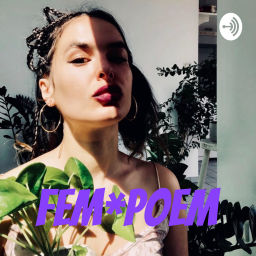
Podcast thumbnail for FEMPOEM

by Romina Achatz

5.0(5 reviews)
39 episodes
Updated Bi-weekly
Accepts GuestsHas SponsorsLocation 🇦🇹

Podcast Overview

The Austrian Podcast Fem Poem (gr. poiēma, „The process of making; production, creation; creativity“, poiēo „I do/ I make“) holds space for the beauty of literature, activism, body politics, queerness and feminism. A show to affect and inspire each other- produced by Romina Achatz. #lyricsmatters Voices of international writers, poets, philosophers, artists, rappers, thinkers. Interviews, Gedichte, Philosophie, Diskurs, Theorie, themenspezifischer Erfahrungsaustausch, persönliche Erzählungen. Eine Sendung zum Austausch, lustvollen, gemeinsamen Denken, reflektieren, affizieren, inspirieren.

Language

🇩🇪

Publishing Since

9/20/2019

1 verified contact email on file for FEMPOEM

Pitch yourself as a guest, propose sponsorships, or reach out directly to the host.

Recent Episodes

Episode thumbnail for Stephen Barber on Zoo Hotel Delirium

November 8, 2025

Stephen Barber on Zoo Hotel Delirium

<p><strong>FEM POEM – Romina Achatz in conversation with Stephen Barber: The Death Zone, Sepsis, and the Return from Hades</strong></p><p><br>In this episode of FEM POEM, Romina Achatz speaks with author Stephen Barber about his haunting and hallucinatory book „Zoo- Hotel Delirium“, a descent into the borderlands between life and death, written in the aftermath of a near-fatal sepsis.  The book will be published next year in May 2026 by Infinity land press, London. The conversation begins with the body: with sepsis as both biological catastrophe and metaphysical rupture. Stephen Barber describes the moment when the body becomes inhabited by death — when tissue turns necrotic, when consciousness begins to fracture, and yet the mind persists in dreaming. Together, they explore how this “death zone” became a geography of its own — a space where the author’s feverish visions unfolded: a brutalist tower in the northern forests, a cursed city, the volcanic mountains of Japan, and a Butoh dancer entering death’s stream.</p><p><br></p><p>Romina Achatz and Stephen Barber move between medicine, philosophy, and art — tracing how the capacity to dream intensely after sepsis can open another kind of perception, where hallucination becomes revelation. Remarkably, both Romina Achatz and Stephen Barber survived sepsis at the same time in their lives- and therefore founded „The Sepsis dreamers club“. Now, they share not only an experience of physical vulnerability at a moment in life but a heightened sense of dreaming, a sharpened sensitivity to presence, and a deeper resilience than before.</p><p>Their dialogue touches on Deleuze’s notion that the artist must descend to Hades and return bearing something of that underworld — as well as on the contemporary machinery of death, the politics of dying, and the persistence of life even inside collapse.</p><p>What unfolds is less an interview than a shared passage — an intimate mapping of the line where death begins, and happiness, creativity, and art continue.</p>

Episode thumbnail for Butoh, Film, Archives, Memories

September 22, 2025

Butoh, Film, Archives, Memories

<p>In this episode, Stephen Barber, writer and cultural researcher, shares his profound experiences with Butoh and the Japanese experimental art scene.</p><p>The dialogue between Romina Achatz and Stephen Barber weaves between history, memory, and artistic practice, offering rare insights into archival discoveries, the contemporary preservation of Butoh, and its living legacy today.</p><p>An expert on Antonin Artaud, Stephen explores Artaud’s and Genet’s influence on the Japanese avant-garde and Butoh in the 1950s and 1960s and 80s. He reflects on the legendary Asbestos-kan studio, a meeting point for artists and writers including Yukio Mishima, and discusses Hijikata’s collaborations with filmmakers such as Donald Richie and Eikoh Hosoe, as well as dancers Yoshito and Kazuo Ohno. Iconic works like the photobook Kamaitachi and the film Naval and A-Bomb, (Heso to genbaku), a short film directed by Eikoh Hosoe and Tatsumi Hijikat are explored, alongside insights into Hijikata’s involvement in erotic and horror films and his experimental approach to performance.</p><p>The show also weaves in personal stories and encounters, including Stephen’s experience with Akiko Motofuji, who asked him to sit in utter darkness through the night to await an encounter with the spirit of Hijikata. Romina and Stephen reflect on their personal sensory experiences in Tokyo, late-night walks through the city, and encounters with the avant-garde performance scene. They also discuss Hijikata’s cinematic involvement, his performance at the Osaka Expo, and the philosophical resonance of Antonin Artaud within Butoh, revealing the rich texture of Japan’s cultural world.</p><p>Romina briefly shares how her early exploration of Japan through her Super 8 and Leica cameras shaped her perception of the landscape and cultivated an observational “eye” that later became a bridge to film dancers such as Murobushi and others. She also recounts filming at the harbour in Le Havre, France, and discusses her ongoing research and her upcoming book.</p><p>FEMPOEM is a radio space for literature, art, and politics — and in this nearly three-hour conversation, which was cut down to almost 1,5 h, the dialogue itself becomes a living archive: a testimony to the power of art, memory, imagination and even the ghostly presence of the past.</p><p>It offers insights into archival discoveries, the contemporary preservation of Butoh, and its ongoing influence today.</p><p> </p>

Episode thumbnail for Imagination und Bewegung in Butoh

September 20, 2025

Imagination und Bewegung in Butoh

<p>Die Sendung beginnt mit einem Essay von Romina Achatz über das schöpferische Potenzial von Imagination und Bewegung. Anschließend folgt eine etymologische Betrachtung der Begriffe Imagination, Bewegung und Butoh. Von dort öffnet sich der Weg zu Yoshito Ohno, der den Körper einst mit Bambus verglich – hohl, durchlässig und leer. Daraus entspinnt sich die Auseinandersetzung mit dem japanischen Zeichen Mu, das zugleich für Leere und für Tänzer steht.</p><p>Daraufhin wendet sich FEM POEM dem Butoh-Fu von Tatsumi Hijikata zu, erforscht poetische Bewegungsanweisungen und imaginationsbasierte Transformationen, und führt weiter zu Übungen von Yoshito Ohno sowie zu zeitgenössischen Ansätzen der Choreografin Minako Seki.</p><p>Abgerundet wird die Sendung mit einem poetischen Epilog über die Kraft der Imagination – als Quelle von Empathie, Verwandlung und radikaler Lebendigkeit.</p><p> </p>

39 total episodes available

Deep-dive analytics for FEMPOEM

Frequently asked questions

Have a different question and can't find the answer you're looking for? Reach out to our support team by sending us an email and we'll get back to you as soon as we can.

What is FEMPOEM?

The Austrian Podcast Fem Poem (gr. poiēma, „The process of making; production, creation; creativity“, poiēo „I do/ I make“) holds space for the beauty of literature, activism, body politics, queerness and feminism. A show to affect and inspire each other- produced by Romina Achatz. #lyricsmatters Voices of international writers, poets, philosophers, artists, rappers, thinkers.

Interviews, Gedichte, Philosophie, Diskurs, Theorie, themenspezifischer Erfahrungsaustausch, persönliche Erzählungen. Eine Sendung zum Austausch, lustvollen, gemeinsamen Denken, reflektieren, affizieren, inspirieren.

How often does this podcast release new episodes?

This podcast updates bi-weekly.

Where can I listen to this podcast?

This podcast is available on 8 platforms including Apple Podcasts, Spotify, and more. You can also use the RSS feed directly.

Does this podcast accept guests?

No, this podcast does not typically feature guests.

Legal Disclaimer

Pod Engine is not affiliated with, endorsed by, or officially connected with any of the podcasts displayed on this platform. We operate independently as a podcast discovery and analytics service.

All podcast artwork, thumbnails, and content displayed on this page are the property of their respective owners and are protected by applicable copyright laws. This includes, but is not limited to, podcast cover art, episode artwork, show descriptions, episode titles, transcripts, audio snippets, and any other content originating from the podcast creators or their licensors.

We display this content under fair use principles and/or implied license for the purpose of podcast discovery, information, and commentary. We make no claim of ownership over any podcast content, artwork, or related materials shown on this platform. All trademarks, service marks, and trade names are the property of their respective owners.

While we strive to ensure all content usage is properly authorized, if you are a rights holder and believe your content is being used inappropriately or without proper authorization, please contact us immediately at hey@podengine.ai for prompt review and appropriate action, which may include content removal or proper attribution.

By accessing and using this platform, you acknowledge and agree to respect all applicable copyright laws and intellectual property rights of content owners. Any unauthorized reproduction, distribution, or commercial use of the content displayed on this platform is strictly prohibited.