
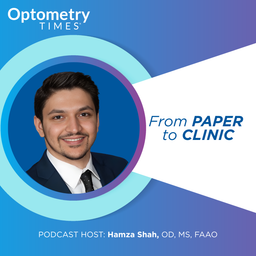
From Paper to Clinic
Claim This Podcastby From Paper to Clinic
Podcast Overview
<div> <strong>From Paper to Clinic</strong> is a clinically focused podcast hosted by <strong>Hamza Shah, OD, MS, FAAO</strong>, designed to bridge the gap between published research and real-world eye care. Each episode uses a recent medical paper as a starting point for practical, expert-led discussion—exploring how evidence translates into everyday clinical decisions, where it adds value, and where judgment still matters.</div>
Language
🇺🇲
Publishing Since
2/16/2026
Reach the team behind From Paper to Clinic
Verified contact details for this show aren't on file yet — sign up to get notified when they land.
Recent Episodes
June 1, 2026
4: Retire 'Artificial Tears': A Call for Updated Terminology in Eye Care (ft. Kaleb Abbott, OD, MS)
<div> <p>In Episode 4 of From Paper to Clinic, “Retire 'Artificial Tears': A Call for Updated Terminology in Eye Care,” <strong>Kaleb Abbott, OD, MS</strong>, joins the show to challenge the entrenched language and assumptions in dry eye care. He argues that the term “artificial tears” is fundamentally misleading—based on an outdated 1988 FDA monograph and bearing less than 1% similarity to true human tears—while natural tears themselves form an extraordinarily complex, biologically active “rainforest” of thousands of proteins, lipids, vitamins, growth factors, and mucins. The pair also critiques other misnomers such as “dry eye” and even “ocular surface disease."</p><p>They also spoke to the clinical management of these patients, exploring common pitfalls such as underestimating patients’ motivation for relief, being too conservative with treatment intensity, and failing to identify the true origin of discomfort—whether evaporative or aqueous-deficient disease, meibomian gland dysfunction, or non-ocular neuropathic pain. Abbott highlighted underutilized therapies like blood-derived products (autologous serum and platelet-rich plasma tears), which more closely approximate natural tear composition, while Shah underscored the value of amniotic membranes as a powerful “reset button” for severely compromised ocular surfaces. </p><p>The paper inspiring this discussion is "<a href="https://www.sciencedirect.com/science/article/abs/pii/S1542012425001107?via%3Dihub">It's time to retire the terms artificial tears and rewetting drops: A call for accurate terminology and updated clinical usage in eye care</a>" by Abbott and Andrew D. Pucker, OD, PhD, published in The Ocular Surface.</p></div>
May 4, 2026
3: AI in Eye Care: From Diabetic Retinopathy to the Clinic of the Future (ft. Michael Twa, OD, PhD)
<div> <p>In Episode 3 of From Paper to Clinic, “AI in Eye Care: From Diabetic Retinopathy to the Clinic of the Future,” <strong>Michael Twa, OD, PhD</strong>, joins the show to discuss artificial intelligence (AI). In the conversation, the pair discusses how AI is reshaping eye care, beginning with its success in retinal image analysis for diabetic retinopathy and expanding to more complex conditions like AMD, where challenges in sensitivity, specificity, and nuanced image interpretation become more pronounced. </p><p>They also discuss how AI can primarily serve as a decision-support tool rather than a standalone diagnostician, emphasizing the inevitability of false positives and negatives and the importance of clinician oversight, as well as the rise of chatbots and agentic AI, from tools handling routine post–cataract surgery follow-ups to future systems that could coordinate appointments, labs, referrals, and population-level outcome analysis via EHR-integrated AI. </p><p>The paper inspiring this discussion is "<a href="https://pmc.ncbi.nlm.nih.gov/articles/PMC12822609/">A Review of Recent Developments in Artificial Intelligence and Big Data Technologies for Ophthalmology Referrals and Clinical Practice</a>" by Paredes et al, published in Medical Science Monitor.</p></div>
April 6, 2026
2: Is Geographic Atrophy a Peripheral Retinal Disease? (ft. Raman Bhakhri, OD, FAAO)
<div> <p>In Episode 2 of From Paper to Clinic, host Hamza Shah, OD, MS, FAAO, is joined by Raman Bhakhri, OD, FAAO, to discuss geographic atrophy. In their conversation, they discuss the theory that peripheral retinal pigment epithelium (RPE) cells might contribute to macular geographic atrophy (GA) by migrating inadequately. </p><p>They also discuss the analogy with limbal stem cells in the cornea and the importance of monitoring the peripheral retina. Bakri highlights the limitations of current research, such as the lack of clinical trials and the applicability of animal studies to humans, and the pair explores potential new therapeutic strategies and the role of optometrists in patient care, emphasizing the importance of preventive medicine and low-vision assistance.</p><p>The paper inspiring this discussion is "<a href="https://www.ophthalmologyretina.org/article/S2468-6530(25)00454-3/fulltext">Is geographic atrophy a peripheral retinal disease?</a>" from Del Priore, published in Ophthalmology: Retina.</p></div>
5 total episodes available
Deep-dive analytics for From Paper to Clinic
Frequently asked questions
Have a different question and can't find the answer you're looking for? Reach out to our support team by sending us an email and we'll get back to you as soon as we can.
- What is From Paper to Clinic?
<div> <strong>From Paper to Clinic</strong> is a clinically focused podcast hosted by <strong>Hamza Shah, OD, MS, FAAO</strong>, designed to bridge the gap between published research and real-world eye care. Each episode uses a recent medical paper as a starting point for practical, expert-led discussion—exploring how evidence translates into everyday clinical decisions, where it adds value, and where judgment still matters.</div> - How often does this podcast release new episodes?
This podcast updates daily.
- Where can I listen to this podcast?
This podcast is available on 4 platforms including Apple Podcasts, Spotify, and more. You can also use the RSS feed directly.
- Does this podcast accept guests?
Yes, this podcast regularly features guests.
Legal Disclaimer
Pod Engine is not affiliated with, endorsed by, or officially connected with any of the podcasts displayed on this platform. We operate independently as a podcast discovery and analytics service.
All podcast artwork, thumbnails, and content displayed on this page are the property of their respective owners and are protected by applicable copyright laws. This includes, but is not limited to, podcast cover art, episode artwork, show descriptions, episode titles, transcripts, audio snippets, and any other content originating from the podcast creators or their licensors.
We display this content under fair use principles and/or implied license for the purpose of podcast discovery, information, and commentary. We make no claim of ownership over any podcast content, artwork, or related materials shown on this platform. All trademarks, service marks, and trade names are the property of their respective owners.
While we strive to ensure all content usage is properly authorized, if you are a rights holder and believe your content is being used inappropriately or without proper authorization, please contact us immediately at hey@podengine.ai for prompt review and appropriate action, which may include content removal or proper attribution.
By accessing and using this platform, you acknowledge and agree to respect all applicable copyright laws and intellectual property rights of content owners. Any unauthorized reproduction, distribution, or commercial use of the content displayed on this platform is strictly prohibited.