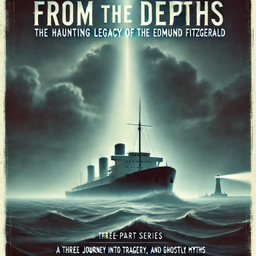

Podcast thumbnail for From The Depths:: The Haunting Legacy of The Edmund Fitzgerald

From The Depths:: The Haunting Legacy of The Edmund Fitzgerald

Claim This Podcast

by Inception Point AI

3.6(7 reviews)
3 episodes
Updated Daily
Accepts GuestsHas SponsorsLocation 🇺🇸

Podcast Overview

Part 1: Into the Depths The Behemoth on the Water The Edmund Fitzgerald was a ship that defied the imagination, a steel leviathan of staggering proportions. At 729 feet long and weighing 13,632 tons, it dwarfed every other vessel on the Great Lakes, a behemoth that could haul more than 26,000 tons of iron ore in a single load. When she launched in 1958, she was the largest ship the Great Lakes had ever seen. Locals marveled at her size and whispered that she was unsinkable, a king among commoners. But there was always something unnerving about her sheer scale. She had an imposing presence, a dark silhouette that, to the superstitious, was as much a harbinger as a triumph. The Fitzgerald was a revered workhorse, captained by seasoned sailor Ernest McSorley, a man who had seen his share of storms, who had heard the old-timers’ tales of ships that had vanished without a trace. But those were stories for land-dwellers, he’d always thought, tales to scare the young and cautious. McSorley was unflinching. He had spent years on Superior, and the lake was no stranger to him. He trusted his ship, though he knew her quirks and the way she bucked in rough water, her great steel hull vibrating with a life all its own. On November 9, 1975, she slipped out of Superior, Wisconsin, her hull loaded with taconite pellets destined for Detroit. The water was smooth, almost too smooth, as the vessel cut across the lake. To those watching from the shore, she seemed to glide like a ghost, her great shape silhouetted against a sky darkening in the early evening. But something was…off. The air was heavy, thick with a quiet that felt unnatural, as though Lake Superior herself was holding her breath. Fishermen along the shore glanced at one another, the hairs on their necks standing up as they watched the Fitzgerald pass. They’d heard the stories too, knew that Lake Superior was no ordinary lake. They had seen what she did to those who didn’t respect her. They called her the "Graveyard of the Great Lakes," a place where ships went down and didn’t come back up. The Fitzgerald was a giant, yes, but even giants were nothing more than toys in the grip of the lake. The crew, hardened men of grit and muscle, paid the silence little mind as they readied the ship. They shared jokes and stories, stowed away personal items, checked the ship’s systems, and prepared for what they thought was an ordinary trip. But even some of them couldn’t ignore a creeping feeling of unease. Lake Superior was silent—too silent—and they were left with only the rumble of the engines and the hollow clang of metal against metal. Captain McSorley felt it too. Standing on the bridge, looking out over the water, he sensed something he couldn’t quite place. It wasn’t fear; McSorley was a practical man, not one to be swayed by ghost stories. But there was something—just a whisper at the back of his mind, like an itch he couldn’t scratch. The lake was watching, he thought, but pushed the idea away, dismissing This content was created in partnership and with the help of Artificial Intelligence AI.

Language

🇺🇲

Publishing Since

11/11/2024

2 verified contact emails on file for From The Depths:: The Haunting Legacy of The Edmund Fitzgerald

Pitch yourself as a guest, propose sponsorships, or reach out directly to the host.

Recent Episodes

Episode thumbnail for Ep. 3 The Ballad and the Ghostly Legacy

November 11, 2024

Ep. 3 The Ballad and the Ghostly Legacy

Episode 3: The Ballad and the Ghostly Legacy <br />Part 1: The Birth of a Haunting Ballad In 1976, only a year after the Edmund Fitzgerald disappeared into the depths, Canadian singer-songwriter Gordon Lightfoot released a ballad that would etch the tragedy into public consciousness. The song, simply titled The Wreck of the Edmund Fitzgerald, wasn’t just a recounting of the disaster—it was a dirge, a haunting lament that captured the eerie power of the lake and the horror of the ship’s final moments. From the first mournful strum of the guitar, Lightfoot’s ballad was a reminder of the lake’s dark history, a musical spell that would weave the Fitzgerald’s story into the fabric of the Great Lakes and beyond. Lightfoot had been inspired by a newspaper article that detailed the wreck, a stark report that laid out the facts with chilling simplicity. But where the article recounted the events, Lightfoot’s ballad brought them to life. His voice, somber and resonant, drifted over the melody like a cold wind, carrying listeners back to that fateful night, back to the rolling waves and the screaming wind, back to the moment when the Fitzgerald vanished into the lake’s depths. The song’s lyrics painted a vivid picture of the tragedy. Listeners could see the ship battling the storm, hear the cries of the crew as they struggled against the lake’s fury. They could feel the tension, the fear, the overwhelming sense of doom that had hung over the Fitzgerald in her final hours. Lightfoot’s words were simple, but they were powerful, each line a reminder of the lives that had been lost, the families left behind, and the lake’s unyielding grip on those who dared to cross it. The ballad struck a chord with people across the world, not just those who lived near the Great Lakes. It became a hit, climbing the charts and drawing new attention to the tragedy. But it was more than just a song; it was a monument, a tribute to the men who had perished and the lake that had taken them. For many, it was the first they had heard of the Edmund Fitzgerald, but after hearing Lightfoot’s haunting melody, they would never forget her. Part 2: A Haunting Legacy in Song Over the years, The Wreck of the Edmund Fitzgerald became more than just a piece of music—it became a symbol, a reminder of the lake’s power and the mysteries it held. The song was played at memorials, at gatherings, at the annual November vigils on the shore. Its lyrics echoed across the water, a ghostly refrain that seemed to call out to the lost crew, as though Lightfoot’s voice could reach through the darkness and bring them home. Listeners spoke of feeling chills as they heard the song, of an inexplicable sadness that settled over them as the notes drifted through the air. It was as if the song itself was haunted, as if the spirits of the Fitzgerald’s crew had imbued the music with their presence. Some even claimed to hear strange echoes in the background, faint voices that seemed to sing along, adding a layer of mystery to an already haunting melody. In the Great Lakes communities, the song took on an almost sacred quality. It was a reminder, a warning, a tribute, all wrapped into one. Lightfoot’s words carried a weight that went beyond the music, a resonance that seemed to echo through the years, as powerful today as it was when it was first released. It was as though the song had become a part of the lake’s lore, a legend passed down from generation to generation. To this day, hearing The Wreck of the Edmund Fitzgerald is like stepping back in time, like standing on the shore as the storm rages and the lake stretches out before you, vast and unforgiving. The song is a reminder of the lake’s power, of the lives it has claimed, and of the mysteries it still holds. It is a bridge between the living and the dead, a ghostly refrain that keeps the memory of the Fitzgerald alive, even as the years slip by. <br />Part 3: A Ghostly Chorus As the song’s popularity grew, so did the stories...

Episode thumbnail for Ep. 2 Echoes Across the Lake

November 11, 2024

Ep. 2 Echoes Across the Lake

Episode 2: Echoes Across the Lake <br />Part 1: The Lake’s Unanswered Questions The disappearance of the Edmund Fitzgerald left a mark on Lake Superior and all who lived by its shores. In the weeks following the wreck, the questions only grew louder, darker, echoing in the minds of those who had seen the lake’s wrath firsthand. What had gone wrong? How could a ship so large, so invincible in appearance, vanish without a trace? For the families left behind, the absence of answers gnawed like an open wound, a silent scream that grew louder with each passing day. The Coast Guard launched an investigation, piecing together whatever scraps of information they could find. Divers descended into the lake’s dark depths, their beams cutting through the murk as they searched for signs of the Fitzgerald. They found her eventually, lying on the lakebed in two massive pieces, her hull split open, her iron belly exposed to the cold water. But even in death, the Fitzgerald held onto her secrets. There was no clear cause, no single explanation for why she had gone down so suddenly. The families of the crew members received the grim news in stoic silence. They gathered at local churches, clinging to one another as they mourned, as they tried to make sense of the senseless. Some turned to faith, seeking comfort in the idea of a higher plan, a purpose beyond their understanding. Others sought solace in superstition, in the old stories of Lake Superior’s restless spirits, the tales of ghost ships and phantom sailors who haunted the water. For some, the lake became an enemy, a dark force that had taken their loved ones and refused to let them go. They avoided the water, shunning its shores, refusing to set foot on its beaches. They wanted nothing to do with the lake that had swallowed their fathers, their sons, their husbands. But for others, the lake became a place of pilgrimage. They returned to the shore year after year, standing on the cold sand as they remembered the men who had been lost. They would stare out over the water, searching the horizon for a sign, a glimmer of hope that their loved ones were still out there somewhere, waiting to come home. Part 2: The Annual Gathering Each November, as the anniversary of the wreck approached, the shores of Lake Superior filled with people who came to honor the memory of the Edmund Fitzgerald and her crew. Families, friends, sailors—people from all walks of life gathered under the gray sky, their breath misting in the cold air as they shared stories, memories, and quiet moments of reflection. At Whitefish Point, where the Fitzgerald had last been seen, a small crowd would gather, standing in solemn silence as they remembered the ship and her crew. The lighthouse stood as a sentinel, its beam cutting through the mist, a solitary light in the darkness. For some, it was a symbol of hope, a reminder that even in the darkest moments, there was always a guiding light. For others, it was a stark reminder of what had been lost, a beacon that had failed to save the men it was meant to protect. The wind howled through the trees, carrying with it the whispers of the past, the faint echo of voices long gone. Some said they could hear the voices of the crew, calling out from the depths, their words lost to the water but their presence lingering, a ghostly reminder of the lives that had been taken. Others claimed to see shadows on the water, dark shapes that moved against the waves, like spirits caught between worlds, forever bound to the lake. At the Great Lakes Shipwreck Museum, the Fitzgerald’s bell was displayed as a tribute to the lost. It was a massive piece of brass, engraved with the ship’s name, a relic of a bygone era. People would gather around it, their hands brushing over the smooth metal as they whispered prayers and remembered the men who had been lost. The bell was a symbol of both tragedy and resilience, a reminder that even in death, the Fitzgerald lived on. As the sun set on the...

Episode thumbnail for Ep.1  Into the Depths

November 11, 2024

Ep.1 Into the Depths

Part 1: Into the Depths <br />The Behemoth on the Water The Edmund Fitzgerald was a ship that defied the imagination, a steel leviathan of staggering proportions. At 729 feet long and weighing 13,632 tons, it dwarfed every other vessel on the Great Lakes, a behemoth that could haul more than 26,000 tons of iron ore in a single load. When she launched in 1958, she was the largest ship the Great Lakes had ever seen. Locals marveled at her size and whispered that she was unsinkable, a king among commoners. But there was always something unnerving about her sheer scale. She had an imposing presence, a dark silhouette that, to the superstitious, was as much a harbinger as a triumph. The Fitzgerald was a revered workhorse, captained by seasoned sailor Ernest McSorley, a man who had seen his share of storms, who had heard the old-timers’ tales of ships that had vanished without a trace. But those were stories for land-dwellers, he’d always thought, tales to scare the young and cautious. McSorley was unflinching. He had spent years on Superior, and the lake was no stranger to him. He trusted his ship, though he knew her quirks and the way she bucked in rough water, her great steel hull vibrating with a life all its own. On November 9, 1975, she slipped out of Superior, Wisconsin, her hull loaded with taconite pellets destined for Detroit. The water was smooth, almost too smooth, as the vessel cut across the lake. To those watching from the shore, she seemed to glide like a ghost, her great shape silhouetted against a sky darkening in the early evening. But something was…off. The air was heavy, thick with a quiet that felt unnatural, as though Lake Superior herself was holding her breath. Fishermen along the shore glanced at one another, the hairs on their necks standing up as they watched the Fitzgerald pass. They’d heard the stories too, knew that Lake Superior was no ordinary lake. They had seen what she did to those who didn’t respect her. They called her the "Graveyard of the Great Lakes," a place where ships went down and didn’t come back up. The Fitzgerald was a giant, yes, but even giants were nothing more than toys in the grip of the lake. The crew, hardened men of grit and muscle, paid the silence little mind as they readied the ship. They shared jokes and stories, stowed away personal items, checked the ship’s systems, and prepared for what they thought was an ordinary trip. But even some of them couldn’t ignore a creeping feeling of unease. Lake Superior was silent—too silent—and they were left with only the rumble of the engines and the hollow clang of metal against metal. Captain McSorley felt it too. Standing on the bridge, looking out over the water, he sensed something he couldn’t quite place. It wasn’t fear; McSorley was a practical man, not one to be swayed by ghost stories. But there was something—just a whisper at the back of his mind, like an itch he couldn’t scratch. The lake was watching, he thought, but pushed the idea away, dismissing it as foolishness. He had a ship to run. The Gathering Storm By dawn on November 10, the wind had begun to rise, a low moan that swept across the water, growing in strength and carrying with it the scent of ice and steel. The Fitzgerald pressed on, cutting through choppy waves as the storm gathered in the distance. McSorley, a man of few words and calm conviction, kept his crew working with quiet nods and steady glances, his demeanor unshaken by the ominous clouds rolling toward them. As the hours passed, the wind howled, and the waves grew. By noon, the lake had turned into a writhing monster, each wave crashing over the bow with a force that seemed almost vengeful. The steel walls of the ship echoed with each impact, groaning under the weight of the lake’s rage. Men on deck were drenched, their clothes sticking to their skin as they battled to keep the ship balanced, each impact of the waves sending them stumbling, reaching out for anything to hold onto. Inside, the ship...

3 total episodes available

Similar Podcasts

Discover related shows you might enjoy

Deep-dive analytics for From The Depths:: The Haunting Legacy of The Edmund Fitzgerald

Frequently asked questions

Have a different question and can't find the answer you're looking for? Reach out to our support team by sending us an email and we'll get back to you as soon as we can.

What is From The Depths:: The Haunting Legacy of The Edmund Fitzgerald?

Part 1: Into the Depths The Behemoth on the Water The Edmund Fitzgerald was a ship that defied the imagination, a steel leviathan of staggering proportions. At 729 feet long and weighing 13,632 tons, it dwarfed every other vessel on the Great Lakes, a behemoth that could haul more than 26,000 tons of iron ore in a single load. When she launched in 1958, she was the largest ship the Great Lakes had ever seen. Locals marveled at her size and whispered that she was unsinkable, a king among commoners. But there was always something unnerving about her sheer scale. She had an imposing presence, a dark silhouette that, to the superstitious, was as much a harbinger as a triumph. The Fitzgerald was a revered workhorse, captained by seasoned sailor Ernest McSorley, a man who had seen his share of storms, who had heard the old-timers’ tales of ships that had vanished without a trace. But those were stories for land-dwellers, he’d always thought, tales to scare the young and cautious. McSorley was unflinching. He had spent years on Superior, and the lake was no stranger to him. He trusted his ship, though he knew her quirks and the way she bucked in rough water, her great steel hull vibrating with a life all its own. On November 9, 1975, she slipped out of Superior, Wisconsin, her hull loaded with taconite pellets destined for Detroit. The water was smooth, almost too smooth, as the vessel cut across the lake. To those watching from the shore, she seemed to glide like a ghost, her great shape silhouetted against a sky darkening in the early evening. But something was…off. The air was heavy, thick with a quiet that felt unnatural, as though Lake Superior herself was holding her breath. Fishermen along the shore glanced at one another, the hairs on their necks standing up as they watched the Fitzgerald pass. They’d heard the stories too, knew that Lake Superior was no ordinary lake. They had seen what she did to those who didn’t respect her. They called her the "Graveyard of the Great Lakes," a place where ships went down and didn’t come back up. The Fitzgerald was a giant, yes, but even giants were nothing more than toys in the grip of the lake. The crew, hardened men of grit and muscle, paid the silence little mind as they readied the ship. They shared jokes and stories, stowed away personal items, checked the ship’s systems, and prepared for what they thought was an ordinary trip. But even some of them couldn’t ignore a creeping feeling of unease. Lake Superior was silent—too silent—and they were left with only the rumble of the engines and the hollow clang of metal against metal. Captain McSorley felt it too. Standing on the bridge, looking out over the water, he sensed something he couldn’t quite place. It wasn’t fear; McSorley was a practical man, not one to be swayed by ghost stories. But there was something—just a whisper at the back of his mind, like an itch he couldn’t scratch. The lake was watching, he thought, but pushed the idea away, dismissing

This content was created in partnership and with the help of Artificial Intelligence AI.

How often does this podcast release new episodes?

This podcast updates daily.

Where can I listen to this podcast?

This podcast is available on 4 platforms including Apple Podcasts, Spotify, and more. You can also use the RSS feed directly.

Does this podcast accept guests?

No, this podcast does not typically feature guests.

Legal Disclaimer

Pod Engine is not affiliated with, endorsed by, or officially connected with any of the podcasts displayed on this platform. We operate independently as a podcast discovery and analytics service.

All podcast artwork, thumbnails, and content displayed on this page are the property of their respective owners and are protected by applicable copyright laws. This includes, but is not limited to, podcast cover art, episode artwork, show descriptions, episode titles, transcripts, audio snippets, and any other content originating from the podcast creators or their licensors.

We display this content under fair use principles and/or implied license for the purpose of podcast discovery, information, and commentary. We make no claim of ownership over any podcast content, artwork, or related materials shown on this platform. All trademarks, service marks, and trade names are the property of their respective owners.

While we strive to ensure all content usage is properly authorized, if you are a rights holder and believe your content is being used inappropriately or without proper authorization, please contact us immediately at hey@podengine.ai for prompt review and appropriate action, which may include content removal or proper attribution.

By accessing and using this platform, you acknowledge and agree to respect all applicable copyright laws and intellectual property rights of content owners. Any unauthorized reproduction, distribution, or commercial use of the content displayed on this platform is strictly prohibited.