- 6
- Episodes
- 4
- Ratings
- Bi-weekly
- Cadence
- 2026
- First episode
About Fullness Of Truth
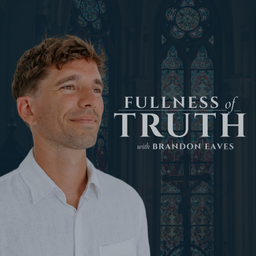
Fullness of Truth is a Catholic podcast hosted by Brandon Eaves, who came to faith in an evangelical church, spent three years seeking to understand the Catholic Church, and was received into her at Easter 2019. Episodes cover basic catechesis and reflections on Scripture, along with conversations with authors, scholars, and people doing good work in ministry. The point is not to win arguments. It is the conversion of hearts, and that is done in charity, without wavering on the truth.
- Publisher
- Brandon Eaves
- Category
- religion & spirituality
- Language
- en
- Explicit
- No
- First episode
- 12 Aug 2026
- Latest episode
- 27 Oct 2026
Latest episodes
6 episodes in the feed.
27 Oct 2026
Catholic Apologist Reacts to Bryce Crawford
Don't doubt. Don't presume. Humbly seek Christ and trust His mercy. You can’t be 100% certain you’re saved, but that’s not a reason to despair. A friend of mine loved the Lord, went to a Christian college, did Bible studies, and still walked away from the faith after college. A clip of Bryce Crawford on the Shawn Ryan Show put a familiar question back in front of me: “If you were to die today, on a scale of one to ten, how confident are you that you would go to heaven? The framing of that question is the problem. It isn’t how the New Testament talks about forgiveness or assurance at all. Scripture gives us promises that God will finish what He started in us. Scripture also gives us blunt warnings about falling away, with named examples of people who did. Both have to be held together. Presumption sits on one side, despair on the other, and the Catholic road runs right between them. The Council of Trent draws that line precisely. Fr. Joseph Pohle sharpens it further with a syllogism that exposes exactly where the Protestant certainty argument breaks down. Moral certainty of grace is real. Infallible certainty is not, and pretending otherwise doesn’t survive contact with a real person walking out the door. By the end, you’ll have the seven signs Pohle gives that you’re in a state of grace, and a line from St. Joan of Arc that answers the whole question better than any number ever could. You’ll learn: [0:00] Introduction [1:37] The problem with the one-to-ten salvation question [3:20] Despair and presumption as the two vices against hope [5:25] The warning passages that balance the promises of assurance [9:54] New Testament figures who fell away from the faith [12:00] Two ways to read the warning passages [15:39] How the Council of Trent threads the needle [17:31] Father Pohle on vain confidence versus humble trust [19:57] Moral certainty and receiving the Eucharist [22:32] Father Pohle’s seven signs of being in a state of grace [23:28] St. Joan of Arc’s answer at her trial Resources Mentioned: Grace, Actual and Habitual by Joseph Pohle | Book (https://www.amazon.com/Grace-Actual-Habitual-Dogmatic-Treatise/dp/1499343965) Council of Trent, Session VI | Website (https://history.hanover.edu/texts/trent/ct06.html) The Shawn Ryan Show episode: Bryce Crawford - The Gen Z Evangelist Walking Into America's Darkest Subcultures | YouTube (https://www.youtube.com/watch?v=mm4ebPON4bM) Bryce Crawford | Website (https://brycecrawford.org/) Find More from Brandon: Brandon Eaves | Instagram (https://www.instagram.com/fullnessoftruth) | X (https://x.com/brandon_eaves7)
13 Oct 2026
Proving Apostolic Succession In 49 Minutes
The Catholic answer to one of the biggest objections to apostolic succession is simply, "We know. We grant it." And that's exactly why the objection doesn't land. Let's talk about three of the most common objections to apostolic succession, drawing on scholars like Gregg Allison, Leonardo De Chirico, Charles Hodge, and Gavin Ortlund, because these are the arguments actually being made in serious Protestant work. The first objection says the Catholic Church has too thick a view of incarnational ministry and compromises the uniqueness of Christ's work. The second says the apostolic office was unique and can't be passed on. The third says the New Testament uses "bishop" and "priest" interchangeably, so a three-office structure can't be of apostolic origin. Here's what makes this episode different. I don't try to wiggle out of the terminology problem in objection three. I concede it, then show why the structural picture still holds from Timothy and Titus through Ignatius, Irenaeus, and Tertullian. If you've ever used Acts 1 as a proof text for succession, I explain why that's a trap worth avoiding. And if you're wondering what's at stake beneath the technical arguments, Cardinal Journet frames it in a way that reorients the discussion around whether Christ still draws near to us after the ascension. It's dense in places, but it's worth it. You’ll learn: [0:00] Introduction [1:30] Apostolic succession defined as Christ's representatives to the world [2:01] Objection one says Christ's ministry ends at the ascension [3:49] De Chirico walks back the no-prolongation claim [6:32] Steel-manning the concern that priests detract from Christ's priesthood [11:24] Peter given the keys and the authority to govern the church [17:39] Objection two says the apostolic age is over [21:57] Extraordinary privileges for founding versus ordinary for preservation [28:44] Objection three says episkopos and presbyteros are interchangeable [33:02] Terminological fluctuation is not structural fluctuation [36:04] Ignatius of Antioch and the threefold structure of the early church [37:05] Polycarp's letter to the Philippians and the two-office reading [40:05] Irenaeus and Tertullian trace mono-episcopacy back to the apostles [44:06] Jerome's account of the origin of the threefold hierarchy [46:40] Apostolic succession as Christ's way of drawing near to us Resources Mentioned: Roman Catholic Theology and Practice by Gregg Allison | Book (https://www.amazon.com/dp/1433501163) Evangelical Theological Perspectives on Post-Vatican II Roman Catholicism by Leonardo De Chirico | Book (https://www.amazon.com/dp/3039101455) Systematic Theology, Vol. 1 by Charles Hodge | Book (https://www.ccel.org/ccel/hodge/theology1.html) Catechism of the Catholic Church, Ascension Edition by the Catholic Church | Book (https://www.amazon.com/dp/1954881894) What It Means to Be Protestant by Gavin Ortlund | Book (https://www.amazon.com/What-Means-Be-Protestant-Always-Reforming/dp/0310156327) Ignatius Catholic Study Bible by Scott Hahn and Curtis Mitch | Bible (https://www.amazon.com/dp/1586176137) Epistle to the Philippians by Polycarp | Book (https://www.newadvent.org/fathers/0136.htm) Against Heresies by Irenaeus | Book (https://www.newadvent.org/fathers/0103.htm) Prescription Against Heretics by Tertullian | Book (https://www.newadvent.org/fathers/0311.htm) The Church of the Word Incarnate, Vol. 1 by Charles Journet | Book (https://www.amazon.com/Church-Word-Incarnate-Apostolic-Hierarchy/dp/1645854310) Magisterium by Avery Dulles | Book (https://www.amazon.com/dp/1932589384) The Science of Sacred Theology by Emmanuel Doronzo | Book (https://www.amazon.com/dp/1990685293) Theology of the Priesthood by Jean Galot | Book (https://www.amazon.com/dp/1586170961) The Sacraments, Vol. 4 by Joseph Pohle and Arthur Preuss | Book (https://archive.org/details/sacramentsdogmat04pohluoft) Find More from Brandon: Brandon Eaves | Instagram (https://www.instagram.com/fullnessoftruth) | X (https://x.com/brandon_eaves7?s=11)
29 Sept 2026
Why The Catholic Church Is Jesus' Church
If you've ever wondered whether denominationalism actually communicates the unity Jesus prayed for in John 17, this episode is written for you. The Catholic Church is the fulfillment of what Ezekiel, Isaiah, Daniel, and Jeremiah pointed to centuries before Christ, and this episode walks through why. The four marks - one, holy, catholic, and apostolic - are not slogans. They are prophecies with specific content, and each one has a concrete fulfillment in the New Testament that most people skim past. John 17 is where this got personal for me. Jesus prays that the unity of his followers would mirror the unity of the Trinity itself, and that unity is meant to be a supernatural sign to the world. So the honest question for anyone comfortable with denominationalism is whether splintered institutions can carry that sign. From there, the argument becomes sharper. Humans learn through their senses, which is why God works through visible realities: the incarnation, the Church, the sacraments. Strip out the visible institution, and you lose the way God chose to reach us. The last section is where the stakes land. Without a teaching office with the charism of infallibility, the Bible cannot accomplish the very purpose God gave it for. You’ll learn: [0:00] Introduction [1:29] Ezekiel foretells one nation under one king [5:56] Daniel's stone that fills the whole world [8:07] The four marks fulfilled in the New Testament [10:05] Christ's high priestly prayer and the unity that converts [16:54] Apostolic authority to bind consciences under pain of damnation [19:01] Why the church must be visible as well as spiritual [24:18] Keys of the kingdom and the office given to Peter [29:23] The proximate rule of faith beyond Scripture alone Find More from Brandon: Brandon Eaves | Instagram (https://www.instagram.com/fullnessoftruth) | X (https://x.com/brandon_eaves7?s=11)
14 Sept 2026
Why Jesus: 5 Reasons Why God Became Incarnate
If God could have forgiven sin with a single word, the cross starts to look like a choice, not a necessity. That's the tension I want to sit with in this episode, working through the classic Christian answer to a question most believers never stop to ask: why Jesus at all? I lean on St. John of Damascus, St. Athanasius, and Thomas Aquinas to walk through five attributes of God: His goodness, power, justice, wisdom, and love, and how each one makes the incarnation fitting rather than arbitrary. Athanasius has this striking image of God caught between His own truthful word to Adam and the ruin of the creatures He made in His image. What kind of maker watches His masterpiece decay and does nothing? There's also a verse in Ezekiel 36 that reorders the usual motive we assume for redemption. God says plainly it is not for Israel's sake that He is about to act. Once you see it, you can't unsee it. The self-emptying of Philippians 2 gets misread constantly, so I spend time on what kenosis actually means and why the incarnation adds rather than subtracts. If you've wondered what God is like, the argument here is that you don't have to guess. You’ll learn: [0:00] Introduction [2:43] God's goodness moved Him to save fallen humanity [7:34] Goodness naturally diffuses and communicates itself outward [10:55] Jesus as the perfect answer to what God is like [13:28] The incarnation magnifies rather than diminishes God's power [15:53] Kenosis means self-emptying by way of addition [19:27] Restoring God's honor as the primary motive for incarnation[23:03] Only God Himself can atone for sin in a way that satisfies His wisdom and justice [29:38] God's love as the final reason for the incarnation [31:05] Every act of the God-man carries infinite value Resources Mentioned: An Exact Exposition of the Orthodox Faith by St. John of Damascus | Book (https://www.amazon.ca/Exact-Exposition-Orthodox-Faith-Biographical/dp/B0C81T4VYM/ref=sr_1_1?crid=163XCOXYSP50D&dib=eyJ2IjoiMSJ9.y9cOzjkoaDqJsnwD3QeNN4M73LAxEYt1wH9t9Xmq-WeT9MqeMTXw86C4gZVfcJzCVbzxqlE2f6ramxba4EbIuMGNPBxhFqnDBZ61-1nMm7fS_yNPSzvuFDXWizQwonsNTd9ggCp0sqF9_vUF4ay7TdoXcm8dzIER6zTevnphmZgnPbjc9lVPM1N7WOThDyaM4MXkW-kaUQatoWenP8vhajNUxzV73VXJZS-l-iduWW0.6I1Q3Mj9KCg7Yh9fxVbmvus-OHOBpaMKPaMstV73VTY&dib_tag=se&keywords=An+Exact+Exposition+of+the+Orthodox+Faith+by+St.+John+of+Damascus&qid=1788375475&s=books&sprefix=%2Cstripbooks%2C237&sr=1-1) The Summa Theologica by St. Thomas Aquinas | Book (https://www.amazon.ca/Summa-Theologica-St-Thomas-Aquinas/dp/1481062735/ref=sr_1_1?crid=2JM9I8OA2FSL4&dib=eyJ2IjoiMSJ9.ILecBdKAVpYL1IE2LKtx0vPjrVX3YOFmiPoszMFMCUzMLRMBVrP9zptaaBQH1phqDd9rgr3ZG5r0GVgb7z7l3dvT5Es2TfveavHWAa4EE_xtZtjbdIT2A_Go3FJZKTId9gCGGVWlIpn4dzwsgyl5P4dSut-EGJQKfzkIrazeLLBlN4YWy4ZSYEdDjJPPm6_2qiaaSD2geYSj_XBnAyyaHtARPSboxmVxjYIsSQeS-lA.NHNfaeYk_QWakDYcTHx9-C42wDEQGSuhE8gsysQaMUs&dib_tag=se&keywords=Summa+Theologica+%28Tertia+Pars%29+by+St.+Thomas+Aquinas&qid=1788375504&s=books&sprefix=summa+theologica+tertia+pars+by+st+thomas+aquinas%2Cstripbooks%2C216&sr=1-1) Paul Washer | Website (https://heartcrymissionary.com/people/paul-david-washer/) Find More from Brandon: Brandon Eaves | Instagram (https://www.instagram.com/fullnessoftruth) | X (https://x.com/brandon_eaves7?s=11)
1 Sept 2026
The Real Reason Your Prayers Never Get Answered (And What to Say Instead)
Prayer isn't primarily about getting what you ask for, and that misunderstanding is why so many people give up on it. When Dan Rather asked Mother Teresa what she says to God when she prays, she answered, "Nothing. I listen". When he asked what God says back, she said, "Nothing. He listens". That exchange reframes almost everything most people assume about prayer. The question that sparked this episode came from a real inquirer: "Why should I pray?" It deserved a real answer, not a slogan. Prayer isn't primarily about getting things. It's communion with the Father, Son, and Holy Spirit. That single shift changes how the whole practice makes sense, and it explains why so many people feel stuck. We work through four questions: What is prayer? Why pray? Who is prayer for? How do we actually do it? The Our Father prayer becomes the roadmap for the last part, and Jesus is more specific about how to pray than most people realize. There's a reason the first three petitions aren't about you. Along the way, St. John Chrysostom shows why the word "Father" carries more weight than most Christians ever stop to consider. St. Augustine reframes what "who art in heaven" actually means. And a small comment from Bishop Barron on silence reframes what listening to God even sounds like. If you've prayed for years and hit a wall, or you've never really prayed and don't know where to start, this one is for you. You’ll learn: [00:00] Introduction [1:11] What prayer actually is [8:46] Why we should pray [12:12] Who prayer is for [21:08] The Our Father, line by line [31:06] Breaking down the seven petitions Resources mentioned: An Introduction to Prayer by Robert Barron | Book (https://www.amazon.ca/Introduction-Prayer-Robert-Barron/dp/1685781462/ref=sr_1_1?dib=eyJ2IjoiMSJ9.ZylfFpycHuQmE3jmTUMqwq_Mlk3o-MpK2bpJlO30RrG0jPKyfNWyhwe7EvCQXrUAnkSf2e3pGWUYNh75z2n0le7MaR_70_J77itA78nh8F0EE5R4J6QQElLMR6oqjuWdJRb3qEnvsMiu97Kivgs43xDI7yl94RnbVqZNgRkICoLizMtMJbXmMDFGbQEQqZ2r8e9r9D33JLb-M_THA5_KWzTuK6wMcOMsjx4WrTk4raU.OV3VPVYK2NccjerVB_AZcDxl0uux54PdbZDETkSTAvI&dib_tag=se&gad_source=1&hvadid=788820310061&hvdev=c&hvexpln=0&hvlocphy=9001471&hvnetw=g&hvocijid=18416111216383228428--&hvqmt=e&hvrand=18416111216383228428&hvtargid=kwd-2360248813913&hydadcr=3213_13880811&keywords=introduction+to+prayer+bishop+barron&mcid=b133f60234f3390fbee9155f9b6baa55&qid=1787779044&sr=8-1) or Audiobook (https://www.amazon.ca/Audible-An-Introduction-to-Prayer/dp/B0DHJDF1ZL/ref=tmm_aud_swatch_0?_encoding=UTF8&dib_tag=se&dib=eyJ2IjoiMSJ9.ZylfFpycHuQmE3jmTUMqwq_Mlk3o-MpK2bpJlO30RrG0jPKyfNWyhwe7EvCQXrUAnkSf2e3pGWUYNh75z2n0le7MaR_70_J77itA78nh8F0EE5R4J6QQElLMR6oqjuWdJRb3qEnvsMiu97Kivgs43xDI7yl94RnbVqZNgRkICoLizMtMJbXmMDFGbQEQqZ2r8e9r9D33JLb-M_THA5_KWzTuK6wMcOMsjx4WrTk4raU.OV3VPVYK2NccjerVB_AZcDxl0uux54PdbZDETkSTAvI&qid=1787779044&sr=8-1) Catechism of the Catholic Church | Website (https://www.usccb.org/sites/default/files/flipbooks/catechism/) Homily 20 on the Gospel of Matthew by St. John Chrysostom | PDF (https://www.documentacatholicaomnia.eu/03d/0345-0407,_Iohannes_Chrysostomus,_Homilies_on_The_Gospel_Of_Matthew,_EN.pdf)
12 Aug 2026
Why I Left Evangelicalism - Pilot Episode | Fullness of Truth
A napkin at Sonny's Barbecue changed the entire direction of my life, and eventually led me out of the evangelical world I loved. I'm Brandon Eaves, and this is the pilot episode of Fullness of Truth. I grew up in Jacksonville, had a real conversion to Christ my junior year of high school, and went to Columbia International University because I fell in love with the Bible. Years later, a friend I was worried about pulled me into a three-year investigation of the Catholic Church I never expected to take seriously. What I found is hard to summarize. G.K. Chesterton described stages of conversion that mapped onto me almost exactly. St. Augustine wrote something about many authors on the same subject that finally permitted me to do this. There's also a story about a stranger with a blue check mark on Instagram, and why I said yes this time after saying no a year ago. If you've never really listened to the Catholic Church, this is where I want to start the conversation. You’ll learn: [00:00] Introduction [01:59] A napkin at Sonny's Barbecue and the 2 AM conversion that changed everything [05:20] I chose CIU and fell in love with studying the Bible [08:02] The Catholic friend I tried to save, and the principle that started it all [10:50] Running out of reasons to shout against the Catholic Church [13:48] Why I couldn't unsee the constellation of Catholic dogma once it appeared [16:23] From ophthalmology to teaching to working for the church [19:30] The out-of-nowhere Instagram message that made this podcast happen [22:31] Why it's called Fullness of Truth, and the three kinds of content to expect [25:24] How to thread the needle between truth and charity in ecumenical dialogue [27:35] Why add another voice? St. Augustine's answer, and the 60 people in OCIA Resources mentioned: God or Nothing by Robert Cardinal Sarah | Book (https://ignatius.com/god-or-nothing-gonp/) Pints with Aquinas with Matt Fradd | Podcast (https://www.youtube.com/channel/UClh4JeqYB1QN6f1h_bzmEng) Trent Horn | Website (https://www.trenthorn.com/) Scott Hahn | Website (https://www.scotthahn.com/)
Reach and audience
Public platform figures. Ratings count people who left a rating, not total listeners.
- Apple Podcasts (US)
- 5.0 / 5
- 3 ratings
- Spotify
- 5.0 / 5
- 1 ratings
Shows with a similar audience


Host of Fullness Of Truth?
Claim your podcast to manage its listing and keep your show details accurate.
Pod Engine is an independent podcast discovery and analytics service and is not affiliated with or endorsed by this podcast. Artwork and show content belong to their owners. Full legal notice.
Explore this show
Podcast research with Pod Engine