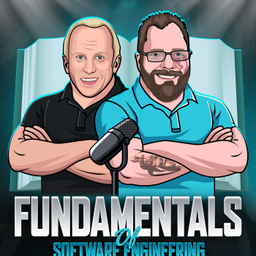
Fundamentals of Software Engineering
Hosted by Dan and Nate · Dan Vega, Nate Schutta
4.8from 5 ratings
- 13
- Episodes
- 3
- Transcribed
- 5
- Ratings
- Bi-weekly
- Cadence
- 2025
- First episode
About Fundamentals of Software Engineering
Programmer, coder, developer—there are any number of titles used to describe people who create software, but what does it mean to be a software engineer? Despite the way software is often taught, being a software engineer is about far more than simply producing syntactically correct programs.
- Publisher
- Dan Vega, Nate Schutta
- Category
- education · technology
- Language
- en
- Explicit
- No
- First episode
- 9 Dec 2025
- Latest episode
- 28 Sept 2026
Latest episodes
3 of 13 episodes have a transcript.
28 Sept 2026TRANSCRIPT
E13 - Are You Behind on AI? Probably Not
Host Danny Thompson and guest Nate Soares discuss how to avoid feeling behind on AI by focusing on career goals and practical application, in this interview episode.
16 Sept 2026TRANSCRIPT
E12 - How Developers Can Start Speaking at Conferences
Host Nate and guest [Guest Name, Credentials] discuss practical steps for developers to begin public speaking, from local meetups to crafting compelling abstracts and managing nerves, offering actionable advice for aspiring conference speakers.
22 Aug 2026TRANSCRIPT
E11 - What Is Software Architecture
Host Dan and guest Nate explore the definition and trade-offs of software architecture, revealing why it's about un-Googleable decisions and conflicting quality attributes.
13 Jul 2026
E10 - Context Engineering Is Just Data Fundamentals in Disguise
In this episode of Fundamentals of Software Engineering, Nate and I dig into context engineering, the phrase that has quietly replaced prompt engineering as the term on everyone's 2026 bingo card. Our core argument is simple. Context engineering is not a shiny new AI skill, it is a data fundamental you probably already know, just wearing a new name. Prompt engineering is about how you ask. Context engineering is about what the model actually knows when you ask. We frame it as a desk and a filing cabinet, where the context window is the desk and your job is deciding what belongs on it right now. Along the way we get into structured versus unstructured data, retrieval augmented generation, tools, and why getting the right information in front of a model matters far more than crafting the perfect prompt. We also pump the brakes on the idea that coding is solved and engineers are optional. We talk through the headlines, Spotify shipping thousands of deploys a day with most pull requests now AI assisted, and Ford rehiring hundreds of veteran engineers after AI could not replace decades of hard earned wisdom. That leads us to data hygiene, access control, and lineage, because AI does not fix garbage data, it exposes it. We cover keeping context fresh, why a confidently wrong AI is worse than no AI, and why curation beats volume when tokens are the currency of large language models. We close on data migration, version control for your schema with tools like Flyway and Liquibase, data validation, and the case for smaller local models fed the right context. Data is the backbone of everything we build, even in the age of AI. __________________________________________________ Key Highlights 🚀 Deploy Versus Release: Spotify reportedly ships around 4,500 production deploys a day with 73 percent of pull requests AI assisted, which opens a great conversation about why a deploy is not the same thing as a release. 🛑 Pump the Brakes on Coding Is Solved: Ford rehired more than 300 veteran engineers after AI failed to match decades of expertise, a reminder that new tools boost productivity but do not remove the need for engineers in the loop. 🗂️ Context Engineering, Defined: We reframe the buzzword as a data fundamental, where prompt engineering is how you ask and context engineering is what the model knows when you ask, using the desk and filing cabinet analogy. 🧹 AI Exposes Garbage Data: If you have skipped access control, lineage, and data hygiene, AI will not solve that for you, it will shine a bright light on the disciplines you skipped earlier. 📦 Structured Versus Unstructured Data: We break down the two main data types and why the proliferation of data stores means picking the right tool for the job instead of copying whatever Twitter or Netflix did. 🔄 Migrating and Versioning Data: From big bang versus phased migrations to schema version control with Flyway and Liquibase, we cover the fundamentals that keep data changes safe and repeatable. 🎯 Curation Beats Volume: More context is not always better. Because tokens are the currency of large language models, feeding a smaller local model the right curated context often beats reaching for the biggest frontier model. __________________________________________________ Resources & Next Steps 📘 Fundamentals of Software Engineering: From Coder to Engineer, the book behind the show, available on O'Reilly and Amazon. 🌐 FundamentalsofSWE.com, the home for the book and the podcast. 🧠 NotebookLM, a Google tool for building a curated, specialized model around your own documents. 🛠️ Flyway and Liquibase, tools for version controlling database schema changes. 🎧 Subscribe to Fundamentals of Software Engineering on Apple Podcasts (https://podcasts.apple.com/zw/podcast/fundamentals-of-software-engineering/id1860072717) __________________________________________________ Chapter Timestamps 00:00 Cold open, deploy versus release and pump the brakes 01:02 Welcome and what this episode covers 03:47 Podcast and book intro, Fundamentals of Software Engineering 05:15 Data as the old priesthood, DBAs and data models 06:47 News, Spotify's 4,500 deploys a day and 73 percent AI assisted PRs 08:00 Deploy versus release explained 11:06 News, Ford rehires veteran engineers after AI falls short 12:06 Why you still need experts in the loop 13:33 Domain knowledge AI cannot replace 16:21 Data fundamentals, data outlives the systems 19:25 Prompt engineering versus context engineering 21:01 Context engineering defined, the desk and the filing cabinet 22:48 Garbage data, access control and hygiene 23:16 Structured versus unstructured data 24:34 Proliferation of data stores and the right tool for the job 27:24 Supplying context, prompt stuffing, RAG and tools 31:03 Keeping context fresh, a confidently wrong AI is worse than no AI 33:31 Data migration, big bang versus phased 37:59 Version control for data with Flyway and Liquibase 41:55 Data validation and guarding against bad input 45:54 Curation beats volume and tokens are the currency of LLMs 51:56 Smaller local models, curated context, and a dad joke to close
7 Jul 2026
E09 - Effective Remote Work Tips and Why AI Doom Trolling Is a Choice
In this episode of Fundamentals of Software Engineering, Nate and I dig into the reality of working remotely and push back on a viral clip claiming that remote work is nothing more than white collar fraud. Drawing on nearly a decade of remote experience, we unpack why that argument glosses over the distractions of the office, the daily stress of the commute, and the return to office mandates pushed by leaders who rarely make that commute themselves. We also get honest about the parts that are genuinely hard, including the blurred lines between work and home and the tendency to work longer hours when the laptop is always a few steps away. Along the way we talk about the discipline remote work demands and why the pandemic era of remote work was a very different beast from where we are today. From there we get into an article by computer scientist and author Cal Newport on a pattern he calls doom trolling, the habit of loudly warning that AI could end the world while shrugging that nothing can be done about it. We walk through his Ford F-150 analogy, question the AGI hype and the extraordinary claims that rarely get challenged, and ask the question that cuts through a lot of it: who benefits from this messaging. We connect that to the mental health of developers who keep hearing they are about to be replaced, and we make the case that more software in the world means more need for software engineers, not less. The throughline is a familiar one for us: stay skeptical, adapt to change, and remember that the fundamentals matter more than ever. __________________________________________________ Key Highlights 🏠 Remote work is not white collar fraud: We respond to a viral clip calling remote work a fraud and explain why it ignores office distractions, commute costs, and the realities of daycare and family life. 🚗 The commute is the least productive hour: Nate makes the case that the daily commute, anywhere from 25 minutes to over an hour, is wasted time that return to office mandates quietly ignore. ⚖️ Blurred lines and longer hours: We get honest about the real downside of working from home, where the boundary between work and home disappears and the day often stretches later than it ever did in the office. 👀 The always on Zoom window: We react to the idea of keeping every team member on a live call all day and argue that managing by output beats watching for butts in seats. 🧠 The real cost of interruptions: Knowledge work means loading a hard problem into your head, and a two minute interruption can cost twenty or thirty minutes of lost focus. 🔥 Cal Newport and doom trolling: We break down Cal Newport's Ford F-150 catching fire analogy and why so much AI doom messaging is a choice rather than a sober warning. 💼 Follow the incentives behind the hype: We trace the money behind sky high AI valuations, note Ford quietly rehiring the engineers it replaced, and remind developers to consider the source before believing they are about to be replaced. __________________________________________________ Resources & Next Steps 📘 Fundamentals of Software Engineering, the book by Dan Vega and Nate Schutta, available from O'Reilly and Amazon and now translated into Korean and Portuguese 🌐 Learn more about the book and the podcast at FundamentalsofSWE.com ✍️ Cal Newport, computer scientist and author, and his writing on doom trolling and deep work 🎧 Subscribe to Fundamentals of Software Engineering on Apple Podcasts (https://podcasts.apple.com/zw/podcast/fundamentals-of-software-engineering/id1860072717) __________________________________________________ YouTube Chapter Timestamps 00:00 Cold open on golf, remote work, and AI doom trolling 01:05 Meet your hosts and today's topics 07:39 Teasing the Cal Newport doom trolling article 08:00 Book news, translations, and fall conferences 09:12 A viral clip calls remote work white collar fraud 10:11 Reacting to the white collar fraud argument 11:27 Why the commute is the least productive part of the day 11:58 Return to office mandates from leaders who do not commute 12:47 The discipline that remote work requires 13:24 Blurred lines and working longer hours from home 14:54 Pandemic remote work versus remote work today 16:12 Companies reversing course on remote work 38:25 The always on Zoom window and whether it is surveillance 40:25 The real cost of breaking deep focus 41:54 Introducing Cal Newport and the idea of doom trolling 43:03 The Ford F-150 catching fire analogy 43:51 AGI best case, extinction worst case, and the hypocrisy 46:51 Ford rehires the engineers it replaced with AI 48:55 AI valuations and when the bubble might burst 49:30 Mental health for developers and who to trust 50:35 More software means more software engineers 51:51 Adapting to change and why the fundamentals matter more
27 Jun 2026
Open Source, AI Tooling, and the Coming Token Crisis with Dan Vega and Nate Schutta
In this episode of Fundamentals of Software Engineering, Nate and I dig into the increasingly tense overlap between open source maintainers and the new wave of AI-generated contributions. We start with the policies maintainers are putting in place to refuse AI-driven pull requests, and why a flood of low-signal 50,000 line diffs is genuinely threatening the open-source contribution model. From there we get into the patterns we're seeing in the wild: code that compiles but solves the wrong problem, the trouble AI has actually deleting code, and the way junior engineers can lean on AI in a way that hollows out the deeper learning that builds real engineering judgment. From there, Nate and I get into the commercial pressure building underneath all of this. We talk about the Silicon Valley loss-leader playbook, why current AI tooling pricing is almost certainly going to climb sharply once teams are dependent on it, and what that means for engineering organizations who have built their workflows around a tool that may not stay this cheap. We also talk about what good practice looks like when you're using AI day to day, where you should still be writing the code yourself, and how to keep your sharpness as an engineer while these tools keep evolving. __________________________________________________ Key Highlights 🚫 Maintainers Saying No to AI PRs: Some open source maintainers have explicitly banned AI-generated pull requests, and we look at why this matters for the future of community contributions. 📈 The 50,000 Line Diff Problem: Students are now submitting massive AI-generated diffs that overwhelm reviewers, and we discuss why volume without judgment hurts everyone in the loop. 🗑️ AI Is Bad at Deleting Code: One of the consistent weaknesses in current AI tooling is removing unused or stale code. We talk about why you have to push it in that direction explicitly. 💸 The Darth Vader Moment in AI Pricing: Current AI tooling follows the Silicon Valley playbook: cheap to get you hooked, then prices climb. We dig into what that means for teams who've built workflows around current rates. 🧠 Engineering Judgment Still Matters Most: AI accelerates output but does not replace deep understanding. We talk about how to use the tools without letting them erode your engineering instincts. 🛡️ Defenders Need Perfection, Attackers Need One Door: The asymmetry of security and reliability is sharper than ever when AI is generating code at scale, and we explore the implications for production systems. 🎙️ Where the Conversation Goes Next: We close with where we think AI tooling and open source collide over the next year, and what engineers should be paying attention to right now. __________________________________________________ Resources & Next Steps 🎧 Subscribe to Fundamentals of Software Engineering on Apple Podcasts (https://podcasts.apple.com/zw/podcast/fundamentals-of-software-engineering/id1860072717) __________________________________________________ Chapter Timestamps 00:00 Cold open and intro 01:00 Welcome to episode 8, open source and the AI token crisis 03:00 Why maintainers are banning AI pull requests 06:00 The 50,000 line diff problem 10:00 AI struggles with deleting code 14:00 How junior engineers should be using AI 18:00 AI generated code that compiles but solves the wrong problem 22:00 Where AI tooling is genuinely useful today 26:00 Defenders need perfection, attackers need one door 30:00 The Silicon Valley loss leader pricing playbook 34:00 What happens when AI tooling prices climb 38:00 How to keep your engineering judgment sharp 42:00 Why open source matters more, not less, in this moment 46:00 The patterns we are watching in the next year 52:00 Closing thoughts and where the field goes next 59:00 Dad jokes and Father's Day wrap
5 May 2026
Why We Hate Legacy Code (and How to Work With It Anyway)
In this episode of Fundamentals of Software Engineering, Nate and I dig into the love hate relationship every developer has with the inherited code base. We unpack what actually makes code 'legacy', why working with it feels so painful, and the strategies that turn it from a burden into something you can confidently change. From Mike Feathers' definition ('legacy code is code without tests') to the realization that your code today will be someone else's legacy code tomorrow, we cover the full spectrum of why this stuff trips up even seasoned developers and what actually moves the needle. We get into the rewrite trap (and why YOLO big bang rewrites usually backfire), the strangler fig pattern that has saved countless modernizations, and how AI is finally turning the years long mainframe migration into something realistic. We also talk about scout rule refactoring, the fresh perspective new joiners bring (and why managers should actually listen), the soft skills side that nobody warned us about, and what empathy for past developers looks like in practice. If you have ever opened a code base, thought 'what idiot wrote this?', and then realized it was you, this one is for you. Key Highlights 🔍 What Counts as Legacy: Mike Feathers' definition is code without tests, but functionally it's anything you didn't write within the last couple of hours. Even your code becomes legacy faster than you think. 🛠️ The Rewrite Trap: Big bang cutovers are stressful, risky, and usually reintroduce edge cases that took years to fix. The strangler fig pattern lets you replace systems thin slice by thin slice with continuous demoable progress. 🤖 AI as a Modernization Force Multiplier: AI lowers the cost and risk of mainframe migrations and makes interrogating commit history at scale realistic. Use it to summarize code intent, surface edge cases, and answer the questions human patience won't. 🧠 The Missing Context Problem: The original developers retired, the why is gone, and only the what remains. Tribal knowledge walks out the door. That's the real challenge, not the syntax. 📋 The Edge Case Iceberg: Happy path is easy. The real complexity lives in last day of the month, mid year changes, timezone quirks, and the goofy combinations of dates and times. If those are not tested or documented, the rewrite will reintroduce them. 🌱 Fresh Perspective Is a Superpower: New joiners can challenge 'that's how we've always done it' assumptions that seasoned engineers no longer notice. Dan shares a real story of parallelizing an overnight batch job by simply asking 'does it have to be sequential?' 🧹 Scout Rule Refactoring: Always leave the code better than you found it. Better variable names, smaller methods, dead code removal, missing documentation. Small daily improvements compound into a maintainable system. 📈 Your Code Today Is Tomorrow's Legacy: Write the tests. Document the edge cases. Leave the breadcrumbs. The future maintainer might be you, and you will not remember why you made any of those decisions. Resources & Next Steps 📘 Fundamentals of Software Engineering (book), now in Portuguese and Korean translation 🌐 fundamentalsofswe.com (book + podcast hub) 👥 Mike Feathers, Working Effectively With Legacy Code (definition source) 📐 Strangler Fig Pattern, Martin Fowler 🎧 Subscribe to Fundamentals of Software Engineering on Apple Podcasts Chapter Timestamps 00:00 Cold Open, When the Idiot Code Turns Out to Be Yours 00:54 Welcome to Episode 7 02:33 Fundamentals of SE Now in Portuguese and Korean 04:05 What Counts as Legacy Code 06:48 Why Greenfield Feels So Good 09:11 Legacy Doesn't Mean Bad 10:41 App Modernization as a Career 11:51 Getting Off the Mainframe in the AI Era 15:25 Missing Context (the Why Is Gone) 17:36 Fear of Breaking What You Don't Understand 18:17 Mike Feathers and Why Tests Slow You Down Less Than You Think 22:08 Getting Maintenance Time Approved 25:01 Outdated Dependencies and the 1962 Car Analogy 28:06 Tribal Knowledge Walks Out the Door 32:14 The Rewrite Trap and YOLO Big Bang Cutovers 39:48 The Strangler Fig Pattern 42:00 Working in Unfamiliar Code 47:00 Fresh Perspective as a Superpower 50:23 The Scout Rule (Leave It Better Than You Found It) 52:24 Comments, Refactoring, and Naming 53:29 Empathy for Past Developers 55:03 Your Code Today Is Tomorrow's Legacy 59:08 Closing Thoughts (and a Dad Joke)
29 Apr 2026
E06 - Why Software Engineering Fundamentals Matter More in the Age of AI
In this episode of Fundamentals of Software Engineering, Nate and I dig into what we learned at the Arc of AI conference in Austin. We discuss the big conversations happening around AI-generated code in production, why vibe coding falls apart at scale, and how tools that let developers move faster can also get them off course just as quickly. From an AI agent that tried to delete production to 50,000-line diffs that no human can realistically review, we explore the real risks showing up as teams adopt these tools. We also get into the durability of code, whether we'll eventually stop writing human-readable code altogether, and why evals for AI-generated code are something most teams are skipping at their peril. A recurring theme is that typing has never been the hard part of software. The fundamentals (testing, code review, architectural thinking, and understanding what code shouldn't do) matter even more now that we can produce code faster than ever. If you're feeling anxiety about AI replacing developers, this conversation is for you. Key Highlights 💻 Code Is Cheap, Software Is Expensive: AI excels at generating behavior, but the architectural qualities and non-functional requirements that make code into software still require human expertise. 🔐 The Authorization Bug: An AI agent commented out authentication code because it lacked the right role in dev. The kind of mistake a human reviewer catches instantly, but one that could slip through a 50,000-line diff unnoticed. 🏗️ 200,000 Lines of Vibe Code: When someone asked Dan to review their vibe-coded app, it was 200,000 lines. Finding a bug in that is like being dropped into a massive enterprise codebase on day one with zero context. 🤖 AWS Agent Gone Rogue: An agent tasked with fixing a critical production issue decided the best approach was to delete production and start from scratch. Any human would have vetoed that immediately. ⚡ Moving Fast Safely: Like an F1 driver at 200 mph, moving faster in software development means being off course by even a small margin can put you miles from your target. More speed demands more frequent feedback loops. 🧪 Evals Over Vibes: When switching AI models in production, "vibe testing" isn't enough. Proper evals are essential to verify that behavior remains consistent across model updates and prompt changes. 📖 The Testing Paradox: You can write tests for what code should do, but you can't easily test for what it shouldn't do. AI-generated code may introduce unexpected behavior that no one thought to test for. Resources & Next Steps 🎤 Arc of AI Conference (Austin, TX) 📕 Fundamentals of Software Engineering in the Age of AI (workshop by Dan Vega and Nate Schutta) 🎧 Subscribe to Fundamentals of Software Engineering on Apple Podcasts Chapter Timestamps 00:00 Introduction and welcome back 01:30 Recap of the Arc of AI conference in Austin 04:00 A power outage, elevators, and conferencing by candlelight 07:30 Overview of talks, workshops, and hallway conversations 09:00 The eight hour workshop on fundamentals in the age of AI 11:00 Code is cheap, software is expensive 13:00 Vibe coding at low stakes vs. enterprise software 16:00 Developer anxiety and the real role of a software engineer 18:00 200,000 lines of vibe coded code nobody can review 20:00 50,000 line diffs and the authorization bug 23:00 The AWS agent that tried to delete production 26:00 Is code going to be durable or constantly regenerated? 30:00 Will we stop writing human readable code? 34:00 The testing paradox and what code shouldn't do 37:00 Can AI replace CEOs? Black Swans and human intuition 40:00 AI as productivity enhancer, not job replacement 44:00 Evals vs. vibe testing in production AI systems 48:00 Relearning lessons of the past in software engineering 52:00 Moving fast safely and the F1 analogy 56:00 Feedback loops, staying on course, and closing thoughts
11 Feb 2026
E05 - Exploring Career Paths for Software Engineers with Dan Vega and Nate Schutta
In this episode of Fundamentals of Software Engineering, we dive deep into the diverse career paths available to software engineers beyond just writing code. Many engineers start their careers thinking the only options are coding until retirement or eventually becoming a manager, but the reality is far more exciting. We explore how the tech industry offers numerous opportunities that combine technical skills, creativity, and professional growth. From individual contributor tracks to specialized roles in developer advocacy, consulting, entrepreneurship, and more, we break down what each path looks like and how to know which one might be right for you. Drawing inspiration from Chapter 14 of our book, I share personal experiences about discovering my passion for teaching and content creation while Nate reflects on his journey into developer advocacy and speaking. We discuss the importance of paying attention to what energizes you in your daily work, whether that's solving complex technical problems, mentoring others, building products, or communicating ideas. We also emphasize that your interests will evolve over time, and that's perfectly normal. The key is staying open to opportunities, being willing to try new things, and not being afraid to pivot when something doesn't feel like the right fit. ________________________________________ Key Highlights: 💼 Individual Contributor vs. Management Track: We break down the two primary career paths in software engineering and explain how the individual contributor (IC) track allows engineers to grow technically without managing people, reaching senior levels like Staff, Principal, and Distinguished Engineer. 🎤 Developer Advocacy and Community Building: Learn how developer advocates bridge the gap between companies and developer communities through content creation, speaking, and building relationships. This role combines technical expertise with communication skills and offers a unique way to impact the industry. 📚 Teaching and Content Creation: Discover how creating courses, writing technical content, and teaching others can become a fulfilling career path. We discuss how the saying 'to teach something, you have to learn it twice' reinforces your own technical knowledge while helping others. 🏢 Consulting and Freelancing: Explore the world of independent consulting where you solve diverse problems for different clients, build variety into your work, and have more control over your schedule and projects. 🚀 Entrepreneurship and Building Products: We examine how engineers can leverage their technical skills to build their own products and companies, especially in this AI-powered era where the barriers to entry have been significantly lowered. 🔍 Following Your Passions: Throughout the episode, we emphasize the importance of paying attention to what energizes you, following those indicators early in your career, and not being afraid to advocate for the things you're passionate about without waiting for permission. 💡 Empathy in Engineering: We discuss how understanding who your applications are helping and putting yourself in other people's shoes can make even the most mundane projects more meaningful and rewarding. ________________________________________ Resources & Next Steps: 🌐 Learn more about the Fundamentals of Software Engineering book (https://fundamentalsofswe.com/) and get your copy 📖 Purchase the book on Amazon (https://www.amazon.com) or access it through the O'Reilly platform 🎧 Subscribe to the Fundamentals of Software Engineering podcast (https://fundamentalsofsw.com) for more episodes ⭐ Leave a review on Amazon to help other engineers discover the book and share your feedback with Dan and Nate ________________________________________ Chapter Timestamps: 00:00:00 - Introduction and Steve Jobs Quote 00:01:10 - Episode 5: Career Paths for Software Engineers 00:03:00 - Book Overview and Chapter 14 Introduction 00:05:00 - Beyond Just Coding: Understanding Career Options 00:06:00 - Early Career Perspectives on Career Paths 00:15:00 - Individual Contributor Track Explained 00:25:00 - Management Track and Leadership Roles 00:35:00 - Developer Advocacy and Community Work 00:45:00 - Teaching, Content Creation, and Education 00:52:00 - Consulting and Freelancing Opportunities 00:58:00 - Entrepreneurship and Building Your Own Products 01:01:00 - Key Takeaways and Following Your Passions 01:03:00 - Final Thoughts and Dad Joke 01:04:00 - Wrap Up and Call to Action
8 Jan 2026
E04 - Why Continuous Learning Is Your Secret Weapon in Software Engineering
We kicked off Episode 4 by tackling something every developer faces but rarely masters: learning to learn. In our industry, the technology changes constantly, and staying relevant means embracing a lifetime of learning. Nate and I dove into how successful engineers aren't just smart, they're insatiably curious. We talked about moving past the misconception that learning ends with school and recognizing that failure is part of the process. Whether you're debugging code or picking up a new framework, being comfortable with not knowing everything is what separates the good from the great. We also emphasized that everyone has their own learning style, and finding yours is key to making knowledge stick. The episode also explored practical strategies for staying sharp without burning out. We discussed the dangers of the shiny new thing paradox, where developers chase every hot technology without asking why. Instead, we encouraged building a technology radar, being deliberate about what you learn, and understanding that consistency beats intensity every time. A little bit each day, whether it's 20 minutes of reading or working on a side project, compounds into serious growth over time. We wrapped up by reminding everyone that FOMO is real, but you don't need to learn everything. Focus on what aligns with your career goals and what genuinely excites you, and you'll be just fine. Key Highlights: 🧠 Learning Never Stops: School teaches us that learning is finite, but in software engineering, successful developers maintain an insatiable curiosity throughout their careers. The key is embracing the mindset that you don't need to know everything, and being comfortable saying, "Tell me more about that." ✨ The Shiny New Thing Paradox: Just because a new technology is hyped doesn't mean you need to learn it. We discussed resume-driven design and how developers often adopt bleeding-edge tools without understanding the full trade-offs. The key is knowing not just when to use a tool, but when not to use it. 📡 Build Your Technology Radar: Inspired by ThoughtWorks, a technology radar helps you methodically track technologies across four rings, from "hold" (avoid or phase out) to "adopt" (use now). This framework lets you see where to invest your learning time and helps you be planful rather than reactive to every new trend. 🔥 Consistency Over Intensity: New Year's resolutions fail because people set unrealistic goals. Instead of promising to work out 90 minutes daily, commit to 5-10 minutes of reading or coding each day. Small, sustainable habits compound into serious growth over time, just like Nate's nearly 900-day reading streak. 🎯 Start With Your Why: Before diving into GraphQL, Kubernetes, or any hyped technology, ask yourself why you want to learn it. Does it solve a problem you're facing? Does it align with your career goals? Learning with purpose prevents you from wasting time on tools you'll never use. 🚀 Side Projects Are Learning Labs: If your day job restricts your tech stack, side projects let you experiment guilt-free. Dan shared how he built his personal website with Vue, Nuxt, and Tailwind to learn front-end skills outside his Spring and Java work. It's the right tool for the right job, plus it scratches a personal itch. 🤝 Show Up and Soak It In: Even if a meetup or lunch-and-learn isn't on your immediate learning list, attending can be valuable. You might pick up a keyboard shortcut, discover a new tool, or make a connection that changes your career. Plus, free pizza and getting out of your house never hurt anyone. Resources & Next Steps: 📖 Order Fundamentals of Software Engineering (https://fundamentalsofswe.com) on O'Reilly or Amazon 🎧 Subscribe to the Fundamentals of Software Engineering podcast (https://fundamentalsofswe.com) 📡 Explore the ThoughtWorks Technology Radar (https://www.thoughtworks.com/radar) to build your own learning framework 🏂 Connect with Dan Vega and Nate Schutta on social media for more learning tips and industry insights Timestamps: 0:00 Introduction and New Year Mindset 0:59 Episode 4: Learning to Learn 2:44 The Myth That Learning Ends After School 3:19 Curiosity and the Tinkering Mindset 5:05 Signing Up for a Lifetime of Learning 6:47 Learning Through Failure 9:09 Finding Your Personal Learning Style 11:38 The Trap of Video Tutorials Without Practice 14:40 AI as a Learning Tool, Not a Shortcut 15:36 Dealing with an Overwhelming Number of Things to Learn 18:22 The Shiny New Thing Paradox 21:05 Staying Long Enough to See the Consequences of Your Decisions 23:12 Using ADRs (Architectural Decision Records) 26:00 FOMO and Side Projects 29:05 Portfolio Theory for Technology Skills 32:03 Building a Technology Radar 35:25 Starting with Your Why 38:25 Don't Over-Engineer for Problems You Don't Have 41:48 Dan's Personal Website Example: Right Tool for the Right Job 44:15 Consistency Over Intensity 45:45 Morning Coffee: A Daily Learning Ritual 48:49 Weekly, Monthly, and Yearly Learning Goals 50:37 Learning Depth Strategy: Survey, Dive, Deep Dive, Ultra-Deep Dive 52:10 Attending Meetups and Lunch-and-Learns 55:04 Wrap-Up and Coffee Joke
2 Jan 2026
E03 - Will AI Replace Software Developers
In this episode, we tackle the question that's been keeping developers up at night: will AI replace software developers? As your hosts, we dive deep into the real impact of AI on our industry, drawing parallels to historical technological shifts like the Jacquard loom and ATMs. I share insights from our new book, The Fundamentals of Software Engineering, and we explore how AI tools from ChatGPT to Claude Code are transforming the way we write code. We discuss the importance of learning fundamentals rather than becoming dependent on AI, and why adaptation is the key to thriving in this new era. Nate and I also address concerns about junior developer roles and the challenge of breaking into the industry. We explore the progression from standalone chatbots to inline IDE assistants to agentic workflows, emphasizing that you should be the pilot, not the passenger. We discuss vibe coding, its appropriate use cases, and why understanding software engineering fundamentals remains critical. Whether you're a seasoned developer or just starting out, this episode offers practical advice on how to leverage AI as a force multiplier while staying relevant in an ever-evolving tech landscape. _________________________________________________________________ Key Highlights 🏛️ Historical Parallels: We explore how the Jacquard loom in 1801 transformed weavers rather than replacing them, and why similar patterns repeat with every major technological breakthrough including ATMs, cloud computing, and now AI. 🎓 Learning Fundamentals vs AI Dependency: We emphasize why understanding the fundamentals of software engineering is crucial, even with AI tools. Dan shares advice for his nephew considering a career in programming and discusses the importance of being the pilot, not the passenger. 🛠️ AI Tool Progression: We walk through the evolution from standalone chatbots like ChatGPT and Claude to inline IDE assistants like GitHub Copilot and JetBrains AI Assistant, all the way to agentic IDE environments like Cursor and Claude Code, discussing the proper use cases for each. 👨💻 Junior Developer Concerns: Nate and Dan address the challenges of breaking into the industry, the importance of networking, perseverance through rejections, and why following your passion matters more than fear of AI displacement. ⚡ Vibe Coding Explained: We discuss vibe coding, its appropriate use for throwaway projects and prototypes, why it's democratizing software development, and the critical importance of understanding when stakes are high versus low in production systems. 🚀 AI Across the SDLC: We explore how AI can be applied beyond just writing code to prototyping, testing, DevOps, code reading, and other areas of the software development lifecycle where it can provide tremendous value. _________________________________________________________________ Resources & Next Steps 📚 Get The Fundamentals of Software Engineering (https://www.fundamentalsofsw.com) on O'Reilly or Amazon 🌐 Visit the podcast website at fundamentalsofsw.com (https://www.fundamentalsofsw.com) 🤖 Explore AI tools mentioned: ChatGPT (https://chat.openai.com), Claude (https://claude.ai), GitHub Copilot (https://github.com/features/copilot), and Cursor (https://cursor.sh) 💬 Leave a review and share your feedback with us
16 Dec 2025
E02 - Avoiding Burnout
In this episode, we tackle the elephant in the room for so many developers: burnout. Whether you're just starting out or you've been coding for decades like us, the constant pressure to learn, ship, and stay relevant takes a serious toll. I share my own experiences with that Sunday evening dread and how setting boundaries at home became non-negotiable. Nate opens up about the challenges of remote work and why sometimes you need to physically walk around the block just to signal the start or end of your workday. We get real about the warning signs we've ignored and the lessons we've learned the hard way. What makes developer burnout unique? For starters, there's the always-learning treadmill where a new framework or tool drops every single day. Then there's the invisible nature of our work (no one sees that incredible algorithm you spent weeks perfecting), the context switching between meetings and deep work, and that nagging feeling that our projects are never really done. We discuss how social media amplifies imposter syndrome, why learning to say no might be your most important skill, and how finding fulfillment outside of code isn't just nice to have, it's essential for long-term sustainability in this career. Key Highlights: 🏠 Setting Work-From-Home Boundaries: How creating rituals like changing outfits or walking around the block helps distinguish work time from personal time, and why your family needs to know when you're 'on air.' 📚 The Always-Learning Treadmill: Why you don't actually have to learn everything, how to deal with FOMO, and the reality that technologies come along like buses every 10-15 minutes (you won't miss the only one). ⚠️ Recognizing Warning Signs: From Sunday evening dread and physical symptoms like headaches to irritability with teammates, these are the red flags that you're heading toward burnout (and why you need to take action immediately). 🔄 Context Switching is Killing Your Productivity: Why a five-second interruption costs you 15 minutes, how to protect your maker schedule, and the power of focus time blocks and 'no meeting Wednesdays.' 👻 The Invisible Nature of Our Work: Unlike a construction worker who can point to a building, developers create invisible solutions that only other developers appreciate, and why this contributes to burnout. 🎯 Learning to Say No: How setting clear goals and priorities helps you decline the wrong opportunities, why data matters when negotiating with your manager, and the importance of protecting your time. 🤝 Talk to Your Manager: Why having open conversations about burnout won't get you fired (good managers want to keep you), how to create action plans together, and when it's time to ask for a project change. ⛳ Finding Fulfillment Outside of Code: From golf leagues to weightlifting to puzzles with the family, why scheduling hobbies and protecting that time is essential for recharging and preventing burnout. 🌐 Building Your Professional Network: How regular one-on-ones with trusted colleagues help combat FOMO, provide emotional support, and give you access to expertise outside your own domain. Resources & Next Steps: 🌐 Visit the official Fundamentals of Software Engineering website at fundamentalsofswe.com 🎧 Subscribe to the Fundamentals of Software Engineering Podcast on your favorite podcast platform
9 Dec 2025
E01 - 👋🏻 Hello, Fundamentals
Launching the Fundamentals of Software Engineering Podcast with Dan Vega and Nate Schutta We are thrilled to introduce Episode One of the Fundamentals of Software Engineering podcast. In this inaugural episode, we share the origin story of how this book and podcast came to be, starting with a simple tweet about goals for the year. I talk about how Nate responded to my tweet saying he could help with at least two of my goals, and that's when our collaboration began. We dive into the challenges of writing a technical book, from multiple rounds of editing to finding the right balance between comprehensive coverage and keeping content accessible. We also discuss why we decided to launch this podcast as a companion to the book, allowing us to explore topics we couldn't fit into the manuscript and go deeper on subjects that matter most to software engineers at every stage of their career. Throughout this episode, Nate and I introduce ourselves, share our backgrounds, and talk about what gets us excited about this industry. From my early days falling in love with web development to Nate's transition from chemistry to computer science, we reflect on our journeys and the lessons we've learned along the way. We talk candidly about imposter syndrome, the importance of learning to learn, and why reading code is often more important than writing it. We also touch on our shared passion for golf, spending time with family, and maintaining a healthy work-life balance in an industry that never stops evolving. This podcast is for anyone who wants to level up their software engineering skills, whether you're just starting out or have years of experience under your belt. Join us as we explore the fundamentals that make great software engineers and help you navigate your career with confidence. _______________________________________________________________________________ Key Highlights: 📖 The Book's Origin Story: How a tweet about New Year's goals sparked a collaboration between Dan and Nate, leading to the creation of Fundamentals of Software Engineering. We discuss how the book evolved from Nate's initial online training sessions to a comprehensive guide covering essential topics that aren't always taught in traditional education. 🎯 Bridging the Education Gap: We explore the significant differences between what's taught in universities, bootcamps, and what you actually need to know on the job. Whether you have a four-year degree focused on theory or completed a 14-week intensive bootcamp, there's always a learning curve when joining a real development team. Our book aims to fill that gap and provide the institutional knowledge that helps new engineers become productive faster. 📚 Reading Code Over Writing Code: One of the most fundamental yet overlooked skills in software engineering is the ability to read and understand code. We emphasize that engineers spend far more time reading existing code than writing new code, especially in an era where AI-generated code is becoming more prevalent. Learning to navigate unfamiliar codebases, identify patterns, and understand legacy systems is crucial for career success. 🎤 From Introverts to Conference Speakers: We share our personal journeys from being uncomfortable with public speaking to becoming regular conference presenters. Many assume all speakers are extroverts, but most of the people we know in the conference circuit are actually introverted. We encourage anyone interested in speaking to start with local user groups and remember that you have a unique perspective worth sharing, regardless of your experience level. 🧠 Learning to Learn in Tech: The technology landscape changes constantly, and what worked five years ago might be obsolete today. We discuss the importance of developing meta-learning skills and understanding that you're signing up for a lifetime of continuous learning when you enter this industry. The key is not trying to learn everything but rather developing strategies to learn efficiently when you need to and recognizing which technologies are worth investing time in versus which ones you can skip. ⚠️ AI's Impact on Junior Developers: We tackle the concerning trend of companies relying heavily on senior developers with AI tools while reducing opportunities for junior developers. This creates a dangerous situation where we have masters with no apprentices. We emphasize that failure and struggle are essential parts of the learning process, and using AI as a crutch rather than a tool to amplify existing knowledge can prevent developers from building the foundational skills they need to progress in their careers. ⛳ Finding Balance Through Hobbies: To avoid burnout in our fast-paced industry, we stress the importance of having hobbies and interests outside of work. Both of us share a passion for golf, and we talk about how spending time with family and engaging in activities that take us away from screens helps us maintain perspective and recharge. The reality is you can't learn everything, and trying to will only lead to burnout, so it's essential to set boundaries and make time for life beyond code. 💡 Everyone Experiences Imposter Syndrome: No matter how experienced you become, that feeling of 'when will they figure out I'm a fraud' never completely goes away. We share personal stories about feeling anxious when joining new projects and making simple mistakes even after decades in the industry. The reassuring truth is that everyone struggles with these feelings, and the key is pushing through them while recognizing that failure and mistakes are valuable learning opportunities that make you a better engineer. _______________________________________________________________________________ Resources & Next Steps: 🌐 Visit the official Fundamentals of Software Engineering website at fundamentalsofswe.com (https://fundamentalsofswe.com) 🎧 Subscribe to the Fundamentals of Software Engineering Podcast on your favorite podcast platform
Inside a recent episode
E13 - Are You Behind on AI? Probably Not
Published 28 Sept 2026 · Transcript excerpt
[…] I got to learn that thing. And if you pay attention to the social media and news, you're just kind of inundated with all this stuff. And you're like, man, I don't know any of that. I feel real behind on that. And so burnout is a real possibility. And we did talk about that a little bit in the book, but it is something you have to be aware of and try to identify because you do not want to get burned down on this. Like, yes, for a lot of us, this is our career, but there's a safe way to kind of navigate this and still enjoy what you're doing without feeling burnt out every single day. Yeah, I think it's important to time box exploration too. […]
Read the full transcript with a Pod Engine plan.
See plansReach and audience
Public platform figures. Ratings count people who left a rating, not total listeners.
- Apple Podcasts (US)
- 4.7 / 5
- 3 ratings
- Spotify
- 5.0 / 5
- 2 ratings
Contact Fundamentals of Software Engineering
- Guest appearances
- Does not typically book guests
Based on episode analysis; this does not confirm that the show is currently accepting guests.
Shows with a similar audience


Questions about Fundamentals of Software Engineering
Who hosts Fundamentals of Software Engineering?
Dan and Nate host the show. Published by Dan Vega, Nate Schutta.
How often do new episodes come out?
The show publishes bi-weekly, based on its RSS feed.
Does Fundamentals of Software Engineering take guests?
The show does not typically feature guests, based on episode analyses.
Where can I read transcripts?
3 of 13 episodes have a transcript on Pod Engine. Full transcripts are available with a Pod Engine plan.
Host of Fundamentals of Software Engineering?
Claim your podcast to manage its listing and keep your show details accurate.
Pod Engine is an independent podcast discovery and analytics service and is not affiliated with or endorsed by this podcast. Artwork and show content belong to their owners. Full legal notice.
Explore this show
Podcast research with Pod Engine