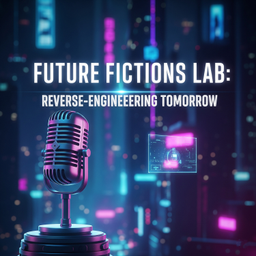
Podcast thumbnail for Future Fictions Lab : Reverse-Engineering Tomorrow

Future Fictions Lab : Reverse-Engineering Tomorrow

Claim This Podcast

by Miquela Bonferroni, Mark M. Whelan,

49 episodes
Updated Daily
Accepts GuestsHas Sponsors
25

Podcast Authority

Beta
PoorBased on show quality, social media presence, reviews, charts, and more
Pod Engine
Quality50
Social0
YouTube0
Engagement0

Podcast Overview

Join Data Scientist Miquela Bonferroni and Futurist Liam O´Farrell to discuss Future Center´s methodology in the Future Fictions Lab – where we dissect science fiction books, films, and worlds to extract actionable insights for tomorrow’s business, tech, and society. Learn the tools to turn speculative fiction into a competitive advantage, one scenario at a time. Based on the book ‘Futurist: How to Forecast with Science Fiction’ by Mark M. Whelan."

Language

🇺🇲

Publishing Since

6/4/2025

Unlock The Full Podcast Authority Score Report

See how your podcast performs across key metrics

25

Podcast Authority

Beta
PoorBased on show quality, social media presence, reviews, charts, and more
Pod Engine
Quality50
Social0
YouTube0
Engagement0
7
Excellent Areas
0
Good Performance
12
Growth Opportunities
excellent
Publishing Consistency
Every 5 days
Performing excellently!
poor
Episode Thumbnails

Recommendations available

Unlock the full report to see detailed tips

+16 More Metrics

Unlock comprehensive insights including:

  • • YouTube presence analysis
  • • Social media reach metrics
  • • RSS compliance scoring
  • • Podcast 2.0 features
  • • Technical standards
What's Included in Your Full Report

Detailed Analytics

  • Complete breakdown of all 19 authority metrics
  • Personalized recommendations for each metric
  • Industry benchmarks and comparisons
  • Technical RSS feed analysis and compliance scoring

Growth Strategies

  • Step-by-step action plans for improvement
  • Quick wins to boost your score immediately
  • Pro tips from successful podcasters
Get your free podcast insights report

See how your show performs across every key metric

Instant delivery
No spam
Attract Better Guests

High authority scores make your podcast more attractive to industry leaders and influencers who want to appear on credible shows.

Secure Sponsorships

Sponsors look for podcasts with proven authority and engagement. Your score demonstrates your podcast's value to potential partners.

Grow Your Audience

Understanding your strengths and weaknesses helps you make data-driven decisions to expand your listener base effectively.

1 verified contact email on file for Future Fictions Lab : Reverse-Engineering Tomorrow

Pitch yourself as a guest, propose sponsorships, or reach out directly to the host.

Recent Episodes

Episode thumbnail for The Forever War´s Relativistic Trap.

June 18, 2026

The Forever War´s Relativistic Trap.

<p><strong>The Forever War</strong>, and its exploration of the <strong>alienating nature of combat</strong>. The text includes a <strong>foreword by John Scalzi</strong> and an <strong>author’s note</strong> explaining how Haldeman’s own <strong>service in the Vietnam War</strong> shaped the narrative&#39;s themes of social displacement and psychological trauma. Following the protagonist, <strong>Mandella</strong>, the story details rigorous training on harsh planets and <strong>brutal skirmishes with the Taurans</strong>, highlighting how <strong>time dilation</strong> causes soldiers to become strangers to an Earth that evolves rapidly in their absence. Later passages describe a <strong>post-war society</strong> where heterosexuality is considered a dysfunction and the conflict is ultimately revealed to be a <strong>meaningless misunderstanding</strong>. Finally, the excerpts conclude with <strong>biographical information and personal photographs</strong> from Haldeman’s life, cementing the link between his <strong>real-world experiences</strong> and his celebrated fictional work.</p>

Episode thumbnail for The Forever War

June 18, 2026

The Forever War

<p><strong>The Forever War</strong>, and its exploration of the <strong>alienating nature of combat</strong>. The text includes a <strong>foreword by John Scalzi</strong> and an <strong>author’s note</strong> explaining how Haldeman’s own <strong>service in the Vietnam War</strong> shaped the narrative&#39;s themes of social displacement and psychological trauma. Following the protagonist, <strong>Mandella</strong>, the story details rigorous training on harsh planets and <strong>brutal skirmishes with the Taurans</strong>, highlighting how <strong>time dilation</strong> causes soldiers to become strangers to an Earth that evolves rapidly in their absence. Later passages describe a <strong>post-war society</strong> where heterosexuality is considered a dysfunction and the conflict is ultimately revealed to be a <strong>meaningless misunderstanding</strong>. Finally, the excerpts conclude with <strong>biographical information and personal photographs</strong> from Haldeman’s life, cementing the link between his <strong>real-world experiences</strong> and his celebrated fictional work.</p>

Episode thumbnail for The Future of Violence: Technology and the Social Contract

June 11, 2026

The Future of Violence: Technology and the Social Contract

<p>In <strong>The Future of Violence</strong>, Benjamin Wittes and Gabriella Blum examine how <strong>technological proliferation</strong> has decentralized the capacity for mass destruction, moving it from the hands of states to <strong>individuals and small groups</strong>. The authors highlight how emerging tools in <strong>biotech, robotics, and cyberwarfare</strong> allow remote actors to threaten global security with unprecedented anonymity. This shift creates a <strong>distribution of vulnerability</strong> where traditional borders and legal frameworks no longer provide adequate protection. Consequently, the text argues that <strong>private corporations</strong> must increasingly act as security partners because they control the essential platforms and technical expertise that governments now lack. To manage these <strong>omnidirectional threats</strong>, the authors suggest a redefined <strong>social contract</strong> that integrates private sector defense with international legal cooperation. Ultimately, the work serves as a warning that <strong>modern liberty</strong> depends on finding new ways to regulate a world where anyone can strike from anywhere.</p>

49 total episodes available

Deep-dive analytics for Future Fictions Lab : Reverse-Engineering Tomorrow

Frequently asked questions

Have a different question and can't find the answer you're looking for? Reach out to our support team by sending us an email and we'll get back to you as soon as we can.

What is Future Fictions Lab : Reverse-Engineering Tomorrow?

Join Data Scientist Miquela Bonferroni and Futurist Liam O´Farrell to discuss Future Center´s methodology in the Future Fictions Lab – where we dissect science fiction books, films, and worlds to extract actionable insights for tomorrow’s business, tech, and society. Learn the tools to turn speculative fiction into a competitive advantage, one scenario at a time.

Based on the book ‘Futurist: How to Forecast with Science Fiction’ by Mark M. Whelan."

How often does this podcast release new episodes?

This podcast updates daily.

Where can I listen to this podcast?

This podcast is available on 4 platforms including Apple Podcasts, Spotify, and more. You can also use the RSS feed directly.

Does this podcast accept guests?

Information about guest appearances is not available.

Legal Disclaimer

Pod Engine is not affiliated with, endorsed by, or officially connected with any of the podcasts displayed on this platform. We operate independently as a podcast discovery and analytics service.

All podcast artwork, thumbnails, and content displayed on this page are the property of their respective owners and are protected by applicable copyright laws. This includes, but is not limited to, podcast cover art, episode artwork, show descriptions, episode titles, transcripts, audio snippets, and any other content originating from the podcast creators or their licensors.

We display this content under fair use principles and/or implied license for the purpose of podcast discovery, information, and commentary. We make no claim of ownership over any podcast content, artwork, or related materials shown on this platform. All trademarks, service marks, and trade names are the property of their respective owners.

While we strive to ensure all content usage is properly authorized, if you are a rights holder and believe your content is being used inappropriately or without proper authorization, please contact us immediately at hey@podengine.ai for prompt review and appropriate action, which may include content removal or proper attribution.

By accessing and using this platform, you acknowledge and agree to respect all applicable copyright laws and intellectual property rights of content owners. Any unauthorized reproduction, distribution, or commercial use of the content displayed on this platform is strictly prohibited.