- 23
- Episodes
- Monthly
- Cadence
- 2024
- First episode
- 350
- YouTube views
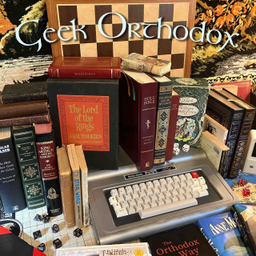
About Geek Orthodox
Orthodox Christianity and geek subculture, hosted by Fr. Justin, an Orthodox priest and life-long book-, computer-, game-, sci-fi-, and fantasy-geek. geekorthodox.substack.com (https://geekorthodox.substack.com?utm_medium=podcast)
- Publisher
- Fr. Justin (Edward) Hewlett
- Category
- religion & spirituality · technology
- Language
- en
- Explicit
- No
- First episode
- 26 Oct 2024
- Latest episode
- 8 Aug 2026
Latest episodes
23 episodes in the feed.
8 Aug 2026
It's the End of the World of Code as We Know It
I’m going to do something a little bit different for this “final” World of Code podcast. Interspersed with the cleaned-up transcript below, I’m going to add some expanded thoughts and annotations using the “callout” block, like this: I’ll start by noting that I really do not feel that I’ve achieved what I set out to achieve with the World of Code podcast. My hope, at this point, is mainly that it has at least achieved some small part of what I was hoping for, and, in particular, I hope that those who don’t know much about the “world of code” will at least have gleaned a little understanding of how computer programming works (or worked—see my thoughts below about AI) and that some of the details and ideas that I’ve shared may have got us all thinking a bit more about how the invisible foundation of code upon which much of our modern world has been built has shaped and is shaping our society and, thereby, all of us as individuals. Hello, and welcome to Geek Orthodox. I’m Fr. Justin, geek from youth. This is the final — at least formally — the final episode of the World of Code arc of the Geek Orthodox podcast. All good things—and even all mediocre things—must come to an end.. It’s been almost two years, and I knew this was going to be a big topic, which is why I planned to devote an entire arc of the podcast to the issues it raised. I did not expect the subject to take over for two years, nor did I expect the subject itself to change so dramatically over that time. We’ve gone from what I described as the world of code in which we live and move and breathe and have our being — starting from the very beginnings, from my early engagement with BASIC — all the way through to AI. And as we’ve done so, AI has radically changed the whole landscape of the world of code. Starting last December, when AI finally got good at coding. Here’s my thoughts on how that happened… We’ve gotten somewhat technical along the way, and that was deliberate, because I wanted to look at the technical underpinnings of this world of code that we’ve created, which has become the foundation for most of the information exchange and economic activity of our modern society — and is being rolled out in all sorts of other aspects of life as well, right down to the humble light switch. And all the while, AI has been getting better and better. And, speaking of light-switches… Near the beginning of this arc — actually, even before I started the World of Code podcast — I was working on a personal project where I was taking my very favourite computer game, Stellar Empires, which I played as a kid on my TRS-80 Color Computer and which really inspired me to get into the world of code. I was trying to port it so I could build myself a little handheld version. I thought I would use AI to do it. That didn’t work. This was almost two years ago, and the AI simply wasn’t up to the task of porting from one obscure BASIC dialect to another almost-equally-obscure BASIC dialect. I documented this more than two years ago, actually, on my personal blog, which is shown in the video, the posts from which I’ve transferred to my Back to BASIC (https://getbacktobasic.substack.com/) Substack (https://getbacktobasic.substack.com/), with the most relevant one here: Fast forward to now, almost two years later, and I’ve managed to get AI to port the original Stellar Empires from TRS-80 Color Computer BASIC to a multiplayer online web version — as faithful to the original as it can possibly be made, or as the AI can possibly make it. Right now I’m going to send a fleet using command number 6 from Capella to Mizar — I happen to know it’s called Mizar because I’ve played this game so many times — sending five ships, and by turn two, Mizar is part of my empire. It’s a great little game, and I’ve got it up on my personal website; I’ll put a link in the description of the video. Here’s the link (click the screenshot): And here’s my story of the game: The point is, AI has radically changed how we code, how code is generated. It hasn’t replaced code — and that’s actually one of the most important points I want to make here. It’s been said that English is the new programming language. That’s kind of sort of true, but not quite, because when we prompt AI to create an app for us — which we can now do with great ease — what the AI does is generate an application coded in one of the many intermediate computer languages we have created to make it possible for us to interact with computers. All of this infrastructure that we’ve been discussing is now being backgrounded by AI, but it’s still there. It’s still what our world of code runs on. As an example, check out my “rogues’ gallery” of entirely AI-created Rogue clones: This matters, because it’s a continuation of the overall trend we’ve seen throughout the history of computer science as we’ve extended computing into the world we live in. We started with pretty basic stuff: computers made of vacuum tubes — essentially large banks of light bulbs turning off and on. We moved from that to transistors, then to silicon chips with massively integrated circuits. As we miniaturized the hardware, we got more and more computational power to work with. As we got more power, the programs we needed to take advantage of it got more and more complicated. And as that happened, we had to abstract away from the basic hardware to what we call high-level programming languages — C, for example, or BASIC, which is what we’ve been looking at here. These high-level languages were designed to look something like English; if you go back to earlier episodes where we were actually building a BASIC application, you can see the if-then statements that look a little like sentences. We were abstracting away some of the complexity of the computer hardware behind something that resembled the English language we know and mostly love. Then as we got still more power and were able to build even more complicated programs, we added more layers: integrated development environments, software development kits, entire physics engines like Unity or Unreal Engine, where much of the coding is no longer done by the individual programmer but by other programmers in the background, allowing the new programmer to build on top of all those accumulated layers of complexity. So the pattern we see is: increasing hardware power leads to increasing complexity, which leads to the need to abstract away some of that complexity — first with machine code, then higher-level programming languages, then software development kits. And now we’re seeing the continuation of that same abstraction with AI. As we discussed in the last episode, AI is essentially a massive prediction engine — at least, AI as it’s currently in the news and currently revolutionizing our society. These large language models are basically mining language for patterns of meaning and functionality, some of which we didn’t even anticipate. For example, we didn’t necessarily set out to create a better translation tool, but because of all the language datasets AI was trained on, it became apparent that AI is actually quite good at translation — better in many ways than what we used to rely on, like Google Translate. When I went to Japan recently, I was able to get in touch with a Japanese friend in Osaka who speaks Osaka-ben, the local dialect, and I could ask the AI to translate not just into Japanese, but right into Osaka-ben. Which capabilities I reference and utilize in these two posts: So AI has moved us from “hey, it can almost generate a computer program that works” to a point where programming now consists, for many people, not so much of actual coding — though there are still plenty of people doing actual coding, and probably will be for some time — but of prompting the AI to create code that does what we want. And when it doesn’t work and there’s an error, all we need to do is feed that error back to the AI and say “this isn’t working, please fix it” — and it will. It’ll do really cool things, like recreate my favorite BASIC computer game as a multiplayer online game, which if anyone wants to play, I’m more than happy to set up. Anyone up for Stellar Empires? ehewlett.net/stellemp (http://ehewlett.net/stellemp/) (Message me and, if I’m free, I’d love to play a game with you!) Since this is the last formal episode of the World of Code arc, I want to ask: what does this all mean? Is AI going to destroy the world of code? I don’t know. It’s early days; it’s a new technology. It has some potential for that — just watch the Terminator movies or The Matrix. But AI is also kind of dumb, in the sense that it’ll do exactly what we tell it to, much like computers have always done from the very beginning. If we tell it to do something unclearly — say, “solve this environmental problem” — and it concludes that the basic environmental problem is human beings and therefore we should just get rid of human beings, that could be bad. Is this actually going to happen? I don’t know, but the very real potential for this is one of the reasons I think it’s essential to ensure there’s always a “human in the loop”: Or it could go in the direction of something like atomic technology. We discovered, for better or for worse, how to split the atom. That led to a massive buildup of nuclear weapons, which are still out there in the background such that we could probably destroy most of civilization many times over if someone pushes the wrong button. But at the same time, we’ve somehow managed to avoid doing that for the last generation or two that we’ve had this technology. So it’s not impossible that with AI, we’ll actually manage to use it responsibly and wisely — or at least, maybe more accurately, semi-responsibly and somewhat wisely. It’s not impossible. We’ve done it before with every technology we’ve invented so far. Is this one going to be different? I don’t know. We’ll have to find out. It may, in fact, be my continual childhood exposure to the fear of nuclear war that led to my parody of Nena’s (https://blog.ehewlett.net/1994/10/99-crepes-du-jour.htm)99 Red Balloons (https://blog.ehewlett.net/1994/10/99-crepes-du-jour.htm) actually “making the cut” in My Heart Leaps Up: My hope, having looked at the world of code, having looked at the rise of AI, having looked at how computing technology — which is now foundational to our modern civilization — has developed, and having tried to make the strengths and weaknesses of it somewhat apparent: my hope is that we can take this deeper understanding of the world of code and think not merely about how to use it for good or for evil — though we should definitely be thinking about that — but about how it affects us. How is it changing how we communicate with one another? How does texting someone differ from talking to them face to face, or even just picking up the phone and calling? Every single one of these choices has an effect that we don’t always think about, because it’s just part of the world in which we live and move and breathe and have our being. Like a fish that doesn’t think about the water it swims in — that’s us. But we’re a little more intelligent than fish, so we can think about the water we swim in. And that’s been my hope and desire for what I set out to achieve with this podcast. Which I probably did most effectively in my favourite episode of the World of Code: Speaking of the way technology shifts and influences our experience of the world — that’s been true of the podcast itself. When I started, it was an audio podcast. Now it’s more of a video podcast. But at the same time, I’ve been posting more and more on Substack in writing. Very different technologies: audio, video, writing — each with its strengths and weaknesses. With audio, I wasn’t able to show any of the code I was working on; it was a bit impractical to narrate code. Video allowed me to do that. Text allows that too, and is perhaps less engaging for some people, or for those of us who like reading, maybe more engaging. Each of these technologies, whether the ancient one of writing, the even more ancient one of speaking, or the modern one of delivering video, has its strengths and weaknesses, and each shapes the communication we engage in. Which I reflected on a bit here (and, yes, I know this is the second time I’ve linked this one…): So this is the end of the World of Code arc of the Geek Orthodox podcast — not the end of the world of code, and not the end of World of Code episodes, but the end of this arc. What’s next? I’m not sure… I’m hoping for a return to some Arthuriana, some reflection on fantasy literature, and, ideally, some interviews with others on questions of AI, history, gaming, and anything else I’m interested in getting together with my friends and acquaintances to “geek out” about. So, I suppose if the podcast does go in this direction, it’ll end up being a geeky collaborative “mix-tape” of sorts. In the meantime, I’m having fun working on developing the most interesting project to (sort of) come out of these reflections: a mash-up of my interests in AI, computer programming, role-play gaming, and storytelling: WorldWeaver.online (https://worldweaver.online/). What is the conclusion of the matter? As I wrote in my Substack, my starting goal in the World of Code podcast was to help anyone who was interested understand the nature and ubiquity of the world of code. My intent was to draw people in and give those who were interested the tools to understand what this world of code is and how it affects us. That turns out to be the necessary conclusion of the matter in the age of AI, even more so — because the temptation in the age of AI is to give up our agency to the computers, like the overweight people in Wall-E gliding around on their hover chairs. But AI actually needs us as the human in the loop, as the ones who are engaged and who understand, who are given the task of being stewards of creation. It needs us to understand the world we live in and the world we’ve created, and to guide the development and usage of it — to steer the direction it’s taking us. So that as we live and move and breathe and have our being in this world of code, and as we continue to direct it, it takes us in directions that do not disengage us from reality or from one another, but allow us to focus on the reality in which we live and on one another in ways that are loving and kind and human — and that embody the teachings of the most important person who has ever lived, who is the Creator not only of us who created the world of code, but of the world itself. Because it is ultimately in Him that we live and move and breathe and have our being. This is a public episode. If you'd like to discuss this with other subscribers or get access to bonus episodes, visit geekorthodox.substack.com/subscribe (https://geekorthodox.substack.com/subscribe?utm_medium=podcast&utm_campaign=CTA_2)
17 Jan 2026
AI and the World of Code
Hello and welcome to Geek Orthodox. I’m Father Justin, geek from my youth. AI has taken the world by storm. Whether we like it or not, it’s embedded in pretty much everything. My wife was just on the phone with an AI agent. This technology is being promoted, pushed, and distributed in all areas of our society. It comes from the world of code and is becoming an essential part of it. In fact, it’s part of the reason why I started this “World of Code (https://geekorthodox.substack.com/t/world-of-code)” arc of my Geek Orthodox podcast. I want to try and explain in the simplest possible layman’s terms what this world of code is that we are immersed in, so that we can understand how it is affecting our lives in a better-informed way. However, undertaking to explain even the Large Language Model (LLM) version of AI is a massive task. Some of the introductory videos I’ve seen are three hours long (https://www.youtube.com/watch?v=7xTGNNLPyMI), and I don’t want to get that deep. I’m not that much of an expert myself, but I do have a long-standing relationship with AI, thanks in part to the oldest AI chat-bot that took the world by storm back in the 1970s: Eliza. The Legacy of Eliza Eliza was a chat-bot written by Joseph Weizenbaum. It was the first chat-bot to “kind of, sort of” pass the Turing test (https://en.wikipedia.org/wiki/Turing_test)—the informal test of whether a computer can fool a user into thinking it’s human. It shares a number of attributes with modern AI. It was originally written in a relatively obscure programming language called MAD-SLIP, but it was popularized in my favorite language, BASIC. Weizenbaum didn’t release the original MAD-SLIP code of ELIZA (https://github.com/jeffshrager/elizagen.org/tree/master/1965_Weizenbaum_MAD-SLIP), but he did publish a paper documenting what the program did and how it worked (https://dl.acm.org/doi/10.1145/365153.365168), which inspired reconstructions in a number of different computer languages. BASIC was the universal language of the early computer revolution, and a BASIC implentation of Eliza was published in (https://vintagecomputer.net/cisc367/Creative%20Computing%20Jul-Aug%201977%20Eliza%20BASIC%20listing.pdf)Creative Computing Magazine (https://vintagecomputer.net/cisc367/Creative%20Computing%20Jul-Aug%201977%20Eliza%20BASIC%20listing.pdf) in 1977. My own first exposure to it was a version customized for my beloved TRS-80 Color Computer by my friend Bruce. I actually have some of the handwritten code he used to customize it, including sheets containing all the variables—something you had to do back when variables were limited to single or double letters. Most of the program consisted of “DATA” statements, which were essentially fragments of conversation. Eliza worked by taking your input, looking for keywords, and then rearranging the relevant portions of your input into a grammatically appropriate response which incorporated one of the conversation fragments which was most relevant to your most important keyword. It functioned best as a “Rogerian” psychologist—the kind of psychologist who asks questions to get the patient to provide more information. For example, if I said, “I have bad dreams,” Eliza might respond, “What does that dream suggest to you?” This illusion tricked many early users into thinking a real person was on the other end of the terminal. However, the illusion fell apart quickly. If you repeated yourself or challenged the bot, it would fall back on canned responses like, “We were discussing you, not me.” From Keywords to Transformers If Eliza was the height of AI back then, current versions are like Eliza on steroids. Well, that’s oversimplifying, of course, but we have to oversimplify something as complex as AI in order to understand. What modern LLM AIs are doing now is not simply looking for single keywords, but using conversation patterns to respond to combinations of keywords. The core of my understanding of AI comes from this wonderful video by Andrej Karpathy (https://youtu.be/kCc8FmEb1nY), who was one of the founders of OpenAI and also worked with AI for Tesla. He’s more recently famous for inventing the term “vibe coding (https://x.com/karpathy/status/1886192184808149383),” which brings us back to the world of code. And in this video, which is now getting very old—it’s two years since it was posted—he builds a large language model (LLM) AI from scratch using Python. Python is, of course, the modern programming language that's fairly easy to use which we've touched on before in previous episodes of the World of Code (https://geekorthodox.substack.com/p/world-of-code-switching-things-up-8aa). In this case, what he does is he creates what's called a transformer. The “GPT” in ChatGPT stands for Generative Pre-trained Transformer. You train it ahead of time on data with patterns, and the computer analyzes those patterns to generate new text that follows them. In this video, Karpathy builds a transformer that analyzes the works of Shakespeare character by character (i.e., letter-by-letter), which then is able, by statistically analyzing the relation of each letter to the characters that tend to follow it, to predictively generate Shakespearean sounding language, producing sentences like, “Verily, my lord. The sights have left thee again the king.” Like this, modern AI doesn’t just look for single keywords; it looks for relationships between common combinations of words. It “tokenizes” text, giving numerical representations to words, parts of words, and punctuation. To illustrate this, I’ve “vibe coded” with AI a tool that analyzes text patterns (https://ehewlett.net/ai/). If you feed it some “training text”—preferably something with a limited vocabulary that is somewhat repetitive, like the first chapter of Genesis in Basic English (https://ebible.org/engBBE/GEN01.htm)—it analyzes the relationship of each word to the next word and then to the third and fourth following words. It creates a statistical map of relationships between words and word-parts that allows it to function, much like a modern LLM AI, as a next-word predictor. So, if I type “God saw,” into my Genesis 1-trained mini-AI, the model predicts “that” as the next word with high likelihood (“God saw that”), and “everything” with a lower likelihood (“God saw everything”). And this is essentially how large language models work. The example I always use is the classic typewriter test-phrase, “The quick brown fox jumps over a lazy dog”, since as soon as we say “the quick brown,” anybody who knows that phrase will assume that the next word is most likely going to be “fox”—or possibly “dog” because people sometimes switch the test-phrase around. But what large language models are doing is not simply predicting the next word, but generating whole phrases and compositions based not on a single small passage of Scripture, but on patterns observed across a massive corpus—all of Scripture, all of Shakespeare, and much of the internet. LLMs, as they analyze the whole corpus of a language for the patterns inherent in such data structures, are essentially mining language for representations of meaning. Stochastic Parrots and the World of Code Another important concept to understand with modern LLM AIs is temperature. Temperature determines how random the next word selection is, which is important because usually we don’t want every AI generated response to a particular query to be exactly the same. In order to generate new patterns that are meaningful to us, we need to introduce, alongside the pattern-derived response, some element of randomness. High temperature introduces more variety but also leads to “hallucinations” or weird responses. I once ran the “quick brown fox” analogy through ChatGPT, and it started talking about a “quick brown table.” It’s a legitimate grammatical construction, of course, but tables—even brown ones—aren’t usually “quick” unless they’re on the back of a truck! AI models are often called stochastic parrots. “Stochastic” basically means semi-random. If you roll a single six-sided die (1d6), you'll get a value between one and six, and, on multiple rolls of that die, those values should be fairly evenly distributed. But if you roll two dice, while the outcome is random it follows a pattern, in that you are much more likely to roll a seven (1+6, 2+5, 3+4) than a two (only 1+1). AI follows patterns derived from language, but, given that those patterns are nothing more than vast arrays of statistical interrelationships between words and parts of words represented as numbers, AI doesn’t actually “understand” anything. It just semi-randomly puts together patterns of text that, statistically speaking, are more frequently associated with one another, which generally results in our perceiving meaning—and often useful meaning—in those generated texts. In the coding world, we’ve moved from machine language to higher-level languages like BASIC to reduce complexity. AI now offers a way to reduce that complexity even further by using our own native languages to generate code. My “vibe coded” tool was created by giving the AI English instructions, which it then translated into functional JavaScript and HTML. AI is actually getting pretty good at this, aided, in part, by the deliberately disambiguated nature of computer languages, which, in some ways, makes them statistically much simpler to master. However, there is a catch. In BASIC, a command is deterministic—it always translates to the same machine code. An LLM is non-deterministic. Because of that semi-random element, we can’t always be sure what the translation will be. So, as we offload these tasks—any tasks—to AI, we must ask: What does this mean for us? What impact does this offloading have on our intellect, our character, and our morality? These are questions we that we—as people who care about things like faith, morality, and meaning—must consider as we think about the impact of AI on the world of code in which we “live and move and breathe and have our being.” References * an excellent site on the history of the ELIZA chat-bot (https://sites.google.com/view/elizagen-org/) * the BASIC port of ELIZA in Creative Computing’s (https://www.atariarchives.org/bigcomputergames/showpage.php?page=20)Big Computer Games (https://www.atariarchives.org/bigcomputergames/showpage.php?page=20) * Jeff Shrager’s original BASIC implementation of ELIZA (https://drive.google.com/file/d/16EqhllNRlkAlHSil2oW_5KQymfzqR_ro/view) * a playable version of the BASIC version of ELIZA at Archive.org (https://archive.org/details/eliza.qb64) * a great list of visualizations of how GPT AIs work (https://dentro.de/ai/visualizations/) * a relatively simple visualization of how GPT “transformers” work (https://poloclub.github.io/transformer-explainer/) * an in-depth interactive visualization of how LLM AIs work (https://bbycroft.net/llm) * the paper that started it all (for GPTs): “Attention Is All You Need (https://arxiv.org/pdf/1706.03762)” This is a public episode. If you'd like to discuss this with other subscribers or get access to bonus episodes, visit geekorthodox.substack.com/subscribe (https://geekorthodox.substack.com/subscribe?utm_medium=podcast&utm_campaign=CTA_2)
25 Oct 2025
The Tale of My Beloved Stellar Empires
It’s story-time again! This one has a bit of almost all things World of Code (https://geekorthodox.substack.com/t/world-of-code) about it: early computing history, strategy gaming, programming, BASIC, some actual code analysis, engagement with real-live early programmers, me getting names mixed up, the relationship between computer hardware and software, an actual hardware/software BASIC programming project, and AI triumphs and failures (mostly failures). Let me take you back in time to the early days of my programming and computer-gaming history, and forward to a significant future programming project intended to take folks back to the past, and down into the weeds of debugging and building what, for me, is a pretty significant project. I do get a little bit technical towards the end, but, if you make it that far, do bear with me… I try to make it mostly understandable and my intention as a story-teller is to give you a sense of the joys and perils of programming that is hopefully at least impressionistically accessible to the non-programmer. I feel particularly bad about mixing up Ted and Drew Shorter, the son and father duo who ported my favourite game, “Stellar Empires” (the main subject of this story), to the TRS-80 Color Computer, where I encountered it. For the record, Ted is the son and Drew is the father, and it was Drew (now more than 80!), who, as far as we know, added the “computer player” feature to the game that enabled me to get into it as a solo player—and that really got me digging into the code to reprogram it! I didn’t “re-shoot” that portion because this whole video-podcast was actually done in a single take (and then lightly edited), and I didn’t want to mess with the continuity. I owe a debt of deep gratitude to them and to the game’s original author, Graham Wilson, that this story and this project are attempting to honour. This episode is based, in part, on the following blog-posts, which I hope to transfer over soon to my brand-new technically focussed Substack, Back to BASIC (https://getbacktobasic.substack.com/): * The Stellar Empires Project, Part I: The Program, Its Significance to Me, and the Project Proposal (https://blog.ehewlett.net/2024/04/the-stellar-empires-project-part-i.html) * The Stellar Empires Project, Part II: Porting and the Early “Open Source” Community (https://blog.ehewlett.net/2024/06/the-stellar-empires-project-part-ii.html) * The Stellar Empires Project, Part III: The Plan, the Problems, and the Development Environment (https://blog.ehewlett.net/2024/07/the-stellar-empires-project-part-iii.html) And I would be remiss if I did not also include a link to Graham Wilson’s very enjoyable StellarEmpires.net (http://stellarempires.net/) site! This is a public episode. If you'd like to discuss this with other subscribers or get access to bonus episodes, visit geekorthodox.substack.com/subscribe (https://geekorthodox.substack.com/subscribe?utm_medium=podcast&utm_campaign=CTA_2)
Reach and audience
Public platform figures. Ratings count people who left a rating, not total listeners.
- YouTube views
- 350
- Score snapshot 15 Sept 2025
Podcast Authority Score: 25 / 100
A composite of feed quality, social presence, YouTube performance and engagement. Read the methodology.
- Quality
- 23
- Social presence
- 0
- YouTube
- 66
- Engagement
- 0
Host of Geek Orthodox?
Claim your podcast to manage its listing and keep your show details accurate.
Pod Engine is an independent podcast discovery and analytics service and is not affiliated with or endorsed by this podcast. Artwork and show content belong to their owners. Full legal notice.
Explore this show
Podcast research with Pod Engine