
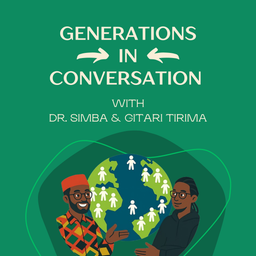
Generations in Conversation w/ Dr. Simba & Gitari Tirima
Claim This Podcastby Dr. Simba & Gitari Tirima
Podcast Overview
<p><span style="font-weight:400;">Have you ever wondered, how do I live in this modern world?</span><b> <br /><br />“Generations in Conversation”</b><span style="font-weight:400;"> is an original podcast hosted by Dr. Simba Tirima an environmental health scientist, humanitarian, transformational leader, father and his son, Gitari “Tari” Tirima entrepreneur, innovator, emerging leader, and curious thinker. <br /><br />Join the father and son duo in a deeply personal, wide-ranging, and intellectually rigorous exploration of human flourishing, leadership, transformation, and meaning in the 21st century, bridging generations and cultures through open-minded dialogue, scientific insight, biblical wisdom, and lived experience.<br /><br />This podcast is a radically honest, science-informed, scripturally-literate, and profoundly human podcast that dismantles the silos of discipline, age, and worldview by curating conversations and stories that challenge, inspire, and equip you to live purposefully, courageously, and authentically.</span></p>
Language
🇺🇲
Publishing Since
8/18/2025
3 verified contact emails on file for Generations in Conversation w/ Dr. Simba & Gitari Tirima
Pitch yourself as a guest, propose sponsorships, or reach out directly to the host.
Recent Episodes
April 25, 2026
Ep. 9: Knowing Isn't the Upgrade - Solomon's Paradox and the Insight Trap
Episode Overview In this episode, Dr. Simba Tirima and Gitari Tirima sit with one of the most quietly uncomfortable tensions in modern life: why so many thoughtful, well-read, podcast-listening, spiritually curious people still find themselves stuck. Drawing on the psychology of Solomon's Paradox, they explore the difference between insight consumption and embodied change, the strange way that knowing can substitute for doing, and what it actually takes to close the gap between clarity and transformation. This is not an attack on learning. It is a deeply honest reckoning with what learning is actually for. Grounded in Kenyan texture, laced with biological science and scriptural wisdom, and anchored in the hosts' own ongoing struggles with their own advice, this episode is for anyone who has ever wondered: why am I not moving, when I know exactly what I should be doing? KNOWING ISN’T THE UPGRADE: 10 QUESTIONS FOR MOVING FROM INSIGHT TO PRACTICE What truth have I been admiring without applying? Where am I wise for others but evasive with myself? Which podcast, book, sermon, or conversation gave me language but not yet movement? 4. What problem in my life have I become unusually eloquent about? If my current struggle belonged to someone I love, what would I advise with honesty and care? What is the behavioral invoice on the insight I say I value? What is one small rep that would turn this from theory into practice this week? 8. Where am I performing growth instead of practicing it? What truth am I willing to repeat after the feelings fade? What would change in my life if I measured wisdom by embodiment, not articulation? 5 Things You Will Walk Away With By the end of this episode, whether you are a professional, a parent, a student, a person of faith, or simply someone trying to live more intentionally, you will have: A clear name for why you can be wise for everyone else and strangely avoidant in your own life. Solomon's Paradox explained in plain language, with real examples from both hosts. An honest look at the insight economy and how podcasts, books, seminars, and frameworks can become another thing we consume rather than a practice we embody A biological and psychological explanation for why insight feels like progress, even when nothing has yet changed. You are not broken. You are human. And there is a reason A practical bridge from knowing to doing, including self-distancing techniques, smaller behavioral reps, honest reflection questions, and the embodiment list you can actually use this week. A deeper spiritual frame: why faith was never meant to be a shelf of admired ideas, and what it looks like to let truth rearrange your life rather than merely inform your vocabulary. Resources & Mentions Research: Grossmann, Igor and Ethan Kross — Solomon's Paradox: Self-Distancing Eliminates the Self-Other Asymmetry in Wise Reasoning (Psychological Science, 2014). The foundational research establishing why people reason more wisely about others' problems than their own. Book: The Expectation Effect by David Robson — referenced in the context of why smart people still make decisions that confound their own insight, including former Nobel laureates. Book: Atomic Habits by James Clear — the science of repetition, behavioral reps, and how small consistent actions compound into durable change. Book: Chatter: The Voice in Our Head by Ethan Kross — on self-distancing and why creating psychological distance from our own problems helps us think more wisely. Book: Tiny Habits by B.J. Fogg — the framework behind shrinking the behavioral rep so small that starting becomes unavoidable. Book: Build the Life You Want by Arthur C. Brooks and Oprah Winfrey — on the gap between emotional knowledge and emotional practice. Scripture: James 2:26 — Faith without action is dead. Referenced in the closing frame as the spiritual anchor of the episode's central argument. Scripture: Matthew 17 (The Tr
March 19, 2026
Ep 8: Stop Eating Your Joy
Episode Summary In this episode, Dr. Simba Tirima and his son Tari examine a quiet but pervasive dynamic in modern life: a consumer culture that trains us to reach for relief rather than build depth. From endless scrolling to impulse purchases and dopamine-driven novelty-chasing, they name what drains joy — and then map a practical alternative: the producer life. Drawing on neuroscience, evolutionary biology, the wisdom of Arthur Brooks and the Stoics, and the earthy realities of Nairobi and the African continent, Simba and Tari make the case that lasting satisfaction is earned, not consumed. With three simple practices — the Craving Check, an Attention Budget, and the Producer Hour — this episode offers tools for reclaiming agency over your inner life. Featuring a moving story about Simba's mother's kitchen, Tari's honest screen-time confession, and a shared love of vinyl records, this is a warm, honest, and practical conversation that never preaches. Reflection Guide: 10 Prompts for a Quieter, More Joyful Life Use these prompts alone, with a journal, or with someone you trust. What do I consume most when I feel stressed? What feeling am I trying to change when I reach for my phone, food, shopping, or noise? What kind of 'relief' leaves me emptier later? What kind of effort reliably leaves me more alive? Where has my desire quietly inflated in the last year? What do I want to want less? What do I want to want more? What is one 'producer hour' I can schedule this week — and what will I build in it? Who is one person I can serve, repair with, or show up for this week? What is one small swap I can make: one quick hit replaced with one slow gain? The Practice Set: Consumer or Producer Three tools you can start today. No shame. No programme. Just clarity and agency. Practice 1 — The Craving Check Before you open an app, make a purchase, or binge a distraction, take 10 seconds and ask yourself one or all three of these questions: Am I feeding a craving, or building a life? Am I numbing, or nourishing? Am I consuming to escape, or practising what creates real satisfaction? Practice 2 — An Attention Budget Just like money, attention is limited. We are born with roughly 4,000 weeks. Decide intentionally where you want your attention to go this week — relationships, craft, prayer, learning, movement, real rest. Then be honest about where it actually went. Not as a verdict. As data. Practice 3 — The Producer Hour One hour, once or twice a week, where you create something small: Write a page Cook a proper meal Clean and organise a corner of your space Learn a skill Fix something broken Call someone and repair or rebuild a relationship Build a plan — then execute one step This is not a hustle hour. It is a dignity hour. You are not doing it to impress anyone. You are doing it to remember that you are not helpless. Bonus — Replace One Quick Hit with One Slow Gain One less scroll → one short walk One less impulse buy → one skill lesson One less gossip thread → one meaningful conversation Small swaps change the nervous system. Humans rarely beat instinct with willpower alone — we beat it by shaping the environment. Reduce friction for the things that build you. Increase friction for the things that drain you. That is not weakness. That is intelligent design. Key Themes Consumer vs Producer: Reaching for relief vs choosing agency — the difference between soothing and satisfying The Dopamine Trap: How novelty and variable reward loops were useful for survival but have been hijacked in a world of endless cheap stimulation Hedonic Adaptation: Why "more" stops working and how the denominator of desire quietly inflates Producer Culture Redefined: Producers are not only business builders — they are parents who keep showing up, friends who call back, leaders who tell the truth Kenyan & African Lens: Digital life, social pressure, and hustle culture in a continent of 500 million smartphones Contentment a
February 25, 2026
Ep. 7: Work, Worth, and the Coming Split Screen
Episode Overview In this episode, father-and-son duo Dr. Simba Tirima and Gitari Tirima return to one of the most pressing tensions of our time: what AI-driven transformation means for work, worth, and meaning. They cut through both the hype and the fear to offer something more useful. Step into a clear-eyed, practical, and deeply human guide to navigating an AI-shaped world. From the "split screen" of acceleration and stagnation, to the shift from doing work to judging work, to the physical realities of AI infrastructure and the irreplaceable role of conscience. This conversation is for anyone trying to stay grounded and relevant. 5 Things You Will Walk Away With By the end of this episode, whether you are a worker, parent, student, pastor, manager, or entrepreneur, you will have: Clarity on why AI feels both powerful and deeply unsettling at the same time. An honest look at why it inspires awe in some moments and real anxiety in others. An understanding of why some people are accelerating while others feel stuck. What is behind the widening gap, and how not to end up on the wrong side of it. A breakdown of what parts of work can be safely automated. What AI is genuinely good at, and where it can responsibly take over repetitive tasks. A firm understanding of what must never be outsourced. Judgment, meaning, responsibility, and moral courage cannot be delegated to an algorithm. Something concrete to do next week; not just someday. Practical steps whether you are leading a team or simply trying to stay relevant in your own career. Key Themes & Highlights The split screen we are living in: Two futures running simultaneously; one where AI amplifies productivity for a select few, and one where work feels increasingly uncertain and disconnected from dignity. From doing to judging: The core thesis of the episode; AI is turning work into judgment. The human being becomes the standard-setter, the quality-checker, and the conscience of every output. What AI can and cannot do: Practical breakdown of where AI genuinely excels (writing software, drafting documents, summarizing research, analyzing data) and where it fundamentally falls short (moral reasoning, accountability, lived consequence, bonding, and emotional depth). The K-shaped split: AI is not an equalizer; it is an amplifier. Those with strong foundations and judgment accelerate. Those without risk falling further behind. Competence is being redefined and credentials signal less. The bottleneck nobody posts about: AI is physical. Data centers, chips, cooling, electricity, and connectivity shape who benefits and who is frustrated, especially across African contexts. Personal playbook; the Rule of Five: Build judgment habits, automate repetitive tasks, protect your attention, deepen one craft, and keep something human on purpose. Organizational playbook: A 10-point checklist for leaders; from defining "human in the loop" and securing data, to redesigning jobs before cutting them and measuring real outcomes. Faith and meaning in the Judgment Era: When machines can imitate language, art, and even prayer-like words, what stays human? The episode anchors its answer in Romans 12:2, disciplined hope, and the conviction that we do not outsource our conscience. Resources & Mentions Research: World Economic Forum Future of Jobs Report 2025; 170 million new roles projected, 92 million displaced, with large-scale skills shifts by 2030. Macro framing: Pictet Group commentary on AI and K-shaped economic dynamics; how AI-linked investment can lift the top while others struggle to keep pace. Scripture: Romans 12:2 — "Be transformed by the renewing of your mind" as a compass for discernment in an AI-shaped world. Concepts discussed: Agents vs. chat AI, "judgment work," exponential improvement, K-shaped economy, the AGI question, attention economy, deskilling risks, and organizational experimentation. Post-Episode Reflection Questions Whe
9 total episodes available
Deep-dive analytics for Generations in Conversation w/ Dr. Simba & Gitari Tirima
Frequently asked questions
Have a different question and can't find the answer you're looking for? Reach out to our support team by sending us an email and we'll get back to you as soon as we can.
- What is Generations in Conversation w/ Dr. Simba & Gitari Tirima?
<p><span style="font-weight:400;">Have you ever wondered, how do I live in this modern world?</span><b> <br /><br />“Generations in Conversation”</b><span style="font-weight:400;"> is an original podcast hosted by Dr. Simba Tirima an environmental health scientist, humanitarian, transformational leader, father and his son, Gitari “Tari” Tirima entrepreneur, innovator, emerging leader, and curious thinker. <br /><br />Join the father and son duo in a deeply personal, wide-ranging, and intellectually rigorous exploration of human flourishing, leadership, transformation, and meaning in the 21st century, bridging generations and cultures through open-minded dialogue, scientific insight, biblical wisdom, and lived experience.<br /><br />This podcast is a radically honest, science-informed, scripturally-literate, and profoundly human podcast that dismantles the silos of discipline, age, and worldview by curating conversations and stories that challenge, inspire, and equip you to live purposefully, courageously, and authentically.</span></p> - How often does this podcast release new episodes?
This podcast updates daily.
- Where can I listen to this podcast?
This podcast is available on 4 platforms including Apple Podcasts, Spotify, and more. You can also use the RSS feed directly.
- Does this podcast accept guests?
No, this podcast does not typically feature guests.
Legal Disclaimer
Pod Engine is not affiliated with, endorsed by, or officially connected with any of the podcasts displayed on this platform. We operate independently as a podcast discovery and analytics service.
All podcast artwork, thumbnails, and content displayed on this page are the property of their respective owners and are protected by applicable copyright laws. This includes, but is not limited to, podcast cover art, episode artwork, show descriptions, episode titles, transcripts, audio snippets, and any other content originating from the podcast creators or their licensors.
We display this content under fair use principles and/or implied license for the purpose of podcast discovery, information, and commentary. We make no claim of ownership over any podcast content, artwork, or related materials shown on this platform. All trademarks, service marks, and trade names are the property of their respective owners.
While we strive to ensure all content usage is properly authorized, if you are a rights holder and believe your content is being used inappropriately or without proper authorization, please contact us immediately at hey@podengine.ai for prompt review and appropriate action, which may include content removal or proper attribution.
By accessing and using this platform, you acknowledge and agree to respect all applicable copyright laws and intellectual property rights of content owners. Any unauthorized reproduction, distribution, or commercial use of the content displayed on this platform is strictly prohibited.