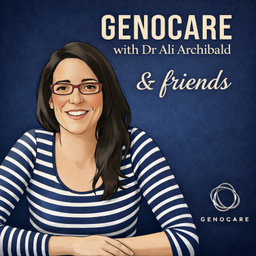
GenoCare is a podcast for clinicians, patients, and anyone navigating genetic and genomic care. Hosted by Dr Ali Archibald, the series explores how genomic testing is used in real clinical practice — and what happens beyond the test result. Through conversations with clinicians, researchers, and people with lived experience, the podcast covers reproductive and cancer genomics, psychosocial impacts of testing, and how health systems can better support patients and families. Produced by GenoCare Pty Ltd for education and general information.

GenoCare— with Dr Ali Archibald & friends
Claim This Podcastby Dr Ali Archibald
Podcast Overview
GenoCare is a podcast for clinicians, patients, and anyone navigating genetic and genomic care. Hosted by Dr Ali Archibald, the series explores how genomic testing is used in real clinical practice — and what happens beyond the test result. Through conversations with clinicians, researchers, and people with lived experience, the podcast covers reproductive and cancer genomics, psychosocial impacts of testing, and how health systems can better support patients and families. Produced by GenoCare Pty Ltd for education and general information.
Language
🇺🇲
Publishing Since
2/4/2026
1 verified contact email on file for GenoCare— with Dr Ali Archibald & friends
Pitch yourself as a guest, propose sponsorships, or reach out directly to the host.
Recent Episodes

June 29, 2026
Result workflows using a Digital Genetic Assistant
<p><strong>After the Test: Managing Genomic Results at Scale</strong></p><p>Most of the genomics conversation is about the science — the sequencing, the panels, the conditions. But once a result lands, a different problem takes over: the manual, repeatable workflow wrapped around every report. Opening PDFs, classifying results, drafting cover notes and patient letters, chasing partner testing, fielding "have my results come back yet?" calls.</p><p>In this episode — the second in our series on digitising the genetic testing journey — Ali is joined by GenoCare Co-Founder Sam Holt to explore how digital tools can take the grind out of results management. The goal isn't to replace genetic counsellors. It's to hand the repeatable admin to a "digital genetic assistant" so clinical teams can spend their time on the conversations that genuinely need a human.</p><p>The outcome: faster patient turnaround, less burnout for practitioners, and the capacity to absorb an exponentially growing demand curve.</p><p><strong>What we cover</strong></p><ul><li>The overnight digital genetic assistant: monitoring the laboratory information management system, reading and classifying reports, and pre-preparing cover notes, so a chunk of the work is done before you arrive at work</li><li>Why ~98% of carrier screening results come back "low chance" — and how automating those frees clinical time for the 2% that need our full attention</li><li>Working to your existing SOPs ("if this, then that"), with human oversight throughout — nothing reaches a patient without approval</li><li>Automating the admin around failed tests and sample recollects</li><li>Patient appointment scheduling by email, SMS and automated phone bot</li><li>Personalised patient results videos patients can rewatch and share — and why the largest US lab now uses them even for increased-chance results, with referrers in the loop</li><li>Real-time practitioner education: sharing results videos with referrers to bring them up to speed on managing genomic results</li><li>A trained, "fenced" Q&A so patients can ask the questions they think of the next day — instead of pasting their report into ChatGPT</li><li>Cascade and family education resources to support relatives accessing testing</li><li>Reducing confusion when patients view their results on My Health Record before a consultation</li><li>The potential to issue low-chance results directly to patients — and how this has been well received in research settings</li><li>Why genetic counsellors are becoming the change agents driving adoption</li></ul><p><strong>A note on safeguards</strong></p><p>Nothing in this conversation suggests moving away from human consultation to manage actionable results. That core conversation stays with a person. Everything else — the triage, the correspondence, the follow-up, the education — is where digital tools complement and extend the care already being provided.</p><p><strong>Who this is for</strong></p><p>Genetic counsellors, lab and pathology teams managing results workflows, clinicians delivering results across reproductive, cancer and primary care, and anyone thinking about how to scale genomics responsibly.</p><p><strong>About GenoCare</strong></p><p>GenoCare holds the exclusive APAC licence for a genomic workflow automation platform already used at scale by some of the highest-volume labs and hospital systems in the US. Our thesis is simple: genomics is ready — the admin isn't. We're digitising the workflow wrapped around every test so more people can access genetic testing, sooner.</p><p><strong>Links</strong></p><p><br></p><ul><li>Platform demos in the episode description</li><li>Referrals: <a href="mailto:hello@genocare.com.au" target="_blank" rel="ugc noopener noreferrer">hello@genocare.com.au</a> or www.genocare.com.au/contact</li></ul><p>Hosts: A/Prof Alison Archibald and Sam Holt</p>

June 22, 2026
Your Digital Genetic Assistant
<p>Genetic testing doesn't have a science problem. It doesn't have a reimbursement problem. And it definitely doesn't have a demand problem. Workforce and workflow issues continue to impede access. How can technology help?</p><p> Ali sits down with GenoCare co-founder Sam Holt to unpack everything that happens before a test is ordered — intake, family history, education and informed consent. It's the messiest, most manual part of the journey, and it's exactly where digital tools can unlock the demand the system already can't service.</p><p>"Genomics isn't a science problem anymore — it's an operations problem."</p><p><strong>In this episode:</strong></p><ul><li>Why the pre-test phase is the highest-leverage place to deploy digital tools</li><li>The platform GenoCare is bringing to Australia under exclusive licence — already used at scale by US labs and major US and Israeli hospital systems</li><li>What a "digital genetic assistant" is, and what it isn't (it doesn't replace genetic counsellors or admin staff)</li><li>Scalable, consistent digital consent: one repeatable process across every test, with a timestamped record for the clinician, patient and lab</li><li>The 15–20%+ Medicare rejection rate on carrier screening samples — and why better consent fixes it</li><li>The "uncanny valley" of waiting weeks for a result, and giving patients a home base instead of a call to the lab</li><li>Why patients arrive at increased-chance results unprepared, and how robust education changes how those results land (the Mackenzie's Mission experience)</li><li>Automating family history capture: real-time pedigree drawing, summary notes, and the three days a year lost just scanning family trees</li><li>The published US evidence: 85% efficiency gains, and 45 minutes of admin condensed to five</li><li>Reducing genetic counsellor burnout by giving the time back to patients</li></ul><p>The throughline: this isn't about replacing people. It's about shorter waitlists, a better patient experience, healthier margins for private labs, and letting genetic counsellors do the work they trained for — patients, not paperwork.</p><p><strong>Watch the demos:</strong></p><ul><li>Digital Genetic Assistant — family intake: <a href="https://www.loom.com/share/576b82b3b0e34965961356d7fb52ee7f" target="_blank" rel="noopener noreferer">click here</a></li><li>Informed consent and education workflow: <a href="https://www.loom.com/share/d6bb8d634b49499b95ccc696f9eb9d72?resume-anon-signup=true" target="_blank" rel="noopener noreferer">click here</a></li></ul><p><strong>Next episode:</strong> we move to the other end of the journey — the result-delivery process, and how digital tools can help there.</p><p>GenoCare brings the world's leading genomic workflow automation platform to Australia under an exclusive licence, automating pre- and post-test clinical workflows so genetic counsellors can spend their time on patients, not paperwork.</p><p><br></p>

June 10, 2026
Reproductive Carrier Screening After a Genetic Diagnosis, with Giorgina Maxwell
<p><strong>Episode Summary</strong></p><p>Most people approach reproductive genetic carrier screening with little prior experience of genetic conditions. But what about the families who already know? In this episode, host Alison Archibald speaks with genetic counsellor and PhD candidate Giorgina Maxwell about her published Master of Genetic Counselling research — exploring how couples who have already experienced a genetic condition in a child or pregnancy approach expanded carrier screening, and what this means for how we support them.</p><p><strong>Guest</strong></p><p><strong>Giorgina Maxwell</strong> is a genetic counsellor and PhD candidate at Flinders University, where she is researching childhood and young-onset glaucoma, genetic causes, and barriers to accessing genetic testing and counselling. Her Master of Genetic Counselling research, completed through the University of Melbourne, was conducted in partnership with the Mackenzie's Mission team and has since been published.</p><p><strong>What We Cover</strong></p><p><strong>Why carrier screening matters beyond the known diagnosis</strong> — Just because a genetic condition has already appeared in a family doesn't mean there couldn't be others. Research confirms we all carry variants for multiple conditions, and Giorgina's work shows that families who have already experienced a diagnosis strongly value being screened for the broader range.</p><p><strong>How lived experience changes the way people see likelihood</strong> — Families who have already been the "one in 100,000" don't hear risk statistics the same way as couples with no prior experience. They identify with the numbers differently — and this fundamentally shapes how they engage with screening, with future pregnancy planning, and with the information they receive.</p><p><strong>"Doing our due diligence"</strong> — The phrase that became the title of Giorgina's paper. Families in the study described carrier screening as part of being responsible parents — a way to gain information, restore a sense of agency, and plan for their family's future after traumatic experiences of diagnosis or pregnancy loss.</p><p><strong>Short-term anxiety versus long-term reassurance</strong> — All participants described some anxiety while waiting for results. But every single one said it was worth it. One participant put it plainly: nothing could be more traumatic than what they had already been through.</p><p><strong>What clinicians need to know</strong> — Don't narrow the focus to the condition already in the family. Check in with families down the track, not just at the point of diagnosis. And when a family reaches family planning again, that is the time to ask about psychosocial support — because returning to pregnancy after trauma brings a lot with it.</p><p><strong>The case for universal offering</strong> — Families in this study were among the strongest advocates for carrier screening being offered at a population level — not just to those with known family histories. Their experience of not knowing earlier shaped a powerful belief that everyone should be given the option.</p><p><br></p>
22 total episodes available
Similar Podcasts
Discover related shows you might enjoy
Deep-dive analytics for GenoCare— with Dr Ali Archibald & friends
Frequently asked questions
Have a different question and can't find the answer you're looking for? Reach out to our support team by sending us an email and we'll get back to you as soon as we can.
- What is GenoCare— with Dr Ali Archibald & friends?
- How often does this podcast release new episodes?
This podcast updates daily.
- Where can I listen to this podcast?
This podcast is available on 4 platforms including Apple Podcasts, Spotify, and more. You can also use the RSS feed directly.
- Does this podcast accept guests?
Yes, this podcast regularly features guests.
Legal Disclaimer
Pod Engine is not affiliated with, endorsed by, or officially connected with any of the podcasts displayed on this platform. We operate independently as a podcast discovery and analytics service.
All podcast artwork, thumbnails, and content displayed on this page are the property of their respective owners and are protected by applicable copyright laws. This includes, but is not limited to, podcast cover art, episode artwork, show descriptions, episode titles, transcripts, audio snippets, and any other content originating from the podcast creators or their licensors.
We display this content under fair use principles and/or implied license for the purpose of podcast discovery, information, and commentary. We make no claim of ownership over any podcast content, artwork, or related materials shown on this platform. All trademarks, service marks, and trade names are the property of their respective owners.
While we strive to ensure all content usage is properly authorized, if you are a rights holder and believe your content is being used inappropriately or without proper authorization, please contact us immediately at hey@podengine.ai for prompt review and appropriate action, which may include content removal or proper attribution.
By accessing and using this platform, you acknowledge and agree to respect all applicable copyright laws and intellectual property rights of content owners. Any unauthorized reproduction, distribution, or commercial use of the content displayed on this platform is strictly prohibited.


