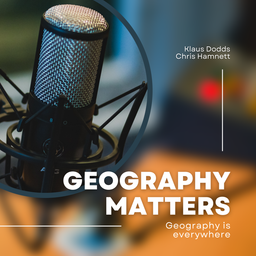
Geography Matters explores the importance of geography in shaping and influencing the world we live in: economy, society, politics and environment. Whether looking at world affairs and geopolitics, at global trade, regional inequality or the character of particular places, geography is important. History looks at when and why things happen. Geography looks at where and why. Everything takes place at particular times and in particular places. You can't escape the importance of geography whether its about conflicts over international borders, religion, the environment or the impact of climate change. Geography is everywhere. It affects who we are, our opportunities and our life chances. You can't escape geography. Follow us at https://feeds.captivate.fm/geography-matters/
In this episode my guest is Hannah Cloke, Regius professor of Meteorology and climate science at the University of Reading. Her title is rather special as she is one of the few professors in Britain appointed by the King or Queen. Her specialty is hydrology and flooding and she now appears regularly on TV whenever there isa major flooding issue. I started by noting the very hot summer of 2026 and Hannah noted that the global climate is now very clearly warming up quite rapidly. One consequence of this is that warmer air is able to hold much more moisture and this has been an important contributory cause of both heavy rainfall and flooding in both Britain and continental Europe. The floods in Valencia in 2025 and the major flooding in Germany in 2021 are clear examples, as are the floods in Yorkshire, Cumbria and the Severn. Beyond Europe we are seeing both more and stronger hurricanes and typhoons as warm seas and air encourage stronger storms. In addition there are now big issues with both melting ice and rising sea levels and the melting of Himalayan and Alpine glaciers. The disastrous floods in Nepal caused by glacial collapse in September 2026 highlight this as do the floods in Switzerland caused by the collapse of part of the Birch glacier on the village of Blatten. But shrinking glaciers also mean the possibility of a longer term shortage of water. This is very important in the Himalayas and the Tibean plateau which are the source of many very important rivers in South and South East Asia: the Bramaputra, the Ganges, Indus, Mekong. Irrawaddy and the Yangtze. The lives of billions of people depend on the water from these rivers. Hannah finishes by stressing that we need to be much more careful in our use of water. It is a scarce resource and it could become much scarcer, floods or not.
1 Sept 2026
Global trade and global supply chains
In this episode I am delighted to have with me Ed Conway to discuss his new book 'Trade World'. Ed is the economics editor of Sky News and in 2023 he published his first booked 'Material World' which looked at some of the key raw materials - salt, copper, iron, oil etc on which our modern world depends. In his new book he looks at the origins, the structure and organisation of the international trade system which our modern world depends on. Many of the products we consume today are not produced in our own countries but imported from overseas. we get many of our fruit and vegetables from southern Europe and our clothes from half way around the world. The T shirt I am wearing is from Nicaragua, but it could have come from Vietnam or Bangladesh or Turkey. Ed looks in his book at the history of supply chains, going back to Greek and Roman Times and the complex web of trade across the Mediterranean and the developments during the Dutch and British empires. He focuses on three key examples in his book, bread, clothing and cars. We should not be surprised by cars, as many of us are used to cars from Germany, Italy, France, Korea and Japan, but now they are also coming from China and Malaysia. Bread is more of a surprise but ,much of the wheat used in its manufacture now comes from North america. But, as he notes we are facing a big change at present. The current era of globalization which got under way in the post war era with the off shoring of production, particularly to SE Asia, is now under threat. People used to argue that we were seeing the 'end of geography'. We could get anything we wanted from anywhere. But Ed suggests we may now be seeing the Return of Geography' with countries and companies re-shoring production and looking at the risks of being dependent on key goods produced abroad. This is why the British government have just intervened to ensure the continuation of steel production in Britain. Can a modern country risk being completely dependent on steel produced overseas? What if the tap is turned off at a time of conflict? Increasingly, countries are thinking about the need to maintain the production of key items within national borders.
1 Jun 2026
Geography Strikes Back?
In this podcast Klaus Dodds and I go back to a topic we discussed in the first series - how, when and where does geography matter. We start by arguing that everything that happens in the world happens in both time and space. In that sense geography is everywhere. But we argue that the role and importance of geography varies over time and across societies. In the Age of Discovery sailors from Western countries were exploring and opening up hitherto unknown parts of the world. Then in the mid- late C19th, geography was increasingly important for Western colonial powers as new parts of the world were incorporated into the growing international system. This period was associated with a set of some western views about the links between climate and economic and social development which tended to argue that western countries had developed rapidly because of their climatic and other advantages. From mid C20th onwards these views were questioned and economic and social development was increasingly seen to be linked to a wider set of economic and political factors. We discuss th difference between North and South Korea after the end of the Korean war in 1953, of East and West Germany and the rise of both the semi-conductor industry in Taiwan from the 1970s and the rapid economic growth of Singapore: an island with very few physical advantages. We conclude by looking at what has happened in recent years, and Klaus suggests that while in the 1990s some people argued that geographical location would become less important, in the last few years climate change, wars and political instability are pointing to the resurgent importance of place
Who has been a guest on Geography Matters
Names identified in recent episode analyses. Showing up to five guests.
Klaus Dodds
Mia Bennett
[Guest Name]
Reach and audience
Public platform figures. Ratings count people who left a rating, not total listeners.
Apple Podcasts (US)
4.8 / 5
4 ratings
Spotify
4.4 / 5
7 ratings
Podcast Authority Score: 18 / 100
A composite of feed quality, social presence, YouTube performance and engagement. Read the methodology.
Quality
22
Social presence
0
YouTube
0
Engagement
32
Contact Geography Matters
Guest appearances
Does not typically book guests
Based on episode analysis; this does not confirm that the show is currently accepting guests.
Pod Engine is an independent podcast discovery and analytics service and is not affiliated with or endorsed by this podcast. Artwork and show content belong to their owners. Full legal notice.
Explore this show Podcast research with Pod Engine