
What’s it like to work in a system that doesn’t do right by your own people? Trainee doctor Emma Espiner is about to find out.
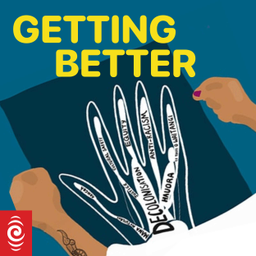
Getting Better
Claim This Podcastby RNZ
5.0(2 reviews)
8 episodes
Updated Daily
Accepts GuestsHas SponsorsLocation 🇳🇿
Podcast Overview
What’s it like to work in a system that doesn’t do right by your own people? Trainee doctor Emma Espiner is about to find out.
Language
🇺🇲
Publishing Since
7/20/2020
1 verified contact email on file for Getting Better
Pitch yourself as a guest, propose sponsorships, or reach out directly to the host.
Recent Episodes
July 28, 2020
Pandemic
<p>Emma spends lockdown at Auckland hospital, and sees how government action on COVID-19 underlines the lack of urgency when it comes to Māori health.</p><p>Emma spends lockdown at Auckland hospital, and sees how government action on COVID-19 underlines the lack of urgency when it comes to Māori health.</p><p>By Gabrielle Baker</p><p>Getting Better consulting producer Gabrielle Baker (Ngāpuhi, Ngāti Kuri) is a public policy and Māori health expert whose focus is on creating a just and effective health system. Here she reflects on hope, worry, and the prospect of a "new normal" after COVID-19.</p><p>During alert level four, most of us were unsettled in some way. And for many of us, the Covid-19 pandemic brought with it the added worry that Māori would be left irreparably harmed.</p><p>The worry was built on whānau stories of the 1918 Influenza pandemic, which saw the death rate for Māori approximately seven times as high as it was for non-Māori and decades of research on health inequity in Aotearoa which show across almost every health and disability indicator the health system does less well for Māori than it does for Pākehā.</p><p>Recently, Dr Melissa McLeod wrote, with a group of other leading Māori health researchers about the increased risks of Covid for Māori. This includes an increased risk of getting Covid and worse outcomes from Covid, not to mention the wider reaching consequences beyond the virus itself, like rising unemployment. All of these concerns were occupying many of our thoughts during alert level four and, in my case at least, driving us to distraction.</p><p>"Whatever it is, coronavirus has made the mighty kneel and brought the world to a halt like nothing else could. Our minds are still racing back and forth, longing for a return to "normality", trying to stitch our future to our past and refusing to acknowledge the rupture. But the rupture exists. And in the midst of this terrible despair, it offers us a chance to rethink the doomsday machine we have built for ourselves. Nothing could be worse than a return to normality."</p><p>When I read these words from Arundhati Roy's in April, I got to take a moment out of the worries to be a little hopeful. At some point beyond the state of emergency, would we have a once-in-a-generation chance to create a new normal and leave behind the stale ideas in the health system that disproportionately impact Māori whānau, people with lived experience of disability, takatāpui and rainbow communities, refugee and migrant families, and many poorer communities? …</p><p><a href="https://www.rnz.co.nz/podcast/getting-better?share=elf_audio_2018754700">Go to this episode on rnz.co.nz for more details</a></p>
July 28, 2020
Te Ahi Kaa
<p>Emma travels home to Tukorehe for her tā moko, and gets some advice from Dr Glenn Colquhoun.</p><p>In this episode of Getting Better we drove to Levin to pay a visit to poet, doctor and youth worker Glenn Colquhoun. But we started that day down the road in Kuku where Emma got her tā moko. </p><p>By Emma Espiner and Noelle McCarthy</p><p>On a road trip to her ancestral home of Tukorehe, in Horowhenua, on State Highway One Emma explained why the time feels right to get her tā moko: "It's not always been obvious, I think, to Māori when I meet them in a hospital or primary care setting, that I'm also Māori and I think people are surprised when I say that, because most people would look at me and know that, but I think it just reflects that power differential, and the fact that there aren't still aren't that many of us. And so I just wanted to enable them to know. To be visible, and to be safe for them."</p><p>Emma's Uncle Tipi Wehipeihana is a well known tā moko artist who lives a few hundred metres from Tukorehe at Kuku. His studio is at the back of the whare, with a comfy sofa and kete and taonga all over the walls. Emma's cousin Courtney ("the favourite moko") also came for the morning. The tikanga is different from tattoos - Emma didn't come with a design for example. So she had no idea what she was going to come away with, but she knew Tipi would understand the whakawhanaungatanga side of it and also the whakapapa she wanted to represent: "I'm a Wehipeihana on my Dad's side, same as Tipi and Courts. My Pākehā side is my Mum's, she's one of 12 kids from Takaka. Her mum was Ethel Smith, a strong woman in an entirely different mould from my Dad's mum Kura." </p><p>Sitting down on the stool opposite Tipi, Emma explained: "I was just thinking last night, about Mum and Dad's wedding, it was the first time that Pākehā and Māori whānau met... and I wasn't there. But, you know, these two are intensely Catholic whānau. And then Nanny insisted on bringing her own priest and then Nana had her priest... So it was a two priest wedding! But they came together - and it was awesome." Tipi drew a design freehand across the diagonal of Emma's arm "If you're looking at both sides, your Nanny's side and that connection, we will have something that represents your Māori side there, and the interweaving in the connection with your Pākeha side down here." The whole conversation only took a couple of minutes, which surprised Noelle, but it's a different thing to get your head around if you're not Māori. Tipi explained that part of the design represents "the pools of lineage in which you swim."…</p><p><a href="https://www.rnz.co.nz/podcast/getting-better?share=elf_audio_2018754699">Go to this episode on rnz.co.nz for more details</a></p>
July 28, 2020
What Does a Surgeon Look Like?
<p>Why do so few indigenous doctors end up becoming surgeons? And why does it matter?</p><p>For this episode, we travelled to the Leaders in Indigenous Medical Education - LIME - Conference in Ōtautahi, to meet trailblazing surgeons, doctors and medical educators from indigenous populations in Canada, USA, Australia, the Pacific Islands, and Aotearoa. </p><p>Before that, we spent an evening with Dr Maxine Ronald (Ngāti Wai, Ngāpuhi) who works as a general and oncoplastic surgeon in Whāngerei.</p><p>By Emma Espiner and Noelle McCarthy</p><p>There's an old joke - what's the difference between god and a surgeon?</p><p>God doesn't think he's a surgeon...</p><p>That long-standing association of surgery with type A personalities - highly driven, confident (did someone say arrogant?) - exists because the profession draws in people who are comfortable operating in life or death situations - the sorts of situations that also underline their own status, and the power of surgery. So why do so few indigenous doctors end up becoming surgeons? And why does it matter?</p><p>In this episode of Getting Better, we meet some doctors who are breaking down that white, male Type- A cliche of a surgeon. But although things are changing, they're changing very slowly. If the number of Māori doctors is proportionally small, the number of Māori surgeons is tiny. </p><p>There are 14 consultant surgeons who identify as Māori. This is out of an overall pool of hundreds - if this figure was proportionally balanced in terms of population, it would be closer to 130. If you're Māori looking to get into surgery, you're not only contending with the intense competition to do surgical training, you're also reckoning with expectations about the best thing you can do with your medical degree, as Maxine Ronald ( Ngāpuhi, Ngātiwai) explains over dinner in Whāngerei: "historically, Māori health has been positioned in primary health care, and public health... with good reason, and in specialities it wasn't well understood where you could make an impact."</p><p>But even so, Maxine always knew surgery was where she wanted to be: "If you're a Māori doctor, you're expected to contribute, to improve Māori health. And I I wanted to do that, but I just love surgery. And I couldn't not love it and I couldn't do anything else... It still blows me away, this neat feeling - just that immense privilege of, seeing it, of being in theatre, of operating on a real person, with real family and being able to remove disease or pathology... That really seemed like real medicine to me."</p><p>Maxine is now a general and oncoplastic breast surgeon, working in Whangārei hospital…</p><p><a href="https://www.rnz.co.nz/podcast/getting-better?share=elf_audio_2018754693">Go to this episode on rnz.co.nz for more details</a></p>
8 total episodes available
Deep-dive analytics for Getting Better
Frequently asked questions
Have a different question and can't find the answer you're looking for? Reach out to our support team by sending us an email and we'll get back to you as soon as we can.
- What is Getting Better?
- How often does this podcast release new episodes?
This podcast updates daily.
- Where can I listen to this podcast?
This podcast is available on 4 platforms including Apple Podcasts, Spotify, and more. You can also use the RSS feed directly.
- Does this podcast accept guests?
Yes, this podcast regularly features guests.
Legal Disclaimer
Pod Engine is not affiliated with, endorsed by, or officially connected with any of the podcasts displayed on this platform. We operate independently as a podcast discovery and analytics service.
All podcast artwork, thumbnails, and content displayed on this page are the property of their respective owners and are protected by applicable copyright laws. This includes, but is not limited to, podcast cover art, episode artwork, show descriptions, episode titles, transcripts, audio snippets, and any other content originating from the podcast creators or their licensors.
We display this content under fair use principles and/or implied license for the purpose of podcast discovery, information, and commentary. We make no claim of ownership over any podcast content, artwork, or related materials shown on this platform. All trademarks, service marks, and trade names are the property of their respective owners.
While we strive to ensure all content usage is properly authorized, if you are a rights holder and believe your content is being used inappropriately or without proper authorization, please contact us immediately at hey@podengine.ai for prompt review and appropriate action, which may include content removal or proper attribution.
By accessing and using this platform, you acknowledge and agree to respect all applicable copyright laws and intellectual property rights of content owners. Any unauthorized reproduction, distribution, or commercial use of the content displayed on this platform is strictly prohibited.