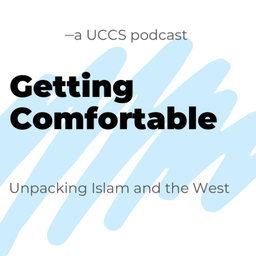
Welcome to “Getting Comfortable,” a University of Colorado Colorado Springs student-led podcast dedicated to unpacking the relationship between Islam and the West, where no one is an expert. The intention of the podcast is to lead with curiosity and have a conversation that identifies concepts, analyzes content, and centers different learning approaches pertaining to the relationship between Islam and the West. Special thanks to Dakota Tyukin for creating the intro and outro music, and to Kerry Corbett for the cover art.
Join Amanda and Cat as they discuss the origins of the Arabic word for America, Amreeka. They wrap up the course's content by engaging with Hamid Dabashi's argument on breaking binaries. The episode connects earlier readings and Dabashi's conclusion that there isn't an "East" nor a "West" after all.
The works referenced in the episode include Alia Malek's A Country Called Amreeka: U.S. History Retold Through Arab-American Lives (New York: Free Press, 2009) and Hamid Dabashi's "Breaking the Binary," and "But There is Neither East nor West," in Being a Muslim in the World (Palgrave Pivot, 2013).
2 Jun 2023
Episode 12: Hajj Narratives and Early Muslim Voices
Join Raisya and Isabella in a discussion about the meaning of the Hajj. They engage with a variety of voices starting off with Omar Ibn Said, an enslaved Muslim scholar, who penned an early 19th century memoir. Another voice is that of Malcolm X and his Hajj experience in the 1960s. The episode ends with a discussion of the documentary Sacred Journeys.
The works referenced in the episode include Omar Ibn Said's A Muslim American Slave: The Life of Omar Ibn Said (University of Wisconsin Press, 2011); Dawn-Marie Gibson's The Nation of Islam, Louis Farrakhan, and the Men Who Follow Him (Palgrave Macmillan, 2016); “Mecca” in The Autobiography of Malcolm X (Ballantine Books, 2015); and Craig Clements's 2016 Sacred Journeys, The Hajj (2020).
2 Jun 2023
Episode 11: Aida, Verdi, and Colonial Legacy
Join Amanda and Cat as they explore Giuseppe Verdi's grand 19th century opera, Aida, through the lens of three different analytical texts. Each author examines the opera through a different perspective, from the music and the libretto to the greater context behind the writing of Aida in 1870, which was first performed in 1871 for the opening of the Cairo Opera House.
The works referenced in the episode include Edward Said's “The Empire at Work: Verdi’s Aida” in Culture and Imperialism (New York: Vintage Books, 1993); Paul Robinson's “Is Aida an Orientalist Opera?” in Opera, Sex, and Other Vital Matters (Chicago: The University of Chicago Press, 2002); and Christopher R. Gauthier and Jennifer McFarlane-Harris's “Nationalism, Racial Difference, and ‘Egyptian’ Meaning in Verdi’s Aida,” in Blackness in Opera, Naomi André, Karen M. Bryan, and Eric Saylor, eds. (University of Illinois Press, 2012).
2 Jun 2023
Episode 10: The Ottoman Mehter, Harem-Escape Literature and Wolfgang Amadeus Mozart
Join Matt and Sierra as they provide a brief engagement with the complicated relationship between Mozart’s opera Die Entführung aus dem Serail (1782) and the opera’s connection to the Ottoman military marching band mehter.
The works referenced in the episode include Eve R. Meyer's “The Image of the Turk in European Performing Arts” in Süleyman the Second and his Time, Halil İnalcık and Cemal Kafadar, eds. (ISIS Press, 1993); Herbert Lindenberger's "On opera and society (assuming a relationship)" in Situating Opera: Period, Genre, Reception (Cambridge Studies in Opera) (Cambridge University Press, 2010); Libretto: The Abduction from the Seraglio, Music by W.A. Mozart, Original text by C.F. Bretzner, English version, John W. Bloch (G. Schirmer, 1962); and Larry Wolff's “Osmin in Vienna: Mozart’s Abduction and the Centennial of the Ottoman Siege” in The Singing Turk (Stanford University Press, 2016).
2 Jun 2023
Episode 9, Part Two: Ottomancentrism and the Diplomat
For the episode, Nico and Isaac have read through the introductory piece of Ottoman historian Daniel Goffman’s The Ottoman Empire and Early Modern Europe in addition to a letter composed by Austrian ambassador to the Ottoman court Ogier Ghiselin de Busbecq on his travels throughout the Ottoman realm. This is a continuation of the discussion opened by Jayda and Kerry on what it means to understand the history of the Ottoman Empire as perceived by the Ottomans.
The works referenced in the episode include Daniel Goffman's "Introduction: Ottomancentrism and the West" in The Ottoman Empire and Early Modern Europe (Cambridge UP, 2002); "The Third Letter Dated Constantinople, 1 June 1560" in The Turkish Letters of Ogier Ghiselin de Busbecq Imperial Ambassador at Constantinople, 1554-1562 (Clarendon Press, 1968, first edition 1927); and Eve R. Meyer's "The Image of the Turk in European Performing Arts" in Süleyman the Second and his Time, Halil İnalcık and Cemal Kafadar, eds. (Istanbul: ISIS Press, 1993).
2 Jun 2023
Episode 9, Part One: Ottomancentrism and the Diplomat
Join Kerry and Jayda as they continue to discuss the Ottoman Empire further by engaging with historian Daniel Goffman’s notion of Ottomancentrism. The question is what does it mean to understand the history of the Ottoman Empire as perceived by the Ottomans as opposed to outside observers.
The works referenced in the episode include Daniel Goffman's "Introduction: Ottomancentrism and the West" in The Ottoman Empire and Early Modern Europe (Cambridge UP, 2002); "The Third Letter Dated Constantinople, 1 June 1560" in The Turkish Letters of Ogier Ghiselin de Busbecq Imperial Ambassador at Constantinople, 1554-1562 (Clarendon Press, 1968, first edition 1927); and Eve R. Meyer's "The Image of the Turk in European Performing Arts" in Süleyman the Second and his Time, Halil İnalcık and Cemal Kafadar, eds. (Istanbul: ISIS Press, 1993).
2 Jun 2023
Episode 8: Becoming Familiar with the Ottomans
Join Jayda and Kerry as they venture into a discussion on what the Ottoman Empire was, and why it is still important.
The works referenced in the episode include Donald Quataert's “Why Study Ottoman history?” in The Ottoman Empire, 1700-1922, New Approaches to European History series (Cambridge University Press, 2005); Daniel Goffman's "Introduction: Ottomancentrism and the West" in The Ottoman Empire and Early Modern Europe (Cambridge University Press, 2002); "The Third Letter Dated Constantinople, 1 June 1560" in The Turkish Letters of Ogier Ghiselin de Busbecq Imperial Ambassador at Constantinople, 1554-1562 (Clarendon Press, 1968, first edition 1927); and Eve R. Meyer's "The Image of the Turk in European Performing Arts" in Süleyman the Second and his Time, Halil İnalcık and Cemal Kafadar, eds. (ISIS Press, 1993).
2 Jun 2023
Episode 7: The Question of Orientalism and After
Join Isabella and Raisya in thinking about what it means to be a public intellectual. They consider the legacy of Edward Said’s work Orientalism (1978) and the controversy with historian Bernard Lewis.
The works referenced in this episode include Alan Lightman’s essay about “The Role of the Public Intellectual," in the MIT Communications Forum; Bernard Lewis's “The Question of Orientalism” in The New York Review of Books, 24 June 1982; Douglas Martin, "Bernard Lewis, Influential Scholar of Islam, Is Dead at 101" in The New York Times (21 May 2018); Edward W. Said and Oleg Grabar's “Orientalism: An Exchange” in The New York Review of Books, 12 August 1982; and Adam Shatz, “'Orientalism,’ Then and Now” in The New York Review of Books, 20 May 2019.
2 Jun 2023
Episode 6: Theorising the West and Power
Join Matt and Sierra as they engage with Edward Said’s seminal text Orientalism (1978). Matt and Sierra consider the impact of Edward Said’s work and his framing of power, which draws upon French philosopher Michel Foucault’s work.
The works referenced in the episode include an excerpt from Edward W. Said’s Orientalism (1978) as found in Colonial Discourse and Post-Colonial Theory: A Reader, Patrick Williams and Laura Chrisman, eds. (Columbia University Press, 1994); Richard Bernstein's “Edward W. Said. Literary Critics and Advocate for Palestinian Independence, Dies at 67” in New York Times, 26 September 2003; and Gauri Viswanathan's “Orientalism and After” in Power, Politics, and Culture: Interviews with Edward W. Said (Vintage Books, 2001).
2 Jun 2023
Episode 5: Unpacking Europe
Join Amanda and Cat as they begin to unpack Europe, the idea of it, and the origins of the word in different meanings. Europe as a monolith has meant different things, from a continent, a peninsula of Asia, a civilization, or a group of different civilizations. By examining Muhammad As-Saffar's account of Paris in 1845-1846, the audience is able to gain an outside perspective of Paris, a great French and European city at the height of its imperial power.
The works referenced in the episode include J.G.A. Pocock's “What do We Mean by Europe?” in The Wilson Quarterly (Winter, 1997) and Susan Gilson Miller's translation of “The City of Paris,” in Disorienting Encounters: Travels of a Moroccan Scholar in France in 1845-1846, The Voyage of Muhammad As-Saffar (Berkeley, CA.: University of California Press, 1992).
2 Jun 2023
Episode 4, Part Two: Of Absolute Categories and Civilizations
Join Nico and Isaac as they discuss what it means when regions, religions, and peoples are referenced as absolute categories. Nico and Isaac also consider what it means to refer to a historical period and region as a “civilization.” The episode builds upon what Sierra and Matt began considering in Part One of Episode 4.
The works referenced in the episode include Samuel P. Huntington’s "The Clash of Civilizations?" in Foreign Affairs (Summer 1993) and Marshall Hodgson’s The Venture of Islam: Conscience and History in a World Civilization, vol. 1 The Classical Age of Islam (University of Chicago Press, 1961).
2 Jun 2023
Episode 4, Part One: Of Absolute Categories and Civilizations
Join Sierra and Matt as they think about what it means when regions, religions, and peoples are referenced as absolute categories. Sierra and Matt also consider what it means to refer to a historical period and region as a “civilization.”
The works referenced in the episode include Samuel P. Huntington’s "The Clash of Civilizations?" in Foreign Affairs (Summer 1993), and Marshall Hodgson’s The Venture of Islam: Conscience and History in a World Civilization, vol. 1 The Classical Age of Islam (University of Chicago Press, 1961).
2 Jun 2023
Episode 3, Part Two: To Capitalize or Not/Lexical Conundrums
Join Isabella and Raisya in Part Two as they discuss the documentary Islam: Empire of Faith, which was produced by PBS in 2000.
The works referenced in the episode include Shahab Ahmed’s What is Islam? The Importance of Being Islamic (Princeton University Press, 2016); Andrew Rippin’s Muslims: Their Religious Beliefs and Practices (Routledge, 2002); and the documentary Islam: Empire of Faith.
2 Jun 2023
Episode 3, Part One: To Capitalize or Not/Lexical Conundrums
Join Raisya and Isabella as they explore the idea of lexical conundrums and liken how we come to consider words to a game of telephone. The main question is whether there is a significance to distinguishing terms.
2 Jun 2023
Episode 2: (Un)Mapping Assumptions of a Region
Join Kerry and Jayda as they discuss the assumptions attached to the region of the "Middle East" including what countries make up the region.
The works referenced in the episode include Abbas Amanat's “Introduction: Is There a Middle East? Problematizing a Virtual Space” in Is There a Middle East? The Evolution of a Geopolitical Concept, Bonine, Amanat, and Gasper, eds. (Stanford UP, 2012) and Michael E. Bonine, “Of Maps and Regions: Where is the Geographer’s Middle East?” in Is There a Middle East? The Evolution of a Geopolitical Concept, Bonine, Amanat, and Gasper, eds. (Stanford UP, 2012).
2 Jun 2023
Episode 1: Introducing the Getting Comfortable Podcast
Join us in an icebreaker episode where Amanda introduces the podcast project and the five production teams. The podcast mirrors the thematic content in the Islam and the West syllabus as designed by Dr. Carole Woodall. The podcast teams are: Matt Reese and Sierra Banks, Jayda Wayman and Kerry Corbett, Amanda Espinel and Cat Bauder, Isabella Arsenault and Raisya Pratama, and Nico Essary and Isaac Sawyer.
Reach and audience
Public platform figures. Ratings count people who left a rating, not total listeners.
Apple Podcasts (US)
5.0 / 5
2 ratings
Contact Getting Comfortable
Guest appearances
Does not typically book guests
Based on episode analysis; this does not confirm that the show is currently accepting guests.
Host of Getting Comfortable?
Claim your podcast to manage its listing and keep your show details accurate.
Pod Engine is an independent podcast discovery and analytics service and is not affiliated with or endorsed by this podcast. Artwork and show content belong to their owners. Full legal notice.
Explore this show Podcast research with Pod Engine