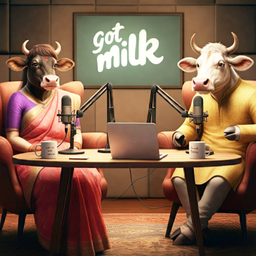
The podcast reviews the latest research & publications in the everything animal husbandry - the milk economy, livestock wellness and health, small and large dairy farmers in India, challenges and opportunities, agritech and more.
Sahiwal & Gir - our bovine podcasters review (and simplify) the latest in research reports, publications, books and news in the Indian dairy / animal husbandry domain and at times do venture into adjoining domains.
And Yeah, almost forgot to mention - these episodes by Sahiwal & Gir are AI enriched! Listen in, learn and share.
Livestock sector contribution to India's national economy - explained.
The livestock sector is a cornerstone of the Indian national economy, playing a multifaceted role in driving growth, ensuring rural stability, and supporting millions of livelihoods. Its contributions can be summarized across the following key areas:Economic Value and Growth
Contribution to GVA: The livestock sector accounts for 5.5% of India's total Gross Value Added (GVA) and a substantial 30.23% of the GVA of the agricultural and allied sectors.
Direct Economic Output: As of the 2022-23 provisional estimates, the sector’s GVA at current prices is approximately Rs 13,55,460 crores. The value of milk output alone reached Rs 11.16 lakh crore in 2023-24.
Market Scale: The total dairy market size was valued at Rs 18.98 lakh crore in 2024 and is projected to grow to Rs 57.00 lakh crore by 2033.
Household Support: The sector provides direct livelihoods to approximately 8.5 crore rural households. It serves as a vital secondary source of income, particularly for landless laborers and small or marginal farmers.
Workforce Engagement: According to the Periodic Labour Force Survey (2023-24), about 6.34% of the workforce is engaged in animal production, while 4.34% is involved in mixed farming.
Job Creation: Initiatives like the Animal Husbandry Infrastructure Development Fund (AHIDF) have generated an estimated 50,000 direct jobs and benefited over 1,80,000 farmers.
Global Production Ranks: India is the world's largest milk producer, contributing 25% of global production. It also ranks 2nd in egg production (8% globally) and 4th in meat production (3% globally).
Nutrition and Availability: The sector ensures national food security by providing affordable animal protein. The per capita availability of milk has reached 471 grams per day, significantly exceeding the world average of 329 grams.
Socio-Economic Buffer: Livestock acts as insurance against crop failures, providing a stable income stream when traditional agriculture is compromised.
Draught Power and Fuel: Beyond food products, livestock is a principal source of draught power for agricultural work and provides fuel and manure for rural households.
Soil Health: Livestock manure enhances soil fertility by improving nutrient availability and organic matter content, which supports overall agricultural productivity.
Women’s Empowerment: The sector is a major platform for female entrepreneurship; for instance, 73.54% of members in technically supported Milk Producer Organizations (MPOs) are women.
Financial Inclusion: Programs like the Kisan Credit Card (KCC) have been extended to livestock farmers, enabling them to access low-interest credit for their operations.
Innovation: Modern practices such as climate-smart farming, renewable energy through biogas, and digital ecosystems like "Bharat Pashudhan" are driving innovation and financial inclusion in rural areas
Employment and LivelihoodsGlobal Leadership and Food SecurityRural Stability and ResilienceEmpowerment and Entrepreneurship
25 Feb 2026
Ruminant Feed Balances in Ethiopia and Burkina Faso
This episode discusses in detail a comprehensive study on ruminant livestock feed balances in Ethiopia and Burkina Faso, utilizing remote sensing technology and data-intensive modeling.
The authors of the report developed a framework to quantify both the potential biomass supply and the specific energy requirements of animal populations across various agro-ecological zones. By comparing these metrics, they identify critical feed scarcity hotspots, particularly in the Ethiopian highlands and the Burkinabe Sahel.
The findings emphasize that while total national biomass may appear vast, localized deficits significantly hinder livestock productivity and resilience to climate shocks. Ultimately, the study suggests that targeted policy interventions—such as improving feed trade, enhancing crop residue use, and managing herd mobility—are essential for sustainable agricultural intensification. The researchers propose this scalable methodology as a vital tool for decision-makers in data-constrained regions to optimize animal health and reduce environmental impacts.
24 Feb 2026
Kenya faces fodder shortages
Kenya’s livestock sector sits at the heart of rural livelihoods, yet fodder insecurity remains a persistent constraint. Recurrent droughts, shrinking grazing land, erratic rainfall, and rising feed costs leave dairy and meat producers struggling to maintain consistent animal nutrition. Seasonal pasture fluctuations often translate into lower milk yields, weight loss, delayed conception, and volatile farm incomes. Quality green fodder becomes scarce precisely when animals need it most.
Hydroponic fodder offers a controlled, water-efficient alternative. By producing fresh, nutrient-dense green feed in compact units throughout the year, farmers can stabilize rations, improve herd health, and reduce dependence on unpredictable climate and imported feed inputs.
Reach and audience
Public platform figures. Ratings count people who left a rating, not total listeners.
YouTube views
26,676
Score snapshot 15 Sept 2025
Podcast Authority Score: 63 / 100
A composite of feed quality, social presence, YouTube performance and engagement. Read the methodology.
Quality
95
Social presence
0
YouTube
76
Engagement
0
Contact Got Milk? - The Indian Dairy Context.
Guest appearances
Books guests
Based on episode analysis; this does not confirm that the show is currently accepting guests.
Host of Got Milk? - The Indian Dairy Context. ?
Claim your podcast to manage its listing and keep your show details accurate.
Pod Engine is an independent podcast discovery and analytics service and is not affiliated with or endorsed by this podcast. Artwork and show content belong to their owners. Full legal notice.
Explore this show Podcast research with Pod Engine