- 26
- Episodes
- 1
- Ratings
- 2023
- First episode
- 544
- YouTube views
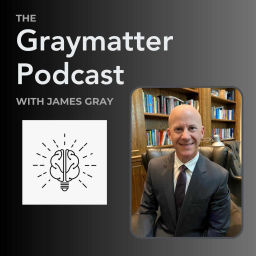
About Graymatter Podcast with James Gray
Practical AI walkthroughs, self-leadership strategies, and real builder stories — for leaders who want to master AI, master themselves, and build what matters. graymatter.jamesgray.ai (https://graymatter.jamesgray.ai?utm_medium=podcast)
- Publisher
- James Gray
- Category
- business · technology
- Language
- en
- Explicit
- No
- First episode
- 4 Jun 2023
- Latest episode
- 20 Apr 2026
Latest episodes
26 episodes in the feed.
20 Apr 2026
Three Questions Before You Say Yes (in the AI Era)
I’ve been reading The Way of Excellence (https://www.bradstulberg.com/) by Brad Stulberg (https://www.bradstulberg.com/) — subtitle, a guide to true greatness and deep satisfaction in a chaotic world. The timing feels right. AI is reshaping jobs, companies, and the skills that matter. Every week I talk to leaders asking some version of the same question: where do I put my time now? One section in Chapter 2 really resonated with me. Stulberg calls it selecting worthwhile pursuits — and it gave me a diagnostic I am starting to use on every new project, every inbound opportunity, every commitment I’m weighing. TL;DR: * Decades of research on motivation point to three core needs: autonomy, competence, and belonging * Before saying yes to a project, job, or commitment, ask: will this increase or decrease autonomy, competence, or belonging in my life? * In an AI-disrupted career, this filter matters more — because the wrong yes compounds faster * For existing commitments, ask what conversations or moves would restore any of the three * Bonus: turn the filter into a prompt and riff with Claude or ChatGPT on the decisions you’re stuck on Graymatter is a reader-supported publication. To receive new posts and support my work, consider becoming a free or paid subscriber. The Three Needs Stulberg pulls from decades of self-determination research. We thrive over the long haul when three needs are met: Autonomy — some control over how we spend our time and energy. Not total freedom. Just a real say in the how. Competence — a path toward concrete improvement in our chosen pursuits. The thing we’re doing needs to grow our craft, not just consume our hours. Belonging — connection to something beyond ourselves. A person, a community, a lineage, a tradition. An emotional stake in why this work exists. His line that stopped me: “The more time and energy we spend on pursuits that afford us autonomy, competence, and belonging, the better.” Simple. But almost nobody applies it when evaluating the next thing on their plate. Why This Filter Matters Right Now A year ago, a lot of work was good enough. The pay was fine, the scope was clear, the path was predictable. You could stay on autopilot and be okay. That’s over. AI is redrawing the edges of what humans should do. Tasks that felt worth doing in 2024 are now commodity output. Roles that felt stable are getting reassembled. The leaders I coach are making harder choices — about what to say yes to, what to drop, and what to rebuild. In that environment, the wrong yes doesn’t just waste time. It compounds. Every month spent on a pursuit that drains autonomy, stalls competence, or isolates you is a month your peers are getting sharper on the things that will actually matter in 2027. Which is why Stulberg’s question has become my default diagnostic: Will this increase or decrease autonomy, competence, or belonging in my life? How I’m Using It Three ways I’ve been running this filter in the last few weeks: On new opportunities. When something lands in my inbox — a speaking gig, a consulting ask, a collaboration — I don’t jump to the calendar. I ask the three. Does it give me more control over my time, or chain me to someone else’s schedule? Does it push my craft forward, or just repeat what I already know? Does it connect me to people and ideas I care about, or is it a transaction? If two of the three are a no, I pass. No agonizing. On existing commitments. Stulberg adds a second move most people skip. For work you’re already in, ask what actions would enrich the three. How can I protect more autonomy here? What conversation with my team would rebuild competence momentum? What would reconnect me to why this work matters? A good commitment doesn’t need to be abandoned — it often just needs a small intervention. As a prompt, when I’m stuck. This is where the AI angle gets practical. When I’m genuinely torn, I paste the situation into Claude and run it through the filter: I'm deciding whether to [take on / continue / walk away from] this project: [brief description — scope, time commitment, stakeholders, outcome] Use Brad Stulberg's framework from The Way of Excellence. Evaluate this on three dimensions: 1. Autonomy — will it increase or decrease my control over my time and energy? 2. Competence — will it grow my craft, or just consume hours? 3. Belonging — does it connect me to something beyond myself, or is it purely transactional? Give me a direct read on each, then the trade-offs I should weigh before saying yes or no. Claude doesn’t decide for me. But it surfaces the angles I’d missed — especially the ones I was quietly avoiding. The Harder Version of the Question The sharpest line in the chapter is this: “What would it look like to shape our lives for more mastery and mattering?” That’s the harder question. Not should I say yes to this one thing, but: Am I designing my life around pursuits that grow me and connect me — or am I letting it happen to me? In an AI era where almost everything about work is in motion, the leaders I watch thriving are the ones asking this out loud. They’re not waiting for the dust to settle. They’re picking the pursuits that compound autonomy, competence, and belonging — and pruning the ones that don’t. That’s the real work. AI is the accelerant. But what you’re accelerating — that’s still the decision only you can make. Your Turn Pick one commitment on your plate right now. Run it through the three. → Is it giving you more or less autonomy than it did six months ago?→ Is it building real competence, or just repeating what you already do well?→ Do you feel connected to the people and the purpose behind it? If the answer is honest and uncomfortable, that’s the signal. The next move isn’t always quit — sometimes it’s a conversation, a scope change, a recommitment. But the filter cuts through the noise. Reply and tell me what came up. I read every response. Stay curious. Stay hands-on. James The book is The Way of Excellence by Brad Stulberg (https://www.bradstulberg.com/). Worth reading the whole chapter on the psychology of excellence — chapter two is where this framework lives. If this was useful, forward it to one person weighing a hard yes right now. They can subscribe at graymatter.jamesgray.ai (https://graymatter.jamesgray.ai). This is a public episode. If you'd like to discuss this with other subscribers or get access to bonus episodes, visit graymatter.jamesgray.ai/subscribe (https://graymatter.jamesgray.ai/subscribe?utm_medium=podcast&utm_campaign=CTA_2)
19 Apr 2026
AI Didn't Create This Question. It Just Made It Impossible to Ignore.
In the final session of my last AI cohort, something unexpected happened. We’d spent weeks learning tools, building workflows, writing prompts. And then, one by one, people started sharing — not what they’d built, but who they were becoming. Someone said AI had made them more creative than they’d felt in years. Another said they could see a broader version of who they could be. A third said: for the first time in a long time, I know what I want to do next. That wasn’t a conversation about AI. That was a conversation about the Life’s Task. Robert Greene writes about this in Mastery — the idea that each of us has a primal inclination, a thread that runs through everything, and that the work of a lifetime is to find it and follow it fully. I’ve been reading Greene for years. But I didn’t expect AI to be the thing that brought his theory to life in real time — accelerating the moment when people finally see what’s possible for them. AI isn’t just changing how we work. It’s forcing a deeper question: what are you actually pointing this at? Five Strategies for Finding Your Life’s Task Greene offers five strategies. I walked through all of them in this episode — here’s the map. 1. Return to Your Origins — The Primal Inclination StrategyGo back before the job titles, before the expectations, before the world told you what to be good at. What drew you in as a child? What did you lose yourself in? I ask this in every cohort, and what strikes me is how quickly people remember — and how long they’ve been ignoring it. That pull was never random. It was always pointing somewhere. 2. Occupy the Perfect Niche — The Darwinian StrategyDon’t compete in a crowded lane. Find the intersection that is uniquely yours — where your combination of skills, experience, and inclination has no direct competition. That’s where you thrive. 3. Avoid the False Path — The Rebellion StrategySome paths are chosen for the wrong reasons — money, approval, inertia. Greene calls this the false path. Recognizing it takes courage. Leaving it takes more. 4. Let Go of the Past — The Adaptation StrategyWhat got you here won’t necessarily get you there. If AI has reshaped your industry or your role, the task isn’t to hold on — it’s to find what carries forward and build from there. 5. Find Your Way Back — The Life-or-Death StrategySome people only find their Life’s Task after a crisis forces the question. A job loss. A health scare. An industry upended. The disruption isn’t the end — it’s the redirection. The Inner Quest The Inner Quest is a series within the Graymatter podcast — dedicated to one of its three pillars: mastering yourself. Alongside mastering AI and building what matters, this is the thread I believe matters most. Not tools. Not frameworks. The deeper journey — to find ourselves, evolve ourselves, and adapt ourselves. The quest that runs beneath everything else. The one that doesn’t end. Every episode, one idea worth sitting with. This is that series. Your Reflection Prompt Somewhere inside you, you already know. There is something — in your heart, in your bones — that is your Life’s Task. Something that would bring out your uniqueness in a way nothing else can. You’ve caught glimpses of it. You may have pushed it away. It’s likely that you haven’t had the courage to fully touch it, to say it out loud, to pursue it. That’s not weakness. That’s human. The Life’s Task asks everything of you, and that’s terrifying. But here’s what I want you to sit with: we don’t know how many days we have. None of us do. And when you hold that truth — really hold it — the question changes. Not “what should I do with my career?” But: what would I honor? What is the one thing you can see, right here, right now — your Life’s Task, your opportunity, the thing that is uniquely yours to bring into the world? Write it down. Even one sentence. That’s where it begins. I’d love to know what comes up for you. Drop it in the comments — even one sentence. You might be surprised what you write. -James This is a public episode. If you'd like to discuss this with other subscribers or get access to bonus episodes, visit graymatter.jamesgray.ai/subscribe (https://graymatter.jamesgray.ai/subscribe?utm_medium=podcast&utm_campaign=CTA_2)
25 Jan 2026
You Can't Automate What You Don't Understand: Deconstructing Workflows for AI
Here’s something I see all the time: A leader wants to automate prospect research. Or customer outreach. Or content creation. They’ve done the process hundreds of times. They know it works. But when they try to apply AI? They get stuck. Not because the AI isn’t capable. But because they’ve never had to explain their process with the kind of precision an AI needs. The workflow lives in their head as intuition—not as clear, repeatable steps. On Friday, I hosted a Lightning Lesson where we tackled this together. Over 340 leaders and professionals joined me to walk through how to take something you know intimately and break it down so AI can actually execute it. No theory. Just a real workflow, deconstructed step by step. Graymatter is a reader-supported publication. To receive new posts and support my work, consider becoming a free or paid subscriber. The Challenge: Getting What’s in Your Head Into Structure Think about something you do regularly in your business. Maybe it’s qualifying leads. Analyzing feedback. Preparing reports. Now imagine explaining every single step to someone who’s smart but has never done it before. Not just the what—the how, the why, the decision points, the nuances. Suddenly it’s not so simple, right? That’s the gap. You have expertise that’s second nature. AI needs explicit instructions. Deconstruction is how you bridge that gap. And honestly? The process of breaking it down often reveals things you didn’t even realize you were doing—which makes your process better, with or without AI. What We Built Together In this session, I walked through a workflow I use for LinkedIn prospect research. Nothing fancy—just a practical business process: * Start with a buyer persona (the kind of prospect you want to find) * Search LinkedIn for people who match that profile * Evaluate each prospect against specific criteria * Generate personalized engagement recommendations * Output everything in a structured format The interesting part isn’t the workflow itself. It’s how we approach building it. Key Concepts You Can Apply Immediately 1. The “What/Why vs. How” Principle You shouldn’t be writing detailed AI instructions from scratch. That’s the old way. Instead, you define the business outcome and sketch high-level steps. Then let AI generate the detailed execution instructions. You bring domain expertise. AI brings execution precision. Stay in your lane. 2. Meta-Prompting: Let AI Write AI Instructions Here’s the actual technique: “You are an expert workflow designer and prompt engineer. Please write a prompt for this scenario. The outcome is [your goal]. Here are the high-level steps: [your steps]. Now write the detailed instructions.” Let the model craft the “how” while you focus on the strategic “what and why.” I demonstrate this live in the session—you’ll see how much better the AI-generated instructions are than what most people write manually. 3. Skills vs. MCPs: Understanding the Difference This came up multiple times in Q&A because it’s genuinely confusing. Skills teach Claude how to do something. Procedural knowledge. “Here’s how to write a LinkedIn post in my style.” MCPs (Model Context Protocol) give Claude access to something. Tool connectivity. “Here’s how to read from and write to my Notion database.” They work together. Skills provide the methodology. MCPs provide the capability. 4. Build a Workflow Registry Don’t just build workflows ad hoc. Create a system. I show my Notion setup where every workflow is documented with: * Name and business process assignment * Description and expected outcome * Trigger conditions * The actual steps * Links to AI assets (prompts, personas, templates) * Status tracking This becomes your institutional knowledge. Your competitive moat. 5. The Clarity Test Here’s how you know if a workflow is ready to automate: Can you explain it clearly enough that a smart person who’s never done it could execute it successfully? If not, you’re not ready for AI yet. The work is in the deconstruction, not the automation. 6. Create Reusable AI Assets In the demo, I use a buyer persona stored as a markdown file. It’s an AI asset I can plug into multiple workflows—prospect research, email outreach, and content creation. Think in building blocks. What pieces of knowledge or context can you document once and reuse everywhere? Questions That Came Up The Q&A was where things got practical. People asked questions like: “Should I design my Notion database first, or let Claude do it?” (Start simple with what makes sense to you, then let Claude optimize based on your actual workflow) “When do I need a Skill versus just a good prompt?” (Skills when you’re doing the same thing across multiple workflows and want consistent execution) “How detailed should my workflow steps be?” (Detailed enough that the AI knows what to do, but not so prescriptive that you lose flexibility) These weren’t hypothetical. These were people actively working through this in their businesses, hitting real obstacles, finding real solutions. Why This Matters Right Now We’re past the “playing around with ChatGPT” phase. The tools are ready. The question isn’t whether AI can help your business—it’s whether you can articulate your processes clearly enough to take advantage of it. The leaders who figure this out aren’t necessarily the most technical. They’re the ones who can think operationally, break down their expertise, and build systems that scale. That’s what this Lightning Lesson is about. Not the technical wizardry (though we cover that too). The mindset shift from “What can AI do?” to “What do I need done, and how do I break it down?” Want to Go Deeper? This Lightning Lesson gives you the approach. If you want to actually build these systems with hands-on guidance and expert feedback, I’m running two cohort courses: Claude and Claude Code for Builders – Starts Tomorrow (January 26) This course is primarily for “builders” - business people who want to go deep on Claude’s capabilities, Claude Code for agentic workflows, and building a prototype application (e.g., website) 25% founder discount for this inaugural cohort. View syllabus and enroll → (https://maven.com/james-gray/claude) Hands-on Agentic AI for Leaders – Next cohort starts February 2 This is for business leaders and non-technical builders who want to move from experimentation to actually deploying AI in their operations. We build real workflows, deploy them, and develop the literacy to lead AI transformation. Rated 4.8/5. Over 250 students trained. View syllabus and enroll → (https://maven.com/james-gray/hands-on-ai-for-leaders) The best AI implementation starts with clear thinking about your business, not with fancy prompts. Watch the session. Pick one workflow. Break it down. That’s where real progress starts. — James This is a public episode. If you'd like to discuss this with other subscribers or get access to bonus episodes, visit graymatter.jamesgray.ai/subscribe (https://graymatter.jamesgray.ai/subscribe?utm_medium=podcast&utm_campaign=CTA_2)
Reach and audience
Public platform figures. Ratings count people who left a rating, not total listeners.
- YouTube views
- 544
- Score snapshot 15 Sept 2025
- Apple Podcasts (US)
- 5.0 / 5
- 1 ratings
Podcast Authority Score: 31 / 100
A composite of feed quality, social presence, YouTube performance and engagement. Read the methodology.
- Quality
- 36
- Social presence
- 0
- YouTube
- 66
- Engagement
- 0
Contact Graymatter Podcast with James Gray
- Guest appearances
- Does not typically book guests
Based on episode analysis; this does not confirm that the show is currently accepting guests.
Host of Graymatter Podcast with James Gray?
Claim your podcast to manage its listing and keep your show details accurate.
Pod Engine is an independent podcast discovery and analytics service and is not affiliated with or endorsed by this podcast. Artwork and show content belong to their owners. Full legal notice.
Explore this show
Podcast research with Pod Engine