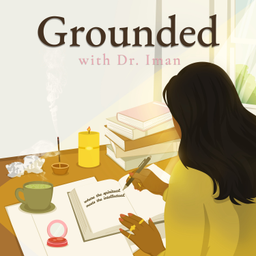
Podcast thumbnail for Grounded

by Iman AbdoulKarim

5.0(4 reviews)
19 episodes
Updated Daily
Accepts GuestsHas SponsorsLocation 🇺🇸

Podcast Overview

Welcome to Grounded with Dr. Iman, a space where the intellectual meets the spiritual. I’m a professor, scholar of religion, and intellectual historian. Each week, I bring conversations from religious studies, Black feminist thought, spirituality, and culture into everyday life, introducing you to the thinkers, questions, and traditions that have transformed how I see the world. Some episodes are personal reflections on where I’m finding grounding. Others draw from my research on religion, Black women’s spiritual lives, and alternative modes of knowing. And sometimes I’m joined by scholars, creators, friends, and listeners! So wherever this takes us, I’m really glad you’re here. Let’s get grounded. @imanabdk on socials | groundedwithdriman@gmail.com

Language

🇺🇲

Publishing Since

2/11/2026

Reach the team behind Grounded

Verified contact details for this show aren't on file yet — sign up to get notified when they land.

Recent Episodes

Episode thumbnail for Ep.18: Why Changing Your Mind Is Your Inheritance?

June 29, 2026

Ep.18: Why Changing Your Mind Is Your Inheritance?

<p>Episode brought to you by me hating on haters of my fav podcast and a 100-year-old Black nationalist newspaper. </p><p>This week, we’re thinking about what it means to change your mind. And why doing so in public is one of the most important Black intellectual traditions we have IMO. I start by reflecting on my own relationship to honesty, embodied knowledge, and what I've been learning through living with a changing body with insulin-resistant PMOS. From there, I ask a bigger question: Why are people suspicious of folks changing their minds? </p><p>Drawing on haters in the comments of one of my fav pods (Pour Minds), the history of The Crusader newspaper, Malcolm X, and Audre Lorde, I show how changing your mind isn't intellectual inconsistency, it's intellectual honesty and a part of the U.S. Black intellectual tradition. </p><p>Chapters </p><p>00:00 — Teaser: Why Changing Your Mind Is Your Intellectual Inheritance </p><p>00:22 — Grounding in PMOS </p><p>05:01 — Why Changing Your Mind Is Your Intellectual Inheritance </p><p>15:33 — Malcolm X: An Example of Changing in Public </p><p>References: </p><p>Alston, Ashanti. “Be Careful of Your Man-Tones! Gender Politics in Revolutionary Struggle.” Interview by Hilary Darcy. Interface: A Journal for and About Social Movements 2, no. 1 (May 2010): 22–35. </p><p>Lorde, Audre. “Learning from the 60s.” In Sister Outsider: Essays and Speeches. Freedom, CA: Crossing Press, 1984.</p><p>The Crusader. 1918–1922</p><p>Pour Minds (hosts Lex P and Drea Nicole)</p>

Episode thumbnail for Ep. 17: How to Time Travel (AKA Develop a Relationship with the Past)

June 22, 2026

Ep. 17: How to Time Travel (AKA Develop a Relationship with the Past)

<p>This week has me pondering time travel. </p><p>Not the sci-fi kind. But the kind that happens when one develops intellectual relationships with people and ideas from the past. </p><p>I explore what it means to not just think *about* the past, but with it. Drawing from my own work as an intellectual historian, I share how developing a relationship with a single question can become a time traveling machine (of sorts). My questions (or Roman Empire as they say interwebs) are around Black women's spiritual and intellectual lives and the role of embodied knowledge in religious meaning-making. I think you should have your own too! And once you do, I discuss what I think really gets one jetting across space-time (intellectually, that is).</p><p>Chapters</p><p>0:00 Teaser</p><p>0:22 Grounding in Being Alone</p><p>3:36 Grounding Question: How to Time Travel</p><p>8:20 What I Think Is the Best Way</p><p>15:04 Desecularizing Time</p><p>18:09 So You've Got Your Question, Found Some Answers, Now What?</p><p><br></p><p>References </p><p>Ahmad Greene-Hayes, Underworld Work: Black Atlantic Religion-Making in Jim Crow New York. Chicago: University of Chicago Press, 2025.</p><p>Asad, Talal. Formations of the Secular: Christianity, Islam, Modernity. Stanford, CA: Stanford University Press, 2003.</p>

Episode thumbnail for Ep. 16: Listener Question: What Makes Something Islamic?

June 15, 2026

Ep. 16: Listener Question: What Makes Something Islamic?

<p>This week, we have a listener question! A lovely listener from Canada asked: What are your thoughts on Black Muslims making Islamic decisions?</p><p>To answer, I take a step back and ask a different question: What makes a decision Islamic in the first place?</p><p>I talk about what scholars call a "lived religion" approach to Islam and turn to Shahab Ahmed's What Is Islam? to think through how Muslims make meaning in conversation with revelation, tradition, and their lived realities. From this perspective, what makes something Islamic is not necessarily the outcome of a decision, but the meaning-making process itself. Why? Because the Islamic tradition has always contained contradictions, competing interpretations, and multiple ways of understanding what it means to live as a Muslim.</p><p>Of course, we also turn to Dr. Kayla Renée Wheeler's concept of "hegemonic Islam" to think about how race and gender shape who and what gets recognized as authentically Islamic, and why Black Muslim practices are often measured against anti-Black and gendered assumptions about the tradition.</p><p>Then, I spend time thinking with the one and only Dr. amina wadud as an example of Black Muslim decision making. Through her Tawhidic paradigm and her willingness to "just say no" to certain verses, dominant interpretations, and norms, wadud offers a powerful egalitarian framework for making meaning within the tradition and imagining more just Muslim futures. </p><p><strong>Chapters</strong></p><p>00:00 Teaser: What Makes Something Islamic?</p><p> 00:27 Grounded in Knowing My Why So I Don't Feel Cringe</p><p> 09:16 Listener Question: What Are Your Thoughts on Black Muslims Making Islamic Decisions?</p><p> 10:11 What Makes Something Islamic?</p><p> 19:23 Hegemonic Islam</p><p> 24:55 amina wadud &amp; Tawhidic Paradigm</p><p> 32:35 — Muslima Theology: What Happens When You Disagree with the Norm?</p><p> 38:24 — Why Crave Simplicity When There is the Capacity for Complexity?</p><p>Ahmed, Shahab. What Is Islam? The Importance of Being Islamic. Princeton, NJ: Princeton University Press, 2015.</p><p>wadud, amina. Qur'an and Woman: Rereading the Sacred Text from a Woman's Perspective. New York: Oxford University Press, 1999.</p><p>wadud, amina. Inside the Gender Jihad: Women's Reform in Islam. Oxford: Oneworld Publications, 2006.</p><p>Hidayatullah, Aysha A. Feminist Edges of the Qur'an. New York: Oxford University Press, 2006.</p><p>Wheeler, Kayla Renée. “All Americanists Are Christian, All Muslims Are Brown, but Some of Us Are Brave: Conclusion.” American Religion 2, no. 1 (2020).</p>

19 total episodes available

Deep-dive analytics for Grounded

Frequently asked questions

Have a different question and can't find the answer you're looking for? Reach out to our support team by sending us an email and we'll get back to you as soon as we can.

What is Grounded?

Welcome to Grounded with Dr. Iman, a space where the intellectual meets the spiritual. I’m a professor, scholar of religion, and intellectual historian. Each week, I bring conversations from religious studies, Black feminist thought, spirituality, and culture into everyday life, introducing you to the thinkers, questions, and traditions that have transformed how I see the world. Some episodes are personal reflections on where I’m finding grounding. Others draw from my research on religion, Black women’s spiritual lives, and alternative modes of knowing. And sometimes I’m joined by scholars, creators, friends, and listeners! So wherever this takes us, I’m really glad you’re here. Let’s get grounded.

@imanabdk on socials | groundedwithdriman@gmail.com

How often does this podcast release new episodes?

This podcast updates daily.

Where can I listen to this podcast?

This podcast is available on 4 platforms including Apple Podcasts, Spotify, and more. You can also use the RSS feed directly.

Does this podcast accept guests?

Information about guest appearances is not available.

Legal Disclaimer

Pod Engine is not affiliated with, endorsed by, or officially connected with any of the podcasts displayed on this platform. We operate independently as a podcast discovery and analytics service.

All podcast artwork, thumbnails, and content displayed on this page are the property of their respective owners and are protected by applicable copyright laws. This includes, but is not limited to, podcast cover art, episode artwork, show descriptions, episode titles, transcripts, audio snippets, and any other content originating from the podcast creators or their licensors.

We display this content under fair use principles and/or implied license for the purpose of podcast discovery, information, and commentary. We make no claim of ownership over any podcast content, artwork, or related materials shown on this platform. All trademarks, service marks, and trade names are the property of their respective owners.

While we strive to ensure all content usage is properly authorized, if you are a rights holder and believe your content is being used inappropriately or without proper authorization, please contact us immediately at hey@podengine.ai for prompt review and appropriate action, which may include content removal or proper attribution.

By accessing and using this platform, you acknowledge and agree to respect all applicable copyright laws and intellectual property rights of content owners. Any unauthorized reproduction, distribution, or commercial use of the content displayed on this platform is strictly prohibited.