
Healing HERstory is a (very) low tech podcast all about trauma and healing and vulnerability and bravery and finding joy, hosted by. Michelle Robertson (me!). It’s a one woman show. In the first season, Things Unspoken, I speak from my own experience, exploring the aspects of childhood abuse and sexual violence that are often bushed over and not addressed. CONTENT WARNING: Take care of YOU! Switch off and step away if you need to. <br/><br/><a href="https://healingherstory.substack.com?utm_medium=podcast">healingherstory.substack.com</a>
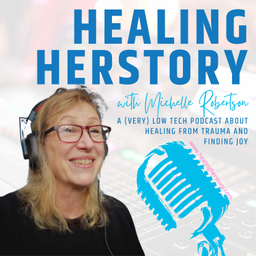
Healing HERstory the Podcast
Claim This Podcastby with Michelle Robertson
12 episodes
Updated Daily
Accepts GuestsHas Sponsors
Podcast Overview
Healing HERstory is a (very) low tech podcast all about trauma and healing and vulnerability and bravery and finding joy, hosted by. Michelle Robertson (me!). It’s a one woman show. In the first season, Things Unspoken, I speak from my own experience, exploring the aspects of childhood abuse and sexual violence that are often bushed over and not addressed. CONTENT WARNING: Take care of YOU! Switch off and step away if you need to. <br/><br/><a href="https://healingherstory.substack.com?utm_medium=podcast">healingherstory.substack.com</a>
Language
🇺🇲
Publishing Since
11/12/2022
1 verified contact email on file for Healing HERstory the Podcast
Pitch yourself as a guest, propose sponsorships, or reach out directly to the host.
Recent Episodes
March 4, 2023
S1: E11 - Talking About Suicide
<p>In this, the final episode of the season, I talk about one of the biggest “Things Unspoken”. Please take extra care and make sure that you’re in a safe space when you listen. I committed to 10 episodes for this first season and I did it, plus 1, despite a few weeks hiatus in between. I’ve really enjoyed this medium and plan to be back with more in the near future.</p><p><p>Thanks so much for listening to this Season. I really appreciate your support. Subscribe for free to be the first to know when Season 2 begins. .</p></p><p>TRANSCRIPTION</p><p>Hi, everyone, and welcome back. This is the final episode of this season of healing her story. Today we're going to be talking about suicide, which is not an easy thing to talk about, and something that is still not openly discussed in any real sense. So I think it fits very well and the theme of Things Unspoken. And yeah, it's something that's really been on my mind. So let's get into it. </p><p>There has been a fair bit of peer reviewed research around the correlation between suicide and child abuse, and very briefly, the conclusions are that Children who experience physical, sexual, and emotional abuse or neglect are at least two to three times more likely to attempt suicide in later life. Of the different types of abuse experienced, only childhood sexual abuse directly predicted suicidal ideation. All other types of abuse indirectly predicted suicidal ideation through their association with anxiety. Overall, Children who experience physical, sexual, and emotional abuse or neglect are at least two to three times more likely to attempt suicide in later life.</p><p>People don't like talking about suicide in public. No, not even those who post on their feeds. I'm here if you want to talk. In fact, these copy and paste posts, really get my hackles up. Leave this on your profile for so many minutes or hours, or whatever, to show that you support. It does nothing. </p><p>Most people who are seriously contemplating suicide are not able to reach out. Talk of suicide makes people uncomfortable, or sanctimonious. They don't know what to say, and they don't know how to respond. In the company of other people's pain and helplessness, people withdraw. They spout platitudes rather than engaging in real conversation about the reasons and circumstances that lead to thoughts of leaving this world. </p><p>Conversations around death by suicide need to be more than telling people, I'm here, you have so much to live for, this will pass, don't give up. You're not alone. Let's face it, when you're stuck in the hopelessness and the agony of having to take each next breath, when you're at that point of feeling, that death is the easiest, most painless way out of the place that you find yourself in now. When you're at the point where you have spoken yourself out of all the reasons you have to stay attached to this world. Those things that people say are empty. </p><p>There is very little acknowledgement of despair. And there's very little acknowledgement or understanding that death can seem like a relief, like a solution, like a way out, like the only avenue open, like the only reasonable choice. Often if we're in that space of suicidal ideation, we don't share our thoughts with others, or we talk about it in the abstract. </p><p>It is widely believed and taught that connection is the antidote to despair. However, in order to feel connected, we need to feel heard and understood. And that includes being understood in our helplessness and hopelessness, and pain. Part of being heard and understood means that we have to be able to say, and to hear, and to see the words. I do not want to live anymore, without having somebody come back with a band aid. You're not alone. I'm here for you. How exactly does that work? What does being here for me mean? </p><p>What is it that we really need in these moments? Do we even know ourselves? I have personally contemplated suicide pretty often. Many, many times over the years. In fact, I've come very close to acting on those thoughts. But the thing that always pulled me back was the thought of what it would do to my children. I've also experienced people I love acting on those feelings. It's beyond devastating for those of us left behind. </p><p>I lost one of my very closest friends to suicide several years ago, and it was crippling. But in that all encompassing grief, I also understood the motivation. He was not outwardly depressed, he had everything going for him, his career was really taking off. He just bought a new home. We'd been discussing a business venture we were planning together. I'd seen him two days before, and everything had seemed the way it always was. When I got the word that he had died, I lost myself in the devastation of his absence from my life, and a part of me shattered, never to be mended. </p><p>And while the reactions of our mutual friends and close family went through the gamut of responses to grief, including anger, how could he do this? I never felt that anger. As much of a shock as it was, it was also not unexpected to me. And it wasn't un-understandable to me. Because I really did understand, intimately, the draw of death as a solution. </p><p>This episode is not to offer answers. But to highlight that for some of us, death always lurks on the edges. Even when we're happy, even when we're dealing with life and coping. And this is another thing that is not spoken. Not in any real sense. Not with any authenticity or transparency. You're not alone. I'm here for you. None of those words or sentiments, really cut it.</p><p>This first series of the podcast has been about Things Unspoken. And it feels right that suicide should be the final episode of the series. It remains the great unspoken.</p><p>I hope that you found the series to be illuminating. And that at the very least, it has helped you feel less of an albatross in the things that you are going through, thinking about, and experiencing. Just because society is beginning to talk about trauma doesn't mean that people are ready for the real, raw experiences to be put into language, and put into the public domain. But these conversations need to be had without the sugarcoating and the platitudes </p><p>I'll be back in a month or two with a second series. I'm not sure yet how that will pan out. But I'll keep you updated. Until then, take care of yourself. And please share this podcast with anybody that you think might find it useful. Thanks for your support, and for listening over the last several weeks and months. And I really look forward to being back shortly.</p><p><p>Thank you for listening. This podcast is public so feel free to share it if there’s someone you think will benefit.</p></p><p></p> <br/><br/>This is a public episode. If you would like to discuss this with other subscribers or get access to bonus episodes, visit <a href="https://healingherstory.substack.com?utm_medium=podcast&utm_campaign=CTA_1">healingherstory.substack.com</a>
February 17, 2023
S1: E10 - Trauma Fractures Our Identity
<p>In this week’s episode I talk about trauma and identity. There is so much to say on this topic and, in fact, it is the basis for much of my work. If it resonates, let me know, I’d love to hear from you. </p><p>TRANSCRIPT</p><p>Hi everyone and welcome to another episode. Over the last few weeks, and possibly even months, I have taken a bit of a step back from the trauma work that I do with others. I have stepped back from my social media pages and I have spent time concentrating on this podcast. In retrospect. This has been extremely draining for me. Speaking the unspeakable is always difficult and many of the things I have spoken about in the podcast, I think that I have never spoken in public. I had to take a short break which leads me to this week’s topic: Trauma and Identity. </p><p>Growing into who we are and developing our identity is a journey from birth all the way through our lives, until we take our last breath. Yes, I believe that the purpose of life is getting to know who we are intimately and deeply.</p><p>When we experience trauma, along our life’s journey, it affects us on an identity level. If we’ve experienced trauma in early childhood, it has a profound effect on our identity and our journey towards self. I would love to be able to tell you that I have it all figured out and that I can point you to a checklist, so that you can come out the other side knowing exactly who you are, what you want, how to deal with life, </p><p>but there is no quick fix for life, and certainly not for trauma.</p><p>I have found many tools along the way that have helped me. They’ve taken me a lifetime to accumulate and assimilate, and the journey has not been an easy, it has, however, been extremely worthwhile. This forms the basis of my trauma work with others. </p><p>It is important to understand that the tools we use through our lives will be different at the different stages during our healing process. We likely used unhealthy tools in order to survive when we were children and young women, but as we begin an active path toward healing we experiment with more healthy approaches. Some of these work and some of them don’t, some of them work for some people and not for others, some of them and will work for a while and then not work again. What worked at the beginning of our healing process may not work later on.</p><p>Something else that I have discovered, is that there are times in our lives that new tools are required. Growing into who we are takes a lifetime, even without the trauma foundation, so when we have begun with a difficult foundation, it is important to understand that this is a journey to self is a journey for everyone, and the destination is not final. We will need new coping tools at the different times and stages of our lives and we will discover new things about ourselves at these different stages. When we experience key moments in our lives birth, death, love career changes, illness and, of course menopause. We my also find ourselves experiencing further traumas, and these will require healing too. </p><p>All of these and more, can throw us off kilter, can derail our healing, and yes we can experience a resurgence of trauma responses that we thought we had overcome. </p><p>Trauma can affect the way that we view ourselves in relation to the world. Everyone talks about the effects of trauma, in childhood and through life, but what they don’t talk much about is that it fractures you on an identity level. There’s so much emphasis on survivorship and healing, that little is voiced in terms of that fracture.</p><p>Identity formation is an important part of normal development, and takes place across our lifespan from birth, through childhood and adolescence, into adulthood, and old age. </p><p>When I speak about identity I’m talking about our sense of self, of feeling enough, the integrations of emotion and intellect, awareness of our own emotional state as we feel it in our hearts and minds and bodies, how secure we feel in ourselves and within the world, how we experience ourselves. </p><p>Identity is<strong> disrupted by developmental trauma because basic survival takes precedence over, and uses resources ordinarily allocated for, normal development of the self.</strong> </p><p><strong>Childhood trauma changes the trajectory of the brain’s development,</strong> because an environment characterised by fear and neglect, for example, causes different adaptations of brain circuitry than one of safety, security, and love. The earlier the distress, on average, the more profound the effect.</p><p>This is contrasted by distinct before and after with traumatic events in adulthood. Who you were before the traumatic event, whatever that may be - the loss of a loved one, an accident, a medical diagnosis, an attack, an abusive relationship, and who you are now, in the aftermath. </p><p>With childhood trauma it’s more complex, it’s layered. Your development of identity is intertwined with the trauma. Trauma becomes the foundation upon which you develop your identity. </p><p>The question of Who Am I, Really? Is one that takes time to answer. It takes work, and most of all it takes the willingness to do the work. </p><p>What that work entails will differ from person to person, and depend on the modality that works for them. </p><p>Again, it is not a quick fix, it is an ongoing journey. </p><p>We need to learn to trust ourselves and trust the other (whomever we choose to work with), </p><p>The process we follow involves observing, feeling, accepting, and integrating.</p><p>A part of this process is also grieving. Grieving isn’t only the terrain of death.</p><p>What we need to do is reclaim our Selves! It’s not about finding ourselves again, it’s about excavating, exploring and discovering who we are at each step of the journey. </p><p>I’m really excited to be starting a project that I’ve called the Self-Dicovery Lab. It’ll be a place where we can journey together on this path of self-discovery. I look forward to sharing more with you in the weeks to come. </p><p><p>Thank you for listening! If there’s someone you think may enjoy the podcast, feel free to share. </p></p><p></p> <br/><br/>This is a public episode. If you would like to discuss this with other subscribers or get access to bonus episodes, visit <a href="https://healingherstory.substack.com?utm_medium=podcast&utm_campaign=CTA_1">healingherstory.substack.com</a>
January 20, 2023
S1: E9 - Promiscuity, Hypersexuality and Risky Sexual Behaviour
<p>I guess this week’s topic is self explanatory. I encourage you to take special care as I speak about sexual violence, child abuse and rape. Take care of YOU! Switch off and step away if you need to.</p><p>TRANSCRIPT</p><p>Sex is such a difficult and complex topic, and one that is naturally shied away from. Yes, even today, when so much is considered acceptable in conversation, and women are so much more empowered than ever before. There is still a lot of subterfuge around the subject, so many lies we tell ourselves and others, so many ways in which the world, and by the world, I mean society, imposes it’s standards upon us. </p><p>Truthfully, this topic requires more than just a short podcast, but it’s certainly one of the “Things Unspoken” and so I have to include it here. </p><p>Promiscuity is also an extremely loaded word:</p><p>The original meaning of the word in the 1500s was to describe something random or disordered, by the 1600s it was used to describe someone who was undiscerning in their choices. By the 1800s it was used to describe sexual behaviour, particularly the sexual behaviour, or perceived behaviour of women. While the word is being reclaimed and the meaning once again opening up, there are still some negative overtones in many sectors of society.</p><p>The word “hypersexuality” is used to describe compulsive sexual behaviour, and risky sexual behaviour speaks for itself.</p><p>I have experienced all of these.</p><p>There’s quite a bit of research around these behaviours and choices as they relate to abuse, and even more speculation. I’m not going to talk about that, the research is available for anyone who want to explore more. What I want to talk about is my own experience and the lived experiences of hundreds of survivors of childhood sexual abuse that I have spoken with over the years. It’s something seldom discussed outside of support groups, and often not even in the sanctitude of therapy.</p><p>It seems counterintuitive at first that sexual abuse in childhood, or sexual violence in adulthood would lead to promiscuous and even risky sexual behaviour. People often think that the natural response would be to shy away from physically intimate contact. </p><p>While this is certainly true for many women, it is not the case for a multitude of others…and it’s really not that simple or that binary. Our responses and attitudes toward sex can vary over time, and even in the short term. We can sleep with a stranger one night and be filled with self-loathing, or feel nothing at all, and then not want to have intimate physical contact at all for a long time. We can obsess over sex and even turn to pornography, yes, women too, as a trauma response. </p><p>The fact that this is not spoken about further isolates survivors and exacerbates our feelings of self loathing and shame. I have spoken with women who are so wracked with guilt and shame over their physical, emotional and cognitive responses to sex, that they are convinced that everything that happened to them is punishment for their own thoughts and feelings. </p><p>When I was a young girl, around twelve I think, I fell with a bottle in my hand and sliced open the ball of my thumb, exposing the muscle. It required a lot of stitches, and I was convinced that it was punishment for using my hand to masturbate. I didn’t know the word ‘masturbate’, this was in the mid seventies, and NOTHING was spoken about. Sex, politics and religion were taboo topics, at least they were where I lived. All I knew was that I had sinned and this was my punishment.</p><p>It may be useful to break down what happens when we are sexually traumatised. Trauma, especially in childhood, but also later in life, shatters us on the level of identity. If the trauma occurred in childhood, we had not yet developed a sense of self. A lot of what I cover in my various courses and programmes, revolves around identity. Our sense of identity lies at the core of our trauma.</p><p>My identity and worthiness (or lack of worth) was built primarily around sex, around the way in which men responded to me. As I’ve mentioned before, the abuse began before the age of three, I had no identity outside of the abuse. </p><p>This is an enormously complex issue. I’ve also mentioned in an earlier episode that I was diagnosed with Dissociative Identity Disorder. This compounded things enormously. No explanation can do justice to my experience of life, but to simplify things, the different parts of me took on different roles. </p><p>I was both drawn to sexual encounters and repulsed by them. </p><p>I found both validation in sexual encounters and self-loathing.</p><p>As much as my self worth was upheld by being desired sexually, it was immediately shattered in the fulfilment of that desire. </p><p>I’d come to learn years later, that it was very much like addiction, it was something I both craved and hated about myself. </p><p>Sex and love were so messed up in my head, as soon as I had feelings for someone, I could no longer maintain a sexual relationship. My body and my mind were completely separate, and I had no idea which way I would respond. </p><p>Sex was both an escape and a wound.</p><p>The first season of this podcast is called “Things Unspoken” and our relationship to sex in the aftermath of sexual violence is definitely one of those unspoken things. As much as we are shining a light on sexual abuse and violence, there is still so much that is hidden, that we keep from the world and each other because of the foundational shame around our experiences and, as we begin to try and heal, around our trauma responses. Keeping silent about what we experience in the aftermath of abuse and sexual violence is as isolating and damaging as the silence around the actual abuse. </p><p>It really is time to break the silence. About all of it. It’s also important to acknowledge that the same way in which each of our experiences are different, our trauma responses and our healing will be different too. It’s my hope that we can destigmatise it ALL, so that we can make the transition from shame to healing without the added judgement from society.</p><p>Shame is a residue of trauma that separates us from ourselves and from others.</p><p>Before I end this, I want to say something about sexuality and promiscuity.</p><p>There is nothing wrong with having different sexual partners. There’s nothing wrong with sexual experimentation and exploration. Sex with different partners can be a way of reclaiming your sexuality. There are both healthy and unhealthy ways of doing this.</p><p>However and with whomever you engage in sexual activity, it should leave you feeling empowered and affirmed and good about yourself, it should be an embodied experience, not a dissociative one, and should not leave you filled with guilt and shame and questioning your self worth.</p><p>Unfortunately we are fighting both ourselves and society on this front, I just hope that the world will continue to change so that young women are able to grow up without the societal stigma around women and sex. </p><p>As always I welcome your thoughts and comments.</p> <br/><br/>This is a public episode. If you would like to discuss this with other subscribers or get access to bonus episodes, visit <a href="https://healingherstory.substack.com?utm_medium=podcast&utm_campaign=CTA_1">healingherstory.substack.com</a>
12 total episodes available
Deep-dive analytics for Healing HERstory the Podcast
Frequently asked questions
Have a different question and can't find the answer you're looking for? Reach out to our support team by sending us an email and we'll get back to you as soon as we can.
- What is Healing HERstory the Podcast?
- How often does this podcast release new episodes?
This podcast updates daily.
- Where can I listen to this podcast?
This podcast is available on 4 platforms including Apple Podcasts, Spotify, and more. You can also use the RSS feed directly.
- Does this podcast accept guests?
No, this podcast does not typically feature guests.
Legal Disclaimer
Pod Engine is not affiliated with, endorsed by, or officially connected with any of the podcasts displayed on this platform. We operate independently as a podcast discovery and analytics service.
All podcast artwork, thumbnails, and content displayed on this page are the property of their respective owners and are protected by applicable copyright laws. This includes, but is not limited to, podcast cover art, episode artwork, show descriptions, episode titles, transcripts, audio snippets, and any other content originating from the podcast creators or their licensors.
We display this content under fair use principles and/or implied license for the purpose of podcast discovery, information, and commentary. We make no claim of ownership over any podcast content, artwork, or related materials shown on this platform. All trademarks, service marks, and trade names are the property of their respective owners.
While we strive to ensure all content usage is properly authorized, if you are a rights holder and believe your content is being used inappropriately or without proper authorization, please contact us immediately at hey@podengine.ai for prompt review and appropriate action, which may include content removal or proper attribution.
By accessing and using this platform, you acknowledge and agree to respect all applicable copyright laws and intellectual property rights of content owners. Any unauthorized reproduction, distribution, or commercial use of the content displayed on this platform is strictly prohibited.