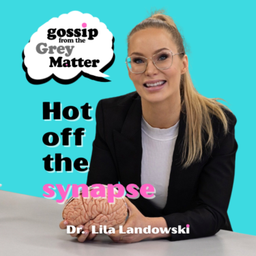
Hot off the Synapse (Live interview archives with Dr Lila Landowski, neuroscientist)
RockAtScientist media
- 16
- Episodes
- 2025
- First episode
About Hot off the Synapse (Live interview archives with Dr Lila Landowski, neuroscientist)
I pop up in the media a lot to talk neuroscience: from tiny brain quirks to big health questions. The only problem? I don't have the bandwidth to turn them into social posts, so if you didn’t catch them live… they vanish into the ether 🫠 I’ve done a little audio archaeology and started gathering some of the radio interviews into one tidy Spotify home, for your listening pleasure. Like what you hear? Follow for more, I'll keep updating when I can!
- Publisher
- RockAtScientist media
- Category
- health & fitness
- Language
- en
- Explicit
- No
- First episode
- 30 Dec 2025
- Latest episode
- 29 Mar 2026
Latest episodes
16 episodes in the feed.
29 Mar 2026
Dr Lila Landowski | TEDx | Brain Hack: 6 secrets to learning faster, backed by neuroscience
Sharing the secrets to productive learning, backed by neuroscience. Dr Lila Landowski explains the methods which can be used to allow us to learn faster. Dr Lila Landowski is a multi-award winning neuroscientist and senior lecturer that expertly arms people with an understanding of how their brain works, to help them make better choices in their lives. She is also a Director of Science and Technology Australia, Fides member of the World Health Organisaiton, as well as a regular guest expert science communicator for the ABC. This talk was given at TEDxHobart, a TEDx event using the TED conference format but independently organized by a local community.
2 Jan 2026
Why Teens Tune Out: The Science Behind Selective Hearing - Neuroscientist Dr Lila Landowski with Andy Park on ABC RN Drive
Why Teens Tune Out: The Science Behind Selective Hearing - Neuroscientist Dr Lila Landowski speaks to host Andy Park on ABC RN Drive This episode explores the intriguing phenomenon of selective hearing in teenagers, particularly focusing on why they may not respond to their mother's voice. Neuroscientist Dr Lila Landowski discusses research from Stanford University that examines brain activity in children and teenagers when listening to their mother's voice versus unfamiliar voices. The findings reveal significant differences in brain responses pre- and post-puberty, suggesting evolutionary reasons for these changes. teenagers, selective hearing, neuroscience, brain activity, puberty, evolutionary psychology Teenagers often exhibit selective hearing, especially towards their mother's voice. Research from Stanford University used MRI to study brain activity in children and teenagers. Pre-puberty children show increased brain activity in reward and social value areas when hearing their mother's voice. Teenagers' brains respond more to unfamiliar voices than to their mother's voice. The use of made-up words in the study helps isolate the brain's response to voice rather than word meaning. The age of 13 is critical for changes in brain response to familiar versus unfamiliar voices. Evolutionary psychology suggests this change aids in independence and social learning. Hormonal changes during puberty contribute to shifts in brain activity and behavior. The desire to distance from parents during puberty is linked to survival and reproduction instincts. Caveman behavior parallels modern teenage behavior in terms of communication and social dynamics.
2 Jan 2026
A stroke of bad luck? Exploring the Stroke Drug Bottleneck
This is the extended version of an episode which aired live on the ABC Radio National Health Report. https://www.abc.net.au/listen/programs/healthreport/improving-stroke-research/11515796 Summary This conversation explores the personal experience of a stroke survivor, the complexities of stroke treatment, the challenges in biomedical research, and the ethical considerations surrounding animal testing. It highlights the need for improved research methodologies and the importance of recovery in the journey after a stroke. Guests: Adrian O'Malley Stroke patient Professor David Howells Professor of Neuroscience and Brain Plasticity, University of Tasmania Dr Alexandra Bannach-Brown Research Fellow, Bond University Consultant in Laboratory Animal Care and Management Reporter: Dr Lila Landowski. This episode was generated as part of Dr Lila Landowski's ABC Top 5 Scientist Media Residency. Host: James Bullen Producer: Joel Werner, Carl Smith, Diane Dean Takeaways Coordination issues can signal a stroke emergency. Stroke can lead to lifelong disabilities without proper treatment. TPA is the only drug for ischemic strokes but has strict eligibility criteria. 70% of patients may not benefit from TPA even if administered. Research waste in biomedical science is a significant issue. Improving drug testing methods can lead to better stroke treatments. Animal models of stroke need to be more representative of human conditions. The three R's of animal testing are replacement, reduction, and refinement. Quality research foundations are crucial for effective treatment development. Recovery from stroke is a collaborative effort involving family support. Chapters 00:00 The Day That Changed Everything 02:45 Understanding Stroke and Its Impact 05:54 The Quest for Better Stroke Treatments 08:55 Improving Research Models for Stroke 10:22 The Importance of Collaboration in Recovery Keywords: stroke, treatment, research, biomedical science, recovery, TPA, animal testing, research waste, neuroscience, health
2 Jan 2026
Australian Neuroscience Society annual conference - chatting to a range of researchers
The 2025 Australasian Neuroscience Society Conference landed in Dr Lila Landowski’s hometown of Hobart—and with so many brilliant researchers descending on the city, she couldn’t resist getting them on the mic to share what they’re working on. This segment is a little different to the usual: you won't hear much from Lila, and instead, you’ll hear from five Australian neuroscientists, each giving a snapshot of their fascinating research. Professor Jason Mattingly- President of the Australasian Neuroscience Society & University of Queensland/Queensland Brain Institute Dr Carly Cullen- University of Queensland, Mater Research Institute. Professor Anthony Hannan- Florey Institute of Neuroscience and Mental Health Aelon Rahmani - Flinders University Dr. Kirsten Coupland- University of Newcastle. Summary The conversation revolves around the Australasian Neuroscience Society Conference, highlighting various research topics in neuroscience, including sensory processing, myelin biology, anxiety disorders, and the role of cerebrospinal fluid in brain health. The speakers share their insights and experiences, emphasizing the importance of collaboration and discovery in the field of neuroscience. Chapters 00:00 Dr Lila Landowski: The Conference Theme 02:46 Prof Jason Mattingley: Understanding Sensory Processing and Attention 05:56 Dr Carly Cullen, Mater Research Institute: Exploring Myelin and Brain Repair 08:45 Modeling Anxiety Disorders in Rodents 11:32 The Role of Immune Activation in Brain Health 14:43 Cerebrospinal Fluid: The Brain's Cleaning Mechanism Keywords: neuroscience, brain research, attention, myelin, anxiety disorders, cerebrospinal fluid, Australasian Neuroscience Society, neurological conditions, mental health, scientific discovery
2 Jan 2026
Minds Under Siege: Your Brain in the digital era with neuroscientist Dr Lila Landowski
Minds Under Siege: Your Brain in the digital era with neuroscientist Dr Lila Landowski Lila spoke to Kylie Baxter live on ABC Radio Hobart Drive program on 6 August 2025 Dr Lila Landowski Neuroscientist and Senior Lecturer, UTAS; Vice President and Director, Science & Technology Australia; Fides Member, World Health Organisation Opinions and perspectives shared here are Lila's, and do not necessarily reflect the opinions of the organisations she works for and represents. Keywords technology, AI, mental health, social media, neuroscience, brain development, face-to-face communication, cognitive skills, sensory overload, human connection Summary In this conversation, Dr. Lila Landosky, a neuroscientist, discusses the profound effects of technology, particularly AI and social media, on human cognition and mental health. She highlights how advancements in technology have historically allowed humans to develop skills and communities but raises concerns about the current reliance on AI and social media, which may hinder cognitive development and social interactions. The discussion emphasizes the importance of face-to-face communication for mental well-being and the risks of sensory overload in our technology-driven lives. Takeaways The brain adapts to efficiency, impacting skill development. AI may reduce our cognitive engagement over time. Social media usage correlates with decreased face-to-face interactions. Lack of socialization can lead to increased anxiety and depression. Face-to-face communication enhances brain synchrony and well-being. Sensory overload can lead to stress and anxiety. Historical advancements in tools have shaped human development. Technology can both aid and hinder our cognitive abilities. Engaging with real humans is vital for mental health. Our reliance on technology is changing our social landscape
31 Dec 2025
Debunking brain myths with neuroscientist Dr Lila Landowski with Helen Shield on ABC Radio
Debunking Brain Myths: we use more than 10% of our brain, the left-right brain conundrum, the truth about learning styles: neuroscientist Dr Lila Landowski chats to host Helen Shield on ABC Radio Keywords brain myths, learning styles, neuroscience, education, intelligence, brain games, memory, teaching methods, cognitive science, psychology Summary In this conversation, Dr. Lila Landowski, neuroscientist, discusses various myths surrounding brain function and learning. She debunks the myth that we only use 10% of our brains, explaining that all parts of the brain are active at different times. The discussion also covers the misconceptions about left-brain versus right-brain functions, the lack of evidence supporting different learning styles, and the limited benefits of brain games. Dr. Landowski emphasizes the importance of a holistic approach to learning and teaching. Takeaways The idea that we only use 10% of our brains is false. All parts of the brain are activated at different times. Left and right brain functions are more integrated than separate. The hippocampus plays a crucial role in memory. There is no correlation between brain size and intelligence. Different learning styles do not guarantee better comprehension. Incorporating various learning methods is beneficial for all students. Brain games improve specific skills but do not increase overall intelligence. The corpus callosum connects the two brain hemispheres for better communication. Understanding brain function can improve teaching methods. Dr Lila Landowski Neuroscientist and Senior Lecturer, UTAS; Vice President and Director, Science & Technology Australia; Fides Member, World Health Organisation Opinions and perspectives shared here are Lila's, and do not necessarily reflect the opinions of the organisations she works for and represents.
31 Dec 2025
Rejuvenating Memory: The Science of Young CSF, Insights from Mice Studies - with Neuroscientist Dr Lila Landowski on ABC Radio National Drive hosted by Andy Park
Rejuvenating Memory: The Science of Young CSF, Insights from Mice Studies - with Neuroscientist Dr Lila Landowski on ABC Radio National Drive hosted by Andy Park This episode delves into groundbreaking research on memory improvement in mice, exploring how cerebrospinal fluid from young mice can rejuvenate the memory of older mice. Neuroscientist Lila Landowski discusses the role of fibroblast growth factor 17 in enhancing brain function, drawing parallels to the potential implications for human brain health. memory improvement, cerebrospinal fluid, fibroblast growth factor 17, neuroscience, brain health, mice research Cerebrospinal fluid from young mice can rejuvenate older mice's memory. Fibroblast growth factor 17 mimics the effects of young cerebrospinal fluid. The hippocampus is crucial for memory improvement in mice. Oligodendrocytes play a key role in neuron efficiency and memory. The study highlights potential implications for human brain health. Cerebrospinal fluid changes with age, impacting brain function. The research offers a direct method to influence brain health. Young blood studies in mice show similar rejuvenating effects. The findings open discussions on ethical implications in research.
31 Dec 2025
Selective hearing of teens, improving memory in old mice, and PFAS in firefighters - Research Filter with Neuroscientist Dr Lila Landowski on ABC Radio National Drive with Andy Park,
Neuroscientist Dr Lila Landowski speaks on ABC Radio National Drive with Andy Park, discussing three new studies - one on the selective hearing of teens, improving memory in old mice, and PFAS in firefighters Keywords neuroscience, aging, memory, teenagers, selective hearing, blood donation, fibroblast growth factor, cerebrospinal fluid, oligodendrocytes, PFAS Summary In this conversation, neuroscientist Dr Lila Landowski discusses groundbreaking research on aging, memory enhancement, and the unique auditory processing of teenagers. She explains how specific proteins can rejuvenate memory in older mice and explores the shift in teenagers' responses to their mothers' voices as they approach puberty. Additionally, she highlights the health benefits of blood donation, particularly in reducing harmful chemicals in the bloodstream. Takeaways Fibroblast growth factor 17 can enhance memory in older mice. Cerebrospinal fluid plays a crucial role in brain function. Teenagers' brains prioritize social voices over their mother's voice. The age of 13 marks a significant change in auditory processing. Independence during adolescence is linked to evolutionary survival. Blood donation can help eliminate harmful forever chemicals. Oligodendrocytes are essential for efficient brain function. The brain's reward pathways change during puberty. Research shows the importance of social learning in adolescence. Donating blood has personal health benefits beyond societal contributions. Titles Unlocking the Secrets of Memory and Aging Teenage Hearing: The Shift from Mom to Social Voices Chapters 01:46 Neuroscience of Aging and Memory 04:47 Teenagers and Selective Hearing 07:37 The Benefits of Blood Donation 220518
30 Dec 2025
12 questions to help you assess your dementia risk with neuroscientist Dr Lila Landowski - ABC Radio National Drive
12 questions to help you assess your dementia risk with neuroscientist Dr Lila Landowski - aired on 24 September 2024 on ABC Radio National Drive with Andy Park Take The New York Times quiz: https://www.nytimes.com/interactive/2024/09/03/well/mind/brain-health-quiz-dementia-depression-stroke.html Has a health care provider ever told you that your blood pressure is high? Has a health care provider ever told you that your blood sugar is high or your hemoglobin A1c is elevated? Has a health care provider ever told you that your cholesterol is elevated and that you need to take a daily medication to treat it? What is your B.M.I.? What does your typical diet include? Select all that apply. How many alcoholic drinks do you consume per week Do you smoke cigarettes? Do you engage in at least 150 minutes of moderate intensity physical activity or 75 minutes of high intensity physical activity per week? What are your typical sleep habits? Select the option that best fits. How are your stress levels? Do you have close connections, other than your spouse or children, with whom you could talk about private matters, or call upon for help? Do you feel that your life has meaning or purpose? Keywords brain health, diet, alcohol, social connections, stress, neurological diseases, cognitive function, mental health, lifestyle choices, neuroscience Summary In this conversation, neuroscientist Dr. Lila Landowski, a neuroscientist, discusses the importance of brain health and how lifestyle choices can impact cognitive function. The discussion covers a quiz that assesses brain health, the effects of diet, alcohol consumption, social connections, and stress on neurological well-being. Dr. Landowski emphasizes that many factors influencing brain health are within our control, encouraging listeners to make informed lifestyle choices to enhance their cognitive health. Takeaways Looking after your physical health is straightforward, but brain health requires specific attention. A quiz can help assess your brain health and risk for neurological diseases. Diet plays a crucial role in brain health, particularly the consumption of whole foods and fiber. High sugar intake can reduce the production of new brain cells. Alcohol consumption, even in moderation, can negatively impact brain health. Social connections are vital for maintaining mental health and reducing stress. Chronic stress can lead to significant cognitive decline and emotional issues. Making informed lifestyle choices can improve brain health and cognitive function. Understanding your brain health score can empower you to make positive changes. The conversation highlights that many aspects of brain health are changeable and within our control. Chapters 00:00 Understanding Brain Health 04:24 The Impact of Diet on Brain Function 09:00 The Role of Social Connections and Stress 12:33 Empowerment Through Knowledge
30 Dec 2025
Dementia & How to keep your brain healthy with neuroscientist Dr Lila Landowski - ABC Radio National, Life Matters Program
Dementia is one of the words we dread hearing. Along with cancer, it's the diagnosis we fear most. Despite advances in research and promising results from new drugs, there is currently no cure. However, it is not an inevitable part of the aging process, so prevention is key when warding off dementia. To help you keep your brain and the brains of your loved ones healthy, Dr. Lila Landowski, a neuroscientist and lecturer at the University of Tasmania, has some tips based on the more recent research. Guest: Dr Lila Landowski, neuroscientist at the University of Tasmania; Vice President of Science & Technology Australia; Fides Member World Health Organisation. Credits ABC Radio National, Life Matters Program Tom Wright, Tegan Taylor Originally Aired 3 Feb 2025: https://www.abc.net.au/listen/programs/lifematters/blank-minds/105233286
30 Dec 2025
Mental Blanks with neuroscientist Dr Lila Landowski - ABC Radio National, Life Matters Program
Mental Blanks with neuroscientist Dr Lila Landowski, on ABC Radio National, Life Matters Program New research suggests that mental blanks should be treated as their own distinct mental state. So, what’s happening up there when the things go blank? Guest: Dr Lila Landowski, neuroscientist at the University of Tasmania; Vice President of Science & Technology Australia; Fides Member World Health Organisation. Credits ABC Radio National, Life Matters Program Tom Wright, Tegan Taylor Originally Aired 30 April 2025: https://www.abc.net.au/listen/programs/lifematters/blank-minds/105233286
30 Dec 2025
How do you measure happiness? Dr Lila Landowski on ABC Radio National Life Matters
The United Nations has announced its annual world happiness report, but how do you actually measure happiness? Guest: Dr Lila Landowski, neuroscientist at the University of Tasmania; Vice President of Science & Technology Australia; Fides Member World Health Organisation. Credits ABC Radio National, Life Matters Program Tom Wright, Tegan Taylor Originally Aired 8 March 2025: https://www.abc.net.au/listen/programs/lifematters/how-do-you-measure-happiness/105031508
30 Dec 2025
Ingredients of Happiness with neuroscientist Dr Lila Landowski - The Dan and Christie Show Hit 100.9
Ingredients of Happiness with neuroscientist Dr Lila Landowski - Originally aired 18 March 2025 on The Dan and Christie Show Hit 100.9 Keywords happiness, neuroscience, social connections, community, time affluence, brain health, oxytocin, cortisol, Fiji, well-being Summary In this conversation, neuroscientist Dr. Lila Landowski discusses the neuroscience of happiness, emphasizing the importance of social connections and community. She shares insights from her recent trip to Fiji, where she observed the happiness of the locals and the role of gratitude and connection in well-being. The discussion also touches on the impact of technology on our interactions and the significance of time affluence in achieving happiness. Dr. Landowski highlights the benefits of being in nature and shared experiences, such as concerts, in fostering happiness and connection. Takeaways Happier people have more neurotransmitters like dopamine and serotonin. Community and connection are vital for happiness. Social interactions release oxytocin, reducing stress. Face-to-face interactions synchronize brainwaves. Technology can hinder our emotional connections. Smiling at others can reduce anger and emotional charge. Time affluence contributes to a sense of happiness. Being in green spaces lowers cortisol levels. Shared experiences create a sense of unity. Connecting with friends in person enhances well-being. Chapters 00:00 Reflections on Neighbours and Career Challenges 02:35 The Neuroscience of Happiness and Connection 05:35 The Importance of Face-to-Face Interactions
30 Dec 2025
The neuroscience of everything + origin story with neuroscientist Dr Lila Landowski - The Dan and Christie Show Hit 100.9
The neuroscience of everything + origin story with neuroscientist Dr Lila Landowski - originally aired 5 June 2024 on The Dan and Christie Show Hit 100.9 Keywords neuroscience, brain hacks, exercise, technology, attention span, love, mental health, brain cells, neurochemicals, personal journey Summary In this conversation, neuroscientist Dr Lila Landowski shares her journey into the field of neuroscience, discussing the importance of exposure to different experiences in shaping one's career. She emphasizes the benefits of exercise for brain health, the detrimental effects of technology on attention spans, and the biological basis of love as an addiction. Lila provides insights into how our brains adapt to experiences and the neurochemicals involved in relationships. Takeaways Lila's journey into neuroscience began with a childhood experience at a school camp. Exposure to different experiences is crucial for discovering one's passion. Exercise not only benefits physical health but also enhances brain function. New brain cells can be created through regular exercise. Mental health improves significantly with physical activity. Technology can erode attention spans, especially in children. The brain is designed to focus on one thing at a time. Love is a biological response that can be likened to addiction. The brain adapts to the presence of neurochemicals over time. Understanding the neuroscience of love can help navigate relationships.
30 Dec 2025
"Brain Washing," "baby brain," Sleep & Dreams with neuroscientist Dr Lila Landowski - The Dan and Christie Show Hit 100.9
Sleep & Dreams with neuroscientist Dr Lila Landowski - The Dan and Christie Show Hit 100.9 originally aired 18 March 2025 keywords sleep, brain health, sleep deprivation, dreams, nightmares, emotional regulation, parenting, neuroscience summary In this conversation, Neuroscientist Dr. Lila Landowski discusses the critical importance of sleep for brain health, the effects of sleep deprivation on emotional regulation, and the science behind dreams and nightmares. She emphasizes the need for understanding and compassion towards those experiencing sleep deprivation, particularly new parents, and offers practical techniques for managing nightmares in children. takeaways Sleep deprivation makes emotional regulation more challenging. New parents often experience significant sleep deprivation. The brain undergoes important cleansing processes during sleep. Dreams help consolidate memories and experiences from the day. Breathing techniques can help manage anxiety and nightmares in children. Sleep is crucial for mental health and decision-making. Understanding sleep can improve parenting strategies. Celebrating the changes in a woman's brain after childbirth is important. Sleep impacts our ability to think clearly and make decisions. Compassion is key for those struggling with sleep issues. Unlocking the Secrets of Sleep The Neuroscience of Sleep and Dreams Full ep: https://play.listnr.com/podcast/hit-hobart-breakfast/episode/the-podcast-bonnie-anderson-dr-lila-landowski-nash-morris (https://play.listnr.com/podcast/hit-hobart-breakfast/episode/the-podcast-bonnie-anderson-dr-lila-landowski-nash-morris)?
30 Dec 2025
Social Media & The Brain with Dr Lila Landowski, neuroscientist - The Dan & Christie Show Hit100.9
Aired on the Dan & Christie Show 23 January 2025 keywords TikTok, social media, mental health, neuroscience, attention span, doom scrolling, communication skills, self-worth, anxiety, depression summary In this conversation, neiuroscientist Dr. Lila Landowski discusses the negative impacts of social media on mental health and attention spans. She highlights the importance of face-to-face communication and the need for educational systems to adapt to the changing landscape of social interaction. The discussion also touches on the phenomenon of doom scrolling and its effects on brain function and social anxiety.takeaways Social media negatively impacts attention spans and self-worth. Teenagers are particularly vulnerable to social media effects. Doom scrolling acts as a stressor for the brain. Short-form content leads to context switching and erosion of focus. Face-to-face communication skills are essential for the next generation. Encouraging boredom can foster creativity and social skills. Social anxiety is increasing due to lack of real-life interactions. Educational systems need to teach communication skills. Setting rules around phone use can help mitigate social media addiction. Engaging in offline activities is crucial for mental health. The Neuroscience of Social Media Understanding the TikTok Effect
Contact Hot off the Synapse (Live interview archives with Dr Lila Landowski, neuroscientist)
- Guest appearances
- Books guests
Based on episode analysis; this does not confirm that the show is currently accepting guests.
Host of Hot off the Synapse (Live interview archives with Dr Lila Landowski, neuroscientist)?
Claim your podcast to manage its listing and keep your show details accurate.
Pod Engine is an independent podcast discovery and analytics service and is not affiliated with or endorsed by this podcast. Artwork and show content belong to their owners. Full legal notice.
Explore this show
Podcast research with Pod Engine