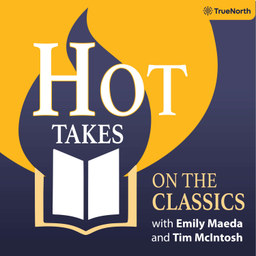
Hot Takes on the Classics is no dusty, academic approach to great books. It’s a gossipy, exciting discussion about the best literature ever written. Hosted by Tim and Emily, who are veteran teachers and long-time friends, Hot Takes is packed with playful debate, meaningful speculation, and hearty laughs.

Hot Takes on the Classics
Claim This Podcastby Emily Maeda & Tim McIntosh
Podcast Overview
Hot Takes on the Classics is no dusty, academic approach to great books. It’s a gossipy, exciting discussion about the best literature ever written. Hosted by Tim and Emily, who are veteran teachers and long-time friends, Hot Takes is packed with playful debate, meaningful speculation, and hearty laughs.
Language
🇺🇲
Publishing Since
11/22/2024
1 verified contact email on file for Hot Takes on the Classics
Pitch yourself as a guest, propose sponsorships, or reach out directly to the host.
Recent Episodes

July 14, 2026
Episode 2: Childhood’s Remembering
Emily Maeda and Tim McIntosh explore William Wordsworth's "Ode: Intimations of Immortality," interviewing each other on childhood's unique perception of transcendent realities.

July 7, 2026
Episode 1: The Selection Show: Choosing the Great Stories for a Season on Life
Emily Maeda and Tim McIntosh interview each other about curating classic literature for childhood, adolescence, adulthood, and old age, highlighting the power of short stories.

February 17, 2026
Episode 24: Favorite Reads of 2025
<p><b>Description</b></p><p>In this special year-end episode of Hot Takes on the Classics, Tim McIntosh and Emily Maeda share their five favorite reads of 2025. Moving from plays and poetry to memoir, philosophy, theology, neuroscience, and historical fiction, they reflect on the books that most shaped their thinking this year. Along the way, they discuss stage design and historical drama, political memoir, levitating saints and historiography, divided brain theory, mystical theology, and poetic devotion. They also ask an intriguing question: Which of these contemporary works might endure as future classics? The episode closes with a preview of next season’s theme—short narratives exploring the milestones of human life.</p><p><b>Episode Outline</b></p><ul><li>Introduction to the “Top Five Reads of 2025” format</li><li>Discussion of the “Top Five Reads of 2025”</li><li>Preview of next season: short stories and short narratives across the arc of life</li></ul><p><b>Key Topics & Takeaways</b></p><ul><li><strong>Literature and Performance Across Time:</strong> The Lehman Trilogy demonstrates how stagecraft and direction can elevate historical narrative into sweeping theatrical art, while Herbert’s The Temple shows how poetry functions as an architectural whole rather than isolated lyrics.</li><li><strong>Autobiography vs. Memoir:</strong> Dorothy Day’s A Long Loneliness offers a straightforward recounting of lived experience, in contrast to more literary memoirs like Augustine’s Confessions. The distinction between recounting and artistic shaping becomes part of the interpretive conversation.</li><li><strong>Mysticism and the Limits of Modern Materialism:</strong> Carlos Eire’s They Flew challenges historians to take seriously supernatural claims recorded in early modern sources, raising questions about empiricism, testimony, and belief.</li><li><strong>The Divided Brain and Cultural Imbalance: </strong>Ian McGilchrist’s The Master and His Emissary and The Matter with Things argue that Western culture overprivileges left-hemisphere abstraction at the expense of right-hemisphere wholeness, intuition, and poetic knowledge.</li><li><strong>Devotion and Incarnation:</strong> Simone Weil’s Waiting on God and George Herbert’s The Temple exemplify deeply incarnational spiritual writing—faith expressed through attention, humility, and beauty.</li><li><strong>The Question of the “Future Classic”: </strong>Throughout the episode, the hosts consider which of their contemporary selections might endure. While older works like Kierkegaard and Herbert are already canonical, authors like Franzen, Fosse, and McGilchrist raise the question of long-term literary legacy.</li></ul><p><b>Questions & Discussion</b></p><ul><li><strong>What makes a book feel “classic” rather than merely contemporary?</strong><br>Consider whether clarity of moral vision, stylistic excellence, cultural influence, or thematic universality determines lasting status.</li><li><strong>How does rereading change a book’s power?</strong><br>Reflect on whether returning to a familiar text (like The Temple) reveals layers missed in earlier readings.</li><li><strong>Is intuition a legitimate form of knowledge?</strong><br>Drawing from McGilchrist’s work, consider how intuition functions in your own decision-making and whether it can be trusted.</li><li><strong>Can contemporary fiction capture generational change convincingly?</strong><br>Discuss whether multi-generational novels like Crossroads can successfully portray cultural shifts across decades.</li><li><strong>Which of these books do you think will still be read 100 years from now?</strong><br>Identify one title from this episode and defend its potential longevity.</li></ul><p><b>Suggested Reading & Resources</b></p><ul><li><a href="https://www.devotchka.net/band">Devotchka</a></li><li><a href="https://amzn.to/4kHKuab">The Lehman Trilogy </a>by Stefano Massini</li><li><a href="https://amzn.to/465efeY">Crossroads</a> by Jonathan Franzen</li><li><a href="https://amzn.to/4tG7YjT">The Sickness Unto Death </a>by Søren Kierkegaard</li><li><a href="https://amzn.to/4tCaB6g">Trilogy</a> by Jon Fosse</li><li><a href="https://amzn.to/44kUvDe">Waiting for God</a> by Simone Weil</li><li><a href="https://amzn.to/4kGvKbw">The Temple </a>by George Herbert</li><li><a href="https://amzn.to/4aAkRDw">The Long Loneliness </a>by Dorothy Day</li><li><a href="https://amzn.to/4qHqBBl">They Flew: A History of the Impossible</a> by Carlos Eire</li><li><a href="https://amzn.to/4aFHCpH">The Master and His Emissary</a> by Ian McGilchrist</li><li><a href="https://amzn.to/4rfi4GM">The Matter with Things</a> by Ian McGilchrist</li><li><a href="https://amzn.to/4tX3aab">The Life You Save May Be Your Own </a>by Paul Elie </li><li><a href="https://amzn.to/4ao4VW8">The League of the Lexicon</a></li><li><a href="https://classicalacademicpress.com/collections">Classical Academic Press</a></li></ul>
50 total episodes available with 3 transcripts
Deep-dive analytics for Hot Takes on the Classics
Frequently asked questions
Have a different question and can't find the answer you're looking for? Reach out to our support team by sending us an email and we'll get back to you as soon as we can.
- What is Hot Takes on the Classics?
- How often does this podcast release new episodes?
This podcast updates daily.
- Where can I listen to this podcast?
This podcast is available on 4 platforms including Apple Podcasts, Spotify, and more. You can also use the RSS feed directly.
- Does this podcast accept guests?
No, this podcast does not typically feature guests.
Legal Disclaimer
Pod Engine is not affiliated with, endorsed by, or officially connected with any of the podcasts displayed on this platform. We operate independently as a podcast discovery and analytics service.
All podcast artwork, thumbnails, and content displayed on this page are the property of their respective owners and are protected by applicable copyright laws. This includes, but is not limited to, podcast cover art, episode artwork, show descriptions, episode titles, transcripts, audio snippets, and any other content originating from the podcast creators or their licensors.
We display this content under fair use principles and/or implied license for the purpose of podcast discovery, information, and commentary. We make no claim of ownership over any podcast content, artwork, or related materials shown on this platform. All trademarks, service marks, and trade names are the property of their respective owners.
While we strive to ensure all content usage is properly authorized, if you are a rights holder and believe your content is being used inappropriately or without proper authorization, please contact us immediately at hey@podengine.ai for prompt review and appropriate action, which may include content removal or proper attribution.
By accessing and using this platform, you acknowledge and agree to respect all applicable copyright laws and intellectual property rights of content owners. Any unauthorized reproduction, distribution, or commercial use of the content displayed on this platform is strictly prohibited.