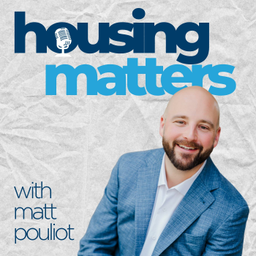
Podcast thumbnail for Housing Matters Podcast

Housing Matters Podcast

Claim This Podcast

by Matt Pouliot

5.0(2 reviews)
37 episodes
Updated Daily
Accepts GuestsHas SponsorsLocation 🇺🇸
16

Podcast Authority

Beta
PoorBased on show quality, social media presence, reviews, charts, and more
Pod Engine
Quality32
Social0
YouTube0
Engagement0

Podcast Overview

Housing Matters is a podcast dedicated to discussing the importance of housing and development in our State. Hosted by Matt Pouliot of Pouliot Real Estate, the podcast aims to educate and inform the public about the significance of housing initiatives, the intricacies of development, and how individuals can secure their dream homes. Through engaging conversations and expert insights, we aim to: ° Advocate for the importance of housing initiatives in fostering thriving communities ° Educate the public about the complexities of real estate development and its impact on local economies ° Empower individuals with knowledge and resources to navigate the housing market effectively ° Spark meaningful discussions on topics ranging from affordable housing solutions to the legal and regulatory challenges facing developers ° Cultivate a deeper understanding of the intricate connections between housing, quality of life, and economic opportunity

Language

🇺🇲

Publishing Since

10/18/2024

Unlock The Full Podcast Authority Score Report

See how your podcast performs across key metrics

16

Podcast Authority

Beta
PoorBased on show quality, social media presence, reviews, charts, and more
Pod Engine
Quality32
Social0
YouTube0
Engagement0
6
Excellent Areas
0
Good Performance
13
Growth Opportunities
excellent
Episode Length
1h 4m
Performing excellently!
needs improvement
Publishing Consistency
Every 17 days

Recommendations available

Unlock the full report to see detailed tips

+16 More Metrics

Unlock comprehensive insights including:

  • • YouTube presence analysis
  • • Social media reach metrics
  • • RSS compliance scoring
  • • Podcast 2.0 features
  • • Technical standards
What's Included in Your Full Report

Detailed Analytics

  • Complete breakdown of all 19 authority metrics
  • Personalized recommendations for each metric
  • Industry benchmarks and comparisons
  • Technical RSS feed analysis and compliance scoring

Growth Strategies

  • Step-by-step action plans for improvement
  • Quick wins to boost your score immediately
  • Pro tips from successful podcasters
Get your free podcast insights report

See how your show performs across every key metric

Instant delivery
No spam
Attract Better Guests

High authority scores make your podcast more attractive to industry leaders and influencers who want to appear on credible shows.

Secure Sponsorships

Sponsors look for podcasts with proven authority and engagement. Your score demonstrates your podcast's value to potential partners.

Grow Your Audience

Understanding your strengths and weaknesses helps you make data-driven decisions to expand your listener base effectively.

1 verified contact email on file for Housing Matters Podcast

Pitch yourself as a guest, propose sponsorships, or reach out directly to the host.

Recent Episodes

Episode thumbnail for 37. The Coliving Solution: How PadSplit Is Turning Empty Bedrooms Into Affordable Housing and Investor Returns

June 24, 2026

37. The Coliving Solution: How PadSplit Is Turning Empty Bedrooms Into Affordable Housing and Investor Returns

What if the affordable housing crisis isn't really a supply problem? What if the answer is already built, sitting in empty bedrooms across America, and we just haven't figured out how to use it? That's the argument Atticus LeBlanc has been making for years, and he built a company around proving it. Atticus is the founder of PadSplit, the largest coliving marketplace in the United States, with over 33,000 units across 40 states. He structured it as a public benefit corporation with a clear mission: help solve the affordable housing crisis for the 50% of American renters who can't afford their rent, without a single dollar of government subsidy. The platform has generated more than $150 million in savings for renters and over $5 billion in taxpayer savings. Before PadSplit, Atticus spent more than a decade as an affordable housing developer and contractor, starting with $10,000 in savings and building to over $100 million in real estate assets. He's presented at MIT, Yale, UC Berkeley, and the U.S. Chamber of Commerce Foundation, and has been featured in The New York Times, Forbes, and Inc. Magazine. He graduated from Yale with a degree in architecture and lives in Decatur, Georgia, with his wife, four boys, two dogs, and a lot of chickens. In this conversation, we get into the real mechanics of how PadSplit works for both investors and residents, and why the coliving model might be one of the most underused tools available right now for people trying to build wealth through real estate in a high interest rate environment. We talk through how hosts on the platform are earning roughly twice what they'd earn from a traditional lease on the same property. We walk through a real investor case study where a guy earning less than $60,000 a year used a VA loan, house-hacked his way into his first PadSplit property, generated $15,000 a year in free cash flow, and used that income to qualify for his next mortgage. We get into the math on how a buyer who can only qualify for a $200,000 home might be able to qualify for a $400,000 four-unit building by presenting rental income to the lender. Atticus also makes a case I hadn't heard put quite this way before: that America doesn't actually have a housing supply problem. It has a housing allocation problem. He walks through the per capita square footage numbers from 1950 to today and makes the argument that you could solve the entire estimated housing shortage, all 7.3 million units, using less than 1% of the existing square footage of housing in the United States. The rooms are there. The regulatory and cultural frameworks around how we use them are the barrier. We also dig into zoning, specifically how local definitions of "family" are one of the most overlooked obstacles to affordable housing in America, how PadSplit navigates those regulations, and what Atticus is currently working on at the federal level to get room rental income recognized by FHA, Fannie Mae, and Freddie Mac in mortgage underwriting. This one covers a lot of ground. Whether you're a real estate investor looking for a way to make deals work in the current market, a first-time buyer trying to figure out a creative path to ownership, or someone who just wants to understand what's actually driving the affordability crisis and what's being done about it, there's something in here for you. Topics covered in this episode: What PadSplit is and how the coliving model works for both hosts and residents How investors are earning approximately 2x rental income compared to traditional leasing Real investor case study: VA loan, house hacking, and $15,000 per year in free cash flow Using room rental income to qualify for a larger mortgage Why the housing crisis is an allocation problem, not a supply problem The per capita square footage argument that reframes the entire affordability debate How zoning's definition of "family" blocks affordable housing solutions How PadSplit handles placement, payments, conflict resolution

Episode thumbnail for 36. Nurses, Teachers & Firefighters Can't Afford to Live Where They Work. Here's a Model That Helps. | Chris Moeller

June 10, 2026

36. Nurses, Teachers & Firefighters Can't Afford to Live Where They Work. Here's a Model That Helps. | Chris Moeller

What happens when the people who serve your community can't afford to live in it? Chris Moeller, CEO of Orion Growth and creator of the Pathway Communities model, joins Matt Pouliot on Housing Matters to lay out a different way of thinking about housing entirely. Not as an asset class. Not as a rent-versus-own binary. But as an operating system built around stable living. Chris has spent over two decades at the intersection of real estate, energy, and technology. After surviving Hurricane Helene, his work took on a new urgency. The question stopped being how to improve housing and became how to design communities that can withstand disruption and actually support the people inside them. In this conversation, Matt and Chris get into the Pathway Communities model from the ground up: who it is built for, how the capital stack works differently, and why the traditional developer approach keeps pricing out the very people communities depend on most. They talk pocket neighborhoods, adaptive reuse, net zero energy design, food systems, digital equity, financial literacy, and a deed restriction structure borrowed in part from the Habitat for Humanity playbook. They also get honest about what is broken. Wages have been trailing median home prices for years. The missing middle housing product barely exists. Teachers, nurses, firefighters, and police officers are choosing not to work in communities where they cannot afford to live. And most developers are still building to minimum code, optimizing for their exit, and walking away before the roof leaks. Chris is not doing that. Hudson Commons in Hudson, North Carolina is his first learning living lab, and it is already in motion. If you work in housing, local government, community development, or you are just trying to make sense of why the system feels so broken, this episode is worth your full attention. Find Chris Moeller on LinkedIn, on Substack at Chasing Arrows, and at pathwaycommunities.org. His podcast, The Edge Report from Brix, is available on Spotify and YouTube. Housing Matters is hosted by Matt Pouliot, CEO and Broker at Pouliot Real Estate in Maine. New episodes drop bi-weekly. Subscribe wherever you listen.

Episode thumbnail for 35. Why Maine's Old Mills, Tanneries, and Closed Schools Stay Vacant (And the Organization Working to Change That) | Gabe Gauvin, Maine Redevelopment

May 27, 2026

35. Why Maine's Old Mills, Tanneries, and Closed Schools Stay Vacant (And the Organization Working to Change That) | Gabe Gauvin, Maine Redevelopment

You've driven past it. An old mill building sitting right on the river, windows gone, roof caving in, weeds taking over. And you've thought the same thing everyone thinks: why hasn't anyone done something with that? The answer is complicated. And in this episode, I'm talking with someone who is working every single day to change it. Gabe Gauvin is the Programs Manager at Maine Redevelopment, a quasi-governmental organization created by the Maine Legislature to unlock the state's most stuck properties and get them back into productive use. Gabe brings a background in place-based economic development, rural planning, and environmental remediation, and he has lived and worked in nearly every corner of Maine. He knows this state and he knows these projects. We cover a lot of ground in this one. We start with Gabe's path from the Kennebec Valley Council of Governments to the Central Maine Growth Council and now to Maine Redevelopment, and how working across so many different parts of the state has shaped the way he thinks about community investment and revitalization. Then we get into what Maine Redevelopment actually is and how it works. They are one of only four or five statewide land bank authorities in the entire country. Their scope covers properties that are vacant, abandoned, functionally obsolete, contaminated, or stuck for legal reasons. And their structure as a quasi-governmental organization gives them something most public agencies do not have: the ability to move fast, take on risk, and operate with an entrepreneurial mindset. From there we dig into the Hartland Tannery, the first property Maine Redevelopment has acquired into its land bank. It is a roughly 30-acre brownfield site along the Sebasticook River in Hartland that has had some kind of industrial operation on it for about 200 years. There is an estimated four to five million dollars worth of contaminated material that needs to be abated and demolished before any real redevelopment can begin. Maine Redevelopment acquired the property in January 2025 and submitted an application to the EPA Brownfields Program two weeks later. They find out this June whether that federal funding came through. We also get into the school reuse crisis that is playing out right now across Maine, the toolkit Maine Redevelopment is building to help communities navigate it, and a piece of legislation that had broad bipartisan support, passed the House and Senate, and then did not make it through Appropriations. That one stung a little to talk about, but it is important context for where things stand. And we talk about the economics. Because great ideas and community support are wonderful, but at the end of the day the numbers have to work. Gabe walks through exactly how Maine Redevelopment approaches making projects pencil out, including in some cases giving the land away for free to a developer whose project aligns with what the community actually needs. If you have ever wondered why these properties sit for decades, or if you are a developer, investor, or community leader trying to figure out whether there is a path forward for a site in your town, this episode is for you. Connect with Maine Redevelopment at maineredevelopment.org. Their full team contact info is on the website and they are active on LinkedIn. Housing Matters is hosted by Matt Pouliot, CEO and Broker at Pouliot Real Estate in Maine. New episodes drop regularly covering Maine real estate, housing affordability, economic development, and the people doing the work to move things forward. Subscribe wherever you listen and find us on YouTube at youtube.com/@housingmatterspod.

37 total episodes available

Recent guests on Housing Matters Podcast

Guests from recent episodes — sign up to see every guest that has ever appeared on this show.

Julie Rabinowitz

Guest

Dave Hench

Guest

Andrew Cramer

Guest

Emily Mottram

Guest

Steve Kautz

Guest

Debora Keller

Guest

Anne Krieg

Guest

Sara Bronin

Guest

Dan Bacon

Guest

Kevin Sutherland

Guest

John Egan

Guest

Matt Pouliot

Guest

Deep-dive analytics for Housing Matters Podcast

Frequently asked questions

Have a different question and can't find the answer you're looking for? Reach out to our support team by sending us an email and we'll get back to you as soon as we can.

What is Housing Matters Podcast?

Housing Matters is a podcast dedicated to discussing the importance of housing and development in our State. Hosted by Matt Pouliot of Pouliot Real Estate, the podcast aims to educate and inform the public about the significance of housing initiatives, the intricacies of development, and how individuals can secure their dream homes.

Through engaging conversations and expert insights, we aim to: ° Advocate for the importance of housing initiatives in fostering thriving communities ° Educate the public about the complexities of real estate development and its impact on local economies ° Empower individuals with knowledge and resources to navigate the housing market effectively ° Spark meaningful discussions on topics ranging from affordable housing solutions to the legal and regulatory challenges facing developers ° Cultivate a deeper understanding of the intricate connections between housing, quality of life, and economic opportunity

How often does this podcast release new episodes?

This podcast updates daily.

Where can I listen to this podcast?

This podcast is available on 4 platforms including Apple Podcasts, Spotify, and more. You can also use the RSS feed directly.

Does this podcast accept guests?

Yes, this podcast regularly features guests.

Legal Disclaimer

Pod Engine is not affiliated with, endorsed by, or officially connected with any of the podcasts displayed on this platform. We operate independently as a podcast discovery and analytics service.

All podcast artwork, thumbnails, and content displayed on this page are the property of their respective owners and are protected by applicable copyright laws. This includes, but is not limited to, podcast cover art, episode artwork, show descriptions, episode titles, transcripts, audio snippets, and any other content originating from the podcast creators or their licensors.

We display this content under fair use principles and/or implied license for the purpose of podcast discovery, information, and commentary. We make no claim of ownership over any podcast content, artwork, or related materials shown on this platform. All trademarks, service marks, and trade names are the property of their respective owners.

While we strive to ensure all content usage is properly authorized, if you are a rights holder and believe your content is being used inappropriately or without proper authorization, please contact us immediately at hey@podengine.ai for prompt review and appropriate action, which may include content removal or proper attribution.

By accessing and using this platform, you acknowledge and agree to respect all applicable copyright laws and intellectual property rights of content owners. Any unauthorized reproduction, distribution, or commercial use of the content displayed on this platform is strictly prohibited.