- 13
- Episodes
- 2026
- First episode
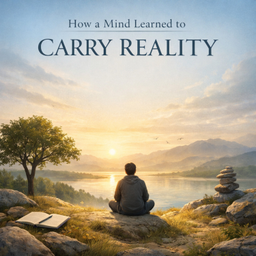
About How a Mind Learned to Carry Reality
Most of us don’t struggle because life is confusing. We struggle because it’s heavy. Too many demands. Too much carried at once. This series isn’t about better answers. It’s about how reality is processed without overload. Through first-person reflections, it traces a quiet arc—from collecting fragments, to choosing what belongs, to building structures that can hold love, meaning, and uncertainty without breaking the person living inside them. Not to conclude anything. Just to name what has taken shape—and leave room to live inside what holds.
- Publisher
- Only Life After All
- Category
- society & culture
- Language
- en
- Explicit
- No
- First episode
- 25 Jan 2026
- Latest episode
- 25 Jan 2026
Latest episodes
13 episodes in the feed.
25 Jan 2026
A Closing Note: Leaving Room to Live
This series was never meant to arrive at an ending. It marks a moment of recognition, not completion — a pause long enough to notice that something has taken shape, and to acknowledge that it can now carry more than it once could. What began as fragments, then patterns, then structure, has become inhabitable. That is worth naming. It does not require sealing. The work described here does not ask for constant attention anymore. It was built to recede into the background, to do its quiet work while life moves forward — imperfectly, unpredictably, and still unfinished. There will be new pressures. New seasons. New forms of weight that cannot yet be anticipated. Some will fit easily. Others will require adjustment. That is not a failure of the system. It is the reason the system exists. Nothing here needs to be preserved exactly as it is. What matters is not the language, the metaphors, or the models, but the orientation they made possible: an attentiveness to limits, a respect for capacity, and a willingness to let structure carry what does not need to be held consciously. So this is not a conclusion. It is a release. An invitation to stop narrating and return to living. To trust what holds. To notice when it no longer does. And to adjust with the same care that built it in the first place. If anything endures beyond these reflections, let it be this quiet permission: You are allowed to live inside what works — and to let the rest remain unresolved for now.
25 Jan 2026
Reflection Ten: Letting the System Be Enough
There is a subtle moment that arrives after a long period of building. It’s not satisfaction. It’s not pride. It’s not even confidence. It’s the realization that continuing to explain the system would now weaken it. For a long time, articulation was necessary. Writing clarified what experience alone could not yet hold. Frameworks named patterns that were still unstable. Language did the work of scaffolding — helping something fragile learn to stand. But eventually, scaffolding must come down. The mind reaches a point where it no longer benefits from constant narration of its own coherence. Where revisiting first principles becomes less useful than trusting the defaults those principles have already shaped. Where the desire to refine gives way to the discipline to stop. This is where I find myself now. Not finished — but finished enough. The system doesn’t require constant attention anymore. It runs quietly in the background, allocating energy, resolving tension, protecting capacity. When something new arrives — an unexpected demand, a fresh desire, a difficult season — it doesn’t panic. It asks familiar questions. It routes the load. It decides what can wait. That’s how I know it’s real. Not because it sounds elegant on the page, but because it functions when life is ordinary. When days are full of small choices rather than big insights. When the work is not self-understanding, but showing up. There is a humility in this stage. It means accepting that no system can eliminate suffering, confusion, or loss — only make them survivable. It means trusting that wisdom does not need constant reaffirmation to remain alive. It means allowing silence where there used to be analysis. Most of all, it means letting peace remain unremarkable. Not something to point to. Not something to defend. Just the absence of unnecessary strain. If there is a final lesson here, it is not about building better minds or more elegant frameworks. It is about learning when to stop intervening — when to let what has been built do its quiet work. The mind doesn’t need to carry everything consciously. It needs a structure that knows what it’s doing. At some point, the most respectful thing you can do for a system that took years to form is to trust it — and get on with the living it was meant to support. That, too, is a form of gratitude. And perhaps the most mature one.
25 Jan 2026
Reflection Nine: Living Within What Holds
After coherence comes a quieter question. Not What else can be built? But What can be lived inside, day after day, without strain? There is a temptation, once a system begins to work, to keep refining it — to add nuance, extend reach, sharpen edges. That impulse can look like growth, but often it is simply another way of asking more than what already works needs to give. What I have learned is that durability matters more than expansion. A life that only functions at peak attention, peak discipline, or peak insight will eventually fail — not because it is wrong, but because it depends on conditions that cannot be reliably maintained. The real measure of a coherent inner system is not how it performs when everything aligns, but how it holds when energy is low, time is short, and life is uncooperative. This is where the idea of holding becomes central. The guideposts no longer need to be revisited daily. The frameworks no longer need to be defended or rehearsed. The lattice no longer needs to be consciously carried. They exist so that less needs to be carried at all. What feels different now is not that reality weighs less. Loss still arrives. Uncertainty still persists. Love still asks something of me. Time still moves forward without negotiation. What has changed is how much of that weight must be held consciously. Structure absorbs some of it. Defaults replace vigilance. Boundaries do their work quietly. Orientation becomes background rather than labor. This is not detachment. It is inhabitation. I can engage without flooding. Commit without depletion. Care without collapse. Think without needing resolution. So the work shifts. From expansion to maintenance. From refinement to restraint. From building coherence to living within it. If earlier stages were about constructing something that could hold, this stage is about trusting what already does. Living within what holds is not a reduction of life. It is what allows life to remain livable over time. And that, quietly, is the difference between intensity and endurance.
25 Jan 2026
Reflection Eight: What I Was Really Trying to Protect
It would be easy, at this point, to tell this story as one of achievement. To frame the arc as progress toward clarity, coherence, or wisdom. But that wouldn’t be honest — and it wouldn’t explain why any of this mattered enough to sustain for so long. What I was really trying to protect was simpler than that. I was trying to protect the ability to live without hardening. Over time, I noticed what happens when overload goes unaddressed. People don’t just get tired. They become brittle. They narrow. They grow impatient with complexity, intolerant of ambiguity, resentful of demands that exceed their capacity. They trade openness for armor, curiosity for certainty, love for control. I could feel those pressures in myself. The work wasn’t about becoming better. It was about not becoming worse in predictable ways. Not losing generosity to exhaustion. Not losing wonder to cynicism. Not losing tenderness to the constant friction of modern life. Peace of mind, I came to understand, was never something to chase. It was what remained when the system stopped being abused. When attention was respected as finite. When love was structured to nourish rather than consume. When meaning was lived rather than solved for. When clarity replaced the need to be right. Joy and gratitude followed — not as achievements, but as signals. They appeared when life no longer felt overdrawn. When enough was enough. When what I cared about fit inside the days I was actually living. When the system wasn’t constantly borrowing energy from the future to survive the present. Looking back, the arc is clear. Quotes and notes were an attempt to remember. Curation was an attempt to choose. Guideposts were an attempt to prevent regret. Manuscripts were attempts to stabilize whole domains of life. Songs were attempts to remember under pressure. The lattice was an attempt to let structure carry what will not go away. All of it served the same quiet aim: to make a life that could be carried without breaking the person living it. I didn’t set out to build an operating system for the mind. I set out to pay attention long enough that life stopped overwhelming the capacity meant to hold it. If there’s anything here that might matter to someone else, it isn’t the frameworks or the language or the metaphors. It’s this permission: You don’t need to understand everything. You don’t need to optimize everything. You don’t need to carry everything at once. You only need to build a way of living that fits the weight of reality you’re actually given. Everything else — peace, joy, gratitude — arrives quietly, when the system finally stops fighting itself.
25 Jan 2026
Reflection Seven: When the Lattice Revealed Itself
In 2025, nothing new appeared. That’s what surprised me most. There was no sudden insight, no breakthrough idea, no revelation that hadn’t been hinted at before. What changed wasn’t the content. It was the relationship between the content. Ideas that had once lived in separate rooms began to speak to one another. Clarity no longer felt abstract. It showed up in how decisions were made under pressure. Meaning no longer felt philosophical. It showed up in what I was willing to commit to without certainty. Love no longer felt romanticized. It showed up in what I would give without disappearing. The models stopped competing for attention. They stopped demanding allegiance. They began cooperating. That’s when I recognized the lattice. Not a hierarchy. Not a system with a center. But a structure where each idea reinforced the others — where weaknesses in one area were supported by strength in another, and where no single insight was asked to carry more weight than it could bear. This was the opposite of accumulation. There were fewer ideas now, not more. Fewer frameworks. Fewer lenses. But each one was load-bearing. Each one earned its place by solving a recurring problem — not in theory, but in life as it was actually lived. I thought of Charlie Munger’s insistence that wisdom comes not from knowing many things, but from knowing a few things deeply and arranging them properly. What mattered wasn’t brilliance. It was fit. Whether the models worked together under real conditions. That’s what I was finally seeing. The guideposts functioned as constraints. The manuscripts functioned as stabilizers. The songs functioned as recall. Together, they formed something resilient. For the first time, I could feel how decisions in one domain no longer destabilized another. How choosing less didn’t create deprivation. How commitment didn’t create resentment. How uncertainty didn’t create paralysis. The lattice didn’t eliminate difficulty. It redistributed it. Instead of carrying everything consciously, all the time, the structure began carrying some of the weight. Orientation became default rather than effortful. Alignment required less force. This wasn’t mastery. It was relief. A quiet confidence that the mind no longer had to solve itself anew each morning. That the same old human pressures — desire, fear, responsibility, love, time — could move through a structure designed to hold them. In 2025, I didn’t arrive anywhere. I stabilized. And that may be the most meaningful form of progress there is.
25 Jan 2026
Reflection Six: Why the Songs Came
The lyrical interpretations arrived without announcement. They didn’t present themselves as part of the same work. In fact, for a while, I treated them as something else entirely — creative detours, moments of play, a different register of expression that ran alongside the more reflective writing but didn’t quite belong to it. That misreading didn’t last. I began to notice when the songs appeared. Not during periods of leisure or abstraction, but under load. When thinking felt expensive. When life was already moving and there wasn’t time to reason my way back to what I knew. When emotion outran analysis and the usual tools felt too slow. The songs weren’t explanations. They were recognitions. Where essays asked the mind to work, lyrics asked it to remember. They didn’t unfold arguments. They compressed them. They bypassed deliberation and went straight to pattern, rhythm, and felt sense. They carried insight in a form that could survive fatigue, grief, desire, and immediacy. That’s when their function became clear. They were not ornaments. They were shortcuts. Quick-access routines for moments when the system couldn’t afford full computation. Ways of restoring orientation without overload. Ways of returning to alignment without having to reconstruct it from first principles every time. A line of lyric could do what pages of prose sometimes could not: interrupt a spiral, soften a grip, reintroduce proportion, remind the body of what the mind already knew but couldn’t currently retrieve. The songs were how the system stayed humane. They allowed wisdom to travel lightly — not as doctrine, not as instruction, but as something carried in the bloodstream. Something available when attention was scarce and stakes were high. I began to see that this wasn’t a departure from the architecture. It was the interface layer. The place where structure meets lived moment. Where insight becomes usable at speed. Just as an operating system relies on cached routines to keep running under pressure, the lyrical work allowed the deeper frameworks to remain accessible when life stopped being theoretical. I wasn’t trying to turn philosophy into art. I was making sure the system could still function when thinking was no longer the bottleneck — when energy was. The songs didn’t replace the other work. They completed it. They ensured that what had been learned slowly could still be remembered quickly.
25 Jan 2026
Reflection Five: The Manuscripts Were Solving the Same Problem
For a long time, the manuscripts felt separate. Each one had its own question, its own tone, its own gravity. The Architecture of Clarity (https://onlylifeafterall.substack.com/p/the-architecture-of-clarity-building)was concerned with how we know — with belief, doubt, and the danger of mistaking certainty for understanding. Life as Answer (https://onlylifeafterall.substack.com/p/life-as-answer-the-search-for-meaning) wrestled with meaning in a world that offers no final explanation. The Architecture of Love (https://onlylifeafterall.substack.com/p/the-architecture-of-love-how-love) explored attachment, desire, and the fragile line between devotion and self-erasure. They appeared to live in different rooms. I treated them that way. Different projects. Different seasons. Different problems. But as the operating system metaphor settled in, something else became visible. I began to see that each manuscript was responding to a different kind of overload — and each was trying, in its own way, to prevent a specific form of failure. Clarity was about cognitive overload. Meaning was about existential overload. Love was about relational overload. Each domain has its own way of breaking a person. Confused beliefs lead to anxiety, rigidity, and endless rumination. Unresolved questions of meaning lead to paralysis or despair. Unstructured love leads to collapse, resentment, or the loss of self. What I had been writing, without fully realizing it, were stabilization layers. The Architecture of Clarity was protecting the mind from overheating — from demanding certainty where only approximation is possible. It was teaching restraint in what we ask our thinking to deliver. Life as Answer was resolving a deadlock — the idea that one must understand life before participating in it. It shifted the load from explanation to engagement, allowing motion where analysis alone had stalled. The Architecture of Love was introducing constraints where culture often celebrates excess. It was not diminishing love, but making it survivable. Making it something that could endure without consuming the person who offers it. Seen this way, the manuscripts were not competing visions. They were cooperative subsystems — each handling a different category of strain, each making the whole more resilient. That realization brought a strange sense of relief. I didn’t need to unify them conceptually or force them into a single thesis. They were already unified by function. They were all asking the same underlying question: How does a finite human being live fully without breaking under the weight of reality? I hadn’t set out to answer that question directly. I’d been circling it, approaching it from different angles, solving pieces of it as they revealed themselves through lived experience. The manuscripts were not separate because I was scattered. They were separate because reality is. And together, they were quietly assembling a system capable of carrying it.
25 Jan 2026
Reflection Four: When the Metaphor Found Me
I wasn’t looking for a metaphor. I wasn’t trying to explain what I had been doing in any unified way. If anything, I was content letting the pieces remain adjacent rather than integrated. They worked well enough. Life felt more navigable. That seemed sufficient. Then the metaphor arrived fully formed — not as an idea to develop, but as something recognized. It came through the Money Wise Macro Framework, in a passage about operating systems and the electrical grid (https://onlylifeafterall.substack.com/i/184105598/what-an-operating-system-actually-does). The words were technical, almost clinical. And yet, they wouldn’t let go of me. An operating system does not create capability. It allocates resources. It manages contention. It prioritizes workloads. It prevents failure. As I read it, something clicked — not intellectually, but structurally. I wasn’t borrowing the metaphor. I was seeing myself inside it. I realized that much of what I had been doing for years had nothing to do with acquiring better ideas. It had everything to do with deciding what gets power. What gets time. What gets attention. What gets to run simultaneously — and what must wait. The guideposts weren’t virtues. They were schedulers. The manuscripts weren’t explorations. They were subsystems. The boundaries I’d learned to keep weren’t limits. They were safeguards. Peace of mind, suddenly, made sense in a new way. It wasn’t an emotional state I needed to achieve. It wasn’t calm I needed to summon. It was what emerged when demands no longer exceeded capacity. When contention was resolved upstream. When the system stopped being asked to do the impossible. That realization reframed everything. I saw how often suffering came not from hardship itself, but from overload — from too many competing claims on a finite inner grid. Too many unresolved priorities. Too many obligations treated as equal. Too much power allocated to things that could never return it. And I saw that the work I had been doing — quietly, imperfectly — was architectural. I hadn’t been trying to live better. I had been trying to live within capacity. The metaphor didn’t flatter me. It sobered me. It clarified the responsibility of being both architect and gatekeeper of an inner system that determines what is possible at all. What grows. What stalls. What quietly fails. From that moment on, I could no longer pretend I was merely collecting insights or writing reflections. I was maintaining infrastructure. And infrastructure, unlike inspiration, does not tolerate neglect. The metaphor didn’t change the work. It named it. And once named, it became easier to honor — not as an achievement, but as an ongoing obligation: to schedule reality in a way that allows life to keep running without breaking.
25 Jan 2026
Reflection Three: When Principles Appeared Before Systems
The guideposts did not arrive as a project. There was no moment where I decided to sit down and define how life should be lived. No ambition to codify wisdom or distill philosophy into something teachable. If anything, the opposite was true. I was trying to reduce friction, not create doctrine. They emerged the way pressure points do — where something keeps hurting until it’s addressed. Certain patterns repeated themselves. Overcommitment followed by resentment. Desire masquerading as obligation. Busyness disguising avoidance. Ideals adopted without asking whether they fit the life I was actually living. Each pattern carried a cost, and each cost eventually demanded payment. The guideposts were not answers to abstract questions. They were responses to lived consequences. I noticed that many problems did not arise in the moment they became visible. They were seeded much earlier — in what I agreed to, what I pursued without questioning, what I allowed to remain vague. By the time the pain appeared, the real decisions had already been made. So the guideposts formed upstream. They functioned less like advice and more like pre-decisions. Ways of resolving tension before it escalated into overload. Ways of saying no early enough that saying yes later would still be possible. “Do not pursue valueless things” was not moral instruction. It was energy conservation. “Convert time into love” was not sentiment. It was prioritization. “Know what is sufficient” was not asceticism. It was relief. Each guidepost reduced the number of active demands. Each one lowered background noise. Each one prevented a category of future regret from ever entering the system. What struck me, even then, was how little they asked of me emotionally. They didn’t require constant vigilance or motivational force. Once adopted, they simplified. They made fewer things possible — and in doing so, made what remained more sustainable. Only later did I realize what was happening. Before there was any architecture, there was constraint. Before systems, there were principles. Before coherence, there was care. I wasn’t building a framework. I was building margins. Margins where life could breathe. Margins where relationships could deepen without collapse. Margins where attention could rest instead of scatter. The guideposts were not the structure itself. They were the load-bearing limits that made structure possible. And once those limits were in place, something unexpected happened. The mind grew quieter — not empty, but ordered. Less driven by urgency. Less reactive to every possibility. More capable of staying with what mattered without constantly defending it. I still didn’t think of this as a system. But in hindsight, this was the moment when architecture stopped being accidental — and began, gently, to take shape.
25 Jan 2026
Reflection Two: From Accumulation to Responsibility
At first, collecting felt harmless. Even virtuous. Saving ideas, capturing lines, holding onto fragments that mattered — none of it seemed to carry a cost. Attention felt elastic then, as if it could stretch indefinitely without consequence. But over time, something subtle changed. The collection grew. The volume increased. And with it came a quiet pressure — not from having too much, but from realizing that not everything I saved deserved equal residence in my mind. What once felt like preservation began to feel like crowding. That was the moment accumulation stopped being neutral. I began to notice that ideas do not simply sit where they are placed. They compete. They influence tone. They shape defaults. They whisper assumptions long after their source is forgotten. Some sharpen perception. Others dull it. Some steady the mind. Others agitate it without offering clarity. And slowly, without naming it, a new responsibility emerged. If attention is finite — and it is — then allowing everything in is not openness. It is abdication. It means surrendering the inner environment to whoever speaks the loudest, repeats the most often, or triggers the strongest reaction. It means confusing exposure with wisdom. This is where the shift happened. I stopped asking only, Is this interesting? And started asking, Is this worth living with? That question changes everything. It introduces consequence. It acknowledges that the mind is not a warehouse but a habitat. That what takes up residence will shape how days are experienced, how decisions are made, how people are treated, and how the future is imagined. The role of curator did not arrive as a title. It arrived as discomfort. As the realization that I was responsible not just for what I consumed, but for what I allowed to remain. That choosing not to choose was itself a choice — one that defaulted power to noise. Gatekeeping, in this sense, had nothing to do with exclusion or superiority. It was an act of care. A recognition that protecting clarity is not rigidity, and that boundaries are not a failure of openness but a condition for coherence. This was also the beginning of discernment — not as judgment, but as stewardship. The understanding that attention is a form of love, and that loving everything equally is another way of loving nothing well. I didn’t yet know where this responsibility would lead. I didn’t know it would eventually shape guideposts, frameworks, or manuscripts. I only knew that something had shifted: that the inner world I was living in required tending, not just stocking. Accumulation had been passive. Responsibility was not. And once that threshold is crossed, there is no returning to innocence. You can no longer pretend that what fills your mind doesn’t matter. You begin, quietly and irrevocably, to take ownership of the space in which your life actually unfolds.
25 Jan 2026
Reflection One: When I Didn’t Know What I Was Building
I didn’t begin with a plan. I began with attention. Certain lines would stop me. Not because they were clever, but because they carried weight. They felt compressed—like they held more than they said. I didn’t always agree with them. I didn’t always understand them. But they stayed. So I wrote them down. At the time, I thought I was collecting quotes. In truth, I was collecting signals. I had no language for what was happening. I wasn’t trying to build a philosophy or assemble a worldview. I wasn’t organizing knowledge. I was responding to a quiet intuition that some ideas mattered more than others, and that forgetting them felt like a loss I couldn’t quite name. What later became Quotes & Notes was not a system. It was a reflex. A way of saying, this belongs somewhere safe. I trusted resonance before understanding. I trusted repetition before synthesis. I trusted that if something returned often enough, it was asking to be kept. There was no hierarchy then. No architecture. No lattice. Just fragments—pulled from books, conversations, lectures, lived moments—resting side by side without explanation. Looking back, it resembles the early stage of any organism: accumulation without structure, growth without direction, energy without form. But something important was already happening. I wasn’t optimizing my thinking. I was protecting it. Each note was a small act of care. A refusal to let meaning slip through my fingers simply because I couldn’t yet articulate it. I didn’t know what these fragments would become, but I sensed that losing them would cost me something—clarity, perhaps, or orientation, or the ability to remember what mattered when life grew loud. In hindsight, this was the earliest expression of what would later become the role of curator and gatekeeper. But at the time, there was no role—only instinct. I didn’t yet know that attention was finite. I didn’t yet know that letting everything in would eventually require paying a price. I only knew that some ideas deserved to stay close. There is a temptation, looking back, to retrofit intention onto those early years. To pretend there was foresight. There wasn’t. There was only a willingness to pause, to notice, and to save what felt essential before it vanished back into the noise. What I was really doing—though I couldn’t have said it then—was beginning to learn how to carry reality. Not all of it. Just enough. Just the parts that refused to be ignored. The structure would come later. The coherence would come later. The responsibility would come later. At the beginning, there was only this: a mind learning, slowly and imperfectly, that what it attends to becomes what it lives with—and that some things are too important to leave unheld.
25 Jan 2026
Preface: On Paying Attention Long Enough
I didn’t set out to build a system. For a long time, I was simply collecting fragments — lines that lingered, ideas that refused to leave, insights that felt compressed rather than complete. I wrote them down without fully understanding why. I trusted resonance before explanation. What later became Quotes & Notes began as nothing more than a habit of paying attention. Over time, something shifted. Accumulation turned into curation. Attention acquired weight. I began to notice that what I allowed into my mind shaped not just how I thought, but how I lived. The quiet role of gatekeeper emerged before I ever named it. The guideposts came next — not as advice, but as relief. They were constraints that reduced friction, upstream decisions that prevented downstream regret. Around them, longer reflections took shape. Manuscripts appeared — on clarity, meaning, love — each addressing a different human problem, yet slowly revealing a shared purpose: making life livable without overload. By 2025, a deeper coherence surfaced. Patterns aligned. Models stopped competing and began cooperating. What emerged resembled a latticework — not of answers, but of orientation. I recognized that much of this work had been quietly constructing something like an inner operating system: a way of allocating attention, managing contention, prioritizing what matters, and preventing failure under real-world constraints. The lyrical interpretations that accompanied this process were not a departure from it. They were its shortcuts — quick-access routines for moments when thinking was too slow and life was already underway. This series is not an instruction manual. It is a witnessing. A record of how a system that began by accident became intentional — and how peace of mind, joy, and gratitude emerged not as goals, but as outcomes. I’m writing this primarily to mark that maturation for myself. If it proves useful to others, I hope it does so not by offering answers, but by offering permission: to trust attention, to honor slow coherence, and to let meaning reveal itself only after it has been lived.
25 Jan 2026
Series Trailer: How a Mind Learned to Carry Reality
Most of us don’t struggle because life is confusing. We struggle because it’s heavy. Too many demands. Too many voices. Too much carried at once. This series isn’t about finding better answers. It’s about learning how reality is processed without overload. It traces a quiet arc — from collecting fragments, to choosing what belongs, to building structures that can hold love, meaning, and uncertainty without breaking the person living inside them. Along the way, peace of mind is re-framed — not as an emotion to chase, but as what remains when demands no longer exceed capacity. How a Mind Learned to Carry Reality is a set of first-person reflections on attention, limits, and endurance. Not to conclude anything. Just to name what has taken shape — and to leave room to live inside what holds.
Contact How a Mind Learned to Carry Reality
- Guest appearances
- Does not typically book guests
Based on episode analysis; this does not confirm that the show is currently accepting guests.
Host of How a Mind Learned to Carry Reality?
Claim your podcast to manage its listing and keep your show details accurate.
Pod Engine is an independent podcast discovery and analytics service and is not affiliated with or endorsed by this podcast. Artwork and show content belong to their owners. Full legal notice.
Explore this show
Podcast research with Pod Engine