- 16
- Episodes
- 8
- Ratings
- 2025
- First episode
About How An Elephant Forgets
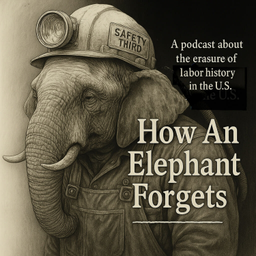
How An Elephant Forgets is a storytelling podcast about how working folks got hoodwinked into forgetting the blood, sweat, and strikes that built their rights—and who wanted them to forget it. From company thugs to classroom censors, from cowboys to culture wars, host Marion Cotillard Morrison… no relation… digs through the dust to remember what the powerful tried to bury.
- Publisher
- Marion Cotillard Morrison
- Category
- history
- Language
- en
- Explicit
- No
- First episode
- 2 Apr 2025
- Latest episode
- 22 May 2025
Latest episodes
16 episodes in the feed.
22 May 2025
The End of the Shift
Every job’s got a quitting time. But some endings ain't just about punchin’ the clock — they’re about what we carry home. In this season finale, we look back at the stories we’ve told and the voices we’ve lifted. We trace the arc from picket lines to pulpits, from broken pens to busted backs, and ask what it means to remember — and what it costs to forget. Because history doesn’t retire. It just waits for the next shift to begin.Further Reading: Howard Zinn, A People’s History of the United States A sweeping account of American history told from the perspective of those at the margins — workers, organizers, and the ones whose names didn’t make the monuments. David Roediger, The Wages of Whiteness An essential work examining how race and class have been used to divide the American labor force — and who benefits from that divide. Rebecca Solnit, Hope in the Dark A meditation on why remembering past struggles — even the unfinished ones — is an act of resistance, and how small acts ripple outward. AFL-CIO, State of the Unions Report A detailed look at where organized labor stands today — gains, setbacks, and the path forward. The Century Foundation, “Rebuilding Worker Power” Series Data-driven research and policy recommendations for strengthening the rights of workers in the 21st century.
20 May 2025
The People Remember
You can knock the dust off an old slogan, print it on a fresh sign, and still mean every word. In this episode, we follow the echoes — from Birmingham to Bessemer, from factory gates to warehouse docks — where a new generation of workers is relearning the language of resistance. Some folks say unions are a thing of the past. But if you listen close, you’ll hear the people remember.Further Reading : Kim Kelly, Fight Like Hell: The Untold History of American Labor A vivid look at the forgotten fighters of the labor movement — and the ones picking up their torches now. More Perfect Union (YouTube / Substack) Up-to-date coverage on union drives, strikes, and solidarity efforts shaping the modern labor landscape. Labor Notes, “Secrets of a Successful Organizer” Step-by-step lessons from the front lines of today’s labor fights — used by workers winning real power. Economic Policy Institute, “Unions Are on the Rise. So Are Employer Tactics to Stop Them.” A report connecting the dots between the uptick in organizing and the backlash that follows. NLRB Cases & Decisions Database Track the rules being tested — and rewritten — in real time.
15 May 2025
What We Stand To Lose
It’s easy to forget just how bad things used to be — and how quickly they can return. In this episode, we take a closer look at what labor protections were built to prevent: the heat, the blades, the blood. From children on kill floors to men collapsing in the sun, this isn’t distant history — it’s a warning. Because while the language has changed, the rollback is already underway. And when memory is lost, so is leverage. Further Reading : National Employment Law Project, Tracking Deregulation in the Trump and Post-Trump Era A detailed record of federal rollbacks to worker protections, including OSHA enforcement, wage theft accountability, and classification laws. Economic Policy Institute, The erosion of worker power Explores long-term trends behind declining union density, stagnant wages, and weakened safety standards. Occupational Safety and Health Administration (OSHA), Data and Statistics Page Useful for tracking inspection rates, citations, and enforcement trends by year and sector. ProPublica, “They Know the Heat Is Killing Workers. If Only the Government Would Listen.” Investigative reporting on how heat-related workplace deaths are rising — and how policy has failed to keep up. American Journal of Public Health, “Child Labor in the United States: Hidden in Plain Sight” A look at how minors are still legally employed in dangerous sectors like agriculture and meat processing.
13 May 2025
SuperEverything Stores
Once upon a checkout lane, convenience became king. In this episode, we trace the rise of the “everything store” — from five-and-dimes to fluorescent mega-aisles — and how a handful of retail giants reshaped America’s working class. We’ll look at the promises that were made (lower prices, more jobs, endless choice) and the quieter costs that came due (union busting, shuttered main streets, supply chains stretched thin across oceans). Somewhere between the smiley-face stickers and falling prices, a whole way of life got rolled back. Further Reading : Nelson Lichtenstein, The Retail Revolution: How Wal-Mart Created a Brave New World of Business A definitive academic take on how Walmart transformed labor relations, global trade, and corporate strategy in America. Bethany Moreton, To Serve God and Wal-Mart: The Making of Christian Free Enterprise A fascinating dive into the culture, gender politics, and religious framing that supported the rise of retail giants. Frontline (PBS), Is Wal-Mart Good for America? A classic documentary exploring the hidden costs of the retail behemoth’s rise. Stacy Mitchell, Big-Box Swindle Investigates how large retailers erode local economies and what alternatives could look like. Institute for Local Self-Reliance (ILSR.org) Ongoing reporting and resources on anti-monopoly advocacy and the revival of local businesses.
8 May 2025
Fox & Friends With Benefits
Back in the day, folks got their news from the same three networks, delivered with a straight face and a necktie. These days? Turn on the TV and you’ll get a sermon in the morning, a scare tactic by lunch, and a culture war bedtime story by sundown. In this episode, we trace how the right-wing media machine came to be—not just Fox News, but the web of AM radio barkers, think tank talking points, and political operatives who figured out that facts don't sell like fear. From Roger Ailes' roots in Nixon's shadow cabinet to Frank Luntz's focus-grouped propaganda disguised as plain talk, we lay out how messaging was weaponized—and why so many working folks started voting against their own best interests. It ain’t brainwashing if you call it freedom, right?Further Reading: Sherman, Gabriel. The Loudest Voice in the Room: How the Brilliant, Bombastic Roger Ailes Built Fox News—and Divided a Country. Random House, 2014. A definitive biography on Ailes and the founding of Fox News. Katz, Elihu. The Irony of Fox News: How the Right Created a Media Empire by Imitating the Left. Columbia Journalism Review, 2017. An article exploring how the Right borrowed tactics from activist media to build a propaganda model. Brock, David. The Republican Noise Machine: Right-Wing Media and How It Corrupts Democracy. Crown, 2004. A former conservative insider explains the architecture of partisan media messaging. Luntz, Frank. Words That Work: It’s Not What You Say, It’s What People Hear. Hyperion, 2007. A revealing look into how political language is shaped to manipulate perception—by one of its leading architects. Hemmer, Nicole. Messengers of the Right: Conservative Media and the Transformation of American Politics. University of Pennsylvania Press, 2016. A scholarly but accessible look at how media built a new political reality from Goldwater to Trump. The Ailes Papers (Hofstra University Special Collections) Archival material on Ailes’ early work with Republican campaigns and media strategy. PRWatch.org (Center for Media and Democracy) Investigative reporting on the overlap between media, policy, and corporate messaging.
6 May 2025
God's Property
Faith can be a powerful force for good. But somewhere along the line, a lotta folks got sold a version of the gospel where God always votes corporate—and poverty’s just a sign you ain’t prayin’ hard enough. In this episode, we dig into how religious language and market ideology got braided together to bless deregulation, bust unions, and make the working poor feel like they were just spiritually underperforming. We talk about the rise of “Christian free enterprise,” the political sermons bankrolled by business lobbies, and how the phrase “God’s property” started meanin’ a little more about land deeds than redemption. It’s the story of how holiness got hijacked by ownership. Further Reading : Kruse, Kevin M. One Nation Under God: How Corporate America Invented Christian America. Basic Books, 2015. The foundational text for understanding the alliance between postwar capitalism and religious messaging. Dochuk, Darren. Anointed with Oil: How Christianity and Crude Made Modern America. Basic Books, 2019. Explores how resource wealth, evangelicalism, and economic policy became intertwined. Balmer, Randall. Bad Faith: Race and the Rise of the Religious Right. Eerdmans, 2021. A powerful rebuttal to the myth that the religious right emerged over abortion—it was about property, control, and desegregation. Martin, William. With God on Our Side: The Rise of the Religious Right in America. Broadway Books, 2005. Provides detailed history of how political actors used religion to gain public loyalty and dismantle New Deal-era ideas. Pierard, Richard V. and Linder, Robert D. Civil Religion and the Presidency. Zondervan, 1988. Discusses how American presidents have used religious language to justify policy—including Reagan’s alignment with Christian economic ideals. Texas Public Policy Foundation – Archive on Religious Liberty and Economic Freedom https://www.texaspolicy.com (https://www.texaspolicy.com) A current-day example of think tanks advocating for deregulation under faith-based rhetoric.
1 May 2025
Saint Ronnie and the Gospel of Deregulation
They say if you can’t say nothin’ nice, don’t say nothin’ at all—but I reckon if you say somethin’ nice enough times with enough flags behind you, folks’ll start thinkin’ it’s gospel. In this episode, we ride into the Reagan years—where the cowboy president smiled, waved, and gutted half a century’s worth of labor protections in the name of “freedom.” We break down how Reagan’s folksy charm helped repackage corporate power as common sense, and how a Hollywood union man turned politician came to declare that the most terrifying words in the English language were, “I’m from the government and I’m here to help.” Funny thing is… he was the government. And he helped plenty—just not the people doin’ the work. Further Reading: McCartin, Joseph A. Collision Course: Ronald Reagan, the Air Traffic Controllers, and the Strike that Changed America. Oxford University Press, 2011. Essential reading on how Reagan’s firing of the PATCO strikers marked a turning point in labor suppression. Phillips-Fein, Kim. Invisible Hands: The Businessmen’s Crusade Against the New Deal. W. W. Norton, 2009. Explores the long campaign by wealthy elites to dismantle New Deal protections—culminating in Reagan’s presidency. Kruse, Kevin M. One Nation Under God: How Corporate America Invented Christian America. Basic Books, 2015. Offers important context on how Reagan fused free-market ideology with religious rhetoric. Wilentz, Sean. The Age of Reagan: A History, 1974–2008. Harper Perennial, 2008. A comprehensive examination of Reagan's rise and long-lasting influence on American politics. Zinn, Howard. A People’s History of the United States. Harper Perennial, 2005. Chapters on the Reagan years offer a bottom-up view of his economic policies’ impact on working-class Americans. The Reagan Library Archives – Presidential papers and speeches https://www.reaganlibrary.gov (https://www.reaganlibrary.gov)
29 Apr 2025
The Textbook Chainsaw Massacre
Now I don’t know about you, but back when I was sittin’ in a plastic chair with gum stuck to the underside and a worn-out copy of America: Land of the Free on my desk, I don’t recall readin’ a single line about labor strikes, child miners, or the bloody business of company towns. That’s no accident. In this episode, we fire up the saw and cut into the clean-cut myth of the American history textbook. From Texas school boards to right-wing think tanks, we trace how the stories of struggle, solidarity, and sweat got edited out—replaced with sanitized patriotism and bootstraps baloney. Turns out history ain't just written by the winners… it’s ghostwritten by the folks who don't want you askin' questions. Further Reading: Goldstein, Dana. The Teacher Wars: A History of America’s Most Embattled Profession. Anchor Books, 2015. A wide-reaching look at how teachers have been shaped—and restrained—by politics and policy. Ravitch, Diane. The Language Police: How Pressure Groups Restrict What Students Learn. Vintage, 2004. Explores how textbook publishers yield to political pressure, often at the expense of honest content. Schoenbach, Livia. “The Textbook Adoption Process and Its Influence on Curriculum.” Social Education, 1993. A breakdown of how Texas and California influence the national narrative. Loewen, James W. Lies My Teacher Told Me: Everything Your American History Textbook Got Wrong. The New Press, 1995. A classic in myth-busting that sparked many a quiet awakening. Zimmerman, Jonathan. Whose America?: Culture Wars in the Public Schools. Harvard University Press, 2002. Investigates the battleground of American identity and curriculum. Texas Freedom Network Education Fund https://tfn.org (https://tfn.org) Reports and analysis on Texas textbook adoptions and ideological influence.
24 Apr 2025
Holy Smoke
In the years after World War II, a new kind of gospel swept across America—one wrapped in stars, stripes, and suspicion. In this episode, we trace how conservative organizers and business-backed ministries fused anti-unionism with evangelical revivalism. From tent revivals to Sunday radio, we follow how scripture was reinterpreted to sanctify free enterprise and demonize collective bargaining. Labor was cast as a sinful rebellion against “God’s order,” and union men were painted not as brothers—but as threats to Christian liberty. It wasn’t just a culture war—it was a calculated one, and it changed the way millions of Americans saw faith, work, and power. Further Reading: Kruse, Kevin M. One Nation Under God: How Corporate America Invented Christian America. Basic Books, 2015. A foundational work on the merger of corporate interests and religious nationalism in the mid-20th century. Phillips-Fein, Kim. Invisible Hands: The Businessmen’s Crusade Against the New Deal. W. W. Norton, 2009. Documents how conservative capitalists courted clergy and funded spiritual campaigns to dismantle labor protections. Dochuk, Darren. From Bible Belt to Sunbelt: Plain-Folk Religion, Grassroots Politics, and the Rise of Evangelical Conservatism. W. W. Norton, 2011. Tracks the migration of political power and religious conservatism from rural revivalism to suburban influence. Balmer, Randall. Thy Kingdom Come: How the Religious Right Distorts the Faith and Threatens America. Basic Books, 2006. Offers context on the theological shifts that enabled political manipulation within American evangelicalism. Gilmore, Glenda Elizabeth. Defying Dixie: The Radical Roots of Civil Rights, 1919–1950. W. W. Norton, 2008. Touches on how leftist movements, including labor organizing, were often smeared through religious framing in the South. Christian Economics (Magazine Archives), 1950s–1960s. A corporate-funded publication used to distribute anti-labor theology to churches. The National Association of Manufacturers – Public Relations Archive Includes sermons, pamphlets, and suggested talking points distributed to clergy.
22 Apr 2025
Choked Songs & Broken Pens
The history of working-class America wasn’t just built with hammers and handshakes—it was written in novels, strummed in folk songs, and whispered in poetry. But many of the artists who spoke up for labor, poverty, and justice were silenced, smeared, or simply left out of the canon. In this episode, we trace the lives and legacies of writers like John Steinbeck, Upton Sinclair, Jack London, and others who dared to tell the truth about exploitation—and paid the price in bans, blacklists, and burnings. We also examine how the voices of women, immigrants, and people of color were systematically excluded from mainstream literary memory. These weren’t just authors—they were witnesses. And their stories still echo today. Further Reading: Steinbeck, John. The Grapes of Wrath. Viking Press, 1939. A defining novel of the Dust Bowl and the plight of migrant laborers—banned in several states upon release. Sinclair, Upton. The Jungle. Doubleday, Page & Company, 1906. A fictional exposé of the meatpacking industry that led to federal reform—but not before Sinclair was smeared as a radical. London, Jack. The Iron Heel. Macmillan, 1908. A dystopian warning about oligarchy and class warfare—less remembered than his adventure stories, but chillingly prescient. Denning, Michael. The Cultural Front: The Laboring of American Culture in the Twentieth Century. Verso, 1996. An essential guide to the intersection of working-class struggle and the arts during the 1930s and ’40s. Nelson, Cary. Repression and Recovery: Modern American Poetry and the Politics of Cultural Memory, 1910–1945. University of Wisconsin Press, 1989. Chronicles the sidelining of progressive poets and labor-friendly writers from mainstream literary anthologies. Kazin, Alfred. On Native Grounds: An Interpretation of Modern American Prose Literature. Reynal & Hitchcock, 1942. Offers insight into how American prose evolved alongside working-class movements. Roy, Gabrielle. The Tin Flute. Reynal & Hitchcock, 1947. A French Canadian novel that captures urban poverty, often overlooked in U.S.-centric literary discussions. Guthrie, Woody. Bound for Glory. E. P. Dutton, 1943. An autobiographical account of folk music and labor organizing through song.
17 Apr 2025
The Tangled Branches of John Birch
It started with a martyr, a candy magnate, and a fear of fluoride—and spiraled into a network of conspiracies that still echo in today’s headlines. In this episode, we dig into the roots of the John Birch Society: how it built a sprawling tree of paranoia that reached into church pulpits, AM radios, school boards, and eventually prime-time news. Along the way, we meet the real John Birch, examine how Robert Welch rebranded extremist rhetoric as patriotism, and trace how the Society’s fingerprints helped shape the modern right-wing media machine. It’s not just history—it’s the origin story of the reality distortion field we’re still living in. Further Reading: McGirr, Lisa. Suburban Warriors: The Origins of the New American Right. Princeton University Press, 2001. A landmark study on grassroots conservative movements, including the rise of the John Birch Society. Kruse, Kevin M., and Julian Zelizer. Fault Lines: A History of the United States Since 1974. W. W. Norton & Company, 2019. Explores how political polarization grew—and where Birch-style messaging fits in. Diamond, Sara. Roads to Dominion: Right-Wing Movements and Political Power in the United States. Guilford Press, 1995. A deep dive into the infrastructure of conservative movements post-WWII. Mulloy, D.J. The World of the John Birch Society: Conspiracy, Conservatism, and the Cold War. Vanderbilt University Press, 2014. One of the most comprehensive scholarly works on the Birchers. Welch, Robert. The Blue Book of the John Birch Society. John Birch Society Press, 1959. The foundational document—more manifesto than manual—outlining Welch’s worldview. Olmsted, Kathryn S. Right Out of California: The 1930s and the Big Business Roots of Modern Conservatism. The New Press, 2015. Contextualizes how the Birchers emerged from a deeper network of elite business interests. Political Research Associates – Archive on Right-Wing Movements https://www.politicalresearch.org (https://www.politicalresearch.org)
15 Apr 2025
Red-Baiting The Blue Collar
When organizing for better wages became “communist.” When striking for safety meant you were un-American. This episode traces how the Red Scare wasn’t just about spies or politicians—it was a full-blown campaign to brand working people as enemies of the state. From the FBI surveillance of union organizers to the blacklistings of teachers, steelworkers, and screenwriters, we follow how Cold War paranoia was weaponized to silence labor. The hammer and sickle weren’t just painted on enemies abroad—they were stamped on the backs of workers at home. Further Reading: Schrecker, Ellen. Many Are the Crimes: McCarthyism in America. Princeton University Press, 1998. A comprehensive dive into the people and institutions crushed by the Red Scare. Zinn, Howard. Postwar America: 1945–1971. Beacon Press, 1973. Zinn documents the labor resistance that persisted in the shadow of McCarthyism. Caute, David. The Great Fear: The Anti-Communist Purge Under Truman and Eisenhower. Simon & Schuster, 1978. A detailed account of how anti-communism was deployed against working people. Kelley, Robin D.G. Hammer and Hoe: Alabama Communists During the Great Depression. University of North Carolina Press, 1990. A powerful look at the intersection of labor, race, and red-baiting in the South. Fried, Richard M. Nightmare in Red: The McCarthy Era in Perspective. Oxford University Press, 1990. An accessible overview of the McCarthy era's broader impact on culture and labor. National Archives. Records of the House Un-American Activities Committee (HUAC) https://www.archives.gov/research/guide-fed-records/groups/233.html
10 Apr 2025
Before The Safety Net (Part 2)
In the second half of our descent into the era before worker protections, we shift from the coal dust and sewing floors of Part 1 into deeper tragedies—events so catastrophic they finally forced the public and politicians to act. We revisit disasters like the Monongah Mine explosion and the New London school blast, and we trace how slow, reluctant change emerged not from compassion—but from catastrophe. These are the stories of lives lost and the protections born from their memory. Selected Bibliography & Further Reading: Derickson, Alan. Black Lung: Anatomy of a Public Health Disaster. Cornell University Press, 1998. Green, James. The Devil Is Here in These Hills: West Virginia’s Coal Miners and Their Battle for Freedom. Atlantic Monthly Press, 2015. Smith, Michael. Blast: The Disastrous History of Explosives. Palgrave Macmillan, 2007. (For context on industrial explosions and safety.) U.S. Department of Labor. The Monongah Mining Disaster of 1907. https://www.dol.gov/general/aboutdol/history/monongah Anderson, William. The New London School Explosion. Eakin Press, 1995. McEvoy, Arthur. The Fishermen’s Problem: Ecology and Law in the California Fisheries, 1850–1980. Cambridge University Press, 1986. (For lesser-known maritime labor hazards.) Occupational Safety and Health Administration (OSHA) archives and historical milestones. https://www.osha.gov (https://www.osha.gov)
8 Apr 2025
Before The Safety Net (Part 1)
Before OSHA. Before workers' comp. Before anyone even pretended to care about child labor—America’s workforce bled in the shadows of smokestacks and mine shafts. In this episode, we walk through some of the darkest chapters in U.S. labor history: the factory fires, crushed limbs, child coffins, and lives shattered in the name of profit. These aren’t cautionary tales—they’re the reason regulations exist. Part 1 focuses on the human toll of a system that valued production over people. Further Reading: Zinn, Howard. A People’s History of the United States. Harper Perennial, 2005. Dreiser, Theodore. Sister Carrie. Doubleday, 1900. (Fictional but captures the era’s labor context.) Freedman, Russell. Kids at Work: Lewis Hine and the Crusade Against Child Labor. Clarion Books, 1994. Grossman, Jonathan. “The Triangle Shirtwaist Fire: March 25, 1911.” U.S. Department of Labor (DOL.gov), 1971. Levinson, Marc. The Box: How the Shipping Container Made the World Smaller and the World Economy Bigger. Princeton University Press, 2006. (For context on industrial expansion.) Trattner, Walter I. Crusade for the Children: A History of the National Child Labor Committee and Child Labor Reform in America. Quadrangle Books, 1970. National Archives. “Child Labor in America 1908–1912: Photographs by Lewis Hine.” https://www.archives.gov (https://www.archives.gov)
3 Apr 2025
What Labor Built
You ever flip a light switch, take a weekend, or clock out after eight hours and think, “Huh, sure is nice livin’ in a civilized society”? Well, buckle up. None of that was handed down from on high—it was won, strike by strike, march by march, over the broken backs and blistered hands of folks who stood up and said, “Enough.” This episode walks you through what labor really built—and how easy it is to lose it if we forget where it came from.Further Reading : Books & Academic Sources: Dray, Philip. There Is Power in a Union: The Epic Story of Labor in America. Anchor Books, 2011. Zinn, Howard. A People’s History of the United States. Harper Perennial, 2003. Dubofsky, Melvyn. Hard Work: The Making of Labor History. University of Illinois Press, 2000. Loomis, Erik. A History of America in Ten Strikes. The New Press, 2018. Freeman, Joshua B. Working-Class New York: Life and Labor Since World War II. The New Press, 2000. Organizations & Digital Archives: AFL-CIO Labor History Timeline: https://aflcio.org/about/history/labor-history-events Labor History Project, Pacific Northwest Labor and Civil Rights Projects: https://depts.washington.edu/labhist/ Library of Congress: “American Labor and Working-Class History” Collections Economic Policy Institute: https://www.epi.org (https://www.epi.org) National Archives – Records of the National Labor Relations Board Multimedia & Documentaries: The Fight in the Fields: César Chávez and the Farmworkers’ Struggle (PBS, 1997) 10 Days That Unexpectedly Changed America: The Homestead Strike (History Channel) A. Philip Randolph: For Jobs and Freedom (PBS) The Pruitt-Igoe Myth (for connections between labor, housing, and urban decline)
2 Apr 2025
Cowboys & Class War
We kick off the season by drawing a bead on America’s favorite myth: the cowboy. While Hollywood filled our heads with wide-open plains and lone gunmen, real working folks were dodging bullets on factory floors and coalfields—just for askin’ for a weekend off. This episode unpacks how that myth helped bury the true history of labor struggle, and who stood to gain from the forgetting. Further Reading: Books & Academic Sources: Foner, Philip S. History of the Labor Movement in the United States. International Publishers, multiple volumes. Zinn, Howard. A People's History of the United States. Harper Perennial, 2003. Green, James. The Devil Is Here in These Hills: West Virginia's Coal Miners and Their Battle for Freedom. Grove Press, 2015. Dray, Philip. There Is Power in a Union: The Epic Story of Labor in America. Anchor Books, 2011. Loomis, Erik. A History of America in Ten Strikes. The New Press, 2018. Articles & Digital Archives: “The Haymarket Affair,” National Archives: https://www.archives.gov/exhibits/haymarket-affair “The Bloody Battle of Blair Mountain,” Smithsonian Magazine, August 2011. Triangle Shirtwaist Factory Fire archive, Cornell University ILR School: https://trianglefire.ilr.cornell.edu/ AFL-CIO Labor History Timeline: https://aflcio.org/about/history/labor-history-events LaborHistory.org – curated labor history resources and strike database. Documentaries & Films Referenced: The Mine Wars, PBS American Experience, 2016. Matewan, dir. John Sayles, 1987. Classic Westerns referenced: Stagecoach (1939), High Noon (1952), The Searchers (1956).
Reach and audience
Public platform figures. Ratings count people who left a rating, not total listeners.
- Apple Podcasts (US)
- 5.0 / 5
- 8 ratings
Podcast Authority Score: 46 / 100
A composite of feed quality, social presence, YouTube performance and engagement. Read the methodology.
- Quality
- 79
- Social presence
- 0
- YouTube
- 0
- Engagement
- 32
Contact How An Elephant Forgets
- Guest appearances
- Does not typically book guests
Based on episode analysis; this does not confirm that the show is currently accepting guests.
Host of How An Elephant Forgets?
Claim your podcast to manage its listing and keep your show details accurate.
Pod Engine is an independent podcast discovery and analytics service and is not affiliated with or endorsed by this podcast. Artwork and show content belong to their owners. Full legal notice.
Explore this show
Podcast research with Pod Engine