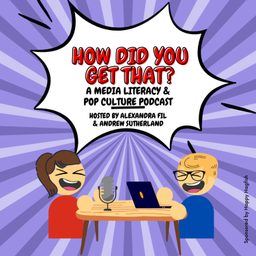
Podcast thumbnail for How Did You Get That? Podcast

How Did You Get That? Podcast

Claim This Podcast

by How Did You Get That? Podcast

5.0(3 reviews)
3 episodes
Updated Daily
Accepts GuestsHas Sponsors
66

Podcast Authority

Beta
GoodBased on show quality, social media presence, reviews, charts, and more
Pod Engine
Quality83
Social0
YouTube93
Engagement32

Podcast Overview

People love to talk about media literacy, but it is a lot deeper than just understanding the source and content. It is about how to Access, Analyze, Evaluate, Create, & Act when we engage with media. It is not just about understanding the source, but also understanding ourselves. The goal of this podcast is to go deeper when it comes to media literacy. We will watch, read, & listen to a whole lot of different media while learning and applying media literacy skills to understand it & ourselves. While also providing practical advice on how we can use media literacy and active media consumers.

Language

🇺🇲

Publishing Since

2/24/2025

Unlock The Full Podcast Authority Score Report

See how your podcast performs across key metrics

66

Podcast Authority

Beta
GoodBased on show quality, social media presence, reviews, charts, and more
Pod Engine
Quality83
Social0
YouTube93
Engagement32
9
Excellent Areas
0
Good Performance
10
Growth Opportunities
excellent
Publishing Consistency
Every 5 days
Performing excellently!
poor
Episode Thumbnails

Recommendations available

Unlock the full report to see detailed tips

+16 More Metrics

Unlock comprehensive insights including:

  • • YouTube presence analysis
  • • Social media reach metrics
  • • RSS compliance scoring
  • • Podcast 2.0 features
  • • Technical standards
What's Included in Your Full Report

Detailed Analytics

  • Complete breakdown of all 19 authority metrics
  • Personalized recommendations for each metric
  • Industry benchmarks and comparisons
  • Technical RSS feed analysis and compliance scoring

Growth Strategies

  • Step-by-step action plans for improvement
  • Quick wins to boost your score immediately
  • Pro tips from successful podcasters
Get your free podcast insights report

See how your show performs across every key metric

Instant delivery
No spam
Attract Better Guests

High authority scores make your podcast more attractive to industry leaders and influencers who want to appear on credible shows.

Secure Sponsorships

Sponsors look for podcasts with proven authority and engagement. Your score demonstrates your podcast's value to potential partners.

Grow Your Audience

Understanding your strengths and weaknesses helps you make data-driven decisions to expand your listener base effectively.

1 verified contact email on file for How Did You Get That? Podcast

Pitch yourself as a guest, propose sponsorships, or reach out directly to the host.

Recent Episodes

Episode thumbnail for Ep 3. Defying the Gravity of Propaganda

March 11, 2025

Ep 3. Defying the Gravity of Propaganda

<li>What can we learn from &#39;Wicked&#39; about Propaganda?The musical turned-movie ‘Wicked’ was so Popular, it took the world by storm. Almost like a tornado. One of the major themes within the Book/Musical/Movie is propaganda, which sparked interest in this episode of How Did You Get That? Podcast. In this episode, we explore what propaganda is and the difference between it and persuasion while also discussing how ‘Wicked’ can teach us how to think critically about it. More importantly, how to identify propaganda and what you can do to defy the gravity of it. Such as asking yourself, &quot;what is this feeling?&quot; when you encounter propaganda. You shouldn&#39;t just be dancing through life, but you also need to be active and engage critically with information.Media Sources:• Baum, L. F. (1990). The Wonderful Wizard of Oz. George M. Hill Company. • Chu, J. M. (Director). (2024). Wicked [Film]. Universal Pictures; Marc Platt Productions.• Maguire, G. (1995). Wicked: The Life and Times of the Wicked Witch of the West. Regan Books.[Heavilybrokn]. (n.d.). R/wicked on reddit: All of this wicked merch coming out... and this is all I’ve really wanted since the leaks from last year! I hope they either release it officially or someone on etsy or something makes it. I’ll buy it so quickly!! https://www.reddit.com/r/wicked/comments/1g2m8sh/all_of_this_wicked_merch_coming_out_and_this_is/ [lovemelikeyoul. (2025). R/wicked on reddit: Wicked Witch propaganda posters from the Roblox game. Reddit. https://www.reddit.com/r/wicked/comments/1hq0d2m/wicked_witch propaganda_posters_ from the robl ox/ He&#39;s watching you. Digital Collections -Northwestern University Libraries. (n.d.). https://dc.library.northwestern.edu/items/b1f17878-0a3b-491f-b742-1bdedd770492Sources:• Bauer, M., Cahlíková, J., Chytilová, J., Roland, G., &amp; Želinský, T. (2023). Shifting punishment onto minorities: Experimental evidence of scapegoating. The Economic Journal, 133(652), 1626–1640. https://doi.org/10.1093/ej/uead005 • Bernays, E. (1928). Propaganda. New York: H. Liveright.• Biddle, W. W. (1931). A psychological definition of propaganda. The Journal of Abnormal and Social Psychology, 26(3), 283–295. ⁠https://doi.org/10.1037/h0074944⁠• Brotherton, R. (2016). Suspicious minds: Why we believe conspiracy theories. Bloomsbury.• Burger, A. (2009) From &#39;The Wizard of Oz&#39; to &#39;Wicked&#39;: Trajectory of American myth. American Culture Studies Ph.D. Dissertations. 31. Bowling Green State University. Retrieved from ⁠https://scholarworks.bgsu.edu/acs_diss/31/⁠• Cote, D. (2005) Wicked: The Grimmerie (A Behind-the-Scenes Look at the Hit Broadway Musical). Principal Photography Joan Marcus. Headcase Design. New York: Hyperion.• Hobbs, R. (2020). Mind Over Media. Norton.• Hobbs, R., &amp; McGee, S. (2014). Teaching about propaganda: An examination of the historical roots of Media Literacy. Journal of Media Literacy Education, 6(2). https://doi.org/10.23860/jmle-6-2-5 • Jowett, G., &amp; O’Donnell, V. (2012). Propaganda &amp; Persuasion. SAGE. • Miller, C. R. &amp; Edwards, V. (1936, October). The intelligent teacher’s guide through campaign propaganda. The Clearing House, 11(2), 69-77.• Power &amp; Propaganda. Wicked The Musical. (2021, August 18). ⁠https://wickedthemusical.com/linguification-library/power-and-propaganda/⁠ Sawyer, K. R. (2022). The Scapegoats.• The NewYork Public Library. (2013). Institute for Propaganda Analysis records. New York Public Library Archives &amp; Manuscripts. Retrieved Jan. 14, 2014, from: http://archives.nypl.org/mss/1513#acquisition_processing#medialiteracy #education #podcast #Wicked</li>

Episode thumbnail for Ep. 2: How Does a Wild Robot Talk About Climate Change?

March 4, 2025

Ep. 2: How Does a Wild Robot Talk About Climate Change?

<p>How does a robot who is raising a goose talk about climate change? In this episode, we watch the movie The Wild Robot and discuss its environmental themes and how its subtle nature it can drive conversations around climate change. We also discuss other major themes and how by understanding who the source of the message is through media literacy, we can become a more active audience rather than passive.</p><p> </p><p>Media Source:</p><p>Brown, P., &amp; Atwater, K. (2021). The Wild Robot. Findaway.</p><p>Sanders, C. (Director). (2024). The Wild Robot [Film]. DreamWorks Animation. </p><p>Drewxdeficit TikTok account: https://www.tiktok.com/@drewxdeficit?_t=ZP-8uPL6ZQdsY2&amp;_r=1</p><p>Citations:</p><p>Burke, K. (1969). A rhetoric of motives. Burkley, CA: University California Press.</p><p>Giaccardi, S., Rogers, A., &amp; Rosenthal, E. L. (2022, October 17). A glaring absence: The climate crisis is virtually nonexistent in Scripted Entertainment. https://sustainability.usc.edu/2022/10/17/a-glaring-absence-the-climate-crisis-is-virtually-nonexistent-in-scripted-entertainment/Hoffner, C. A., &amp; Cohen, E. L. (2014). Portrayal of mental illness on the TV series Monk: Presumed influence and consequences of exposure. Health Communication, 30(10), 1046–1054. https://doi.org/10.1080/10410236.2014.917840</p><p>Scharrer, E., &amp; Ramasubramanian, S.(2015). Intervening in the media’s influence on stereotypes of race and ethnicity: The role of media literacy education. Journal of Social Issues, 71(1), 171–185. doi:10.1111/josi.12103</p><p>Stamps, D. L., &amp; Sahlman, J. (2021).Audiences’ mediated contact with Black characters in scripted television and support for racialized social issues. Communication Studies, 72(5), 834-849. <a href="https://psycnet.apa.org/doi/10.1080/10510974.2021.1975140" target="_blank">https://doi.org/10.1080/10510974.2021.1975140</a></p>

Episode thumbnail for Ep 1: A, B, Media Litra-C

February 24, 2025

Ep 1: A, B, Media Litra-C

<p>Media literacy is a skill that we can develop. However, as in the case of many skills and behaviors, the confidence someone has in those skills can predict a person&#39;s willingness to do such skills. In our first episode, we explore the idea of Self-Efficacy and how Sesame Street helps develop cognitive skills while addressing affective goals, increasing children&#39;s and parents&#39; self-esteem, competency, and self-efficacy. Sesame Street offers valuable skills to both children and parents through Entertainment Education. So, how can we learn from Sesame Street and apply their approaches to media literacy application?</p><p>Media Sources:</p><p>Sesame Workshop. (2024, May 3). Big Bird gets the COVID-19 vaccine. https://sesameworkshop.org/resources/big-bird-gets-the-covid-vaccine/</p><p>Sesame Street Workshop. (2015, October 20). Talk Listen Connect. For Families: Deployment Story. YouTube. https://www.youtube.com/watch?v=X6bK2ayZIBo</p><p>Sesame Workshop. (2024, June 26). Financial education. https://sesameworkshop.org/topics/financial-education/</p><p>Wilcox, D. (1972, February 16). Sesame Street: S3. Sesame Workshop.</p><p><br></p><p><br></p><p>Research Sources:</p><p>Bandura, A. (1989). Human agency in social cognitive theory. American Psychologist, 44(9), 1175–1184. https://doi.org/10.1037/0003-066X.44.9.1175 </p><p>Bandura, A. (2004). Social Cognitive Theory for Personal and Social Change by Enabling Media. In A. Singhal, M. J. Cody, E. M. Rogers, &amp; M. Sabido (Eds.), Entertainment-education and social change: History, research, and practice (pp. 75–96). Lawrence Erlbaum Associates Publishers.</p><p>Bandura, A. (2013). Health promotion from the perspective of social cognitive theory. In Understanding and changing health behavior (pp. 299-339). Psychology Press. </p><p>Davis, Michael (2008). Street Gang: The Complete History of Sesame Street. New York: Viking Penguin. ISBN 978-0-670-01996-0. </p><p>Fisch, S. M., &amp; Truglio, R. T. (2011). “G” is for growing: Thirty Years of Research on children and Sesame Street. Routledge.</p><p>Flittner O’Grady, A., Thomaseo Burton, E., Chawla, N., Topp, D., &amp; MacDermid Wadsworth, S. (2015). Evaluation of a multimedia intervention for children and families facing multiple military deployments. The Journal of Primary Prevention, 37(1), 53–70. https://doi.org/10.1007/s10935-015-0410-7</p><p>Kearney, M., &amp; Levine, P. (2015). Early Childhood Education by MOOC: Lessons from Sesame Street. https://doi.org/10.3386/w21229</p><p>Li, J., Foley, J. M., Dumdum, O., &amp; Wagner, M. W. (2022). The power of a genre: Political news presented as fact-checking increases accurate belief updating and hostile media perceptions. Mass Communication and Society, 25, 282-307. doi:10/1080/15205436.2021.1924382</p><p>Mielke, K.W. (1990). Research and development at the Children’s Television Workshop. Educational Technology Research and Development, 38 (4), 7-16.</p><p>NAMLE. (2024, March 7). Core principles. https://namle.net/publications/core-principles/</p><p>Shapiro, J. (2018). Digital play for global citizens: A guide from the Joan Ganz Cooney Center at Sesame Workshop. The Joan Ganz Cooney Center: Advancing children’s education in the digital age. https://joanganzcooneycenter.org/wp-content/uploads/2018/03/jgcc_digitalplayforglobalcitizens.pdf</p><p>Sherman, M. D., Monn, A., Larsen, J. L., &amp; Gewirtz, A. (2018). Evaluation of a Sesame Street multimedia intervention for families transitioning out of the military. Journal of Child and Family Studies, 27(8), 2533-2540. https://doi.org/10.1007/s10826-018-1083-7</p><p><br></p>

3 total episodes available

Deep-dive analytics for How Did You Get That? Podcast

Frequently asked questions

Have a different question and can't find the answer you're looking for? Reach out to our support team by sending us an email and we'll get back to you as soon as we can.

What is How Did You Get That? Podcast?

People love to talk about media literacy, but it is a lot deeper than just understanding the source and content. It is about how to Access, Analyze, Evaluate, Create, & Act when we engage with media. It is not just about understanding the source, but also understanding ourselves.

The goal of this podcast is to go deeper when it comes to media literacy. We will watch, read, & listen to a whole lot of different media while learning and applying media literacy skills to understand it & ourselves. While also providing practical advice on how we can use media literacy and active media consumers.

How often does this podcast release new episodes?

This podcast updates daily.

Where can I listen to this podcast?

This podcast is available on 4 platforms including Apple Podcasts, Spotify, and more. You can also use the RSS feed directly.

Does this podcast accept guests?

Yes, this podcast regularly features guests.

Legal Disclaimer

Pod Engine is not affiliated with, endorsed by, or officially connected with any of the podcasts displayed on this platform. We operate independently as a podcast discovery and analytics service.

All podcast artwork, thumbnails, and content displayed on this page are the property of their respective owners and are protected by applicable copyright laws. This includes, but is not limited to, podcast cover art, episode artwork, show descriptions, episode titles, transcripts, audio snippets, and any other content originating from the podcast creators or their licensors.

We display this content under fair use principles and/or implied license for the purpose of podcast discovery, information, and commentary. We make no claim of ownership over any podcast content, artwork, or related materials shown on this platform. All trademarks, service marks, and trade names are the property of their respective owners.

While we strive to ensure all content usage is properly authorized, if you are a rights holder and believe your content is being used inappropriately or without proper authorization, please contact us immediately at hey@podengine.ai for prompt review and appropriate action, which may include content removal or proper attribution.

By accessing and using this platform, you acknowledge and agree to respect all applicable copyright laws and intellectual property rights of content owners. Any unauthorized reproduction, distribution, or commercial use of the content displayed on this platform is strictly prohibited.