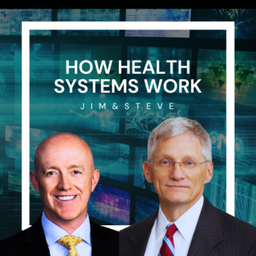
Interviews with the U.S Health Systems Brightest Minds.
Over the years, Jim Burke has had the privilege of engaging in deep, insightful conversations with some of the brightest minds in healthcare. These leaders possess invaluable perspectives that could offer solutions to many of the challenges facing the U.S. health Systems today. Driven by his curiosity and passion for learning, Jim created this podcast to amplify these voices and share their stories.
This series invites healthcare leaders to tune in, learn from these mental models, and be inspired to collaborate and challenge the status
Sun Health: Making "Assisted" Living Available to All of Us
Most health systems have spent the past two decades consolidating around acute care and shedding post-acute and senior living operations. Sun Health took the opposite path. In 2008, the organization merged its hospitals into Banner Health and restructured entirely around senior living, wellness coordination, and community-based health services. Today it operates five life plan communities in the Phoenix market, serves a growing population through its Sun Health at Home program, and is building toward an individualized health span model.
In this episode, Jim Burke and Steven Pratt speak with Mark Reifsteck, vice chair of the Sun Health board and a retired healthcare executive, and Joe [Last Name], Sun Health's CEO for over three decades. The conversation covers how the transition from acute care was structured and why the financing model enabled it, what daily life and care coordination look like across Sun Health's campuses, how the at-home and Vibrant Life Choices programs extend services beyond campus walls, and where the organization sees its model heading over the next five to ten years, including connections to research institutes, value-based arrangements, and expansion to younger demographics.
Whether you lead a health system evaluating its post-acute strategy, sit on a nonprofit board navigating mission and sustainability, or work in senior living operations, this episode offers a detailed look at an organization that built a successful model around the parts of the continuum most systems have abandoned.
17 Jun 2026
Susan James: In-House and Outside Counsel in Health Systems
Health systems depend on legal counsel for everything from physician agreements and regulatory compliance to middle-of-the-night operational crises. How that legal function is organized, and how in-house and outside counsel work together, has a direct impact on the quality and speed of the advice reaching executive teams.
In this episode, Jim Burke and Steven Pratt speak with Susan James, a healthcare attorney who has moved between in-house general counsel positions and law firm practice multiple times over a career spanning decades. She is now at Hall Render, where she is also partially seconded to a health system building out its legal function.
The conversation covers what in-house counsel gains from being physically embedded in operations, how general counsel should evaluate when to send work outside and select the right attorney, the distinction between treating outside counsel as a partner versus a commodity, what health systems lose when legal departments centralize or go fully remote, and the tension between the in-house standard of good enough and the law firm pursuit of precision. Susan also shares firsthand accounts from on-call rotations that illustrate why proximity to the client matters.
Whether you manage a health system legal department, serve as outside counsel to health systems, or lead an organization that relies on both, this episode offers a practical perspective from someone who has operated on each side.
27 May 2026
The AI Era in Healthcare. Part 3 — Training, Transparency, and the Equity Question with Dr. Nadia Smati
AI tools in clinical settings are getting easier to use, but ease of use does not mean safe use. Automation bias, hallucinations that look convincing, and the risk of de-skilling are real concerns as health systems move from pilot deployments to broader adoption.
In this episode, Jim Burke, Steven Pratt, and Michael Batt speak with Dr. Nadia Smati, an internal medicine physician and faculty member at Houston Methodist who also serves as an advisor and capital partner working with healthcare AI startups. Dr. Smati has practiced under the UK's National Health Service, Kaiser Permanente, and Houston Methodist, giving her a comparative view of how different systems approach technology adoption and value-based care.
The conversation covers how AI is influencing clinical decision-making beyond documentation, the de-skilling risk observed in procedure-based specialties, a practical framework for treating AI output like a trainee's note, vendor transparency and the evolving question of liability, and whether AI will close or widen the equity gap between well-resourced and under-resourced health systems.
Whether you lead clinical operations, manage AI governance, or are thinking about workforce training strategy, this episode addresses the questions that follow deployment.
Who has been a guest on How Health Systems Work
Names identified in recent episode analyses. Showing up to five guests.
Andrew Dick
Larry Bucshon
James Junger
Bain Farris
Mike Greer
Reach and audience
Public platform figures. Ratings count people who left a rating, not total listeners.
Apple Podcasts (US)
5.0 / 5
2 ratings
Spotify
5.0 / 5
3 ratings
Podcast Authority Score: 32 / 100
A composite of feed quality, social presence, YouTube performance and engagement. Read the methodology.
Quality
52
Social presence
0
YouTube
0
Engagement
32
Contact How Health Systems Work
Guest appearances
Books guests
Based on episode analysis; this does not confirm that the show is currently accepting guests.
Host of How Health Systems Work?
Claim your podcast to manage its listing and keep your show details accurate.
Pod Engine is an independent podcast discovery and analytics service and is not affiliated with or endorsed by this podcast. Artwork and show content belong to their owners. Full legal notice.
Explore this show Podcast research with Pod Engine