
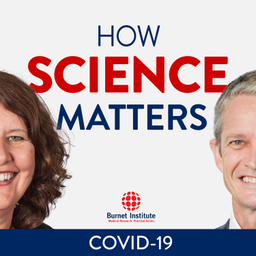
How Science Matters
Claim This Podcastby Burnet Institute
Podcast Overview
<p>Helping us to make sense of the many impacts from the COVID-19 pandemic through science. Why is it so hard to crush this pandemic and will we solve this complex problem? Digging through the science of the coronavirus and other infectious diseases, we look at how we got here, and what comes next. In these uncertain times, this 8-part series shares the stories of Australian scientists to help make sense of a mutating virus and to give us hope. This is a science podcast from Burnet Institute, a key adviser to government and the global response during the COVID-19 pandemic. Hear from the nation’s leading scientific thinkers as they forensically uncover what it takes to battle a deadly disease. Hosted by journalist Tracy Parish and Professor Brendan Crabb, a microbiologist, malaria researcher, and one of the best minds in infectious diseases and global health today.</p> <p>Produced by <a href="https://writtenandrecorded.com/">Written & Recorded</a>.</p> <p>Find all episodes of How Science Matters at <br>burnet.edu.au/how-science-matters</p> <p> </p> <p>How Science Matters was recorded on the traditional land of the Bunurong people of the Kulin Nations and we offer our respects to Elders past and present. We recognise and respect the cultural heritage of this land.</p> <p data-pm-slice="1 1 []"><strong>Disclaimer: </strong>Series 1 of this podcast was recorded between June and July 2021. For current information on the pandemic, please search for the latest official coronavirus advice in your area.</p>
Language
🇺🇲
Publishing Since
7/22/2021
1 verified contact email on file for How Science Matters
Pitch yourself as a guest, propose sponsorships, or reach out directly to the host.
Recent Episodes
September 13, 2021
Episode 8: Lost Voice – COVID's impact on eliminating malaria
<p>The COVID-19 pandemic threatens to derail global efforts against killer infectious diseases like malaria, tuberculosis, and HIV, leading to more deaths. As limited health resources in parts of Africa, Asia and Papua New Guinea are channelled into controlling the coronavirus, this could set back years of progress in tackling these diseases across vulnerable communities. In this episode, you’ll meet Burnet Institute’s Deputy Director, Professor James Beeson, a malaria vaccine specialist who also works on maternal and child health. Find out how our environment shapes our immune system and why it was possible to develop multiple vaccines for COVID-19 so quickly, but the only malaria vaccine has a protection level as low as 30 per cent. </p> <p>Get the transcript <a href="https://burnet.edu.au/covid-19/126">here</a>.</p> <p><strong>Credits: </strong>Hosted by journalist Tracy Parish and Professor Brendan Crabb, a microbiologist, malaria researcher, and one of the best minds in infectious diseases and global health today.</p> <p>Produced by <a href="https://writtenandrecorded.com/">Written & Recorded</a></p> <p>Executive Producers: Serpil Senelmis & James Brandis</p> <p>Sound Design/Engineering: James Brandis</p> <p>Production Assistance: Nick Dalziel, Burnet Institute </p> <p>How Science Matters was recorded on the traditional land of the Bunurong people of the Kulin Nations and we offer our respects to Elders past and present. We recognise and respect the cultural heritage of this land.</p> <p data-pm-slice="1 1 []"><strong>Disclaimer: </strong>This podcast series was recorded between June and July 2021. For current information on the pandemic, please search for the latest official coronavirus advice in your area.</p><p>See <a href="https://omnystudio.com/listener">omnystudio.com/listener</a> for privacy information.</p>
September 6, 2021
Episode 7: Modelling COVID-19 – Can we predict the future?
<p><strong>Episode 7: Modelling COVID-19: Can we predict the future? </strong></p> <p>In an island-continent like Australia, with a population of almost 26 million, how is the coronavirus likely to spread? And how can transmission be halted? In this episode, you’ll meet Burnet Institute’s Deputy Director, Professor Margaret Hellard and Dr Nick Scott, the Head of Modelling. They are part of the team behind the Victorian adaptation of the COVASIM Epidemic model, which was first developed by the Institute for Disease Modelling in the USA. Hear how modelling helps prepare our health system and governments for the likelihood of the virus spreading in the future and the risks around that. It’s what informs intervention strategies like international air travel, lockdowns, social distancing, density limits on cafés and restaurants, and homeschooling. </p> <p> </p> <p>Get the transcript <a href="https://burnet.edu.au/covid-19/125">here</a>.</p> <p> </p> <p><strong>Credits: </strong>Hosted by journalist Tracy Parish and Professor Brendan Crabb, a microbiologist, malaria researcher, and one of the best minds in infectious diseases and global health today.</p> <p>Produced by <a href="https://writtenandrecorded.com/">Written & Recorded</a></p> <p>Executive Producers: Serpil Senelmis & James Brandis</p> <p>Sound Design/Engineering: James Brandis</p> <p>Production Assistance: Nick Dalziel, Burnet Institute </p> <p>How Science Matters was recorded on the traditional land of the Bunurong people of the Kulin Nations and we offer our respects to Elders past and present. We recognise and respect the cultural heritage of this land.</p> <p data-pm-slice="1 1 []"><strong>Disclaimer: </strong>This podcast series was recorded between June and July 2021. For current information on the pandemic, please search for the latest official coronavirus advice in your area.</p><p>See <a href="https://omnystudio.com/listener">omnystudio.com/listener</a> for privacy information.</p>
August 30, 2021
Episode 6: Motherhood in a time of pandemic
<p>For some pregnant women in Australia, the arrival of COVID-19 ushered in an unusually strange and lonely time. Reassuring face-to-face antenatal care was replaced by remote telehealth. Many gave birth supported by midwives dressed in PPE gear. In developing countries, women were considered lucky if they managed to secure an appointment with a midwife. In this episode, you’ll meet Burnet Institute’s Professor Caroline Homer, a leading midwifery researcher and maternal and newborn health expert. She talks about the crushing emotional toll of the pandemic on expectant mothers worldwide, alongside the success stories for maternal health.</p> <p>Content warning: this episode discusses miscarriage.</p> <p>Get the transcript <a href="https://burnet.edu.au/covid-19/124">here</a>.</p> <p><strong>Credits: </strong>Hosted by journalist Tracy Parish and Professor Brendan Crabb, a microbiologist, malaria researcher, and one of the best minds in infectious diseases and global health today.</p> <p>Produced by <a href="https://writtenandrecorded.com/">Written & Recorded</a></p> <p>Executive Producers: Serpil Senelmis & James Brandis</p> <p>Sound Design/Engineering: James Brandis</p> <p>Production Assistance: Nick Dalziel, Burnet Institute </p> <p>How Science Matters was recorded on the traditional land of the Bunurong people of the Kulin Nations and we offer our respects to Elders past and present. We recognise and respect the cultural heritage of this land.</p> <p data-pm-slice="1 1 []"><strong>Disclaimer: </strong>This podcast series was recorded between June and July 2021. For current information on the pandemic, please search for the latest official coronavirus advice in your area.</p><p>See <a href="https://omnystudio.com/listener">omnystudio.com/listener</a> for privacy information.</p>
9 total episodes available
Deep-dive analytics for How Science Matters
Frequently asked questions
Have a different question and can't find the answer you're looking for? Reach out to our support team by sending us an email and we'll get back to you as soon as we can.
- What is How Science Matters?
<p>Helping us to make sense of the many impacts from the COVID-19 pandemic through science. Why is it so hard to crush this pandemic and will we solve this complex problem? Digging through the science of the coronavirus and other infectious diseases, we look at how we got here, and what comes next. In these uncertain times, this 8-part series shares the stories of Australian scientists to help make sense of a mutating virus and to give us hope. This is a science podcast from Burnet Institute, a key adviser to government and the global response during the COVID-19 pandemic. Hear from the nation’s leading scientific thinkers as they forensically uncover what it takes to battle a deadly disease. Hosted by journalist Tracy Parish and Professor Brendan Crabb, a microbiologist, malaria researcher, and one of the best minds in infectious diseases and global health today.</p> <p>Produced by <a href="https://writtenandrecorded.com/">Written & Recorded</a>.</p> <p>Find all episodes of How Science Matters at <br>burnet.edu.au/how-science-matters</p> <p> </p> <p>How Science Matters was recorded on the traditional land of the Bunurong people of the Kulin Nations and we offer our respects to Elders past and present. We recognise and respect the cultural heritage of this land.</p> <p data-pm-slice="1 1 []"><strong>Disclaimer: </strong>Series 1 of this podcast was recorded between June and July 2021. For current information on the pandemic, please search for the latest official coronavirus advice in your area.</p> - How often does this podcast release new episodes?
This podcast updates daily.
- Where can I listen to this podcast?
This podcast is available on 4 platforms including Apple Podcasts, Spotify, and more. You can also use the RSS feed directly.
- Does this podcast accept guests?
Yes, this podcast regularly features guests.
Legal Disclaimer
Pod Engine is not affiliated with, endorsed by, or officially connected with any of the podcasts displayed on this platform. We operate independently as a podcast discovery and analytics service.
All podcast artwork, thumbnails, and content displayed on this page are the property of their respective owners and are protected by applicable copyright laws. This includes, but is not limited to, podcast cover art, episode artwork, show descriptions, episode titles, transcripts, audio snippets, and any other content originating from the podcast creators or their licensors.
We display this content under fair use principles and/or implied license for the purpose of podcast discovery, information, and commentary. We make no claim of ownership over any podcast content, artwork, or related materials shown on this platform. All trademarks, service marks, and trade names are the property of their respective owners.
While we strive to ensure all content usage is properly authorized, if you are a rights holder and believe your content is being used inappropriately or without proper authorization, please contact us immediately at hey@podengine.ai for prompt review and appropriate action, which may include content removal or proper attribution.
By accessing and using this platform, you acknowledge and agree to respect all applicable copyright laws and intellectual property rights of content owners. Any unauthorized reproduction, distribution, or commercial use of the content displayed on this platform is strictly prohibited.