- 17
- Episodes
- 1
- Ratings
- 2025
- First episode
- 3K
- YouTube views
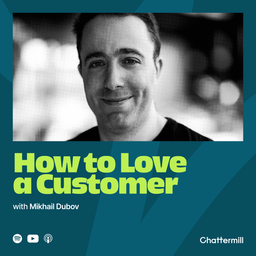
About How To Love a Customer
How to Love a Customer explores how great brands transform surprising customer moments into unforgettable experiences, with Chattermill CEO Mikhail Dubov interviewing the leaders who truly listen to their customers and understand the human behavior that drives loyalty.
- Publisher
- Chattermill
- Category
- business
- Language
- en
- Explicit
- No
- First episode
- 1 Jul 2025
- Latest episode
- 9 Jul 2026
Latest episodes
17 episodes in the feed.
9 Jul 2026
How one warm-food complaint exposed a churn problem nobody could see | Victoria Weiss (Senior Director of CX, Smalls)
In this episode of How to Love a Customer, Victoria Weiss, Senior Director of Customer Experience at Smalls, shares the story of a loyal customer named Jill whose frozen food kept arriving warm, and how that single escalation exposed a delivery problem that was quietly driving subscribers away. After several layers of escalation got Jill nowhere, Victoria got on a call, fixed her immediate problem, then asked the question most companies skip: how many other customers are hitting this exact issue? Drawing on a decade in DTC customer experience, from agent work at Rent the Runway to leading CX at Daily Harvest, Little Spoon, and now Smalls, Victoria explains why one escalated customer is usually a signal rather than an outlier. She breaks down how she quantifies a problem before leadership will act on it, why she refuses to wait on the analytics team, and how bringing both data and real customer stories to the table is what actually moves people. Victoria also gets into how she builds and empowers a CX team, why agents should be trusted to make the right call even when it costs money, and where AI fits into modern customer experience. She's deploying it carefully, starting with the easy stuff, with one rule she won't bend: customers can always reach a human. Plus her take on the DTC industry's stubborn habit of treating CX as a cost center, and why Amazon went from writing the book on service to a model of what not to become. Tune in to learn how to turn a single frustrated customer into a company-wide fix, how to make leadership listen with scrappy data, and why great CX in DTC comes down to trust, empowerment, and actually listening.
10 Jun 2026
Why the best customer support is the one that's never needed | Olga Ivanova (Senior Director of CX, inDrive)
In this episode of How to Love a Customer, Olga Ivanova, Senior Director of Customer Experience at inDrive, shares what it actually takes to run CX for the world's second-most-downloaded ride-hailing app — operating across 48 markets, on a two-sided bidding platform, where drivers and riders set their own prices and cash is still how most payments work. The company started as a Facebook group in Yakutia, Russia, where ordinary people fought back against taxi drivers hiking prices in minus-42-degree weather. That founding obsession with fairness, Olga Ivanova explains, isn't just a values statement at inDrive — it's baked into every policy, every script, and every product decision. At the centre of this episode is one of the hardest problems in two-sided marketplaces: what do you do when a rider and a driver tell completely different stories, and your support agent wasn't there? Olga Ivanova walks through how inDrive built an LLM-assisted conflict resolution model — seven factors, fully automated inputs, designed specifically to remove the burden of impossible judgements from support agents. She also explains why transparency matters so much for drivers who depend on the platform for their income, and how inDrive measures whether the model is actually working. Olga Ivanova also makes a case that's rarer than you'd think in CX circles: that "delight" is the wrong goal for most teams. Especially in functional categories like ride-hailing, consistency beats surprise every time. She describes what she calls the "carpet of automation" — the risk of automating support contacts without tracking what's underneath, so problems get quieter without ever getting solved. Her approach: look at all contact reasons, automated or not, because a problem resolved in one second is still a problem if it keeps happening. Tune in to learn why the best customer support is the kind that never gets contacted — and what it actually takes to build CX infrastructure that's fair, consistent, and honest about what's broken.
27 May 2026
How CitizenM turned a failed internal app into a masterclass in listening | Casper Overbeek (Chief Product Officer, CitizenM)
In this episode of How to Love a Customer, Casper Overbeek — Chief Product & Experience Officer at CitizenM — shares how the boutique hotel brand scaled from 10 to nearly 40 properties without losing the thing guests actually come for: genuine human hospitality. He starts with an honest story about a product failure. CitizenM built an ambassador app, rolled it out with confidence, and watched almost no one use it. The fix came only after they did what they should have done first — talked to the frontline staff. One remote iPad restart feature changed everything. Casper unpacks what made CitizenM's model work: ambassadors with a single KPI (guest satisfaction), no check-in desks, and an inverted hierarchy where frontline staff sit above leadership. He explains why revenue is an outcome not a strategy, how CitizenM's deliberate choice to be not for families or pharmaceutical conferences is precisely what lets them be excellent for the guests they do serve, and what it takes to hold core principles under commercial pressure as you scale. He also goes deep on feedback — specifically how piping live customer comments into a Slack channel, visible to everyone in real time, created a team culture of immediacy that no monthly dashboard ever could. And he shares a changed view on AI: a year ago he didn't believe it could be empathic enough to matter in hospitality; today he's involved in a startup handling hotel phone calls via AI — partly because 40% of hotel calls were going unanswered in the first place. Tune in to learn why the best CX programs aren't the most sophisticated ones, why consistency and coherence matter more than delight, and what a coffee shop called Gratitude has to do with building a brand that lasts.
18 May 2026
Why the people closest to your customer are the last ones asked | Jai Patel (Principal | Retail Excellence & Consumer Experiences, Nike)
In this episode of How to Love a Customer, Jai Patel, Principal | EMEA Nike Store Partner Management : Retail Excellence & Consumer Experiences — a retail leader who started on the shop floor at 15 and has since worked across Next, Selfridges, Bicester Village, and Dyson — shares how the gap between boardroom strategy and in-store execution is the real CX problem most brands aren't solving. The moment that crystallised it for him: standing in a Nike store in Liverpool while customers shouted at his team because the receipt printer was broken, and realising the operational failure was only half the story. The other half was that nobody at head office had thought about what it felt like to be the person in the middle of it. Jai traces how that observation shaped his work at PVH — where he found store teams delivering brand programmes "robotically," running through mental checklists instead of actually connecting with shoppers. The fix wasn't a new process. It was building the feedback loop that had never existed: giving store associates a platform to say what they saw, what customers were frustrated by, and what corporate decisions were making their jobs harder. He describes the moment in France when 30 store managers stopped engaging within five minutes, and what it took to earn their trust — including telling them plainly that he'd stood where they were standing. He also walks through the Bicester Village WhatsApp initiative — how a luxury outlet destination maintained its high-touch experience during COVID by connecting real store team members with shoppers via WhatsApp rather than routing them to a chatbot. Getting the brand partners on board meant mapping two different customer journeys and finding where they actually overlapped. The tech was straightforward. The alignment wasn't. Tune in to learn why consumers remember intent, not efficiency — and why the companies that build great retail experiences are the ones that treat their store teams as a source of insight, not just a vehicle for execution. Jai is about to start a new chapter at Nike's corporate partner store team, which makes this conversation a rare look at how someone with 30 years of floor-up experience thinks about strategy from the inside.
1 May 2026
How a subscription cancellation became a company-wide act of kindness | Jordan Cousins (Director of CX Operations, Who Gives A Crap)
In this episode of How to Love a Customer, Jordan Cousins, Director of Customer Experience Operations at Who Gives A Crap, shares how a single cancellation email — from the family of a long-time customer moving into aged care — turned into a company-wide moment of generosity. The customer happiness team spotted the signal, asked a couple of careful questions, and before long the internal Slack thread had exploded with ideas. Welcome gifts went out. The co-founder wrote a handwritten letter. No tracking, no referral code, no social post attached. Jordan explains how Who Gives A Crap's "random acts of crappiness" work precisely because they aren't measured. He walks through why the company deliberately splits customer happiness (the frontline) from customer experience (the insight work) while keeping them in one department, and why that separation makes both jobs better. Drawing on nearly seven years at the profit-for-purpose paper brand — and earlier stints launching Deliveroo in Australia — he makes the case that kind gestures only land when the fundamentals underneath already work. He's equally direct on what's overhyped: the "deliver and delight" trend minus the deliver, and the framing of AI as a solution rather than a tool. He shares the story of a chatbot the team built four years ago that quietly failed — not because it was bad, but because customers never saw it. Every touchpoint flowed through email, so customers hit reply. The new approach embeds AI into the email queue, handling the fast, low-emotion requests while keeping humans on anything that needs real judgement. Tune in to learn why Who Gives A Crap protects the human moments, automates the transactional ones, and does kind things for customers with nothing attached to the end of them — and why, in Jordan's words, "if it's a choice between a robot or a human, the human wins."
7 Apr 2026
How a one-hour AI workflow turned a first meeting into a strategic partnership | Lisa Knowles (Strategic Program Manager, Miro)
In this episode of How to Love a Customer, Lisa Knowles, Strategic Program Manager at Miro, shares how she used an AI workflow she’d built inside Miro to prepare for a meeting with a Japanese customer she’d never spoken to. By pulling together CSM notes, scoping documents, annual reports, and competitor data, she walked into the room with tailored recommendations and a full presentation — in Japanese — ready in under an hour. The customer couldn’t believe it was their first conversation. Lisa explains how that moment crystallised something Miro had been building toward: a culture where customer centricity isn’t a slogan but an operating system. She breaks down how the company empowers every team to experiment with AI, why their “canvas is the prompt” philosophy keeps humans in the loop, and how their breakout AI Flows feature is driving new teams onto the platform by making multi-step AI workflows visual and transparent. She also gets into the practical mechanics of scaling customer insights: how CSMs save four to six hours per engagement with AI-powered research, why the “everyone should be an analyst” model only works with the right guardrails, and how Miro’s product teams take different approaches to customer data depending on whether they’re building widgets or full solutions. Along the way, she shares her take on why “alignment” is an overused buzzword, why Costco is the gold standard for customer loyalty, and what a handwritten note from a Delta flight crew taught her about the power of small gestures. Tune in to learn how Miro is turning its own platform into an engine for customer understanding — and why the companies that win aren’t the ones that talk about customer centricity, but the ones that build the systems to actually deliver it.
25 Mar 2026
How a paper receipt redesign saved millions — and what it reveals about great product thinking | Lennard Winters (Product Manager, IKEA)
In this episode of How to Love a Customer, Lennard Winters, Product Manager leading IKEA's global customer audience platform, reveals two quietly powerful stories about what happens when you truly listen to customers. The first: a customer discovery session where shoppers admitted they'd stopped saving wishlists — because they trusted retargeted ads to remember their browsing for them. The second: how a digital product team found that simplifying IKEA's paper receipt (removing lines no customer actually used) saved millions in costs and improved the experience — all through subtraction, not addition. Lennard unpacks the philosophy behind IKEA's digital product approach: the "customers don't want a drill, they want a hole" principle that drives discovery; how 90% of IKEA's digital products are built globally with local exceptions only for legislation; and why empowered product teams — organised by customer journey ownership — are trusted to autonomously find and fix the problems that matter most. He explains how, at IKEA's scale, even small improvements compound into enormous value. He also shares how marketing and product are more intertwined than most organisations admit — and why "advertising as a product feature" might be the most honest description of modern personalised retargeting. Add in hot takes on hyper-personalisation as a buzzword to retire, Tesla's dashboard as the gold standard of cutting clutter, and a delightfully simple delivery SMS that won his heart — versus a telco whose disconnected systems represented everything CX should not be. Tune in to learn how thinking like a product manager can transform your CX practice — and why, sometimes, the most valuable thing you can do for your customer is figure out what to remove.
4 Mar 2026
How a Facebook message uncovered the difference between brand voice and customer trust | Domonique Brown (Head of Customer Experience, Liquid IV)
In this episode of How to Love a Customer, Domonique Brown—Head of Customer Experience at Liquid IV—shares how one frustrated customer completely changed her approach to building CX at scale. Early in her time at the company (when she was just employee #11), Domonique responded to a Facebook message with playful brand energy borrowed from her beauty industry background. Within minutes, that customer called—upset, frustrated, and feeling dismissed. They had a medical condition Domonique wasn't familiar with, and what she thought was engaging came across as generic and uncaring. That moment taught her the most important lesson of her career: when customers are putting your product in their bodies, trust beats brand voice every single time. Domonique unpacks how that interaction shaped seven years of customer experience strategy at Liquid IV, a company that went from $20 million in revenue to a billion-dollar brand now part of Unilever. She explains why CPG customer experience is fundamentally different—customers aren't just buying a product, they're making choices about their health and wellness. From college athletes to people managing POTS (Postural Orthostatic Tachycardia Syndrome), every customer has different needs, concerns, and expectations. Liquid IV's CX team had to learn how to instill confidence and trust, not just deliver great service. She also reveals how Liquid IV uses AI strategically—deploying chatbots for simple, repeatable tasks like product questions and order tracking, while empowering human agents to handle complex, trust-building moments. The result? Customer satisfaction scores actually improved after implementing AI because agents could focus on what they do best: building relationships, solving problems, and going above and beyond. Domonique also shares how her team built "surprise and delight" into their formal annual strategy, supporting loyal customers (especially the POTS community) during financial hardship and reaching out to top fans with exclusive gifts and flavors. Drawing from her experience scaling CX through hyper-growth, Domonique breaks down why training is a lost art—and how teaching agents to think strategically (not just close tickets) creates a culture of ownership and empathy. She explains why negative feedback is a gift (customers complaining means they care), why there's no single "hero metric" for CX success, and why democratizing voice of customer data across quality assurance, product, marketing, and operations is what separates good companies from great ones. Tune in to learn why listening to customers—especially the difficult conversations—drives competitive advantage, why AI should free up humans (not replace them), and how one upset phone call can reshape an entire CX philosophy for years to come.
26 Jan 2026
How a "love your customer like your wife" mantra shaped decades of CX philosophy | Rufus Weston (Insights Consultant, formerly BBC, Nike, Just Eat, HelloFresh)
In this episode of How to Love a Customer, Rufus Weston—insights leader with decades of experience at BBC, Nike, Just Eat, HelloFresh, and now running his own consultancy—shares how one powerful mantra from a CMO changed everything: "Love your customer like you love your wife." What started as a simple phrase became the foundation for how Rufus thinks about building customer-centric cultures, proving the value of insights, and turning CX into a business driver instead of a cost center. Rufus walks through the evolution of customer insights—from telephone surveys to AI—and explains why, despite all the technological change, the fundamental challenges remain the same: getting a seat at the table, communicating impact, and making insights actually matter to leadership. He breaks down the three ingredients every insights team needs to succeed (strong team, customer-focused culture, and listening leadership), and why most companies still get it wrong by treating customer experience as an expense rather than an investment. Drawing from his time at Just Eat under Adrian Blair (now CEO of Trustpilot), Rufus reveals how leadership sets the tone for customer obsession, why ROI calculations for CX are often misleading, and how treating your customer experience as your business model—not a budget line—is the real path to sustainable success. He also shares unexpected CX heroes like Abel & Cole and the Dutch government, proving that great customer experience doesn't require flashy gimmicks—just reliability, empathy, and genuine care. Tune in to learn why loving your customer isn't just good ethics—it's good business. And why sometimes, the simplest advice is the most powerful.
17 Dec 2025
How a “root beer in a cola can” moment shaped CX philosophy | Eli Weiss (VP Advocacy, Yotpo)
In this episode of How to Love a Customer, Eli Weiss — longtime DTC operator and now a leader at Yotpo — shares how a single customer email at OLIPOP exposed a major production error: root beer accidentally canned as Vintage Cola. What could have been written off as a confusing complaint instead became a defining moment in how fast, empowered CX teams can protect a brand from disaster. Acting quickly prevented the wrong product from hitting shelves nationwide — and reinforced just how much customer insight matters long before dashboards detect a problem. Eli unpacks how that moment shaped his philosophy on customer experience: meet expectations before you try to exceed them, move quickly when customers raise alarms, and build cultures where CX voices carry all the way to the founder. He contrasts meaningful listening with performative “surprise and delight,” explains why most brands try to build peaks before filling the valleys, and shares how expectation-setting — not gimmicks — is the real engine of LTV in DTC. Drawing from his time at Olipop, Jones Road Beauty, and now Yotpo, Eli breaks down why some brands scale sustainably while others burn through cash, how DTC has evolved across three generations, and why CX is often the invisible differentiator behind profitable growth. He also offers candid takes on AI, why most metrics miss what customers actually feel, and how brands can avoid delighting the wrong people with the wrong gestures. Tune in to learn why listening deeply, acting fast, and empowering CX teams isn’t just “good service” — it’s a competitive advantage. And why, in Eli’s words, sometimes the customer isn’t wrong… you just haven’t caught up yet.
3 Dec 2025
How a dumpster-top usability test reshaped HelloFresh’s UX culture | James Villacci (Head of Global UX Research, HelloFresh)
In this episode of How to Love a Customer, James Villacci, Head of Global UX Research at HelloFresh, shares how one scrappy usability test—run on top of a New York City dumpster—uncovered a critical friction point in the signup flow and proved just how directly customer problems can impact revenue. James explains how that moment helped shift HelloFresh from seeing research as “nice to have” to building a company-wide culture where insights drive decisions. He describes his “research restaurant” model, where teams across the business become chefs of their own small studies, and insight “meal kits” empower product, engineering, and commercial teams to de-risk ideas quickly and at scale. He also reveals how the unique complexity of meal-kit UX—balancing choice, simplicity, personalization, and global eating habits—informs everything from menu filters to the launch of new meal occasions. And with tools like Chattermill and new AI workflows, his team now uncovers patterns and trends in minutes that once took weeks, helping HelloFresh evolve as fast as customer expectations. Tune in to learn how James built a research practice that’s playful, memorable, and relentlessly customer-obsessed—and why sometimes, one fast insight can shift an entire organization’s mindset.
12 Nov 2025
How listening to one unhappy customer changed how we support thousands | Olga Arsenii (Head of Customer Insights, Qonto)
In this episode of How to Love a Customer, Olga Arsenii, Head of Customer Insights at Qonto, shares how one frustrated customer exposed a weakness in their onboarding experience—and sparked a company-wide movement to fix it. While analyzing feedback with her team, Olga discovered that many new users felt alone and overwhelmed during account setup. Support agents were reading scripts instead of solving real problems, and language barriers only made things worse. Within weeks, cross-functional teams—from frontline support to C-suite leaders—came together to redesign the process, proving that at Qonto, everyone owns customer experience. Olga explains how a culture of curiosity and action, not rigid frameworks, helped her young insights team turn data into change. She reveals how they use tools like Chattermill to uncover pain points at scale, why “customer delight” isn’t fireworks but simply things working right, and how balancing speed, reliability, and empathy defines great CX in modern FinTech. Tune in to learn how Qonto built a company where customer insights drive every decision—and why sometimes, one piece of honest feedback can transform an entire organization.
13 Oct 2025
How a 10-Minute Mosquito Fix Redefined Customer Experience | Anastasia Zdoroviak (Chief Customer Experience Officer, Snoonu)
In this episode of How to Love a Customer, Anastasia Zdoroviak—former CX leader at DoorDash and Rappi, now Chief Customer Experience Officer at Snoonu—shares a personal story that perfectly captures what great CX really means. One night in Mexico City, her daughter couldn’t sleep because of mosquitoes. The stores were closed, delivery slots were full, and no quick fix seemed possible—until her own team unknowingly solved the same problem for thousands of users by analyzing failed search sessions and launching 10-minute deliveries from dark stores. Anastasia explains how this “mosquito moment” became proof that data-driven empathy can transform customer pain into product innovation. She discusses how to build CX functions that reduce the need for support, why NPS isn’t enough, and how different cultures—from the U.S. to Latin America to the Middle East—define trust, communication, and “on-time” in completely different ways. Tune in for insights on setting the right success metrics, balancing tech and human touch, and why the best CX goal is to make support almost unnecessary.
25 Sept 2025
How an epic delivery disaster became our blueprint for excellence | David McDaid (Director of CX & Studio, END.)
In this episode of How to Love a Customer, David McDaid from END. Clothing shares the customer story that transformed his company's approach to quality - one where everything possible went wrong. Warehouse delays, customs issues, weather problems, a missing package, and finally the wrong item delivered after a week and a half. Instead of writing it off as bad luck, David's team created an internal "quality score" system that evaluates every order against six common failure points. Their score jumped from the mid-40s to the high-90s, customer complaints dropped dramatically, and the original customer returned to thank them personally. David also discusses why customer service teams shouldn't be cost centers and how challenger banks like Monzo are reshaping customer experience expectations across industries. Subscribe for more insights from leaders who turn customer disasters into competitive advantages.
6 Aug 2025
What every hospitality company gets wrong about guest comfort | Julia Zuber (Customer Insights Lead, Limehome)
In this episode, Julia Zuber from Lime Home reveals how a seemingly minor guest complaint about sleep quality led to one of their most impactful customer experience improvements. What started as scattered feedback about uncomfortable nights turned into a company-wide pillow revolution that transformed guest satisfaction scores. Julia shares the detective work that uncovered the real culprit behind poor sleep experiences across 5,000 properties in Europe. It wasn't the beds, the rooms, or the booking process - it was something so basic that it almost slipped through the cracks entirely. By diving deep into guest feedback patterns and enriching data with room-level insights, her team discovered how one small change could dramatically improve the entire stay experience. Beyond pillows, Julia opens up about building a customer insights culture from scratch in a fast-growing hospitality company, why she believes "delight" is an overrated customer experience goal, and how support teams hold the key to understanding what guests really want. She also tackles the tricky balance between AI automation and human connection in hospitality, sharing lessons from Lime Home's own chatbot experiments. Subscribe for more customer experience insights from leaders who prove that the most powerful improvements often come from paying attention to the details everyone else overlooks.
17 Jul 2025
The pig story: How one customer's disaster helped shape my CX philosophy | James McGhee (Operations Director, FOOTASYLUM)
In this episode, James McGhee from Foot Asylum shares the customer story that completely changed how he thinks about experience design, and it involves a whole butchered pig, a narrowboat, and a freezer that couldn't handle the cold. When James took an escalation call from a customer whose entire year's worth of pig meat had spoiled due to a faulty freezer, he discovered something crucial: the experience you design isn't always the experience customers receive. This self-sufficient customer living on a narrowboat had bought a chest freezer specifically to store his pig, but nobody had educated him about temperature operating limits. What happened next? A ruined investment and a powerful lesson about the gap between what businesses think they're delivering and what customers actually get. James reveals how this moment sparked a transformation at Foot Asylum, where customer feedback became their primary tool for solving operational mysteries that traditional metrics couldn't detect. When delivery partners insisted everything was running smoothly while customer satisfaction plummeted, James used voice-of-customer data to uncover hidden problems like cherry-picked review requests and delayed processing that was invisible to standard logistics reports. The outcome? Improved carrier relationships, better customer experiences, and a culture where every team member is empowered to solve problems with principles, not prescriptions. This episode is packed with insights on building customer-obsessed teams, using feedback to challenge vendor relationships, and why the smallest customer stories often reveal the biggest business truths. Subscribe for more customer experience insights from leaders who turn unexpected moments into lasting competitive advantages.
1 Jul 2025
How to build customer love when you only get one shot per month | Abdul Khaled (Head of CX & Digital Product, E.O.N. Next)
Abdul Khaled discusses how E.O.N. Next boosted customer engagement by addressing the root causes of billing complaints, like disconnected smart meters, resulting in a 75% increase, in this interview.
Reach and audience
Public platform figures. Ratings count people who left a rating, not total listeners.
- YouTube views
- 3,492
- Score snapshot 15 Sept 2025
- Apple Podcasts (US)
- 5.0 / 5
- 1 ratings
Podcast Authority Score: 29 / 100
A composite of feed quality, social presence, YouTube performance and engagement. Read the methodology.
- Quality
- 30
- Social presence
- 0
- YouTube
- 68
- Engagement
- 0
Contact How To Love a Customer
- Guest appearances
- Books guests
Based on episode analysis; this does not confirm that the show is currently accepting guests.
Host of How To Love a Customer?
Claim your podcast to manage its listing and keep your show details accurate.
Pod Engine is an independent podcast discovery and analytics service and is not affiliated with or endorsed by this podcast. Artwork and show content belong to their owners. Full legal notice.
Explore this show
Podcast research with Pod Engine