- 74
- Episodes
- Weekly
- Cadence
- 2026
- First episode
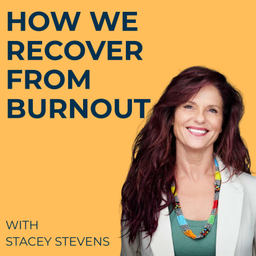
About How We Recover From Burnout
Writer. Award-winning speaker. Lawyer. Writing about my life as high-achieving women who has broken free from performance conditioning and reclaimed my autonomy, self-worth, and personal power—without guilt, apology, or permission. staceylstevens.substack.com (https://staceylstevens.substack.com?utm_medium=podcast)
- Publisher
- Stacey Stevens
- Category
- business · business
- Language
- en
- Explicit
- No
- First episode
- 19 Feb 2026
- Latest episode
- 19 Oct 2026
Latest episodes
74 episodes in the feed.
19 Oct 2026
Can Childhood Beliefs Cause Burnout? I Spent Decades Living by the Rules of the Girl Who Left Home at 15
I left home at 15. A few years later, maybe 17 or 18, I remember sitting and thinking about where my life had taken me, and I made myself a promise: one day I’m going to share my story, because somebody out there might need to hear it. Then I forgot it. Completely. Life happened, my career happened, and for decades I never thought about that promise. When it finally came back, it came with the answer to a question I’d spent years not asking: whether childhood beliefs can cause burnout. In my case, they did. Can childhood beliefs cause burnout? They can, and they do it quietly, through a stress response that fires decades after the moment that set it up. As children, we start deciding what our experiences mean about us, and those meanings go on running long after we’ve forgotten deciding anything. “As children, we don’t just live through things. We start to decide what they mean about us. Not good enough. I have to earn my place. Don’t make trouble. And these meanings, they become part of our internal operating system.” -Stacey Stevens, lawyer and host of How We Recover From Burnout An internal operating system, the way I use the phrase, is the set of meanings about yourself that runs underneath everything you do without ever announcing itself. Decades later, everything else has changed. We’ve grown up, we’re adults, and we haven’t changed our story, so it keeps replaying. It might be a deadline or a late-night email. Something in that moment sounds to your nervous system like the old childhood meaning, and it triggers a stress response; day after day, that cascade of stress hormones becomes a big part of what burns us out. If you’re living your life based on a past conditioned version of yourself, you’re going to burn out. I know because that’s what I did for years without ever seeing it. Why does “it’s just part of the job” sound so reasonable when you’re burnt out? Because the old story has learned to speak in your professional voice. The sentences sound like someone who is realistic about the work, which is exactly why they’re so hard to catch. “How many times have you said, hey, it’s just part of the job, or look, I’m tired, everybody’s tired. Or, I’ll rest when this file or this deal closes. It isn’t reasonable. It’s actually an old story that’s speaking to you in your professional voice.” -Stacey Stevens, lawyer and host of How We Recover From Burnout Listen for “everybody’s tired” in particular. It turns your exhaustion into a group norm, so that questioning it starts to feel like complaining about something nobody else is complaining about. I came at the same voice from another direction in the post on why it’s so hard to say no at work, where the fear underneath a yes gets relabeled as being reasonable. Here the relabeling runs the other way. The word reasonable gets attached to the exhaustion itself. What does it look like to live by an old version of yourself? From the outside, it can look like a successful career. On the inside, I was still carrying the baseline beliefs of a girl who needed to be a certain way just to get by. “I was still living my life based on an old version of me. Right? The girl who just needed to be a certain way just to get by. On the outside. I was still me, but I was still carrying my old baseline beliefs inside. I was just wearing better shoes.” -Stacey Stevens, lawyer and host of How We Recover From Burnout Baseline beliefs, as I mean them, are the ones you set as a kid and never went back to revise, so they become the starting point you measure everything else from. I realized this a couple of years ago, and I’d be lying if I said it was news. It was something I probably knew deep down and never wanted to see. That was also the moment the promise came back, the one I’d made at 17 or 18 and then forgotten for decades. The promise had its own friction. I think I made it to give myself a sense of purpose rather than feeling ashamed of the decisions I’d made. So the story I’m sharing now started as a way to avoid looking at it too closely. Is it too late to stop living burnt out if you’re 20 years into your career? No. I want the women 20 years in to know it’s not too late, and I want the woman six months into her career to know before she loses herself. I started at a law firm as a receptionist. I went to law school at 37 with two teenagers at home and a high school diploma in hand. That’s it. I became a lawyer at 41. “Nobody gave me a map. Nobody told me the exhaustion that I was carrying wasn’t actually the price of admission.” -Stacey Stevens, lawyer and host of How We Recover From Burnout That’s who this is for: the women coming up behind me, and behind all of us, really. Sharing the story is how I reach back for them, because none of us have to live burnt out, exhausted, and disconnected from our family, friends, and the things that matter most to us. What promise did you make yourself and then forget? Most of us made one somewhere along the way. Maybe it was who you’d be, or something you’d finally do for yourself, and maybe, like me, you forgot it. “Somewhere along the way, you probably made yourself a promise too ... And maybe just like me, you forgot it. This week, see if you can find it. Because you don’t need anybody’s permission to go back and pick up that promise.” -Stacey Stevens, lawyer and host of How We Recover From Burnout Mine took decades to come back, and when it did, it brought the old version of me with it, which is how I finally saw her. You will recover from burnout, Stacey Thanks for reading Stacey Stevens | How We Recover From Burnout! Subscribe for free to receive new posts and support my work. Thanks for reading Stacey Stevens | How We Recover From Burnout! This post is public so feel free to share it. This is a public episode. If you would like to discuss this with other subscribers or get access to bonus episodes, visit staceylstevens.substack.com (https://staceylstevens.substack.com?utm_medium=podcast&utm_campaign=CTA_1)
13 Oct 2026
How to Stay Calm When Someone Is Getting on Your Nerves: The Sentence I Said to Myself in the Hallway
Earlier this week I had the privilege of giving a talk to a group of rehabilitation support workers, and I want to talk about capacity, though maybe not in the way you think. If you’ve been searching for how to stay calm when someone is getting on your nerves, this is where that conversation went. There were a lot of questions at the end, and most of them started with something outside the people asking: an external event, a circumstance, somebody else’s behaviour. As we dug deeper, almost every one of them came back to how they were feeling in that moment. How do you stay calm when someone is getting on your nerves? Get out of the room before you answer them, take a breath, and tell yourself that this person is acting at their capacity in this moment, at this time. That sentence hands the moment back to the person it belongs to, and that’s what lets your body come down far enough to walk back in. Capacity, the way I’m using it, means what a person actually has available to give at a particular moment, which some days is a lot less than what the room is asking of them. Here’s how it went for me. I excused myself and went out into the hall. I took a deep breath, short in, long out, and I said the sentence to myself. Then I took a couple more minutes, walked, took a few more breaths and regrounded myself until I had a little bit better center, and I went back into the meeting, and the rest of the day went fine. What does it feel like right before you say something you’ll regret in a meeting? For me, my breath went short and shallow, and I got more and more irritated, to the point where I knew whatever I said next wasn’t going to come out the way I wanted it to. I was, to put it bluntly, on literally my last nerve. It was a long meeting, a whole afternoon, and we were covering things that were very important. One person in the room kept interrupting while other people were talking and kept asking what seemed like the same question over and over again. It was clear they just weren’t up to speed. They hadn’t read the materials, and they weren’t prepared for the meeting. “And when I think back to how I was feeling at that time, I was tense, my breath was short and shallow, and I was irritated. I was getting really irritated to the point where I knew that whatever I was going to say next wasn’t going to come out the way I wanted it to, and it wasn’t going to sound the way I wanted it to. To put it bluntly, I was on literally my last nerve.” Stacey Stevens, lawyer and host of How We Recover From Burnout It might not be work. It could be a friend group or a recreational group. It could even be at home. Why does telling yourself “they’re at their capacity” calm you down? Because it takes the focus off of you and gives the moment back to the person it belongs to, with the grace you’d expect for yourself on a bad day. The second I said it, my entire nervous system shifted. “And I reminded myself that person is just acting at their capacity in this moment at this time. And as soon as I did that, I felt my entire nervous system shift because I took the focus off of me, first of all, and I put it on who it belonged. And I put it on that person with the same amount of grace that I would expect if I was the person who said, I’m sorry, but I’m at my capacity right now and this is the best I can do.” Stacey Stevens, lawyer and host of How We Recover From Burnout Sitting in that room, every repeated question had started to feel like something being done to me, to my afternoon and my patience. The sentence stopped making it about me and put it back exactly where it belonged, on them, and nothing about how they were behaving had to change for that to happen. The test I use for the grace part is simple. Is it the same amount I’d want if I were the one saying, I’m sorry, I’m at my capacity right now? What has already happened in your body by the time someone is on your last nerve? By the time you’re saying, "This is getting on my last nerve," you’re already deep in survival mode, and the physiological changes have already happened. Cortisol and adrenaline are already up. Survival mode, as I use it, is your stress response running the show, the chemistry that gets your body ready to deal with a threat, whether or not there is one in the room. “By the time we get to the point where we’re saying, this is getting on my last nerve, or we are feeling so angry and irritated, we are already so far into survival mode that we’ve already experienced all of the physiological and biological changes in our systems.” Stacey Stevens, lawyer and host of How We Recover From Burnout Your body is designed to handle those two chemicals. Don’t get me wrong. The trouble is an environment where you’re chronically, low-grade stressed out, or worse, because then you get a continuous spike in both of them, with chain reactions through the rest of your body that lead to health consequences. I wrote about the low-grade version of this, the part that follows you through your own front door, in the post on how to stop bringing work stress home. A meeting is just a smaller room for the same chemistry. How can you practice this with someone who got on your nerves last week? Pick a time from today or last week when you were dealing with somebody who was getting on your very last nerve, go back to how you felt in that moment, and then tell yourself they were acting within the capacity they had. Then notice whether anything shifts. The going back matters. If you look at it from where you’re sitting now, calmer and with the whole week behind you, it won’t do much. “Don’t look at it from how you’re feeling today, but really go back there and think about it. Feel those feelings and then tell yourself, but they were just acting within the capacity that they had at that moment. And see how you feel. See if it makes a shift.” Stacey Stevens, lawyer and host of How We Recover From Burnout I’d love to hear what happened when you tried it, in the comments or in a direct message. You will recover from burnout, Stacey Thanks for reading Stacey Stevens | How We Recover From Burnout! Subscribe for free to receive new posts and support my work. Thanks for reading Stacey Stevens | How We Recover From Burnout! This post is public so feel free to share it. This is a public episode. If you would like to discuss this with other subscribers or get access to bonus episodes, visit staceylstevens.substack.com (https://staceylstevens.substack.com?utm_medium=podcast&utm_campaign=CTA_1)
6 Oct 2026
Why Is It So Hard to Say No at Work, Even When You Walk In With a Full Tank?
Recently, we talked about energy vampires (https://staceylstevens.substack.com/p/why-isnt-self-care-helping-my-burnout), and I gave you a practice. Name what drains you and what fills you back up, and if you know one of those people is coming, talk yourself up first, with music or movement or whatever gets you there, before the energy vampire comes for you. It works, and I still do it. But it doesn’t answer why it's so hard to say no at work, and I have to be honest with you: it never was. What this covers: what the energy practice doesn’t fix, why we relabel fear as being reasonable, what the flinch is and where it comes from, and the two questions I ask before I answer. Why is it so hard to say no at work? Because at the moment you go to say it, saying no feels dangerous, and that feeling usually belongs to a much older moment than the one you’re standing in. Being tired makes it worse, but you can walk in calm and fully resourced and still hear yourself agree. A boundary, the way I’m using the word, is the line between what you’ll take on and what you won’t, said out loud to the person who’s asking. Most of us know where our line is. The trouble is in the half second between the ask and the answer. You walk in with a full tank of energy, and you still don’t say the thing. You watch yourself agree to take on the extra file, the extra task. You watch yourself smooth things over instead of pushing back, or apologize for a delay that wasn’t really your fault. “You can still walk in fully charged and still leave having agreed to do something that you didn’t agree to, didn’t want to ... Carry one more thing that wasn’t yours to really carry.” Stacey Stevens, lawyer and host of How We Recover From Burnout Why doesn’t topping up your energy help you set boundaries? Because topping up changes the state you arrive in, and it does nothing about the moment someone asks you for something. Topping up, as I use it, means deliberately raising your energy before an interaction you know will drain you. That was my advice last episode, and I’m not taking it back. But I have to be honest with you about something that this actually does not fix. It gets you through the meeting. It doesn’t get you out of the phone call or the visit, and it doesn’t stop you from saying yes when the true answer is no. Another problem lives underneath the energy one, even after you've refilled your energy: we’ve never actually set a boundary in the first place. A full tank just means you have more to give away. Why do we call it “being reasonable” when we’re afraid to say no? Because “fear” sounds like weakness and “reasonable” sounds like professionalism, so we pick the word that lets us keep our self-image. Underneath being a team player, there’s usually a flinch, and the flinch is fear. “That is not an energy problem, even though it still depletes our energy. That is a fear problem. And it’s worth naming because ... we don’t call this fear. We call it being reasonable.” Stacey Stevens, lawyer and host of How We Recover From Burnout Listen to how it sounds in your own head. I’m going to be a team player. I’m not going to make this a bigger deal than it needs to be. Those are the sentences firms reward, and they are also, a lot of the time, a way to avoid feeling the fear long enough to look at it. That’s an uncomfortable thing to say in a profession that treats “team player” as the highest compliment you can pay an associate. I’m saying it anyway. Some of what gets praised as collegiality is people who are scared to say no, and the people praising it benefit from that. What is the flinch you feel before saying no? The flinch is the split second before you answer when saying no feels dangerous, out of all proportion to anything actually happening in the room. You’ll feel it if you look for it, and once you’ve named it, you start to notice it in a lot of places. “There’s a flinch. There’s a moment where saying no felt dangerous. Not inconvenient. Dangerous. Even when there was nothing about the actual situation that warranted it.” Stacey Stevens, lawyer and host of How We Recover From Burnout The person asking might be perfectly pleasant. The ask might be small. Your body responds as if declining it would cost you something you can’t get back. Where does the fear of saying no come from? Usually, it comes from somewhere much older than the request in front of you. If you slow down and ask yourself where you’ve felt that exact feeling before, you’ll often find it’s rooted in history. “It almost never belongs to the moment that you’re actually in. Yes, it feels current. It feels like it’s about this person, this ask ... But if you slow down and you actually ask yourself where you felt that exact feeling before, you’ll find it’s pretty old.” Stacey Stevens, lawyer and host of How We Recover From Burnout Maybe it’s your boss from 10 years ago, or a parent. Someone who taught you, a long time before your current position existed, that saying no would cost you something you couldn’t afford to lose. The feeling arrives in the present tense, which is why it’s so convincing, but the lesson behind it was learned by a version of you who had far less power than you have now. What two questions should you ask before you say yes when you mean no? Pause, and ask two questions before you respond. First: have I felt this feeling before, and what does it remind me of? Second: is what I’m afraid of actually going to happen here, or is it something that already happened a long time ago to someone much younger than I am now? The second question does most of the work. The person answering it today knows more and has accomplished more than the person who first learned the fear, and that’s worth remembering in the moment, because the flinch tends to make you feel like her again. Most of the time, as I put it in the episode, “the fear is real, but it’s just not a real fear about today.” Asking the questions lets it shrink down to its actual size, which is usually much smaller than it felt a second ago. Do you have to stop being afraid before you set a boundary? No. You set the boundary anyway, even if your voice shakes a little, and you let the questions shrink the fear rather than waiting for it to disappear. “You don’t need the fear to be gone. You just need it to be small enough that it isn’t the thing that is making the decision for you.” Stacey Stevens, lawyer and host of How We Recover From Burnout So the next time you feel yourself about to say yes when you mean no, just pause, ask the two questions, and then say the no. Waiting until it feels safe is how most of us end up never saying it at all. What’s the difference between managing your energy and protecting it? Managing your energy is what the energy vampire practice does: it gets you into the room resourced. You measure protecting it by whether you leave that room having said what you actually meant, with your tank still full. You already did the hard work last time. You know who your energy vampires are, and you know how to walk in with something in your tank. The next piece isn’t about finding more energy or more time. It’s about understanding where the fear that stops you from setting the boundary comes from, so that the next time it shows up, you can treat the flinch as something old rather than as proof about the person in front of you. You will recover from burnout, Stacey Thanks for reading Stacey Stevens | How We Recover From Burnout! Subscribe for free to receive new posts and support my work. Thanks for reading Stacey Stevens | How We Recover From Burnout! This post is public so feel free to share it. This is a public episode. If you would like to discuss this with other subscribers or get access to bonus episodes, visit staceylstevens.substack.com (https://staceylstevens.substack.com?utm_medium=podcast&utm_campaign=CTA_1)
Contact How We Recover From Burnout
- Guest appearances
- Does not typically book guests
Based on episode analysis; this does not confirm that the show is currently accepting guests.
Host of How We Recover From Burnout?
Claim your podcast to manage its listing and keep your show details accurate.
Pod Engine is an independent podcast discovery and analytics service and is not affiliated with or endorsed by this podcast. Artwork and show content belong to their owners. Full legal notice.
Explore this show
Podcast research with Pod Engine