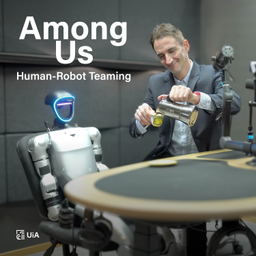
Human-Robot Teaming
Universitetet i Agder
5.0from 4 ratings
- 19
- Episodes
- 4
- Ratings
- Bi-weekly
- Cadence
- 2026
- First episode
About Human-Robot Teaming
Robots are no longer confined to factories or research labs. They are in our hospitals, our industries, our public spaces, and increasingly, in our homes. Among Us: Human-Robot Teaming is a podcast exploring what happens when humans and intelligent machines work together. Hosted by Professor Filippo Sanfilippo, this series brings together leading international researchers, engineers, innovators, and thinkers to discuss the technical, cognitive, ethical, and societal dimensions for different levels of human-robot collaboration. Each episode dives into the challenges and opportunities of designing robotic systems that are not just autonomous but collaborative. This is not about science fiction. It is about trust, shared control, responsibility, and the future of teamwork. Through thoughtful, coffee-style conversations, the podcast highlights cutting-edge research while making complex ideas accessible to students, academics, industry professionals, and anyone curious about how intelligent systems are reshaping our world. Because robots are no longer tools at the margins. They are among us.
- Publisher
- Universitetet i Agder
- Category
- science · technology
- Language
- en
- Explicit
- No
- First episode
- 25 Feb 2026
- Latest episode
- 7 Oct 2026
Latest episodes
19 episodes in the feed.
7 Oct 2026
How a University Startup Turned Haptics Into Real-World Robot Control
Human-Robot Teaming, Touch, and the Rise of Wearable Haptics This episode explores how tactile feedback can make teleoperation more natural, safer, and more effective, and why touch is becoming central to human-robot teaming. Host Filippo Sanfilippo speaks with Guido Gioioso, CEO and co-founder of WEART, about moving haptic interfaces from university research into real products for XR, teleoperation, and shared autonomy. Guests Guido Gioioso CEO and co-founder of WEART, with a background in robotics, automation, and haptics Filippo Sanfilippo Host and professor at the University of Agder, Norway Key topics From lab research to startup reality Guido shares how WEART grew out of the University of Siena, where the team worked on human hand sensing, wearable interfaces, prosthetics, and robotic manipulation. Why touch was the missing channel In teleoperation, visual and audio feedback alone cannot reliably convey force, contact, texture, temperature, or stiffness. Guido explains that the skin is a high-bandwidth communication channel that is often underused in human-robot interaction. How WEART products render multiple sensations The company’s TouchDiver Pro glove uses six contact points and can deliver forces, vibration-based texture cues, and thermal feedback. Guido describes how these channels can be combined or used independently depending on the task. XR as the first market, robotics as the return WEART initially focused on VR and AR use cases such as training, safety, edutainment, medical, industrial, and design applications. The company is now moving back into robotics as humanoids and teleoperation gain momentum. Embodiment through haptics Guido argues that touch helps transform teleoperation from “using a tool” into feeling like “inhabiting a body” at a distance. This reduces cognitive load and makes remote work feel more transparent and natural. Shared autonomy instead of perfect one-to-one replication Both speakers discuss a middle ground between full autonomy and full human control. The robot can handle navigation, orientation, and obstacle avoidance while the human operator makes higher-level and final millimeter-level decisions. Teleoperation as a training tool and a final use case In some scenarios, teleoperation is used to teach robots tasks so they can later act autonomously. In others, such as medical, nuclear, offshore, and high-risk industrial settings, teleoperation itself is the end goal. Real-world deployments and safety Guido mentions applications where humans cannot safely enter, such as high-voltage maintenance and hazardous environments. The robotic system acts as a physical twin or extension of the operator, keeping humans central while improving safety. The real challenge is usability Guido stresses that successful products must be comfortable, fast to wear, robust, repeatable, and practical for long sessions. The market rewards reliability and ease of use more than lab-grade peak performance. The future of human-robot teams The conversation ends on a vision of robots as extensions of human capabilities, not replacements. The long-term goal is remote access to physical work, with reduced risk, lower cost, and less unnecessary travel. Timestamps 00:00 - Introducing the podcast and today’s guest, Guido Gioioso 03:03 - WEART’s roots in Siena and the move from research to company building 04:53 - Starting in XR before returning to teleoperation and robotics 08:16 - Why touch adds essential information in remote manipulation 10:29 - Embodiment as the difference between a tool and a body 14:24 - TouchDiver Pro: a five-finger glove with six haptic contact points 15:25 - Using force, vibration, and thermal cues together in teleoperation 17:16 - How teleoperation helps train robots for autonomy 19:03 - Remote work in hazardous environments where autonomy is not enough 20:37 - Shared forces, shared space, and shared decisions in teaming 21:57 - Why shared autonomy is more realistic than perfect replication 23:48 - Using tactile feedback for informed, natural control loops 24:42 - Technical challenges: sensors, actuators, latency, and network quality 27:07 - Why comfort, ergonomics, battery life, and repeatability matter most 31:02 - A future of robots as extensions of human bodies 32:28 - Social and environmental benefits of remote physical work 33:53 - Closing thoughts on teaming and human-machine coexistence Notable quotes “The sense of touch was the missing part.” “Embodiment means transforming something from a tool to be used to a body that you can inhabit.” “We believe in robots that are extensions of human bodies, not replications of human bodies.” WEART: https://weart.it/
23 Sept 2026
The Hidden Intelligence Inside Robot Mechanics
This episode explores how mechanical design can do more than support robotics, it can shape intelligence, adaptability, and even communication in human-robot teaming (HRT). Professor Filippo Sanfilippo is joined by Dr. Monica Malvezzi, professor of applied mechanics at the University of Siena, for a conversation about contact-rich interaction, embodied intelligence, and why robots should be designed to work with humans rather than around them. Key topics In this episode, Filippo introduces Monica Malvezzi's work at the intersection of mechanics, robotics, haptics, grasping, dexterous manipulation, wearable robotics, and human-robot interaction. Monica explains why robotics should move beyond the old "divide and conquer" mindset and treat structure, sensing, and control as a blended system. We discuss the shift from avoiding contact to exploiting contact as a useful part of human-robot teamwork. Monica describes how physical contact can support both task execution and communication, including work inspired by human handshaking. The conversation looks at embodied intelligence and the idea that some intelligence can be placed in the robot's mechanics through compliance, morphology, and passive adaptability. Monica highlights how new materials, new manufacturing methods, and 3D printing make it easier to design robots that adapt to uncertainty. Filippo and Monica discuss shared autonomy, where control can shift between human and robot depending on the task and the situation. Monica gives examples from handshaking and dance-inspired interaction to show that collaboration does not always mean a strict leader-follower relationship. The episode also examines the human side of teaming, including stress, psychology, and human intention as essential factors in robot design. Monica closes with a future-facing view of robotics as a tool for solving problems in aging, disability, and sustainability rather than creating new social issues. Timestamps 00:00 - Welcome to Human-Robot Teaming and introduction of Monica Malvezzi 01:17 - Monica's academic background and research across mechanics and robotics 03:16 - Soft hands, wearable robotics, and physical augmentation 05:11 - From avoiding contact to exploiting contact in teamwork 06:56 - Why robots should be designed as interacting team members 11:20 - Embodied intelligence and moving complexity into mechanics 13:25 - Structure and controller as a blended system 14:20 - New materials, design strategies, and 3D printing 16:48 - Sharing autonomy between human and machine 18:11 - Handshaking as mutual exchange rather than fixed leadership 19:09 - Dance-inspired interaction and shared responsibility 20:34 - Adaptive roles in unpredictable human-robot teams 21:02 - Why human psychology and stress matter in robot teaming 23:36 - Three ingredients for human-robot teaming: mechanics, actuators, algorithms 24:26 - Monica's vision for the future of robotics 27:37 - Final thanks and Monica's closing remarks Notable quotes "Can physical contact become a communication channel between humans and machines?" "The structure and the controller are no more something that are completely separated." "Robotic robots can become a solution of our problems without being an issue."
26 Aug 2026
Why Touch Is the Missing Language of Human-Robot Teaming
In this episode, Filippo Sanfilippo is joined by Claudio Pacchierotti, a CNRS researcher at IRISA and an expert in haptics, wearable interfaces, robotic teleoperation, and shared control. They explore how touch can become a communication channel between humans and machines, and why haptic feedback matters for safer, more intuitive human-robot teaming.We discuss how autonomy can shift fluidly between humans and robots depending on task difficulty, confidence, and environmental uncertainty, plus where wearable haptics are heading next and which applications stand to benefit most. Key topics Filippo Sanfilippo introduces human-robot teaming as the next step beyond human-robot interaction and collaboration, where humans and robots share space, forces, and decisions. Claudio explains haptics as a communication channel that adds a physical layer to human-machine interaction, making control more natural and safe. We discuss why touch is still underexplored compared with vision and audio, even though it becomes critical when humans and robots physically interact. Claudio describes shared control and shifting autonomy, where the robot takes on more or less of the task depending on confidence, task difficulty, and sensor quality. The episode looks at how haptic feedback supports situational awareness without overloading the visual channel. Claudio explains why wearable haptics matter for teleoperation and training, especially when natural dexterity must be preserved. We discuss cutaneous haptics such as vibration, skin stretch, pressure, and temperature, and how these can be combined with vision and audio. Claudio highlights practical application areas including drone fleets, humanoid robots, hospitals, logistics, medicine, space, defense, delivery, and factories. The conversation closes on the idea of human-centered robotics, where robots empower humans rather than replace them. Timestamps 00:00 - Introducing Claudio Pacchierotti and the idea of human-robot teaming 00:32 - Claudio’s background in haptics, wearable interfaces, and shared control 01:31 - Why touch matters in human-machine interaction 03:05 - From human-robot collaboration to shared space, forces, and decisions 04:09 - Haptics as a communication channel between humans and robots 06:26 - Shared control for complex systems like humanoid robots and drone fleets 08:26 - How haptic feedback improves situational awareness during control 09:56 - Why touch can convey physical and abstract information without visual overload 11:15 - Shifting autonomy based on task difficulty and confidence 13:10 - Using shifting autonomy for training and complex robotic systems 15:17 - Cutaneous haptics, safe teleoperation, and keeping dexterity intact 17:22 - Combining vibration, pressure, skin stretch, and temperature 18:48 - Where human-robot teaming matters most in real-world applications 21:05 - Better actuators, sensors, algorithms, and haptic interfaces for teaming 23:13 - Why rich feedback improves trust, acceptance, and collaboration 24:56 - “Just enough haptics” and the future of wearable interfaces 27:12 - Human-centered robotics that empower rather than replace people 30:07 - Why the field is broad, multidisciplinary, and still expanding Notable quotes “Haptics as a way of communication between humans and cyber-physical systems.” “We believe in robots that can empower humans, not replace humans.” “Just enough haptics.”
12 Aug 2026
Why Randomness Is the Secret Engine of Human-Robot Teaming
Human-Robot Teaming, Randomness, and Why Statistics Matter In this episode, Filippo Sanfilippo speaks with Professor Svein Olav Nyberg from the University of Agder about how statistics and probability sit at the center of human-robot teaming. They connect robotics to bachata dancing, human movement prediction, teaching, machine learning, and even dreams and consciousness.The conversation is wide-ranging, but the through line is clear: humans are not perfectly predictable, and good systems need to handle uncertainty rather than pretend it does not exist. Key topics In this episode: Filippo introduces Svein Olav Nyberg as a colleague, researcher, author of Bayesian Way, and one of the statistical foundations behind the group’s human-robot teaming work. The discussion defines human-robot teaming (HRT) as more than interaction or collaboration: humans and machines share space, forces, and intention, and the leader-follower role can shift depending on the task. Bachata dancing becomes the metaphor for control design, especially the idea that one partner leads while the other follows, and that those roles can sometimes be swapped. The hosts explain a Greek-letter autonomy parameter, alpha, which acts like a slider for delegating more or less control from human to robot. A major example is trajectory prediction in industrial settings, where synthetic human motion is generated instead of forcing real workers to repeat paths thousands of times. Svein Olav describes using an Ornstein-Uhlenbeck process to model random motion with a pull back toward an intended path, including both position and velocity in two dimensions. The same movement data can support more than prediction: it can help slow robots near passing workers, adapt machine behavior to the workspace, identify operators by gait, and detect anomalies. Randomness becomes a recurring theme, from heart rate variability and walking patterns to art, teaching, and memory retention. Svein Olav shares how introducing randomness in lectures and exams can increase engagement and improve memory, because interest boosts retention. The conversation broadens to machine learning and statistics, with the point that statistics is the engine under the hood, especially when uncertainty matters more than a single output number. They discuss robotics moving from rigid white-box control toward hybrid systems that combine low-level motor and sensor control with statistical and machine learning methods. In the closing section, the guests reflect on future systems that can handle unexpected input, on pseudo-randomness in cryptography, and on whether machines might someday dream or feel emotions. Timestamps 00:00 - Opening the episode and introducing the guest 01:21 - Why statistics matters for human-robot teaming 03:21 - From human-robot interaction to shared space, force, and intention 04:20 - Bachata as a metaphor for leader-follower control 05:47 - Swapping roles with AI during dance instruction 06:46 - The autonomy slider, alpha, in human-robot teaming 10:03 - Modeling human trajectories in industrial environments 11:00 - Generating synthetic humans instead of collecting exhausting real-world data 12:57 - Ornstein-Uhlenbeck motion modeling for position and velocity 14:23 - Using the same data for robot adaptation, identification, and anomaly detection 16:57 - Randomness, heart rate variability, and healthy human rhythms 19:42 - Random teaching, dice-based exams, and student engagement 21:29 - Why interest improves memory retention 23:30 - Statistics as the bridge between theory and practice in AI 24:56 - Why uncertainty matters more than a single machine learning output 27:24 - Bridging traditional robotics with statistics and machine learning 28:14 - Randomness in cryptography and pseudo-random number generators 30:26 - A football example that unexpectedly became a teaching tool 33:11 - Dreams, hallucinations, and whether machines can interpret or have dreams 34:49 - Blade Runner, consciousness, and synthetic beings 37:26 - The future is more open because systems must handle the unexpected 39:10 - Closing thoughts, karaoke, and the episode sign-off Key frameworks Human-robot teaming Shared space Shared forces Shared intention Autonomy slider A controllable degree of delegation between human and robot Ornstein-Uhlenbeck process Random motion with a tendency to return toward a target state Statistics under the hood Machine learning is powerful, but statistics explains uncertainty and credibility Notable quotes "The future is far more open than we actually believe it is." "Statistics is the engine" behind machine learning. "We share space, we share forces, and we finally also share intention."
29 Jul 2026
How Imitation Learning Turns Robots Into Skilled Learners - Like Toddlers Breaking Eggs to Learn
Join us for an enlightening discussion with PhD candidate Martin Økter about the forefront of human-robot teaming (HRT). We delve into how touch, machine learning, simulation, and safety are shaping the future of robotics across industries such as automotive recycling, healthcare, and space exploration. Main Topics: The role of haptics and touch in enhancing human-robot interaction Imitation learning and simulation for robot training and safety Modular robotics architectures and ROS for complex applications Future implications and societal benefits of collaborative robots Practical insights for aspiring researchers and industry leaders Timestamps: 00:00 - Introduction to human-robot teaming and Martin Økter 00:30 - The significance of haptics and the senses in robotics 01:02 - Applications of HRT in battery disassembly processes 01:33 - The shift from humans teaching robots to joint teamwork 02:02 - Using machine learning and imitation learning in robots 02:31 - The importance of tactile feedback and learning through testing 03:01 - Augmented surgical aid: reducing reliance on cadavers 03:30 - Designing scalable robotic systems with ROS 04:11 - Modular control architectures for complex disassembly tasks 04:49 - Simulation environments like Nvidia's IsaacSim for training robots 05:20 - Safety constraints and merging traditional control with machine learning 06:00 - Challenges and opportunities in long-term robot deployment 06:45 - Future scenarios: robotic applications in medical and industrial sectors 07:30 - The importance of continuous learning and exploration in robotics 08:10 - Advice for young researchers: passion, curiosity, and perseverance 08:50 - The societal role of collaborative robots and ethical considerations 09:40 - Concluding thoughts: a future driven by human-robot collaboration Resources & Links: Nvidia IsaacSim (https://developer.nvidia.com/) - Nvidia's physics-based simulation platform Robot Operating System (ROS) (https://www.ros.org/) - Modular framework for robot software development Connect with Martin Økter: LinkedIn (https://www.linkedin.com/in/martin-%C3%B8kter-193056249/) Join us on this journey to the future of collaborative robotics, where humans and machines support each other, overcoming challenges and unlocking new potentials!
15 Jul 2026
The Hidden Power of Perception: How Multilevel Sensing Shapes Human-Robot Teaming
Human-Robot Teaming, Artificial Intelligence, Perception, Art and Mathematics, Unsupervised Learning, Future of Robotics, Art and AI, Perception and Language, Creativity in AI Exploring Human-Robot Teaming, Perception, and Artistic Innovation with Professor Marius Leordeanu Dive into a thought-provoking conversation with Professor Marius Leordeanu as he discusses the intersection of robotics, perception, art, and mathematics. Discover how AI is transforming our understanding of perception, elevating human creativity, and inspiring new ways to live and collaborate with machines. Main Topics Covered: The essence of human-robot teaming: sharing space, forces, and decisions The deep connection between mathematics, poetry, art, and perception The role of perception at multiple levels: sensors, semantics, and consciousness Innovations in real-time art creation using AI and diffusion models The philosophical perspective: AI as an extension, not a replacement, of humanity How AI and robotics enhance creativity, exploration, and understanding of the world The importance of mathematics in technology and AI development The future of multimodal interfaces integrating sight, sound, touch, and potentially taste and smell Ethical considerations: security, trust, and the role of AI in society The concept of perception with intention and its significance in human-robot interaction Timestamps: (00:00) - Introduction to Human-Robot Teaming: Collaboration in shared space and decision-making (02:00) - Professor Marius Leordeanu's background: Robotics, mathematics, and AI research (04:26) - From snake robots to search-and-rescue: Practical applications of robotics in extreme environments (06:10) - The intersection of mathematics, art, and perception: Deep analogies and metaphors (08:53) - Robots as extensions of human senses and capabilities: Transcendence through automation (12:24) - AI as a tool for increasing human consciousness and creativity (14:32) - The concept of teaming: robotics as a partnership, not a replacement (16:57) - The importance of perception at multiple levels for human-robot interaction (23:19) - The challenge of understanding metaphors: language, vision, and context in AI systems (25:43) - The connection between language and perception: building a unified understanding (31:16) - Limitations of humanoid robots and the importance of context and imitation in machine understanding (35:32) - The evolution of human-centered technology: smartphones and multimodal interfaces (38:29) - The role of mathematics and linear algebra in AI and perception (41:11) - Moving beyond pattern recognition: AI's potential to understand life, consciousness, and purpose (45:09) - Perception with intention: AI as a tool for serving human and societal goals (50:04) - Mathematics as the foundation of understanding our universe and AI's role in future innovations (54:45) - Art, AI, and the Smile Project: Creating interactive art responding to human emotions (69:40) - Artistic storytelling and virtual reality: Using AI for immersive narrative experiences (77:29) - Flying robots and extended perception: Exploring new frontiers in aerial AI systems (82:41) - Gratitude, inspiration, and calls to action for the future of AI and robotics Resources & Links: Carnegie Mellon University (https://www.cmu.edu/) Norwegian Research Centre (NORCE) (https://norceresearch.no/) Simeon Stoilov Institute of Mathematics (https://www.ici.ro/) Connect with Professor Marius Leordeanu: LinkedIn (https://www.linkedin.com/in/marius-leordeanu-6908b08/) Join us for a visionary exploration into how AI is transforming perception, art, and human-robot collaboration, and what this means for our future society. Don't miss the final inspiring message from Professor Marius Leordeanu about elevating humanity through technology.
1 Jul 2026
From Disabilities to Superheroes: The Vision of Human-Robot Teaming That Augment Humans
Human-Robot Teaming: Innovations in Exoskeletons and Haptic Interfaces with Professor Mihai Dragusanu Explore how advanced robotics, soft actuators, and intuitive haptic interfaces are revolutionizing healthcare, rehabilitation, and industrial environments through collaborative human-robot teaming. In this episode, Professor Mihai Dragusanu shares insights into developing wearable exoskeletons, integrating AI for intention detection, and envisioning the future of multi-agent robotics.Key topics The evolution from rigid to soft exoskeletons and their benefits for usability and safety The role of AI and advanced sensors in understanding human intentions The importance of haptic feedback for trust and control in human-robot interaction Modular and customizable robotic systems for personalized rehabilitation Future perspectives on environment-aware exoskeletons communicating with other cobots and humans The societal impact of wearable robotics: from disability mitigation to superhuman capabilities Reusing design principles like AI integration across various robotic applications The vision of collaborative, community-based rehabilitation and industrial work environments Philosophical implications of technology extending human abilities beyond disabilities Timestamps 00:00 - Introduction to Professor Mihai Dragusanu and the theme of human-robot teaming 02:41 - Mihai’s research background in exoskeletons and soft robotics 04:37 - Achievements and recognition at ICRA for innovative exoskeleton research 07:01 - Core enabling technologies: sensors, actuators, and adaptive algorithms 09:02 - How personal disability experiences drive Mihai’s research focus 11:18 - Transition from rigid to soft exoskeletons and the development of twist string actuators 14:41 - Combining soft and rigid elements for powerful, lightweight exoskeletons 17:25 - Disabling vs. augmenting capabilities through wearable technology 19:17 - The significance of intuitive haptic interfaces for trust and control 20:09 - Personal experience with haptic feedback during robotic demonstrations 26:37 - Rehabilitation applications: modular, personalized, AI-driven exoskeletons 29:13 - Tele-rehabilitation and AI for intent recognition in therapy 31:20 - Wearable haptics and tactile feedback in healthcare and industrial tasks 33:04 - Future visions: environment-aware, multi-user, and community-based exoskeleton systems 35:44 - Shifting paradigms from one-to-one to many-to-many human-robot collaboration 40:20 - Envisioning a future where disabilities are integrated into the technological fabric of society 43:01 - Final reflections and upcoming collaborations, including conferences and esteemed colleaguesResources & Links Domenico Praticizzo (https://www.linkedin.com/in/domenicoprattichizzo/) - Collaborator Connect with Mihai Dragusanu LinkedIn (https://www.linkedin.com/in/mihai-dragusanu-227436156/) This episode delves into cutting-edge research, philosophical reflections, and future visions that underscore the transformative potential of collaborative robotics rooted in soft, intuitive, and adaptive systems. Whether in healthcare or industry, the message is clear: technology today aims to extend human capabilities and foster inclusive, dynamic, and resilient team environments.
28 Jun 2026
Special Episode from the 40th ECMS International Conference on Modelling and Simulation (ECMS 2026)
In this special episode recorded for the 40th ECMS International Conference on Modelling and Simulation (ECMS) in Grimstad, Norway, we bring together three perspectives on the future of simulation, AI, and human-centered robotics. From supply chain digital twins and agentic AI to wearable robotic devices and human-robot teaming in battery disassembly, this episode highlights how modeling and simulation are shaping practical innovation across research and industry. Featured Talks Prof. Dr. Dr. habil. Dmitry Ivanov “Supply chain simulation, agentic AI and digital twins: from theory to use cases and implementation blueprints” Prof. Monica Malvezzi “The Role Of Simulation In The Design Of Wearable Robotic Devices: A Human-Centered Perspective With Modular Gloves And Twisted String Actuators” Prof. Filippo Sanfilippo and Cecilia Scoccia “Imitation Learning For Human–robot Teaming In Battery Disassembly: Enabling Technologies and a Collaborative Manipulation Pipeline” What You’ll Learn How simulation supports resilient and intelligent supply chains Why digital twins and agentic AI are becoming central to implementation blueprints How human-centered design informs the next generation of wearable robotic devices How imitation learning can enable human-robot teaming in complex disassembly tasks The broader role of modeling and simulation in advancing Industry 4.0 and beyond Conference Context This episode is connected to the proceedings of the 40th ECMS International Conference on Modelling and Simulation, Grimstad, Norway, June 23rd to 26th, 2026. Credits ECMS (https://www.scs-europe.net/conf/ecms2026/)
17 Jun 2026
The Philosophical Impact of Art That Makes Machines Feel Human
Exploring the Fusion of Art, Human Emotion, and Artificial Intelligence with Cristina Lazăr Join us in this inspiring episode where art meets AI, as Cristina Lazăr shares her visionary projects that integrate creativity, emotion, and advanced technology. Discover how her innovative work is reshaping human-machine interactions and pushing the boundaries of artistic expression. Main Topics Covered: The intersection of art, science, and artificial intelligence in contemporary projects How sensors, lights, and neural networks allow art to respond to human emotions The concept of emotional loops in human-robot teaming and non-verbal communication The project "Paint with Me" as an example of real-time, multisensory artistic engagement The philosophical and spiritual dimensions of creating art as a service to humanity Future perspectives on human-robot collaboration and emotion sharing in AI Timestamps: 00:00 - Introduction to Cristina Lazăr and her artistic environment 00:48 - Connecting art, science, and AI through human-robot teaming 01:33 - Cristina Lazăr’s background as an artist and researcher in human-AI interaction 02:48 - Cristina’s previous projects and recent exhibitions in Norway 03:53 - Collaborations with European robotics communities and other scientists 05:10 - The "Maya" project: non-verbal, real-time communication system 06:25 - Artwork as an interactive, sensorized entity that responds to human emotions 07:54 - The integration of mathematics, algorithms, and art in Cristina’s practice 09:34 - The role of emotion, expression, and trust in AI-enabled art 11:06 - The use of convolutional neural networks to make paintings "see" and respond 12:48 - Art as a mirror of the human soul and the importance of tactile interaction 14:20 - Elevating traditional art techniques with multisensory, sensor-based technology 16:48 - The significance of non-verbal languages, mirroring, and emotion recognition 18:08 - Neural networks and AI systems perceiving and reacting to human gestures 19:01 - The importance of trust, presence, and acknowledgment in human-AI interactions 21:42 - Summarizing Cristina’s vision: eyes, brain, and emotion in art 23:46 - The "Paint with Me" project and the fusion of classical painting with AI-driven responses 25:17 - Cultural and historical allusions, like the civilization of Maya, in human-AI emotional exchange 27:08 - The potential to use sensors and AI for emotion detection and adaptation in art 28:40 - The role of art and AI in creating meaningful stories connected to our past and future 30:36 - Art as a tool to evoke emotions and reflect the human condition 35:47 - The journey from curiosity to mastery in art and robotics over decades 38:50 - Returning to non-verbal, embodied, and multi-sensory forms of communication in art and research 41:50 - The philosophical insights: art, research, and the human soul as expressions of the divine 44:55 - The evolution of the expression of human feelings through neural networks and AI 48:50 - Vision for future human-robot teaming: sharing feelings, physical collaboration, and emotional resonance 53:29 - The spiritual dimension in Cristina Lazăr’s work: love, life, and connection to the universe 54:42 - Closing thoughts: art as a divine act, inspiration, and ongoing collaboration Connect with Cristina Lazăr: Youtube (https://www.youtube.com/@crishumanai?app=desktop&fbclid=PAZXh0bgNhZW0CMTEAc3J0YwZhcHBfaWQPOTM2NjE5NzQzMzkyNDU5AAGnFg_g7Vb8zAGfgZDfauPYAoz5Rt-eIp0w5f6kkTWS2ExwZ3cFkBwHNGQcRSQ_aem_odkwYvOM-ybk90l7WCLfNQ) Instagram (https://www.instagram.com/cristinalazarart/) Personal Website (https://sites.google.com/view/cristinalazar/pagina-de-pornire?utm_source=ig&utm_medium=social&utm_content=link_in_bio&fbclid=PAZXh0bgNhZW0CMTEAc3J0YwZhcHBfaWQPOTM2NjE5NzQzMzkyNDU5AAGnIPlrDAPfHC97LLZeLxtGMZPy4kF17k5CTzkLdLBXt7BPxB2P_n27HUPoPpw_aem_RFc1WjuyJ1Zr1jHE9EJaWg) This episode celebrates the harmony between creativity and technology, and how emotional intelligence shapes the future of human-robot collaboration. Expect insights into how art can serve as a bridge to understanding ourselves and each other in this evolving digital era.
6 Jun 2026
Among Us: Human-Robot Teaming - Special ICRA 2026 Episode
Episode Overview: Join Professor Filippo Sanfilippo as he takes a guided tour of an exciting robotics exhibition at ICRA 2026 in Vienna, Austria. This special episode showcases groundbreaking demonstrations and cutting-edge research from leading experts in robotics, human-robot interaction, and AI-driven automation. Featured Guests & Highlights: Syed Kumayl Raza Moosavi presents the work alongside Muhammad Hamza Zafar and Filippo Sanfilippo on "Neuromorphic Event Camera-Based Object Recognition and Grasping Position Detection Using a Transfer Learning-Enhanced Multi-Task Model" (IEEE Transactions on Automation Science and Engineering, 2025). LinkedIn: https://www.linkedin.com/in/syed-kumayl-raza-moosavi-38b224125/ (https://www.linkedin.com/in/syed-kumayl-raza-moosavi-38b224125/) Pietro Balatti demonstrates a markerless motion capture system, highlighting advances in real-time human movement tracking. LinkedIn: https://www.linkedin.com/in/pietrobalatti/ (https://www.linkedin.com/in/pietrobalatti/) Erik Ballesteros showcases Super Libs and Human Augmentation technologies, exploring the frontier of collaborative robotics. LinkedIn: https://www.linkedin.com/in/erik-ballesteros-9aa25b78/ (https://www.linkedin.com/in/erik-ballesteros-9aa25b78/) Website: https://thefalcoguy.github.io/ (https://thefalcoguy.github.io/) Kentaro Barhydt presents Loop Closure Grasping, detailing a paradigm for strong, gentle, and versatile robotic grasps. Relevant works include: Website: https://www.kentarobarhydt.com/ (https://www.kentarobarhydt.com/) LinkedIn: https://www.linkedin.com/in/kentarobarhydt/ (https://www.linkedin.com/in/kentarobarhydt/) First inciting work: A High-Strength, Highly-Flexible Robotic Strap for Harnessing, Lifting, and Transferring Humans (RA-L) – IEEE Xplore (https://ieeexplore.ieee.org/document/10048528) Official Loop Closure Grasping presentation: Loop closure grasping: Topological transformations enable strong, gentle, and versatile grasps (Science Advances) – Science Advances (https://www.science.org/doi/10.1126/sciadv.ady9581) Growing sling design: Mechanically Programming the Cross-Sectional Shape of Soft Growing Robotic Structures for Patient Transfer (IROS) – IEEE Xplore (https://ieeexplore.ieee.org/document/11246281) MIT Press Release: https://news.mit.edu/2025/vine-inspired-robotic-gripper-gently-lifts-heavy-and-fragile-objects-1210 (https://news.mit.edu/2025/vine-inspired-robotic-gripper-gently-lifts-heavy-and-fragile-objects-1210) Francesco Ferro, President of EuRobotics and CEO/co-founder of PAL Robotics, shares his perspective on the future of human-robot collaboration and innovation in industrial and service robotics. LinkedIn: https://www.linkedin.com/in/francesco-ferro-88791a1/?skipRedirect=true (https://www.linkedin.com/in/francesco-ferro-88791a1/?skipRedirect=true) What You’ll Learn: How neuromorphic event cameras improve robotic perception for object recognition and grasping. The latest in markerless motion capture for natural human-robot interaction. Strategies for enhancing human capabilities using collaborative robotic systems. The Loop Closure Grasping paradigm and its applications in safe, gentle, and versatile object handling. Insights from top robotics leaders on the future of automation and human-robot teaming. Event Details: Location: Vienna, Austria Conference: IEEE International Conference on Robotics and Automation (ICRA 2026) Dates: June 1–5, 2026 Tune in to experience the intersection of research, innovation, and real-world robotics demonstrations, all captured during this premier robotics event.
3 Jun 2026
From Rigid Control to Shared Autonomy: The Future of Medical Robotics and Surgery
Exploring Human-Robot Teaming: Insights from Professor Paolo Fiorini In this episode of Among Us, Human-Robot Teaming, we sit down with robotics pioneer Professor Paolo Fiorini to discuss the evolution of robotic autonomy, ethics, and the future of collaboration between humans and machines. Discover his insights on surgical robotics, trust in AI, and the role of simulation and haptics in advancing human-robot interaction. Main Topics: The progression from isolated industrial robots to collaborative human-robot teaming The role of autonomy levels, from teleoperation to autonomous systems Challenges of trust, safety, and ethics in AI and robotics Innovations in surgical robotics and the significance of tactile/haptic feedback Future perspectives on specialized AI tools and the importance of simulation Timestamps:00:45 - Introduction to Professor Fiorini and his pioneering work in robotics 01:27 - Biographical overview of Professor Fiorini's career and achievements 02:18 - Bridging theoretical control and real-world application through robotics 03:16 - Key projects: surgical robotics: autonomy, safety, and certification 04:43 - The rise of Needle Eye Robotics in prostate cancer diagnosis and therapy 05:42 - The evolution of human-robot interaction and physical collaboration 07:11 - From segregated robots to immersive teaming: autonomy levels’ progression 08:38 - Telerobotics, telepresence, and the early days of autonomy in robotics 09:37 - AI development stages and risks: from neural networks to semantic control 10:55 - Shared control and the importance of reciprocal trust in human-robot interaction 12:29 - Ethical challenges in AI: emerging misbehavior and training data issues 13:52 - Control theory versus machine learning: stability and adaptability in robotics 14:19 - Ethical dilemmas and decision-making transparency in autonomous systems 15:14 - The practical limits of AI in safety-critical applications like surgery 16:21 - Mechanical constraints: managing the challenge of safe AI deployment 17:51 - The slow pace of legislative and standardization updates in robotics 19:05 - Advances in surgical robotics and autonomous assistance in interventions 20:14 - Data availability as a barrier in robotic surgery AI development 23:12 - Modeling complex surgical procedures with logic-based systems 25:33 - The unpredictability and creativity of human surgeons versus AI 26:37 - The use of haptics and tactile feedback in medical robotics 28:42 - The debate on force feedback benefits and user adaptation 30:16 - The significance of tactile sensing for learning, especially in soft tissues 33:09 - Challenges of sensory integration and synchronization in multi-modal feedback 35:14 - Future of AI: focused, reliable tools over general artificial intelligence 37:27 - Simulation as a trust-building tool and explanation of robotic actions 38:25 - Limitations of simulation in personalized medicine and soft tissue modeling 39:49 - AI in prostate cancer diagnosis: small steps with high societal impact 40:54 - The importance of balanced, practical solutions for human-robot collaboration 41:46 - The ongoing challenge of connecting generations and sharing experience 42:52 - Closing thoughts from Professor Fiorini and upcoming conferences. Connect with Professor Fiorini: LinkedIn (linkedin.com/in/paolo-fiorini-a594aa1/?skipRedirect=true) Additional Notes: The episode highlights the importance of focusing research on specific, impactful problems rather than pursuing overly broad AI goals. The conversation emphasizes the ethical, safety, and explainability challenges in deploying AI and robotics in healthcare and other critical fields. The integration of simulation and tactile feedback remains a key area for future research, especially in soft tissue robotics.
20 May 2026
How Speech & Visual Cues Are Transforming Human-Robot Teaming
Exploring Human-Robot Emotional Interaction with Omar Serghini In this episode, Filippo Sanfilippo hosts Omar Serghini, a PhD researcher specializing in speech emotion recognition, spectrum sensing, and neuromorphic cameras, to discuss the future of human-robot teaming. They delve into how emotional awareness through speech and visual cues can transform collaborative AI systems, especially in healthcare and social contexts. Key Topics: The role of speech-emotional recognition in enhancing human-robot interaction How prosody and vocal cues inform a robot’s understanding of human emotions Spectrum sensing as a parallel for decision-making under uncertainty in robotics The emergence of neuromorphic (event-based) cameras for dynamic scene perception Moving from static to dynamic interaction through high-temporal-resolution sensors Building multi-channel emotion recognition integrating speech, vision, and context Challenges and ethical considerations in developing empathetic machines Future prospects of AI in healthcare, elderly care, and emergency rescue scenarios The importance of interdisciplinary collaboration for advancing emotional AI Timestamps: 00:45 - Introduction to Omar Serghini and his research background 01:31 - The importance of emotional detection in human-robot teaming 02:58 - Speech emotion recognition: what it is and why it matters 05:15 - Using vocal cues like tone and rhythm to gauge confidence and hesitation 06:39 - How emotion detection helps robots adapt behavior and ensure safety 08:07 - The evolution of human-robot interaction from command-based to peer-like relationships 10:09 - Spectrum sensing as a metaphor for decision-making in robotics under uncertainty 12:15 - Robustness in noisy environments: lessons from spectrum sensing applied to robotics 16:11 - The role of neuromorphic (event-based) cameras in real-time emotion perception 17:39 - How event-based vision captures fast, subtle changes for dynamic interaction 22:53 - Integrating multiple sensory channels for a richer understanding of human emotions 25:21 - The potential and limitations of robotic empathy in social and care settings 27:22 - Ethical and cultural considerations in emotion recognition technology 28:47 - Challenges and future directions for emotion-aware AI in healthcare and safety 35:23 - Final thoughts on multidisciplinary collaboration and the future of emotional AI Resources & Links: Serghini, O., Serrano, S., Semlali, H., & Maali, A. (2024, September). Robust DNN-Enabled Cooperative Spectrum Sensing. In 2024 International Conference on Software, Telecommunications and Computer Networks (SoftCOM) (pp. 1-6). IEEE.@ Connect with Omar Serghini: LinkedIn (https://www.linkedin.com/in/omar-serghini01/) Note: This episode emphasizes the importance of integrating multiple sensory modalities for emotionally intelligent human-robot interactions and highlights ongoing interdisciplinary efforts to bring empathetic AI closer to human behavior.
6 May 2026
Human Activity Recognition for Human-Robot Teaming
Insights from Professor Florenc Demrozi. Explore how sensors, AI, and wearable technology are transforming human-robot collaboration, healthcare, and assisted living. Discover the vision of lifelong learning machines and their potential to evolve with us, aiding independence and safety. Key Topics: Evolution of human-robot interaction from isolation to collaboration The role of sensors, wearables, and environmental context in human activity recognition Challenges in data quality, AI modeling, and system safety for healthcare applications The concept of robots as lifelong companions and lifelong learners Future scenarios: robots as learning partners, safety enforcers, and co-evolving entities Timestamps: 00:00 - Introduction to human-robot teaming and interview guest Professor Florenc Demrozi 01:16 - The historical transition from isolated robots to collaborative human-robot interaction 02:13 - The progression towards physical collaboration and shared space in human-robot teaming 02:43 - Recognizing human activity and intent through sensing and AI 03:12 - The importance of understanding human status within physical and environmental contexts 04:08 - How ubiquitous sensors and multi-modal data fusion advance healthcare robotics 05:10 - Applications in healthcare: Parkinson’s, Alzheimer’s, disabilities, and aging population challenges 09:17 - Robots in assisted living: coaching, teaching, and digital therapeutics 11:10 - Empowering the elderly: training and maintaining independence with robots 12:40 - Robots as lifelong companions, physical helpers, and co-learners 14:08 - Challenges of trust, reliability, safety, and real-time collaboration in human-robot teaming 15:02 - Controlling and ensuring safety of robots via constraints and innovative actuators 16:00 - Developing intrinsically safe and elastic actuators like human muscles 17:25 - Data quality, sensor noise, and AI model generalization challenges 20:50 - Regulatory hurdles and the necessity of validation for medical applications 21:51 - Generalization across different environments, sensors, and users 23:21 - Envisioning the future: robots as lifelong learning partners and companions 24:25 - The concept of the lifelong learning digital companion evolving with users 26:25 - Knowledge exchange between humans and machines, and eventual AI surpassing human knowledge in specific tasks 27:24 - Digital coaching systems: recognizing and blocking risky behaviors 28:22 - The vision of humans and robots as equal, continuously evolving partners 29:07 - The role of curiosity and ongoing research in advancing human-robot teaming 29:44 - Closing thoughts and a special message for the next generation of researchers Resources & Links: Florenc Demrozi - University of Stavanger (https://www.uis.no/nb/profile/florenc-demrozi) Connect with Professor Florenc Demrozi: LinkedIn (https://www.linkedin.com/in/florenc-demrozi-69409493/)
22 Apr 2026
How Snake Robots Could Revolutionize Human-Robot Teaming
In this episode, we delve into innovative research on bio-inspired snake robots and their transformative potential in disaster scenarios. Syed Kumayl Raza Moosavi, a PhD researcher, shares insights on how these modular, adaptable robots can navigate complex terrains, assist first responders, and enhance safety through autonomous aid delivery. Key Topics: The bio-inspired design and modular structure of snake robots Applications in space exploration, search and rescue, and disaster environments How snake robots use terrain-aided locomotion and obstacle-aware navigation (POLl framework) Multi-robot systems integrating UAVs and snake robots for efficient aid delivery Future challenges: terrain adaptability, sensor integration, and real-world deployment Techniques for simulating and optimizing locomotion across varied friction surfaces Vision for human-robot teaming and autonomous decision-making in critical scenarios Timestamps: (00:46) - Introduction to among us: human-robot teaming in disaster scenarios (01:25) - Why bio-inspired snake robots? Flexibility and navigability benefits (02:24) - Biological traits inspiring robotic design; multi-environment adaptability (03:17) - Unique capabilities of snake robots in space exploration (04:16) - Snake robots in search and rescue: navigating debris and collapsed structures (08:03) - Modular design and skin imitation for terrain adaptability (09:29) - Using snake robots across disaster phases: preparedness, response, recovery (12:27) - Autonomous assessment and aid delivery with heterogeneous robot teams (16:16) - Combining grasping, navigation, and aid dispatch in rescue operations (20:37) - Prototype development challenges: skin mimicking and multi-terrain locomotion (25:45) - Transfer from simulation to real-life deployment: friction and terrain transitions (29:28) - Future of snake robotics in planetary exploration and low-light environments (31:50) - The POLL framework and perception-driven obstacle-aided locomotion (33:17) - Advancing sensory and planning capabilities for complex tasks (34:14) - Collaborative opportunities and upcoming discussions on snake robotics (35:01) - Final reminder and closing remarks Resources & Links: Filippo Sanfilippo, Jon Azpiazu, Giancarlo Marafioti, Aksel A. Transeth, Øyvind Stavdahl, and Pål Liljebäck. 2017. "Perception-Driven Obstacle-Aided Locomotion for Snake Robots: The State of the Art, Challenges and Possibilities" Applied Sciences 7, no. 4: 336. https://doi.org/10.3390/app7040336 (https://doi.org/10.3390/app7040336). Filippo Sanfilippo, Erlend Helgerud, Per Anders Stadheim, and Sondre Lieblein Aronsen. 2019. "Serpens: A Highly Compliant Low-Cost ROS-Based Snake Robot with Series Elastic Actuators, Stereoscopic Vision and a Screw-Less Assembly Mechanism" Applied Sciences 9, no. 3: 396. https://doi.org/10.3390/app9030396 (https://doi.org/10.3390/app9030396). Filippo Sanfilippo. "Combining grasping with adaptive path following and locomotion for modular snake robots." International Journal of Mechanical Engineering and Robotics Research 11, no. 2 (2022): 59-65. Filippo Sanfilippo, Øyvind Stavdahl, and Pål Liljebäck. "SnakeSIM: A ROS-based rapid-prototyping framework for perception-driven obstacle-aided locomotion of snake robots." In 2017 IEEE International Conference on Robotics and Biomimetics (ROBIO), pp. 1226-1231. IEEE, 2017. Syed Kumayl Raza Moosavi, Muhammad Hamza Zafar, and Filippo Sanfilippo. "Collaborative robots (cobots) for disaster risk resilience: a framework for swarm of snake robots in delivering first aid in emergency situations." Frontiers in Robotics and AI 11 (2024): 1362294. doi: 10.3389/frobt.2024.1362294 (https//10.3389/frobt.2024.1362294). Askan Duivon, Pino Kirsch, Boris Mauboussin, Gabriel Mougard, Jakub Woszczyk, and Filippo Sanfilippo. "The redesigned serpens, a low-cost, highly compliant snake robot." Robotics 11, no. 2 (2022): 42. Inaki Rañó, A. Gómez Eguíluz, and Filippo Sanfilippo. "Bridging the gap between bio-inspired steering and locomotion: A braitenberg 3a snake robot." In 2018 15th International Conference on Control, Automation, Robotics and Vision (ICARCV), pp. 1394-1399. IEEE, 2018. Connect with Kumail Raza: LinkedIn (https://www.linkedin.com/in/syed-kumayl-raza-moosavi-38b224125/?originalSubdomain=no) Note: For more detailed research papers and collaboration inquiries, visit the research group's official site here (https://filipposanfilippo.inspitivity.com/).
8 Apr 2026
How Passion Will Inspire Advances in Human-Robot Teaming
Join us in this inspiring episode featuring Professor Bruno Siciliano, a pioneer in robotics and a highly esteemed IEEE Fellow. We explore his incredible journey, the role of passion in research, and the future of human-robot collaboration. Discover how soccer, culture, and scientific innovation intertwine to shape the next era of robotics. Main Topics Discussed: The influence of passion, especially football and culture, on robotics innovation The concept of human-robot teaming and shared autonomy Barriers, standards, and the global landscape of robotics development The ethical and societal implications of technological progress Inspirational advice for future generations of researchers In this episode: Professor Siciliano recounts his lifelong passion for Napoli football and its influence on his creativity Insight into the potential of collaborative autonomy and the balance between control and compliance Examples of unexpected applications of robotics, from fashion industry to surgical tools The importance of cultural, societal, and international perspectives in shaping robotics standards Personal stories of mentorship, international cooperation, and the responsibility of future innovators The vision of a seamless, human-centered future powered by physical AI and hyper-connectivity Timestamps: 00:00 - Welcome and introduction to Professor Siciliano's impact in robotics 01:13 - The significance of his research and cultural background 02:33 - Passion for football and its influence on engineering creativity 03:43 - The role of adrenaline and emotional engagement in research and teaching 05:03 - The social and cultural insights from stadium visits across Europe 06:44 - Creativity inspired by local city culture and its impact on innovations 09:14 - The story behind the ERC grant and the pizza robot demonstrator 11:44 - Robotics as a societally inspired pursuit rooted in cultural identity 12:45 - The sociological dimension of human-robot interaction in urban environments 13:14 - Gesticulation, cultural behaviors, and AI training datasets 14:43 - The importance of sensory development and education in human evolution 15:42 - Interdisciplinary approaches and cross-fertilization between robotics and other fields 16:09 - Teaching beyond textbooks: inspiring the next generation 18:11 - Student assessments, ethics in education, and the value of understanding concepts 20:14 - The role of AI and accessible knowledge in democratizing robotics 22:29 - The founding of the "Technology Humanism" initiative and societal responsibilities 23:51 - Creativity as a driver for research and the symbolic link to soccer 24:37 - Imagining robots playing soccer and rethinking human-robot interaction 25:14 - Supporting and connecting people across disciplines for innovative collaborations 33:42 - The potential of joint human-robot creative endeavors and storytelling 34:00 - The importance of shared control and the blending roles in human-robot teaming 50:53 - The balance between control, safety, and social acceptability in robots 54:43 - The emerging era of diverse robotic systems beyond humanoids 59:34 - The future of design, control, and integration in robotics 60:00 - The establishment of Stanford’s new Robotics Center and the pillars of modern robotics 61:10 - The four pillars: Knowledge, Design, Interaction, Impact 65:21 - Shared emotions, the human side of robotics, and the euphoria of technological progress 66:15 - Barriers to human-robot teaming and strategies to overcome them 70:38 - Unexpected applications of robotics (surgical, industrial, assistive) 75:29 - Enabling new applications, from virtual guides to assistive devices 79:31 - Rethinking the human-robot relationship and the evolution of “robots” into collaborative partners 82:29 - Standards, regulations, and international differences in robotics development 90:22 - The potential of robotics to bridge cultural and societal gaps 94:08 - The importance of interdisciplinary and international cooperation for future progress 99:50 - Visions of the future: technological, emotional, and societal changes in the next decades 104:37 - The responsibility of today’s scientists and engineers to preserve emotional and cultural legacies 115:41 - Final reflections: inspiring the next generation to dream bigger and collaborate globally Resources & Links: Even Falkenberg Langås, Muhammad Hamza Zafar, and Filippo Sanfilippo. "Exploring the synergy of human-robot teaming, digital twins, and machine learning in Industry 5.0: a step towards sustainable manufacturing." Journal of Intelligent Manufacturing 37, no. 3 (2026): 999-1022. https://doi.org/10.1007/s10845-025-02580-x (https://doi.org/10.1007/s10845-025-02580-x). Filippo Sanfilippo, Timothy Wiley, and Rebekah Rousi. "Robocup soccer autonomy uprising: How crowds, referees, and humanoid robots are redefining the future of human-robot interaction." In 2025 20th ACM/IEEE International Conference on Human-Robot Interaction (HRI), pp. 1131-1139. IEEE, 2025. doi: https://10.1109/HRI61500.2025.10974154 (10.1109/HRI61500.2025.10974154). Filippo Sanfilippo, Muhammad Hamza Zafar, Timothy Wiley, and Fabio Zambetta. "From caged robots to high-fives in robotics: Exploring the paradigm shift from human–robot interaction to human–robot teaming in human–machine interfaces." Journal of Manufacturing Systems 78 (2025): 1-25. https://doi.org/10.1016/j.jmsy.2024.10.015 (https://doi.org/10.1016/j.jmsy.2024.10.015). Connect with Professor Siciliano: LinkedIn (https://www.linkedin.com/in/bruno-siciliano-6270832/?originalSubdomain=it) This episode encapsulates the synergy between passion, culture, and scientific curiosity, demonstrating that the future of robotics is fundamentally human-centered and inspired by shared dreams and responsibilities.
30 Mar 2026
Special Episode: European Robotics Forum (ERF) 2026
Recorded live at the European Robotics Forum 2026 in Stavanger, this special episode of Among Us: Human–Robot Teaming takes you inside one of Europe’s most important robotics gatherings—through conversations, demos, and cutting-edge research. This is not theory. This is what robotics actually looks like today. 🎤 Who You’ll Hear in This Episode 🔹 Opening Perspective: The Vision Behind ERF We start with Nabil Belbachir, organizer of ERF, discussing: The strategic direction of robotics in Europe Where industry and research are actually converging Why events like ERF matter beyond networking 🔹 Bio-Inspired Flight & Flapping Drones Next, a fascinating discussion with Matěj Karásek from Flapper Drones: How flapping-wing drones differ from traditional UAVs The role of bio-inspired design in robotics Real-world applications where conventional drones fail 🔹 Precision Haptics & Human Interaction We then speak with Marco Aggravi, Project Manager and R&D Engineer at Haption: High-fidelity force feedback systems The role of haptics in teleoperation and training Why touch is still the missing piece in many robotic systems 🔹 Live Demo: Immersive Interaction with SenseGlove A hands-on demo with SenseGlove showcases: Real-time haptic feedback in virtual and robotic environments Applications in training, simulation, and remote manipulation The transition from demo tech → deployable systems 🔹 Research Spotlight: Human Trajectory Prediction The episode concludes with a presentation of the paper: “Transformer-Based Human Trajectory Prediction in Manufacturing Settings” Authored by: Even Langås Atle Aalerud Daniel Hagen Filippo Sanfilippo Key ideas explored: Predicting human motion in industrial environments Using transformer architectures for temporal modeling Improving safety and fluency in human–robot collaboration 🧠 What Connects All of This? At first glance, these look like separate topics: Event organization Bio-inspired drones Haptics Wearable interfaces AI-based trajectory prediction They’re not. They all point toward one thing: 👉 Robots that understand, adapt, and physically interact with humans in real environments ⚙️ The Real Insight (No Sugarcoating) Most robotics systems today: Perceive poorly Predict weakly Interact unnaturally This episode shows what it takes to fix that: Better sensing (event cameras, multimodal systems) Better prediction (transformers, temporal models) Better interaction (haptics, wearable feedback) 🎯 Who This Episode Is For Robotics researchers and PhD students Engineers working on HRI/HRC systems Anyone serious about moving from demos → deployable systems 🚀 Final Takeaway If you want real human–robot teaming, you need to combine: Perception + Prediction + Physical Interaction Miss one—and your system breaks in the real world.
25 Mar 2026
Bilateral Communication Between Humans and Robots as the Future of Human-Robot Teaming
In this episode, Dr. Gionata Salvietti shares groundbreaking perspectives on human-robot collaboration, emphasizing the crucial role of tactile feedback and multisensory interaction. Discover the advances in robotic hand manipulation, sensory integration, and how these innovations are paving the way for more seamless and intuitive teaming between humans and robots. Key Topics: The evolving definition and importance of human-robot teaming Bilateral and multi-modal communication channels, especially touch The biological basis and engineering of tactile feedback in robotics Synergies and compliance in robotic hand control The concept of augmentation: from sixth fingers to assistive robotics Transition from prototypes to commercialization with companies like Sixto Challenges in sensor development, including robust e-skin technology Ethical considerations and societal implications of robotics revolution The future trajectory of AI-powered multisensory integration Timestamps: 00:00 - Introduction to human-robot teaming and its significance 02:25 - Defining human-robot collaboration in a rapidly evolving context 03:49 - The bilateral communication channel for effective teaming 04:54 - Moving towards balanced human-robot interactions 07:15 - The role of touch and tactile feedback in communication 08:44 - How biological tactile interactions inspire robotic hand design 10:08 - The importance of emotional and functional touch in humans 11:17 - Using touch for guidance irrespective of sight and hearing impairments 12:44 - Historical overview of sensory technology, focusing on touch 14:24 - The revolutionary potential of recording and reproducing tactile interactions 15:44 - The integration of multiple senses and multisensory teaming 17:15 - Manipulation synergies and brain-inspired control strategies 18:47 - Simplifying control through synergies and compliance in robotics 20:16 - The concept of invisible threads and brain's organization of hand movements 21:39 - The brain's management of hand complexity and use of compliance 23:50 - The impact of synergy and compliance on collaborative manipulation 26:01 - Exploring augmentation: the story of the sixth finger 28:52 - Assistive robotics: aiding stroke patients with robotic augmentations 31:47 - The pathway from prototypes to commercial products (e.g., Sixto) 34:25 - Scaling devices for education and medical training 35:23 - Main barriers and future challenges for human-robot teaming 37:40 - Sensor technology limitations and future directions 39:50 - The importance of standards, safety, and societal acceptance 42:14 - The societal impact, fears, and opportunities of robotics revolution 44:57 - Cross-disciplinary collaboration and the role of AI in sensor networks 46:16 - Final thoughts and encouragement for active engagement in the field Resources & Links: Domenico Prattichizzo's research group (https://sirslab.dii.unisi.it/) ImmersiveSurgicalEdu (https://immersivesurgicaledu.eu/) Connect with Gionata Salvietti: LinkedIn (https://www.linkedin.com/in/gionata-salvietti-26959735/?locale=en_US) Research Articles: Filippo Sanfilippo, Gionata Salvietti, Tomas Blazauskas, Guido Gabriele, Maria Zafar, Minh Tuan Hua, Muhammad Hamza Zafar, Syed Kumayl Raza Moosavi, Patrikas Armalis, Mohammad Poursina, Povilas Ignatavicius, Andrejus Subocius, Audrius Parseliunas, Ernest Margelis. “Integrating VR, AR, and haptics in basic surgical skills training: a review and perspective.” IEEE Access (2025), doi: 10.1109/ACCESS.2025.3574265 (https://doi.org/10.1109/ACCESS.2025.3574265). Filippo Sanfilippo, Tomas Blazauskas, Gionata Salvietti, Isabel Ramos, Silviu Vert, Jaziar Radianti, Tim A. Majchrzak, and Daniel Oliveira. 2022. "A Perspective Review on Integrating VR/AR with Haptics into STEM Education for Multi-Sensory Learning" Robotics 11, no. 2: 41. https://doi.org/10.3390/robotics11020041 (https://doi.org/10.3390/robotics11020041). Filippo Sanfilippo, Tomas Blažauskas, Martynas Girdžiūna, Airidas Janonis, Eligijus Kiudys, and Gionata Salvietti. "A multi-modal auditory-visual-tactile e-learning framework." In International conference on intelligent technologies and applications, pp. 119-131. Cham: Springer International Publishing, 2021. https://doi.org/10.1007/978-3-031-10525-8_10 (https://doi.org/10.1007/978-3-031-10525-8_10). Filippo Sanfilippo, Houxiang Zhang, Kristin Ytterstad Pettersen, Gionata Salvietti, and Domenico Prattichizzo. "ModGrasp: an open-source rapid-prototyping framework for designing low-cost sensorised modular hands." In 5th IEEE RAS/EMBS International Conference on Biomedical Robotics and Biomechatronics, pp. 951-957. IEEE, 2014. doi: 10.1109/BIOROB.2014.6913903 (https://10.1109/BIOROB.2014.6913903). Filippo Sanfilippo, Gionata Salvietti, H. X. Zhang, Hans Petter Hildre, and Domenico Prattichizzo. "Efficient modular grasping: an iterative approach." In 2012 4th IEEE RAS & EMBS International Conference on Biomedical Robotics and Biomechatronics (BioRob), pp. 1281-1286. IEEE, 2012. https://10.0.4.85/BioRob.2012.6290693 (https://10.0.4.85/BioRob.2012.6290693). Additional Notes: This episode highlights the importance of multidisciplinary approaches—combining neuroscience, robotics, AI, and design—to address the challenges and unlock the full potential of human-robot teaming. We also discuss societal implications, ethical considerations, and the accelerating pace of technological change.
11 Mar 2026
When Robots Become Teammates: Sensors, Digital Twins, and the Rise of Human-Centric AI
Join us in this episode as we explore the cutting-edge developments in human-robot collaboration, emphasizing sensor technologies, gesture-based interfaces, privacy preservation, and emotional understanding. Hamza Zafar shares insights from his PhD research, highlighting how new sensors and algorithms are transforming the way humans and robots work together safely and intuitively. Main Topics Covered: The evolution and impact of gesture-based interfaces in human-robot teaming The role of neuromorphic event cameras versus traditional RGB cameras Privacy-preserving techniques such as federated learning in sensor data Integration of digital twins and Industry 5.0 for dynamic, human-centric environments Predicting human intentions and emotional states to enhance collaboration Future perspectives: robots cohabiting living spaces, especially aiding elderly people Timestamps: 00:00 - Introduction to "Among Us" podcast and episode theme 01:23 - High-level overview of human-robot teaming and core elements 04:16 - Hamza discusses gesture-based interfaces and sensor types 05:36 - Sensors used in human-robot interaction: RGB, EMG, neuromorphic cameras 07:18 - Privacy-preserving methods in gesture recognition using federated learning 09:09 - Differences between traditional and predictive gesture interfaces 10:54 - Real-time limb and hand tracking for improved robot responsiveness 13:40 - Merging digital twins with machine learning for Industry 5.0 16:17 - Ensuring safety and risk mitigation via digital twins 17:25 - Future visions: robots living with humans, especially the elderly 20:50 - Incorporating emotion prediction and physiological sensing 23:33 - Physiological vs non-verbal emotion recognition for adaptive systems 26:27 - The importance of interdisciplinary collaboration in advancing HRT 28:24 - Neuromorphic event cameras: how they work and their advantages 32:49 - Summary of benefits of event cameras: efficiency, privacy, low data load 34:17 - Final thoughts, collaborations, and closing remarks Resources & Links: Hamza Zafar's Scholar Profile (https://scholar.google.com/citations?user=mehULisAAAAJ&hl=en) Exploring the synergies between collaborative robotics, digital twins, augmentation, and industry 5.0 for smart manufacturing: A state-of-the-art review (https://www.sciencedirect.com/science/article/pii/S0736584524000553) Empowering Human-Robot Interaction Using sEMG Sensor: Hybrid Deep Learning Model for Accurate Hand Gesture Recognition (https://www.sciencedirect.com/science/article/pii/S2590123023007661) Federated learning-enhanced edge deep learning model for EMG-based gesture recognition in real-time human–robot interaction (https://ieeexplore.ieee.org/abstract/document/10847750) Harmony unleashed: Exploring the ethical and philosophical aspects of machine learning in human-robot collaboration for industry 5.0 (https://ieeexplore.ieee.org/abstract/document/10371798) Connect with Hamza: LinkedIn (https://www.linkedin.com/in/muhammad-hamza-zafar-56599b200/) In this episode, we bridge the latest technological advancements with the ethical and human-centered considerations essential for safe and effective human-robot collaboration.
25 Feb 2026
Emotional Intelligence in Human-Robot Teaming
In this episode, we explore the evolving field of human-robot teaming (HRT), emphasizing the importance of understanding human psychology, nonverbal communication, and ethical considerations in creating trustworthy and effective robotic partners. Our guest, Dr. Cristina Brasi, brings her expertise in forensic psychology and behavioral analysis to shed light on how robots can better read and respond to human cues, especially in high-pressure environments. Key Topics The evolution of human-robot interaction from isolated robots to collaborative teams The role of sensors, actuators, and algorithms in enabling effective teaming The importance of personalized behavioral calibration over universal models Recognizing behavioral leakage and micro-expressions to interpret true emotions Cognitive ergonomics: tailoring robotic communication to individual neural profiles Challenges and risks of robot misinterpretation in emergency and stressful scenarios Designing transparent and predictable robots to foster trust The ethical implications of robots analyzing micro-expressions and emotional states The vision of a future where robots recognize and respect the complex social fabric of human life Bridging the "invisible barrier" and liberating both humans and machines for more harmonious coexistence Timestamps 00:00 - Introduction to human-robot teaming and its significance 03:08 - Why robots need to move beyond mere automation and towards true collaboration 04:32 - The evolution from industrial robots to physical and shared space teaming 05:29 - Critical elements for effective human-robot interaction: sensors, actuators, algorithms 06:56 - The importance of humanizing robots through emotional and behavioral understanding 12:21 - The story behind naming the robot "Ambroggio" and symbolic meaning 13:43 - Identifying gaps between robotics and behavioral sciences 14:12 - Personalizing robotic responses through behavioral signatures and leakage detection 15:11 - Moving from action recognition to intent recognition in robots 16:08 - Embracing cognitive ergonomics and adapting to diverse neural profiles 18:28 - Risks of misinterpreting signals in emergency rescue environments 19:38 - Distinguishing pain vs. deception through micro-dynamic gesture analysis 20:35 - The importance of social fluency and subtle cues in high-stakes scenarios 22:27 - Defining successful human-robot non-verbal collaboration: trust, transparency, predictability 24:20 - Designing robots that display their internal states visually for better predictability 27:35 - The future potential of human-robot teaming in mental health and operational safety 29:14 - Contextual adaptive responses for social appropriateness 30:12 - The vision of robots recognizing and respecting the social fabric of human life 31:50 - Closing remarks and encouragement for ongoing collaboration Resources & Links Emotion recognition with a Randomized CNN-multihead-attention hybrid model optimized by evolutionary intelligence algorithm (https://www.sciencedirect.com/science/article/pii/S2590005625000281) Connect with Dr. Cristina Brasi: LinkedIn (https://www.linkedin.com/in/cristina-brasi-a9059b107/) Join us in future episodes as we continue to unravel the fascinating intersection of human psychology, AI, and robotics. Stay tuned for more inspiring insights and innovative visions for a harmonious future of humans and robots working together.
Reach and audience
Public platform figures. Ratings count people who left a rating, not total listeners.
- Spotify
- 5.0 / 5
- 4 ratings
Contact Human-Robot Teaming
- Guest appearances
- Books guests
Based on episode analysis; this does not confirm that the show is currently accepting guests.
Host of Human-Robot Teaming?
Claim your podcast to manage its listing and keep your show details accurate.
Pod Engine is an independent podcast discovery and analytics service and is not affiliated with or endorsed by this podcast. Artwork and show content belong to their owners. Full legal notice.
Explore this show
Podcast research with Pod Engine