
In this podcast series, we explore the challenges and opportunities of engineering education in the Global South while linking our conversations to the broader international landscape.
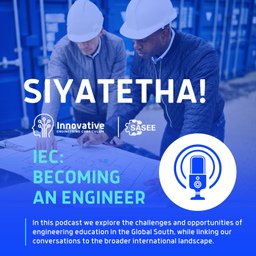
IEC: Becoming an Engineer
Claim This Podcastby Innovative Engineering Curriculum (IEC)
6 episodes
Updated Daily
Accepts GuestsHas SponsorsLocation 🇿🇦
Podcast Overview
In this podcast series, we explore the challenges and opportunities of engineering education in the Global South while linking our conversations to the broader international landscape.
Language
🇺🇲
Publishing Since
11/17/2025
1 verified contact email on file for IEC: Becoming an Engineer
Pitch yourself as a guest, propose sponsorships, or reach out directly to the host.
Recent Episodes
May 15, 2026
Beyond Content: Preparing Engineers for Complex Real-World Practice (feat. Prof. Zach Simpson)
<p>In this episode, we speak with <strong>Prof. Zach Simpson</strong>, whose work explores the evolving nature of engineering education, academic development, and the everyday complexities of curriculum practice. Drawing on a journey that began in educational linguistics, Zach reflects on questions of identity, belonging, and the often invisible work involved in supporting engineering academics through change. Together, we discuss how conventional teaching practices shape student participation, what it means to prepare graduates for complex workplaces, and why engineering education must continually rethink not only what is taught, but how and why it is taught.<br />Links:</p><ul><li><a href="https://www.linkedin.com/in/zach-simpson-uj/" target="_blank" rel="ugc noopener noreferrer">Prof ZS LinkedIn</a></li><li><a href="https://journals.uj.ac.za/SOTL/index.php/sotls" target="_blank" rel="ugc noopener noreferrer">SoTL in the South journal and conference</a></li></ul>
April 14, 2026
Shaping a Field: The Evolution of Engineering Education in South Africa (feat. Prof. Jenni Case)
<p>In this episode, we are joined by <strong>Prof. Jenni Case</strong>, whose work has played a foundational role in shaping Engineering Education Research in South Africa. From her early experiences in academic development at UCT to her leadership in establishing initiatives such as CREE and SASEE, Jenni reflects on the evolution of the field and the complexities of teaching and learning in engineering. Drawing on her experiences in both South Africa and the United States, the conversation explores what it means to support educators in their practice, how context shapes educational approaches, and what kinds of futures engineering education should be preparing students for.</p><p><strong>Links:</strong></p><ul><li>Prof. Jenni Case LinkedIn: <a href="https://www.linkedin.com/in/jenni-case-b3a44438" target="_blank" rel="noreferrer noopener">https://www.linkedin.com/in/jenni-case-b3a44438</a></li><li>Prof. Jenni Case Google Scholar: <a href="https://scholar.google.com/citations?hl=en&user=USeqOt0AAAAJ" target="_blank" rel="noreferrer noopener">https://scholar.google.com/citations?hl=en&user=USeqOt0AAAAJ</a></li><li>Centre for Research in Engineering Education (CREE): <a href="https://ebe.uct.ac.za/cree">https://ebe.uct.ac.za/cree</a></li><li>Virginia Tech Profile Page: <a href="https://enge.vt.edu/People/researchfaculty/jennicase.html" target="_blank" rel="noreferrer noopener">https://enge.vt.edu/People/researchfaculty/jennicase.html</a></li><li>South African Society for Engineering Education (SASEE): <a href="https://www.sasee.org.za/">https://www.sasee.org.za/</a></li><li>Southern Journal of Engineering Education (SJEE): <a href="https://journals.uct.ac.za/index.php/sjee">https://journals.uct.ac.za/index.php/sjee</a> </li></ul>
March 14, 2026
Navigating Misalignment: Agency, Cultural Capital and Student Success in Engineering (feat. Dr Disa Mogashana)
<p>In this episode, we speak with Dr Disa Mogashana, whose work explores how identity, structure, and access shape success in engineering education. Drawing on her own experiences as a student and her research on cultural capital and student agency, Disa reflects on the often invisible systems that determine who thrives in university spaces and who must work harder simply to belong. Our conversation moves from personal narrative to institutional practice, exploring how educators, universities, and industry can better recognise misalignment and design environments where students are supported not only academically, but relationally and structurally.</p><p><strong>Links:</strong></p><ul><li><a href="https://iecurricula.co.za/wp-content/uploads/2026/03/Transforming-engineering-education.pdf" rel="ugc noopener noreferrer" target="_blank">JSU-EWB Innovate Article</a></li><li>Resources on Cultural Capital: <a href="https://www.jstor.org/stable/3649652" target="_blank" rel="ugc noopener noreferrer">https://www.jstor.org/stable/3649652</a></li><li>Teaching Matters (article on pages 46-48): <a href="https://rhgraham.org/resources/Crisis-and-catalyst.pdf" target="_blank" rel="ugc noopener noreferrer"></a><a href="https://drupalwebprod-files.up.ac.za/Public/2025-11/teaching-matters_vol-2.zp272198.pdf?VersionId=5Di_rBMtDitORx7dZUTRpPHmO0.EP6lg" target="_blank" rel="ugc noopener noreferrer">https://drupalwebprod-files.up.ac.za/Public/2025-11/teaching-matters_vol-2.zp272198.pdf?VersionId=5Di_rBMtDitORx7dZUTRpPHmO0.EP6lg</a><a href="https://rhgraham.org/resources/Crisis-and-catalyst.pdf" target="_blank" rel="ugc noopener noreferrer"></a></li><li>Mogashana, D., Case, J.M. & Williams, K. (2022). How ADP students navigate enablements and constraints of the programme: An exploration of structure and agency. South African Journal of Higher Education, 36 (2), 204-221. ISSN 1753-5913. <a href="https://sigarra.up.pt/feup/en/noticias_geral.ver_noticia?p_nr=159571" target="_blank" rel="ugc noopener noreferrer"></a></li><li>Mogashana, D., Basitere, M., Ivala, E.(2023). Harnessing students’ agency for easier transition and success in higher education in South Africa: A qualitative account of the role of a life coaching intervention. Journal of Student Affairs in Africa 11(1), 49-63). DOI: 10.24085/jsaa.v11i1.4206 </li><li>Mogashana, D. G. (2015). The interplay between structure and agency: How academic development programme students 'make their way' through their undergraduate studies in engineering. (Thesis). University of Cape Town ,Faculty of Engineering & the Built Environment ,Department of Chemical Engineering. Retrieved from <a href="http://hdl.handle.net/11427/16601" target="_blank" rel="ugc noopener noreferrer">http://hdl.handle.net/11427/16601</a></li><li><a href="https://journals.co.za/doi/epdf/10.20853/36-2-4526" target="_blank" rel="ugc noopener noreferrer">Ideological Positioning of Extended Curriculum Programmes – A Case Study of a Large South African Research University</a></li></ul>
6 total episodes available
Deep-dive analytics for IEC: Becoming an Engineer
Frequently asked questions
Have a different question and can't find the answer you're looking for? Reach out to our support team by sending us an email and we'll get back to you as soon as we can.
- What is IEC: Becoming an Engineer?
- How often does this podcast release new episodes?
This podcast updates daily.
- Where can I listen to this podcast?
This podcast is available on 4 platforms including Apple Podcasts, Spotify, and more. You can also use the RSS feed directly.
- Does this podcast accept guests?
Yes, this podcast regularly features guests.
Legal Disclaimer
Pod Engine is not affiliated with, endorsed by, or officially connected with any of the podcasts displayed on this platform. We operate independently as a podcast discovery and analytics service.
All podcast artwork, thumbnails, and content displayed on this page are the property of their respective owners and are protected by applicable copyright laws. This includes, but is not limited to, podcast cover art, episode artwork, show descriptions, episode titles, transcripts, audio snippets, and any other content originating from the podcast creators or their licensors.
We display this content under fair use principles and/or implied license for the purpose of podcast discovery, information, and commentary. We make no claim of ownership over any podcast content, artwork, or related materials shown on this platform. All trademarks, service marks, and trade names are the property of their respective owners.
While we strive to ensure all content usage is properly authorized, if you are a rights holder and believe your content is being used inappropriately or without proper authorization, please contact us immediately at hey@podengine.ai for prompt review and appropriate action, which may include content removal or proper attribution.
By accessing and using this platform, you acknowledge and agree to respect all applicable copyright laws and intellectual property rights of content owners. Any unauthorized reproduction, distribution, or commercial use of the content displayed on this platform is strictly prohibited.