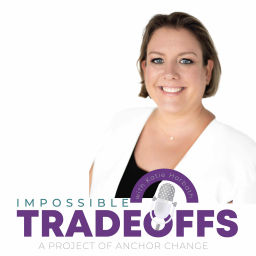
Welcome to Anchor Change, where we help you panic responsibly in a chaotic world. I’m Katie Harbath—a Midwesterner living in DC who’s spent two decades navigating impossible tradeoffs at the intersection of tech, politics, and democracy.
Each week, I’ll break down the headlines, talk with people forging bold paths, and explore how we can face disruption with clarity and courage. This isn’t about hot takes—it’s about finding steady ground when everything feels uncertain.
In a world of complexity, you don’t have to navigate it alone.
anchorchange.substack.com (https://anchorchange.substack.com?utm_medium=podcast)
Replay: AI, Voters, and the 2026 Midterms: What the Data Actually Shows
Voters are using AI to research candidates. Campaigns are using AI to write fundraising emails. Platforms are updating their policies — and their enforcement is lagging behind. But what does the data actually show?
This is a replay of the webinar I hosted on AI and the 2026 midterms — pulling from original polling with 1,010 likely voters (conducted with the Rainey Center (https://www.raineycenter.org/)), a survey of 68 campaign professionals on how they’re using AI inside their operations, and her ongoing analysis of how major platforms are preparing for November.
This isn’t a recap of the AI discourse. It’s an interpretation of what the data signals — the partisan splits, the governance gaps, and the transparency questions that are going to matter when it counts.
The last 20 minutes will open for Q&A and discussion. The format mirrors Anchor Change’s monthly Briefing Network calls (https://anchorchangebriefing.substack.com/p/welcome-to-the-anchor-change-briefing), so you’ll also get a live preview of what membership looks like.
For more information on the poll and survey:
* Voters are using AI to fact-check. The tools are wrong 90% of the time. (https://anchorchange.substack.com/p/voters-are-using-ai-to-fact-check)
* What Campaign Professionals Told Us About AI in Politics (https://anchorchange.substack.com/p/what-campaign-professionals-told)
* The partisan divide in campaign AI use: Republicans generate more content, Democrats govern it more (https://anchorchange.substack.com/p/partisan-divide-campaign-ai-use)
We were also joined by Luis Lozada, the CEO of Democracy Works, to talk about their work with companies like OpenAI and Anthropic. To learn more, visit their website (https://www.democracy.works/).
Click here (https://docs.google.com/presentation/d/1aLedcvLNLUAl61UNWWk9FOnsmU73leACSCPmXmKQfKw/edit?usp=sharing) to view the slides presented.
The private room for senior practitioners in tech, politics and democracy
There’s no shortage of newsletters covering this space. What’s missing is a place where the people closest to it — trust and safety leads, policy professionals, campaign strategists, Hill alumni — can actually think it through together. The Anchor Change Briefing Network is that room. Private memos twice a month. A live monthly peer conversation under Chatham House Rules. 38 founding seats at $400/month. Once they’re gone, pricing moves to $500.
This is a public episode. If you'd like to discuss this with other subscribers or get access to bonus episodes, visit anchorchange.substack.com/subscribe (https://anchorchange.substack.com/subscribe?utm_medium=podcast&utm_campaign=CTA_2)
22 Dec 2025
Mapping Power: Navigating Tech and Systems Change
In this episode, Katie talks with Charley Johnson (https://www.charley-johnson.com/) about his leap into independent work through his newsletter, Untangled, (https://untangled.substack.com/) and what it takes to build a life and career outside traditional structures. Charley breaks down how power actually moves through technology, why many leaders still misread the systems they operate within, and how imagination—not just strategy—shapes better futures. He shares the blind spots he sees most often in tech and policy, the role community plays in sustaining meaningful change, and how AI fits into the broader landscape of systems transformation. Charley closes with an honest reflection on success—what he’s letting go of, what he’s moving toward, and why metrics alone will never tell the full story.
Learn more about (https://luma.com/user/usr-4hWLBkpZC4VMtvJ) Charley’s upcoming workshops: 1) Mapping Your System: How to Navigate Power, People & Change in Uncertain Times and 2) Beyond the Principles: How to Make Responsible AI Real, A 3-Part Intensive for Tech & Society Leaders.
Takeaways
* Independent work can be both disorienting and deeply energizing.
* Power in tech often operates invisibly, yet shapes outcomes everywhere.
* Building community is essential for meaningful, sustainable change.
* Many leaders misinterpret data as neutral rather than value-laden.
* Technology must be aligned with a clear, intentional vision of the future.
* Cynicism limits possibility; curiosity expands it.
* AI is a tool—not an answer to systemic problems.
* True success is grounded in fulfillment and relationships, not just scale.
* Understanding systems is essential to influencing them.
* Imagination is a critical—yet underrated—skill in tech and policy.
Chapters
* 00:00 Mapping Power and Technology
* 22:45 The Journey of Independence
* 27:39 Navigating Content Creation
* 33:02 Defining Success and AI Perspectives
* 38:30 Building Businesses with Purpose
* 39:00 Looking Ahead: Technology and Future Planning
Anchor Change with Katie Harbath is a reader-supported publication. To receive new posts and support my work, consider becoming a free or paid subscriber.
Get full access to Anchor Change with Katie Harbath at anchorchange.substack.com/subscribe (https://anchorchange.substack.com/subscribe?utm_medium=podcast&utm_campaign=CTA_4)
18 Dec 2025
The Impact of EU Regulation on Political Campaigns
In this episode, Katie talks with Clare O’Donoghue Velikić about the shifting landscape of political advertising in Europe—and what’s driving those changes. They trace how Brexit, the Cambridge Analytica scandal, and rising public scrutiny of tech platforms set the stage for today’s regulatory environment. Clare breaks down the stark differences between U.S. and European campaign practices, the ripple effects of GDPR and data rules, and how policymakers are thinking about political communication in a post-scandal world. They also unpack Meta’s recent decision to ban political ads in the EU, exploring why it matters, who it affects, and what transparency risks emerge when legitimate political messaging is pushed out of public view. The conversation offers a grounded look at the future of digital campaigning in Europe—and the tradeoffs ahead as platforms, regulators, and political actors navigate a rapidly changing system.
Takeaways
* Regulation intended to increase transparency can lead to less transparency.
* Europe’s political advertising landscape is significantly different from the US.
* Data protection laws in Europe limit campaign strategies.
* The early days of Facebook were marked by excitement and innovation.
* The Cambridge Analytica scandal raised serious concerns about data use in politics.
* Building political ad transparency tools was a complex process.
* The current political ad ban in Europe poses risks to democratic discourse.
* Extremist content may thrive in the absence of regulated political ads.
* Finding a compromise between tech companies and regulators is crucial.
* The removal of political ads silences moderate voices in social media.
Chapters
* 00:00 Introduction to Political Advertising in Europe
* 03:38 Differences Between US and European Political Campaigning
* 06:12 The Early Days of Facebook and Political Campaigning
* 08:56 The Impact of Cambridge Analytica and Foreign Interference
* 11:14 Building Political Ad Transparency Tools
* 13:59 Challenges in Regulating Political Advertising
* 16:49 Personal Experiences in Political Campaigning
* 19:02 The Role of Data and Privacy in Political Advertising
* 25:43 Political Ad Authorization and Campaign Dynamics
* 29:29 Challenges of Political Advertising in Europe
* 33:08 Meta’s Political Ad Transparency Initiatives
* 39:05 Impact of New Regulations on Political Advertising
* 44:12 The Future of Political Advertising and Social Media
* 48:53 The Role of Moderation in Social Discourse
* 52:15 The Evolution of Political Advertising on Facebook
* 52:44 Challenges of Transparency in Online Ads
Anchor Change with Katie Harbath is a reader-supported publication. To receive new posts and support my work, consider becoming a free or paid subscriber.
Get full access to Anchor Change with Katie Harbath at anchorchange.substack.com/subscribe (https://anchorchange.substack.com/subscribe?utm_medium=podcast&utm_campaign=CTA_4)
Who has been a guest on Impossible Tradeoffs with Katie Harbath
Names identified in recent episode analyses. Showing up to five guests.
Steve Grove
Hamish McKenzie
Rumman Chowdhury
Nicholas Thompson
Suzy Dean
Reach and audience
Public platform figures. Ratings count people who left a rating, not total listeners.
YouTube views
13,562
Score snapshot 15 Sept 2025
Apple Podcasts (US)
5.0 / 5
7 ratings
Spotify
5.0 / 5
4 ratings
Podcast Authority Score: 71 / 100
A composite of feed quality, social presence, YouTube performance and engagement. Read the methodology.
Quality
84
Social presence
0
YouTube
72
Engagement
71
Contact Impossible Tradeoffs with Katie Harbath
Guest appearances
Books guests
Based on episode analysis; this does not confirm that the show is currently accepting guests.
Questions about Impossible Tradeoffs with Katie Harbath
Who hosts Impossible Tradeoffs with Katie Harbath?
Katie Harbath host the show. Published by Katie Harbath.
How often do new episodes come out?
The show publishes weekly, based on its RSS feed.
Does Impossible Tradeoffs with Katie Harbath take guests?
Yes. Guests have been identified in episode analyses.
Host of Impossible Tradeoffs with Katie Harbath?
Claim your podcast to manage its listing and keep your show details accurate.
Pod Engine is an independent podcast discovery and analytics service and is not affiliated with or endorsed by this podcast. Artwork and show content belong to their owners. Full legal notice.
Explore this show Podcast research with Pod Engine