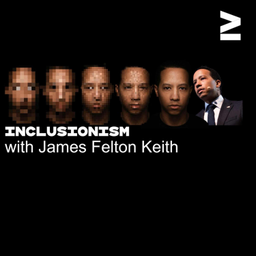
James Felton Keith explores the tenets of inclusionism . As always, JFK is joined by Peter Willumsen and friends. His ethic of inclusionism is at the core of his work on global diversity equity inclusion and belonging. JFK is the Founder of Techstars Venture Backed, InclusionScore Companies and a lecturer at the University of Georgia's Terry College of Business. In 2017 he became the first Black LGBT person to run for federal office in the United States during his bid for Congress to represent Harlem. <br/><br/><a href="https://jamesfeltonkeith.substack.com?utm_medium=podcast">jamesfeltonkeith.substack.com</a>

Inclusionism
Claim This Podcastby James Felton Keith
Podcast Overview
James Felton Keith explores the tenets of inclusionism . As always, JFK is joined by Peter Willumsen and friends. His ethic of inclusionism is at the core of his work on global diversity equity inclusion and belonging. JFK is the Founder of Techstars Venture Backed, InclusionScore Companies and a lecturer at the University of Georgia's Terry College of Business. In 2017 he became the first Black LGBT person to run for federal office in the United States during his bid for Congress to represent Harlem. <br/><br/><a href="https://jamesfeltonkeith.substack.com?utm_medium=podcast">jamesfeltonkeith.substack.com</a>
Language
🇺🇲
Publishing Since
1/12/2025
1 verified contact email on file for Inclusionism
Pitch yourself as a guest, propose sponsorships, or reach out directly to the host.
Recent Episodes

April 20, 2026
Now on Spotify: Your Data, Their Wealth
<p>This book makes a plain argument: your data is not incidental to the AI economy. It is an input. It helps train systems, shape products, reduce risk, increase efficiency, and create enormous enterprise value. Yet the people whose lives, behaviors, language, preferences, and patterns make that value possible are rarely recognized, credited, or paid.</p><p>I wrote this book to name that imbalance clearly and to push the conversation forward. If data functions like labor, capital, or any other productive input, then it should be measured differently, governed differently, and valued differently.</p><p>If you have been following my work on data, value, ownership, AI, and economic justice, this is the book that brings those arguments together in one place.</p><p><a target="_blank" href="https://open.spotify.com/show/7bIgvHk7Okiov2bFulwqdY?si=dfba10d1462e4908"><strong>You can listen now on Spotify</strong></a>. The hard cover comes out on Juneteenth (June 19)</p><p>Your data built this economy. It is time to talk about what that is worth.</p><p></p> <br/><br/>This is a public episode. If you would like to discuss this with other subscribers or get access to bonus episodes, visit <a href="https://jamesfeltonkeith.substack.com?utm_medium=podcast&utm_campaign=CTA_1">jamesfeltonkeith.substack.com</a>

March 23, 2026
The White House is Sacrificing People for Cold War AI “Dominance”.
<p>The White House has now made its position on artificial intelligence much clearer.</p><p>It sees the harms. It sees the scams, the deepfakes, the threats to children, the pressure on the electric grid, the fights over copyright, and the disruption coming for workers. It is not blind to the damage.</p><p>But it is still committed to the same old framework of power: sacrifice the public, protect the market, and call it national strength.</p><p>That is the deeper problem with this AI policy framework. It talks about the visible harms of AI, but it refuses to confront the extraction model underneath it. It wants to regulate the symptoms while preserving the structure. It wants America to dominate AI, but it never really asks who pays for that dominance and who gets left behind to make it possible.</p><p>That idea of “dominance” is not neutral. It comes out of a Cold War mindset. It assumes that the nation must race ahead at all costs, that scale itself is victory, and that any serious constraint on industry is a strategic weakness. In that worldview, people are not partners in development. They are fuel. Workers are a labor supply problem. Families are a safety issue. Communities are an infrastructure problem. States are obstacles. The public is something to manage while the machine expands.</p><p>That is exactly what this framework sounds like.</p><p>It offers protections at the margins. It talks about guarding children, fighting fraud, and limiting some of the most obvious abuses of synthetic identity. Fine. Those are real problems. But those protections do not change the central fact that AI systems are being built on human expression, human behavior, human culture, and human decision-making without creating meaningful economic rights for the people whose lives are being turned into inputs.</p><p>That is the scandal.</p><p>The White House is willing to admit that AI can harm people. It is not willing to admit that AI is profitable because it extracts value from people.</p><p>So the framework treats the public as something to defend, not something to pay. It treats workers as people who need retraining, not as contributors who deserve bargaining power. It treats communities as places that should be protected from higher electric bills, not as stakeholders who should have a claim on the wealth being generated around them. It treats creators as possible rights-holders, but ordinary people remain economically invisible even though their data, patterns, preferences, and behavior are part of what makes these systems useful.</p><p>That is not reform. That is damage control.</p><p>And it is noticeably behind the rest of the world.</p><p>The European Union has already done what Washington still seems afraid to do: pass an actual AI law. Europe may not have solved everything, but it at least recognized that artificial intelligence is important enough to govern in binding terms. It built a legal structure. It imposed obligations. It drew lines.</p><p>The United States is still talking like a superpower in decline: obsessed with beating rivals, terrified of slowing industry, and unwilling to discipline capital even when the public cost is obvious.</p><p>That is what makes this framework feel so dated. Its language is modern, but its politics are old. Beneath the talk of safety and innovation is a very familiar national logic: centralize power, protect incumbents, preempt local resistance, and tell the public that sacrifice is necessary for the greater good.</p><p>We have heard that story before.</p><p>We heard it in the name of industrial supremacy. We heard it in the name of military necessity. We heard it in the name of global competition. And ordinary people were almost always told to wait, adapt, trust the experts, and accept the tradeoffs.</p><p>Now they are being told the same thing again in the language of AI.</p><p>The public should not accept it.</p><p>If artificial intelligence is built from society, then society must have rights in what it produces. Not just warnings. Not just safety promises. Not just technical standards written by the same firms racing to dominate the field. Rights. Compensation. Bargaining power. Ownership.</p><p>Anything less leaves the basic arrangement untouched: the people generate the value, the companies capture the upside, and the government manages the fallout.</p><p>That is why this framework is not bold. It is cautious where it should be transformative. It is aggressive where it should be democratic. It is protective only at the edges, while the center of the system remains deeply extractive.</p><p>America does not need a Cold War theory of AI dominance.</p><p>It needs an AI policy built around human ownership, human dignity, and human leverage.</p><p>Otherwise “dominance” will mean what it usually means: a small number of institutions gaining power by treating the rest of the country as expendable.</p> <br/><br/>This is a public episode. If you would like to discuss this with other subscribers or get access to bonus episodes, visit <a href="https://jamesfeltonkeith.substack.com?utm_medium=podcast&utm_campaign=CTA_1">jamesfeltonkeith.substack.com</a>

March 20, 2026
Property Rights Make AI Equitable
<p>Everybody is talking about whether AI will be fair, safe, or inclusive, but most of that conversation misses the real issue: ownership. AI will not become equitable just because companies promise better ethics. It becomes equitable when the people whose lives, behavior, culture, and data make these systems valuable actually have property rights in what they are producing. That is the missing piece. For centuries, property rights have been the mechanism that turned people from subjects into stakeholders. They created claims, contracts, and economic leverage. AI should be no different. If our data trains systems, improves products, reduces uncertainty, and drives profits, then our contribution cannot be treated as a free raw material. It has to be recognized as an owned input to the economy. That is how you move beyond empty talk about fairness and toward a real structure for participation, compensation, and power. AI is only equitable when the people feeding it are no longer invisible, but treated as owners.</p><p><strong>AI does not become equitable through promises. It becomes equitable when people own the value they create.</strong></p> <br/><br/>This is a public episode. If you would like to discuss this with other subscribers or get access to bonus episodes, visit <a href="https://jamesfeltonkeith.substack.com?utm_medium=podcast&utm_campaign=CTA_1">jamesfeltonkeith.substack.com</a>
28 total episodes available
Deep-dive analytics for Inclusionism
Frequently asked questions
Have a different question and can't find the answer you're looking for? Reach out to our support team by sending us an email and we'll get back to you as soon as we can.
- What is Inclusionism?
- How often does this podcast release new episodes?
This podcast updates daily.
- Where can I listen to this podcast?
This podcast is available on 4 platforms including Apple Podcasts, Spotify, and more. You can also use the RSS feed directly.
- Does this podcast accept guests?
Information about guest appearances is not available.
Legal Disclaimer
Pod Engine is not affiliated with, endorsed by, or officially connected with any of the podcasts displayed on this platform. We operate independently as a podcast discovery and analytics service.
All podcast artwork, thumbnails, and content displayed on this page are the property of their respective owners and are protected by applicable copyright laws. This includes, but is not limited to, podcast cover art, episode artwork, show descriptions, episode titles, transcripts, audio snippets, and any other content originating from the podcast creators or their licensors.
We display this content under fair use principles and/or implied license for the purpose of podcast discovery, information, and commentary. We make no claim of ownership over any podcast content, artwork, or related materials shown on this platform. All trademarks, service marks, and trade names are the property of their respective owners.
While we strive to ensure all content usage is properly authorized, if you are a rights holder and believe your content is being used inappropriately or without proper authorization, please contact us immediately at hey@podengine.ai for prompt review and appropriate action, which may include content removal or proper attribution.
By accessing and using this platform, you acknowledge and agree to respect all applicable copyright laws and intellectual property rights of content owners. Any unauthorized reproduction, distribution, or commercial use of the content displayed on this platform is strictly prohibited.