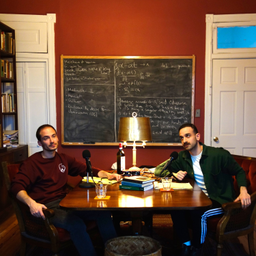
Tim Harrison (GUEST): Impossible Experience and the Invention of Consciousness
What would it mean to remember the beginning of consciousness? Tim Harrison (English and Social Thought, UChicago) takes us through moments when literary and philosophical authors portray the beginning of experience. From Milton's Adam and Eve to the late-discovered poems of Thomas Traherne to the political-philosophical thought of Locke and Rawls to the concerns of our AI age, we discuss the implications of this exciting thought experiment. Tim also treats us to a reading from Traherne's poem "The Preparative".
2 Jul 2026
Rosanna Warren (GUEST): Sacred Cannibalism
Join us as we ask distinguished poet, critic, and translator Rosanna Warren about her literary autobiography, the state of literary criticism, and the role of the poet-critic. Rosanna discusses her literary and painterly childhood in France and her unusual path through the academy; the capaciousness of English in particular; past literary movements like deconstruction and New Criticism, as well as the eclecticism of our current moment; and the "sacred cannibalism" of literary influence. Rosanna concludes by reading her poem "A New Year" (a "train poem", as she explains).
15 May 2026
Miguel de Beistegui (GUEST): The Crisis of Crises
In this episode of Invasive Thoughts, we speak with Miguel de Beistegui (ICREA Research Professor, Universitat Pompeu Fabra) about crisis as one of the basic conditions of contemporary life. Our present is labelled with crises of almost every kind: financial, ecological, democratic, geopolitical, migratory, public-health, economic, and technological. Moving from the financial crisis of 2008 and the COVID pandemic of 2020 to Heidegger, Mallarmé, neoliberalism, and non-Western thought, we ask what these crises reveal about the world we inhabit and the forms of thinking still prevalent among us. Beistegui invites us to think more deeply about what it means to live and act when the shared and fragile ground of our lives—the Earth itself, or Gaia—has entered into crisis.
6 Apr 2026
Emily Riehl (GUEST): Metamathematics and Infinity Category Theory
Emily Riehl (Johns Hopkins, Mathematics) joins us to discuss the power of abstraction in mathematics. Is category theory the mathematics of mathematics? What is infinity category theory? How has the form of a mathematical proof changed over time? Can AI execute mathematical proofs?
Check out Emily's game, Reintroduction to Proofs: https://adam.math.hhu.de/#/g/emilyriehl/reintroductiontoproofs
10 Mar 2026
Peter Fenves (GUEST): Kant's Rational Delusions
Peter Fenves (Northwestern) poses some unexpected questions relating to Immanuel Kant’s thought. How does politics emerge from a shortage of space? Should we understand humans as two-dimensional rather than three-dimensional creatures? Why do we so often desire to fly? Is the moral destiny of humanity to give way to a new species of rational beings on Earth? Is Nicholas delusional? (Listen at minute 53.) Finally, we consider what disappointed Walter Benjamin in Kant’s writings on history and how Benjamin’s critique reframes the Enlightenment conception of science.
8 Feb 2026
Sean Kirkland (GUEST): Nietzsche and Heidegger at the End of Metaphysics
Is Nietzsche a philosopher or an anti-philosopher? Is Western philosophical thought one monolithic tradition? Sean Kirkland (DePaul Philosophy) joins us to discuss the position of such "threshold" thinkers as Plato and Aristotle on one hand and Heidegger and Nietzsche on the other. He also relates what he learned by translating Nietzsche for the new Stanford translation of the Complete Works. (This includes Nietzsche's punctuation habits: Sean counts 13 colons in one sentence from Nietzsche's drafts and 91 exclamation marks in The Birth of Tragedy.) Along the way, we return to the Greeks and the tragic vision of the world captured in Aristotle’s philosophy.
27 Jan 2026
Jon Cogburn (GUEST): Bridging the Continental-Analytic Divide; Paradoxico-Metaphysics; and, Panpsychism, or, are all things Mind?
In this episode of Invasive Thoughts, we’re joined by Jon Cogburn, Chair of Philosophy at Louisiana State University. Jon sketches a history of the Continental–Analytic divide in American philosophy and suggests what it might take to bridge it today. Jon explains how more than one metaphysics could be true at the same time, and how even a self-contradictory metaphysics could be true. We go on to discuss contemporary philosophy’s attraction to set theory; the flat ontologies of Graham Harman and Tristan Garcia; ancient and contemporary forms of panpsychism; and, along the way, why philosophers so often find themselves at odds with administrators. We talk about the religion of Silicon Valley, philosophy’s relationship to popular culture (Jon has co-authored a book on philosophy and Dungeons & Dragons), and finally Jon’s Buddhism and how it informs his philosophical outlook.
20 Jan 2026
David Wellbery (GUEST): Goethe, the Age of Goethe, and World Literature
David Wellbery explores Goethe's central role in a vibrant intellectual circle and his diverse accomplishments in literature and natural philosophy, offering insights into the humanities through world literature in this interview.
14 Jan 2026
Richard Strier (GUEST): Shakespeare, Herbert, Jarrell, Dylan
Richard Strier, emeritus professor, discusses influential poetry, reconciles formalism with historicism, interprets George Herbert's "Love" (III), and debates Bob Dylan's music, in an interview.
28 Dec 2025
Terry Pinkard (GUEST): Hegel's America and America's Hegel
Terry Pinkard, Hegel scholar, explores his intellectual journey, the difficulties of interpreting Hegel, Hegel's influence in America, and his connection to American democracy in an interview.
6 Nov 2025
Peirce Again: Chance, Necessity, Love
This episode explores Charles Sanders Peirce's speculative essays, examining the role of chance, spontaneity, and love in shaping a philosophical worldview after Darwin.
6 Sept 2025
Metzinger's Ego Machines
Host [Host Name] interviews philosopher Thomas Metzinger about how neuroscience challenges our self-perception and redefines individuality.
10 Jul 2025
Jane Addams and Hull House
This episode explores the impactful writings and social work of Jane Addams, the American pragmatist philosopher and Nobel Prize winner, highlighting her founding of Hull House and advocacy for peace.
9 Jun 2025
Agamben's Bored Animals
Giorgio Agamben's work on the distinction between humans and animals explores the concept of boredom as a uniquely human trait, offering insights into philosophical anthropology.
16 May 2025
Northrop Frye's Literary Universe
What is literary criticism? What concept of literature underlies it? Northrop Frye's 1957 Anatomy of Criticism sketches a vast and comprehensive map of the literary universe and shows us what it would look like to entertain a total order of literature. We discuss aspects of Frye's visionary project as well as literary criticism's status today.
4 Apr 2025
Meillassoux's Failed Coup
Quentin Meillassoux's 2006 After Finitude seemed like it was going to revolutionize philosophy. It didn't. We talk about its radical implications and why it may still have traction today.
4 Apr 2025
Hegel, Goethe's Gardener
Around the time he was finishing the Phenomenology of Spirit, Hegel almost became director of Goethe's botanical gardens in Jena. We play around with affinities between Goethe's botany and Hegel's idealism.
4 Apr 2025
Peirce, the "Greatest American Thinker"?
"Certainly the greatest American thinker ever." - Bertrand Russell. A foray into the thought of Charles Sanders Peirce, father of pragmatism, largely through six classic essays.
Who has been a guest on Invasive Thoughts
Names identified in recent episode analyses. Showing up to five guests.
David Wellbery
Richard Strier
Terry Pinkard
Thomas Metzinger
Reach and audience
Public platform figures. Ratings count people who left a rating, not total listeners.
Apple Podcasts (US)
4.8 / 5
16 ratings
Spotify
5.0 / 5
23 ratings
Podcast Authority Score: 20 / 100
A composite of feed quality, social presence, YouTube performance and engagement. Read the methodology.
Quality
19
Social presence
0
YouTube
0
Engagement
51
Host of Invasive Thoughts?
Claim your podcast to manage its listing and keep your show details accurate.
Pod Engine is an independent podcast discovery and analytics service and is not affiliated with or endorsed by this podcast. Artwork and show content belong to their owners. Full legal notice.
Explore this show Podcast research with Pod Engine