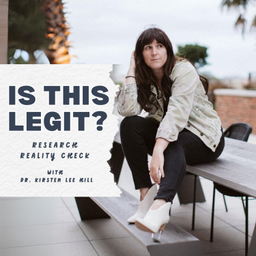
Is this legit? Research reality check with Dr. Kirsten Lee Hill
Kirsten Lee Hill
5.0from 1 ratings
- 12
- Episodes
- 1
- Ratings
- 2024
- First episode
About Is this legit? Research reality check with Dr. Kirsten Lee Hill
Join your host, Dr. Kirsten Lee Hill, as she dives into the viral stats and facts sweeping the internet. Along the way, you’ll learn how to conduct better research, spot misleading claims, gather credible data, and make better decisions. Whether you’re a fellow data geek, an entrepreneur, a student, or just someone who loves a good data mystery, tune in to explore the power of data, the importance of transparency, and how to make sure you never get duped by “research” again.
- Publisher
- Kirsten Lee Hill
- Category
- science
- Language
- en
- Explicit
- No
- First episode
- 19 Nov 2024
- Latest episode
- 18 Mar 2025
Latest episodes
12 episodes in the feed.
18 Mar 2025
Do husbands = more housework?
Have you seen or heard the viral claim: “Having a husband adds 7 hours of housework per week for women?” It feels right—but is it? In this episode of Is This Legit?, I track down the source of this stat, dig into what the research actually says, and uncover why outdated data keeps going viral. Along the way, we’ll talk about: The 2008 University of Michigan press release behind this claim (and why it’s not a study). What more recent research says about gender, marriage, and housework. How social media algorithms push misinformation. Why cuts to research funding are making it harder to get real answers. If you’ve ever questioned where viral stats actually come from, wondered whether we’re using outdated data when better research exists, or just want to know the truth about who’s really doing the housework, this episode is for you. Referenced: University of Michigan article (https://news.umich.edu/exactly-how-much-housework-does-a-husband-create/) 2023 American Time Use Survey Results (https://www.bls.gov/charts/american-time-use/activity-by-hldh.htm) 2024 Gender Equity Policy Institute Report (https://thegepi.org/the-free-time-gender-gap/#:~:text=Analyzing%20data%20from%20the%202022,equity%20in%20the%20United%20States.) 2013 PEW research report (https://www.pewresearch.org/social-trends/2013/03/14/chapter-6-time-in-work-and-leisure-patterns-by-gender-and-family-structure/#2fbee3e00eab1dfc94263cf0ca3b3294) 2022 meta-analysis (https://www.thelancet.com/journals/lanpub/article/PIIS2468-2667(22)00160-8/fulltext) ABC news article (https://abcnews.go.com/GMA/Living/women-spend-double-amount-time-chores-men-study/story?id=91032694#:~:text=Researchers%20analyzed%20data%20from%2019%20studies%20which,day%20on%20the%20same%20or%20similar%20tasks.)
4 Mar 2025
Is ChatGPT’s Deep Research as Smart as It Looks?
The internet is buzzing—ChatGPT’s Deep Research feature is here, and people are calling it a game-changer. Some even say it could replace researchers altogether. (Eek!) But is it really that good? Or does it just look good? In this episode, I put Deep Research to the test, running my own experiments on two widely shared statistics. What I found raised some serious questions about how AI gathers information, whether it can be trusted, and why looking "legit" doesn’t always mean being accurate. If you’ve ever wondered whether AI can actually do research—or if it’s just like really good at Googling—this episode is for you.
25 Feb 2025
Have We Lost Our Ability to Focus?
A New York Times bestseller. Big, dramatic stats. And a research scavenger hunt that left me questioning everything (except my ability to focus). This week, we’re breaking down a 2022 book that recently went viral: the viral book Stolen Focus: Why You Can't Pay Attention--and How to Think Deeply Again (https://www.amazon.com/Stolen-Focus-Attention-Think-Deeply/dp/0593138511)—a book that claims to be “beautifully researched” and endorsed by some of the biggest names in media and politics. But when I started looking into the statistics being repeated on TikTok, I ran into a problem: no one seemed to know where they actually came from… other than the book. So, in rare form, I bought the book and set off on a citation scavenger hunt—and let me tell you, things got weird. 🔎 In this episode, we’ll uncover: A bizarrely confusing citation system that makes fact-checking as you read insanely frustrating (and wondering what the author is hiding) How a claim about “23 minutes to refocus after an interruption” leads to a study where… that number isn’t actually there. A controversial stat about teenagers’ attention spans used in marketing the book that is… well definitely different than what you’re thinking. A “5.4 hours on phones vs. 17 minutes reading” claim that falls apart under scrutiny. The absurd research trail behind claims that people speak and walk faster today. More importantly, we’ll ask: Why major publishers let research-based books use cherry-picked, out-of-context studies to push a narrative? Why media outlets repeat these claims without verifying them. And, Why does the burden of fact-checking always fall on us—the readers? This episode is a deep dive into misleading research, bad citations, and how viral misinformation thrives. Listen in, and remember: Just because a stat goes viral doesn’t mean it’s true. Referenced: The Book: Stolen Focus: Why You Can't Pay Attention--and How to Think Deeply Again (https://www.amazon.com/Stolen-Focus-Attention-Think-Deeply/dp/0593138511) 23-minute refocus stat (cited in Stolen Focus): Gloria Mark’s 2015 conference paper (https://d1wqtxts1xzle7.cloudfront.net/43021331/cscwf438-mark2-libre.pdf?1456343655=&response-content-disposition=inline%3B+filename%3DFocused_Aroused_but_so_Distractible_A_Te.pdf&Expires=1740464637&Signature=WBPPXsKu5ukSPSJ-2pCngnj0x~zbcQYcXRPuh9UKAiUFV-YgsvVqcAv77MymoSBbj4xfbt3h1ruFnvjRxcI72~pTMhL2MQ~oCNg6Dx36mIpOoArWg604B3ldTdSpKxOZQ6q9td3cbEMrS7zcEP12Py~kPo3sKIapwBd25i9-VEqvgTpM3G5-jkMRzXSKA3dWYGaxB8h51qMKlx57qwNJO2ppHfyogPa2Pl4CFPbpSGKhKrf3TNH~6vBv1H9~A5iTRs-~gAN6dc-MeZbxY2CFwtTYj-xoqx32fDzAdpHX5vBR5U7dBhIGICTSGBcOyKf~B4SIvAQDH54rTPbspmwmpg__&Key-Pair-Id=APKAJLOHF5GGSLRBV4ZA) (This paper cites 23 minutes but does not contain original research for this number.) 23-minute refocus stat (earlier source cited in the 2015 paper): Gloria Mark’s 2005 conference paper (https://d1wqtxts1xzle7.cloudfront.net/6123897/10.1.1.77.7612-libre.pdf?1392064411=&response-content-disposition=inline%3B+filename%3DNo_task_left_behind_examining_the_nature.pdf&Expires=1740464664&Signature=dBA8oBmKlXf8M0sZ4F3ZQvpzPQMubE-rVM9a6ghg8WDHHfvpl4yQBjVgbUaqxdQEMpW~SuSM-J52xKI1x3KvQkUDVw3LUR4aZc-qXELzQdqBlsYQrUpSwvl5IWfqZxoKuiBl9GtIfQH6acXNAWUf8o0g49iD852ML2JKl03cypxGVPFYFHLRNQHFAg~Qq9aWhtOF~aJ0GlH2dXkiQlhHeyFpHvWPUlGtfm8TSXtLHBctFVLxOuINdREL2mhKYpeSUxvJJM63RBo7abSGYsHj03lIeECx72IrINVFDY11WiYv65vylfwnCfxzgJdbii0Jmdyuwin9jreXWInAiMf2yA__&Key-Pair-Id=APKAJLOHF5GGSLRBV4ZA) (This paper does not contain the 23-minute stat at all—stat appears to have drifted.) Teenagers’ 65-second stat source: Journal of Communication study on media multitasking (https://academic.oup.com/joc/article-abstract/64/1/167/4085996?redirectedFrom=fulltext) (Focused on college students, not teenagers) 5.4 hours on their phone stat: Survey by Provision Living, cited by Zdnet (https://www.zdnet.com/article/americans-spend-far-more-time-on-their-smartphones-than-they-think/)(Limited sample of millennials & baby boomers; no full report available.) 17-minute reading stat: American Time Use Survey (https://www.bls.gov/charts/american-time-use/activity-leisure.htm) (Varies by age and reading type; does not necessarily include digital reading.) Speaking faster stat: Study of Norwegian parliamentary stenographers (https://www.uniforum.uio.no/nyheter/2005/06/med-eit-muntert-blikk-paa-styre-og-stell.html) (Measured stenography speed, not natural speech; limited scope.) Walking faster stat: Discussed in this article (https://www.reuters.com/article/lifestyle/worlds-cities-step-up-pace-of-life-in-fast-lane-idUSKUA248545/#:~:text=Richard%20Wiseman%2C%20a%20professor%20of%20psychology%20at,now%20much%20quicker%20than%20before%2C%22%20he%20said.) and also in this blog (http://www.richardwiseman.com/quirkology/pace_method.htm) (Sampled 70 people per city; outdated and narrow scope.)
18 Feb 2025
Do we make 35,000 decisions a day?
In today’s episode, we’re diving into a mysterious and dramatic decision-making stat that’s been popping up everywhere lately. But when you try to track it down, no one actually knows where it comes from. Every source just says it comes from various sources—or cites a source that points to… more unnamed sources, in an endless loop. So what’s the truth? We’ll break down the citation loop that keeps this number alive, expose the lack of a real source, and reveal how even major publications like Harvard Business Review, Forbes, and PBS repeated it without fact-checking. Join me as I unpack what we know (and don’t know) about decision-making, how misinformation spreads even in places we should be able to trust, and why we need more good people in research to answer questions like this. Referenced: 2015 - Roberts Wesleyan University Article (https://go.roberts.edu/leadingedge/the-great-choices-of-strategic-leaders) 2016 - The Wall Street Journal (https://www.wsj.com/articles/the-cure-for-decision-fatigue-1465596928) 2018 - Psychology Today (https://www.psychologytoday.com/us/blog/stretching-theory/201809/how-many-decisions-do-we-make-each-day) 2018 - National Library of Medicine (https://pmc.ncbi.nlm.nih.gov/articles/PMC6119549/) 2021 - PBS (https://www.pbsnc.org/blogs/science/how-many-decisions-do-we-make-in-one-day/) 2022 - CNN Health (https://edition.cnn.com/2022/04/21/health/decision-fatigue-solutions-wellness/index.html) 2023 - Harvard Business Review (https://hbr.org/2023/12/a-simple-way-to-make-better-decisions) 2023 - Forbes (https://www.forbes.com/sites/nelldebevoise/2023/10/27/decisions-are-for-suckers-avoid-decision-fatigue/) Cornell University Study (https://news.cornell.edu/stories/2006/12/mindless-autopilot-drives-people-underestimate-food-decisions) OREO Study (https://www.the-sun.com/lifestyle/12240697/decision-making-oreo-clattenburg-regret-decide/) Noom Study (https://uk.style.yahoo.com/number-of-decisions-we-make-daily-revealed-102938055.html) Microsoft Ad (https://www.youtube.com/watch?v=6k3_T84z5Ds)
4 Feb 2025
Do Squats Regulate Blood Sugar Better than a 30-Minute Walk?
In today’s episode, I’m tackling a viral health claim that sounds simple—but isn’t: that doing 10 squats every 45 minutes during an 8.5-hour period of sitting is better for blood sugar regulation than taking a 30-minute walk. Is that what the research actually says? Not quite. We’ll break down the study’s methodology, expose the grammatical ambiguity that helped this misinformation spread, and reveal how even AI initially misread the study. Plus, you’ll learn why you should make reading the methods section of research your superpower, how bad science communication erodes public trust, and why representation in research matters more than you think. Join me as I unpack what this study really found, challenge misleading claims, and share practical tips for spotting the next viral “science-backed” myth before it fools you. Referenced: The Study (https://www.researchgate.net/profile/Qingyang-Li-21/publication/379875074_Enhanced_muscle_activity_during_interrupted_sitting_improves_glycemic_control_in_overweight_and_obese_men/links/6623531739e7641c0bdae044/Enhanced-muscle-activity-during-interrupted-sitting-improves-glycemic-control-in-overweight-and-obese-men.pdf) The Video on Instagram (https://www.instagram.com/foundmyfitness/reel/C6zFWQWvzRl/?hl=en) The Tweet (https://x.com/foundmyfitness/status/1788991915633045809?lang=en) The Newsweek Article (https://www.newsweek.com/how-100-body-squats-can-change-your-health-1972103)
28 Jan 2025
Are AI’s Carbon Emissions For Writing Really Lower Than Ours?
In today’s episode, I’m tackling the bold, research-backed claim that AI produces lower carbon emissions for writing and drawing than humans. We’ll break down the study’s methodology, question its framing, and uncover the glaring omissions that make its conclusions feel more like a pro-AI pitch than neutral science. Plus, you’ll learn what Mark Twain has to do with all of this and why apples-to-oranges carbon calculations can skew the bigger picture. Join me as I unpack the study’s findings, explore why bias in research matters, and share tips for critically evaluating the next viral “science-backed” claim you encounter. Referenced: Scientific Reports article (https://www.nature.com/articles/s41598-024-54271-x) The Writer Magazine (https://www.writermag.com/writing-inspiration/the-writing-life/many-words-one-write-per-day/) EPA’s Greenhouse Gas Equivalencies Calculator (https://www.epa.gov/energy/greenhouse-gas-equivalencies-calculator) The Nature Conservancy’s footprint calculator (https://www.nature.org/en-us/get-involved/how-to-help/carbon-footprint-calculator/)
21 Jan 2025
Can a Triple Nod Improve Communication?
In today’s episode, I’m diving into the viral claim (https://www.tiktok.com/@doacpod/video/7451046786388593962) behind the triple nod, touted as a research backed hack for better communication. We’ll trace its evolution over the years, explore the research (or lack thereof) that backs it up, and unpack how ambiguous stats and missing citations can turn into misinformation. From precise percentages to vague references, we’ll see whether this popular nonverbal cue holds up to scrutiny. Join me as I separate fact from fiction, explain why transparency in sharing “research” matters, and share tips for navigating the next viral stat you encounter. Referenced: Mel Robbins Podcast (https://www.youtube.com/watch?v=EAALACf6bzQ) YouTube video for the speaker’s organization (https://www.youtube.com/watch?v=DWnusEeo7QI) The Carey Nieuwhof Leadership Podcast (https://www.youtube.com/watch?v=mewLD5aMDBo) Time Magazine article (https://time.com/4462658/body-language-tips/) LifeHacker (https://lifehacker.com/use-the-triple-nod-for-more-engaging-small-talk-1548849601) Science of People (https://www.scienceofpeople.com/mirroring/#_ftn1)
14 Jan 2025
Will This Drink Help You Sleep Better?
Perhaps you’ve seen the ads: a hot chocolate drink that promises to fix your sleep, boasting “93% of participants said it helped them get a better night’s rest.” But as a researcher who loves digging into the details, I had to ask: REALLY? In today’s episode, I’m diving into the clinical study (https://shopbeam.com/pages/clinical-study) behind this claim from Beam’s Dream Powder. We’ll break down the who, what, when, where, and why of the research; explore the buzzwords like “randomized,” “double-blind,” and “placebo-controlled”; and unpack how the study design may not be as rigorous as it seems. From missing demographic details to potential placebo effects (hello, distinct flavors), we’ll see whether this magic hot chocolate truly lives up to its promise. Join me as I separate fact from marketing spin, explain why transparency in research matters, and share tips for evaluating the next “scientifically proven” claim you see. Clinical Trial Registry (https://ichgcp.net/clinical-trials-registry/NCT05521243) Beam Blog (https://shopbeam.com/blogs/news/cold-hard-science-the-results-of-our-recent-clinical-study-on-dream)
7 Jan 2025
Are 70% of Divorces Filed By Women?
Perhaps you've seen it all over social media: “70% of divorces are filed by women.” But as a researcher who loves digging into the details, I had to ask: REALLY? In today’s episode, I’m diving into the study behind this viral claim: Who Wants the Breakup? (https://web.stanford.edu/~mrosenfe/Rosenfeld_gender_of_breakup.pdf) by Michael J. Rosenfeld. We’ll break down the who, what, when, where, and why of this research; explore the difference between wanting, initiating, and filing for divorce; and unpack how this stat has been oversimplified in headlines and social media posts. Join me as I separate fact from fiction, explain why the words we use matter, and share tips on how to spot research claims that might not be as true as they seem.
17 Dec 2024
Do We Raise Our Dogs Like Our Parents Raised Us?
Did you catch that recent viral video from Kinship, the pet-parenting website, claiming that a “new study shows” we raise our dogs the same way our parents raised us (https://www.kinship.com/dog-behavior/dog-parenting-style-study)? As a proud dog mom who never yells and spoils her pup silly, I saw this and thought: Not a chance. In today’s episode, I’m digging into the 2024 study behind that headline: Intergenerational Transmission of Human Parenting Styles to Human–Dog Relationships (https://www.mdpi.com/2076-2615/14/7/1038). We’ll break down the who, what, when, where, and why of this research, see what it really says about the influence of our own upbringings on our dog parenting styles, and unpack Kinship’s sweeping claim: Are we actually following in our parents’ footsteps, or is this just click-worthy spin? Join me as I separate fact from fluff, highlight why research literacy matters, and chat about why even “cute” misinformation is a big problem.
10 Dec 2024
Is THIS the Secret to Aging Well?
Did you catch the super cute CBS Sunday Morning segment (https://www.youtube.com/watch?v=KQXAJRY6XYs) where they rolled out “the science” and Jane Fonda, claiming a positive mindset about aging can add 7.5 years to your life? I saw it go viral on TikTok and immediately thought: omg, is this legit? In today’s episode, I dive into the study behind this bold claim—a 2002 journal article (https://www.apa.org/pubs/journals/releases/psp-832261.pdf) linking positive self-perceptions of aging to longevity. We’ll unpack the who, what, when, where, and why of the research, explore its fascinating findings, and ask critical questions: Is this stat fact, fiction, or somewhere in between? Join me as I break down the science, separate fact from marketing flair, and highlight why diversity and replication in research matter now more than ever.
19 Nov 2024
Trailer
Coming to an earbud near you on December 10th. Join your host, Dr. Kirsten Lee Hill, as she dives into the viral stats and facts sweeping the internet. Each week, she’ll dive into a new ‘research shows’ or ‘study finds’ making waves in the headlines and uncover whether it’s legit or not. Along the way, you’ll learn how to conduct better research, spot misleading claims, gather credible data, and make better decisions. Whether you’re a fellow data geek, an entrepreneur, a student, or just someone who loves a good data mystery, tune in to explore the power of data, the importance of transparency, and how to make sure you never get duped by “research” again.
Reach and audience
Public platform figures. Ratings count people who left a rating, not total listeners.
- Spotify
- 5.0 / 5
- 1 ratings
Podcast Authority Score: 25 / 100
A composite of feed quality, social presence, YouTube performance and engagement. Read the methodology.
- Quality
- 37
- Social presence
- 0
- YouTube
- 0
- Engagement
- 32
Host of Is this legit? Research reality check with Dr. Kirsten Lee Hill?
Claim your podcast to manage its listing and keep your show details accurate.
Pod Engine is an independent podcast discovery and analytics service and is not affiliated with or endorsed by this podcast. Artwork and show content belong to their owners. Full legal notice.
Explore this show
Podcast research with Pod Engine