- 15
- Episodes
- 5
- Ratings
- 2026
- First episode
About It All Happened Before
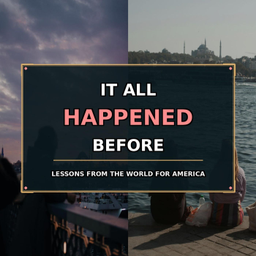
Democracy doesn't collapse overnight—it follows a script. Join us as we decode America's current political crisis through the eyes of those who've seen it unfold elsewhere. Drawing on Turkey's experience and voices from across the globe, we explore the rise of autocracy and populism with guests who understand these forces intimately. This isn't just analysis—it's a search for solutions, guided by those who know that the past isn't just prologue, it's a roadmap. Hosts: Ekin Yaşin (https://ekinyasin.com/) is the Director of Communication Leadership graduate program and a Teaching Professor at the University of Washington, where she designs inclusive and meaningful learning experiences for communities. She thinks and talks about the future of work, organizational communication, innovative teaching methods, and future of higher ed. Outside of work, she is a food, music, travel and literature enthusiast. She splits her time between Seattle and Istanbul. Burcu Baykurt (https://www.baykurt.org/) is Associate Professor of Media Studies at the University of Massachusetts Amherst. She is the author of Smart as a City: The Politics of Test-Bed Urbanism and coeditor of Soft-Power Internationalism: Competing for Cultural Influence in the 21st-Century Global Order. Her research examines the politics of digital infrastructures, media, and state power across global contexts. Outside of work, she is happiest near the sea.
- Publisher
- Ekin and Burcu
- Category
- news
- Language
- en
- Explicit
- No
- First episode
- 19 Mar 2026
- Latest episode
- 3 Jul 2026
Latest episodes
15 episodes in the feed.
3 Jul 2026
Episode 14: On Rethinking the Words We Reach For (Season Finale)
For our final episode, we sat down without a guest to ask ourselves the questions we usually put to others. Has the podcast changed how we see Turkey, the US, and our own positions this season, and are we even reaching for the right words anymore? One answer surprised us: we are rethinking the term democratic backsliding itself. The word suggests a straight line, a country was a democracy, then it slid, and will presumably slide back. Almost nobody we spoke with described their own examples and experiences that way. Dr. Karabekir Akkoyunlu, Dr. Maria Repnikova, Gülsin Harman, Suzy Hansen, Dr.Bilge Yeşil, Dr. Matthew Powers,, and Dr.Mert Can Bayar each, in their own way, described something less like a slide and more like capture, entrenchment, and contest, conditions a country can live inside rather than fall back to. That shift in language changes how we think about everything. We also admit something we had been circling without saying outright, that comparing Turkey and the US can become its own kind of avoidance. It is easier to analyze someone else's crisis than to sit with what is happening at home, and we wanted to name that temptation rather than pretend we were immune to it. Looking ahead, there are threads we have not explored yet that feel essential, among them the role of diaspora communities in either enabling or resisting these dynamics, the transformation of higher education institutions around the globe and weaponization of legal system, to name a few. Finally, we talk about who we now imagine listening. We started out picturing an academic peer, someone who would catch every reference. That person has receded. The listener we picture now is someone watching their own country change and looking for language, not analysis, to describe it. Thank you for a season of listening. We will be back. Subscribe to our companion newsletter: itallhappenedbefore.substack.com (http://itallhappenedbefore.substack.com)
15 Jun 2026
Episode 13: We've Seen the Story Turn with Dr. Karabekir Akkoyunlu
As we explore the various forms of authoritarianism around the world these days, it can feel like there's no end in sight. That's why this week, we wanted to look for something else: a case that might offer some hope, albeit cautiously. We turn to Brazil, and to Dr. Karabekir Akkoyunlu (https://urldefense.com/v3/__https://www.karabekir.net/__;!!K-Hz7m0Vt54!k-UpdBFC8FtomnR7imKsMPMbZr-V9sTbO7hhq1f_vmEMOpRCDp8ClVKUKYoXKXNwwSyeLeHbtQG5-yZ4o6fV$), a comparative politics scholar working across Turkey, Iran, Brazil, and Indonesia. He walks us through the last decade of Brazilian politics: Lula's imprisonment ahead of the 2018 election, Bolsonaro's rise as a Trump-idolizing celebrity-populist, his COVID-era collapse, Lula's return, and, for the first time in Brazil's history, the conviction of a former president and a slate of generals for attempting a coup. We also dig into the difference between "redemocratization" with a capital R — an actual regime transition — and the small-r version Brazil is living through now: a swing within the same system, a respite rather than a fresh start, with Bolsonaro's base intact and his son waiting in the wings for 2026. From there we move on to the "rainbow coalition" strategy — Lula's exceptional skill at building alliances that cut across the polarizing lines an autocratizing leader depends on, a strategy Péter Magyar has echoed in Hungary — and the much harder problem of keeping that coalition together once the election is won. We close our conversation with what two decades on Turkey and Iran look like from Brazil: the same fight for a dignified life shows up everywhere, but the circumstances and thresholds differ. Things can get worse. They can also get better. Dr. Karabekir Akkoyunlu's books: Guardianship and Democracy in Iran and Turkey: Tutelary Consolidation, Popular Contestation (2024) — https://edinburghuniversitypress.com/book-guardianship-and-democracy-in-iran-and-turkey.html (https://edinburghuniversitypress.com/book-guardianship-and-democracy-in-iran-and-turkey.html) Contesting Autocratisation: Actors and Institutions of Democratic Resistance in a Global Perspective (2026), edited by Bilge Yabanci, Karabekir Akkoyunlu, Kerem Öktem — https://www.routledge.com/Contesting-Autocratisation-Actors-and-Institutions-of-Democratic-Resistance-in-a-Global-Perspective/Yabanci-Akkoyunlu-Oktem/p/book/9781041198864 (https://www.routledge.com/Contesting-Autocratisation-Actors-and-Institutions-of-Democratic-Resistance-in-a-Global-Perspective/Yabanci-Akkoyunlu-Oktem/p/book/9781041198864) Subscribe to our companion newsletter: itallhappenedbefore.substack.com (http://itallhappenedbefore.substack.com)
3 Jun 2026
Episode 12: We've Been Walking Around Obstacles with Dr. Maria Repnikova
When we talk about resistance, we tend to picture it: marchers in the street, dissidents with megaphones, confrontation made visible. But in societies where activists are monitored, journalists are constrained, and the costs of speaking out are real and immediate, resistance looks different. It learns to walk around obstacles rather than through them. It becomes quieter, more adaptive, harder to name. To think through what that means — and what our usual frameworks miss — we turn to Dr. Maria Repnikova (https://www.mariarepnikova.com/), a scholar of Chinese political communication. We move across a lot of terrain in this conversation: the lived experiences of journalists and activists who find ways to work around obstacles rather than through them, nonconfrontational activism as strategy and as survival, the blurry line between resistance and complicity, and what "participatory persuasion" reveals about who's really in control of a narrative. We also draw comparisons between China and Russia — where the constraints look similar on the surface but the logic underneath is different. And we ask why soft power is no longer a distinctly Western or liberal-democratic project. What emerges is something we keep coming back to: the importance of image — for autocratic states, for democratic ones, and for all of us trying to make sense of a global information order that keeps shifting. It All Happened Before began as a way of seeing our future in other countries' pasts and presents — primarily through Turkey. This season and next, we keep widening that lens. We started with Turkey. The world keeps giving us more to think with. Dr. Maria Repnikova's books: Media Politics in China: Improvising Power under Authoritarianism (2017) — https://www.amazon.com/Media-Politics-China-Improvising-Authoritarianism/dp/1107195985 (https://www.amazon.com/Media-Politics-China-Improvising-Authoritarianism/dp/1107195985) Chinese Soft Power (2022)— https://www.cambridge.org/core/elements/chinese-soft-power/4E9C9E445C5F8A9F81F5AAEEAD2DF21D (https://www.cambridge.org/core/elements/chinese-soft-power/4E9C9E445C5F8A9F81F5AAEEAD2DF21D) Competing for Softpower: China's Image Making in Africa (forthcoming July 2026): https://www.amazon.com/Competing-Soft-Power-Chinas-Making/dp/100971029X (https://www.amazon.com/Competing-Soft-Power-Chinas-Making/dp/100971029X) Read more and subscribe: https://itallhappenedbefore.substack.com (https://itallhappenedbefore.substack.com)
27 May 2026
Episode 11: A Neighborhood in the Age of Authoritarianism: A Conversation with Author Suzy Hansen
Suzy Hansen's first book, Notes on a Foreign Country: An American Abroad in a Post-American World, is one of the books we kept returning to in the conversations that eventually became this podcast. Her account of seeing the United States from the outside — and her reckoning with American exceptionalism helped us name what we were trying to do here: think about the U.S. with Turkey in the frame, and refuse the comfort of believing it can't happen here. So when listeners and friends started asking us to invite her, it felt overdue. Suzy Hansen joins us to talk about her new book, From Life Itself: Turkey, Istanbul and a Neighborhood in the Age of Erdoğan (April 2026) (https://us.macmillan.com/books/9780374298432/fromlifeitself/) — a decade-long portrait of Karagümrük and the people who live there. Where Notes asked what it means to be American once you've left America, From Life Itself asks a different question: how do ordinary people experience authoritarianism in the twenty-first century? What does it feel like when the world transforms around you while you're trying to live your life, raise your kids, run your shop, get through the week? We talk about what it means to write authoritarianism from inside a single neighborhood in Istanbul rather than from the height of the strongman narrative — the muhtar, the corner shop, the slow accumulation of small adjustments that become a new normal. We sit with the systemic violence directed at Roma and Syrian communities in the neighborhood, and what it means that everyday ambivalence at street level coexists so easily with institutional disposability. And we keep returning to her argument that authoritarianism is "an act of creation, a process of transformation that begins when few are watching and, once identified, is often too late to stop." We end where the show always ends up — looking back and forth between Turkey and the U.S. right now: at the immigration regime and ICE, at the disposability of certain communities, at the textures of life under a transformation that's already well underway, and at what Turkey's last decade can tell Americans who are still asking whether this is really happening. About Suzy Hansen Suzy Hansen is the author of From Life Itself: Turkey, Istanbul and a Neighborhood in the Age of Erdoğan (https://us.macmillan.com/books/9780374298432/fromlifeitself/) (2026). She lived for more than a decade in Istanbul as a contributing writer for The New York Times Magazine. Her first book, Notes on a Foreign Country: An American Abroad in a Post-American World (https://us.macmillan.com/books/9780374537838/notesonaforeigncountry/), was a finalist for the 2018 Pulitzer Prize in nonfiction and won the Overseas Press Club's Cornelius Ryan Award. She has taught writing at Princeton, NYU, and Bard, and has been a fellow at New America and the Institute of Current World Affairs. She lives in New York City. Subscribe to our companion newsletter: itallhappenedbefore.substack.com (http://itallhappenedbefore.substack.com)
20 May 2026
Episode 10: We've Watched Journalists Become Content Creators with Journalist Gulsin Harman
When mainstream media gets captured, the story doesn't end — it migrates. In Turkey, journalism moved from legacy newspapers and TV channels to scrappy independent websites, then to YouTube, and now to individual creator channels where the line between reporter and personality has all but dissolved. This week, Istanbul-based journalist Gülsin Harman joins us to map that journey from the inside. Gülsin has worked within Turkish and global mainstream media — she contributes to the New York Times and BBC Monitoring — and has spent the last several years researching and advising the independent outlets that emerged in capture's wake. So she thinks about not just whether independent journalism survives, but how it stays solvent. We get into the questions that keep independent media awake at night: Which business models are actually working, and which are quietly failing? What does it mean when mid-career journalists like Nevşin Mengü leave CNN Türk to become "newsfluencers" on YouTube — when reporting, opinion, and creator culture fuse into something new — and how does that reshape public debate when your trusted news source is also someone you follow? We also compare notes with the US, where the same migration is underway. And because digital media isn't immune to capture either, we talk about how Turkey's independent journalists have learned to recognize economic and political pressure in its newer forms and survive it. Plus a detour into Hasan Piker's growing streaming empire — fitting, since this episode runs nearly as long as one of his Twitch sessions. Our Guest: Gülsin Harman is an Istanbul-based journalist contributing to the New York Times and BBC Monitoring's Turkey coverage, an editorial strategy consultant for independent media, a 2020 Nieman Foundation Fellow at Harvard, and a member of the News Product Alliance and the Society for News Design. Subscribe to our companion newsletter: itallhappenedbefore.substack.com (http://itallhappenedbefore.substack.com)
13 May 2026
Episode 9: We've Been Frustrated with the Opposition Party Before with Dr. Aytuğ Şaşmaz
The Democratic Party is trying to figure out what will work — and the competing forces within it are doing so loudly. In Maine, an oyster farmer and Marine veteran named Graham Platner pushed a sitting Democratic governor out of the Senate primary. In Michigan, physician Abdul El-Sayed is running neck-and-neck with the party-preferred pick. In California, eight Democrats are splitting the field so thoroughly that two Republicans may take both top-two slots. Same frustration underneath: in fighting and vision contests. If you've watched Turkish politics for the last two decades, you've lived this frustration. Erdoğan's AKP has held power since 2002, in part because the main opposition — the CHP — kept losing with candidates its own base was lukewarm about. Voters showed up. They lost. They showed up again. In Episode 9, we talk with Dr. Aytuğ Şaşmaz (https://aytugsasmaz.com/), Assistant Professor of Political Science at Bryn Mawr College. Aytuğ's central concept is the valence deficit — the gap between a party's values and voters' belief that it can govern competently. The mechanism is internal: when parties lose cohesion, they nominate factional loyalists instead of capable candidates. We talk through what changed between the CHP's 2023 alliance loss and its 2024 historic win — 35 of 81 provinces, the AKP's first national defeat in two decades. And we sit with the harder part: six months later, the regime arrested İmamoğlu. Aytuğ reads the arrest not as a refutation of the strategy but as confirmation that it was working. Then we push on the comparison. Where does the CHP framework map onto the Democrats? Where does it break? We've been frustrated with the opposition party before. The question is what frustrated voters did with it — and how any of that travels. Subscribe to our Substack: itallhappenedbefore.substack.com (http://itallhappenedbefore.substack.com) Further reading: Aytuğ's piece in Medyascope (https://medyascope.tv/2023/07/02/aytug-sasmaz-yazdi-kilicdaroglunun-liderligi-chp-orgutunde-donusumu-nasil-etkiledi/) on how Kılıçdaroğlu's leadership transformed the CHP organization (in Turkish).
6 May 2026
Episode 8: We've Seen Protesters Called Terrorists - A Conversation with Dr. Lisel Hintz
In March 2025, masked federal agents arrested a Turkish PhD student on a Somerville sidewalk as she walked to break her Ramadan fast. Rümeysa Öztürk's offense, according to the Trump administration, was co-authoring a Tufts Daily op-ed critical of the university's response to the war in Gaza. Her F-1 visa had been quietly revoked by the Secretary of State. She spent six weeks in detention, much of it in a Louisiana ICE facility, before a federal judge ruled there were no grounds to deport her. If you grew up in Turkey, none of this looks new. An op-ed becomes evidence. A student becomes a security threat. A protester becomes a terrorist. Days after Rümeysa's arrest, our guest Dr. Lisel Hintz (http://www.liselhintz.com/) co-wrote a piece in The Atlantic — "We Study Repression in Turkey. Now We See It Here." (https://www.theatlantic.com/ideas/archive/2025/03/repression-turkey-we-see-it-here/682233/) — making the case that Trump's playbook against student activists looked unmistakably like Erdoğan's. She would know. Lisel is a political scientist at SOAS, University of London, and the author of Identity Politics Inside Out (https://global.oup.com/academic/product/identity-politics-inside-out-9780190655976) (Oxford, 2018). Her current book project examines Turkey's state-society struggles through the lens of pop culture, and she writes regularly for Foreign Policy, the Washington Post, the BBC, and other outlets — work that pays close attention to how media itself, both captured and creative, shapes what's politically possible. After Gezi protests in 2013, Dr. Hintz mapped how the Erdoğan government built a vilification playbook around three moves — naming, blaming, framing — designed not just to discredit protesters but to actively demobilize them. We talk through how that playbook is being run in the United States right now, from the framing of anti-ICE protesters as domestic terrorists to the repression of pro-Palestine activism, and where the parallels stop and the differences begin to matter. We ask Dr. Lisel Hintz the question that haunts every conversation like this one: when protesters keep losing, why do they keep showing up? What does persistence actually do, politically — even when nothing visible seems to change? Her answer is one of the most clarifying things we've heard on this show. It happened in Turkey. It's happening here. The language the state uses to make dissent look like danger travels easier than we'd like to think. Listen and subscribe: itallhappenedbefore.substack.com (http://itallhappenedbefore.substack.com)
29 Apr 2026
Episode 7: We've Lived With the Deep State -- A Conversation with Dr. Mert Can Bayar
Americans have been talking about the "deep state" like it's a new discovery. It isn't. Derin devlet is a Turkish coinage — a phrase the rest of the world borrowed from a country that has lived inside conspiratorial politics for so long that the language for it had to be invented there first. There used to be a kind of conspiracy theory that, however wrong, at least tried. It marshaled evidence, connected dots, named the shadowy operators. The new conspiracism is something else entirely: no proofs, no patterns, no operators — just innuendo and bare assertion. A lot of people are saying. In this episode, we chat with Mert Can Bayar — political scientist, postdoctoral scholar at the University of Washington's Center for an Informed Public (https://www.cip.uw.edu/people/), and one of the first scholars to take seriously what conspiracism is doing to democracies, not just to individuals. His dissertation, The Politics of Good and Evil, traces partisan conspiracy theories through the parallel democratic erosions of Turkey and the United States. Why those two countries? What does it mean that Turkish political culture has been "built on conspiracism" since the Tanzimat era — and what changes when an entire nation comes to embody itself in a single paranoid spokesperson? Why did Erdoğan grow into conspiracism while Trump arrived already fluent? And — Mert Can's most counterintuitive finding — what do we make of the fact that partisan conspiracy theories actually increase political participation? Is that good news? Or is it precisely the trap? We also spend some time with the question Bruno Latour kept asking before he died: where exactly is the line between the paranoid fantasy and the popularized version of social critique we teach our students? More on Dr. Mert Can Bayar: LinkedIn (https://www.linkedin.com/in/mert-can-bayar/) · CIP profile (https://www.cip.uw.edu/people/) · personal site (https://mertbayar.com/) Subscribe to our companion newsletter via Substack (https://itallhappenedbefore.substack.com/)
22 Apr 2026
Episode 6: We've seen the gilded buildings before
In 2014, a year after Gezi, Recep Tayyip Erdoğan moved into a 1,100-room palace built on Atatürk's protected forest farm — in defiance of court orders that ruled it illegal. In October 2025, Trump's crews demolished the East Wing of the White House to break ground on a $400 million ballroom, financed by anonymous corporate donors with active business before the federal government; this spring, he unveiled plans for a 250-foot triumphal arch across the Potomac from the Lincoln Memorial. When asked whom the arch was meant to honor, Trump replied: "Me." This week on It All Happened Before, we sit with the strange, telling pattern of leaders who build colossal monuments to themselves at the precise moment they believe the institutional resistance is broken. Both projects are bunkered — Erdoğan's against biological and nuclear attack, Trump's housing a classified military complex underneath the ballroom floor. Both involved demolitions that overwrote an older symbolic order: Çankaya, where every Turkish president since Atatürk had worked; the East Wing, the traditional working space of First Ladies. Both bypassed the courts and the planning bodies meant to constrain them, often with the courts then being remade in the leader's image. And both, in different ways, are being normalized. We trace the comparative pattern — from Ceaușescu's Casa Poporului to Hitler's Reichskanzlei, Tito's bunker at Konjic — and ask the question that should unsettle American listeners: a decade ago, Erdoğan's palace generated discussion and outrage. Today, it's just where the president lives. How long does that normalization take?
15 Apr 2026
Episode 5: We’ve Seen Nepotism Before
In this episode, we go deep into the role of family in political power, unpacking how nepotism operates under the cloak of democracy. From Donald Trump’s inner circle—Jared Kushner and Ivanka Trump—to Turkey’s “damat” politics with Berat Albayrak and Selçuk Bayraktar, we explore how family ties become pathways to influence, wealth, and legitimacy. Building on our conversations about institutions, personalities, and the “strongman myth,” we examine how political dynasties are constructed—not just in the U.S. and Turkey, but across the world. From the Bush family to the Trudeaus, this isn’t new. But the scale, stakes, and consequences may be different. What happens when (very)underqualified relatives are handed extraordinary power? How do these networks shape economies, foreign policy, and democratic norms? And what are the real-world consequences—from economic crises to global conflict? This episode asks a simple but urgent question: when power stays in the family, how do we pay the price?
9 Apr 2026
Episode 4: We've Seen Journalists Adapt Before -- A Conversation with Dr. Matt Powers
FCC Chair Brendan Carr threatens to revoke broadcast licenses over war coverage. Pete Hegseth demands a more "patriotic press." These declarations feel almost theatrical — and that's exactly the point. They draw attention to the loud, visible pressure, while the quieter kind takes hold inside the newsroom. We welcome a special guest to make sense of these new tactics, and examples from other countries and contexts that contextualize this moment. Matt Powers is a Professor of Communication at the University of Washington and Co-Director of its Center for Journalism, Media and Democracy. He is the author of The Journalist's Predicament: Difficult Choices in a Declining Profession (https://cup.columbia.edu/book/the-journalists-predicament/9780231207904) (Columbia University Press, 2023) and NGOs as Newsmakers: The Changing Landscape of International News (https://cup.columbia.edu/book/ngos-as-newsmakers/9780231177931) (Columbia University Press, 2018). In his recent article with Ozan Asik, An Ethics of Suppression: How Professional Values Silence Critical Journalism in Turkey (https://journals.sagepub.com/doi/10.1177/19401612261418269), he takes us inside Turkish newsrooms to show how journalists navigate — and survive — under authoritarian pressure. (He also has a (very) close connection to one of our hosts!) What he found is unsettling: editors suppressing critical reporting while genuinely believing they are protecting the space for journalism to survive. At what point does maintaining the appearance of a functioning newsroom become indistinguishable from providing cover for its capture? And the question Turkish journalists learned the hard way: most people can't just leave. So what does staying and continuing to do the work actually look like — inside a system that is increasingly hostile to the journalism you came to do?
6 Apr 2026
Bonus Episode: Media Capture Doesn't Announce Itself — A Conversation with Dr. Bilge Yesil
We started our media capture discussions last episode asking whether what's happening to American media is a rupture or a reckoning. Bilge Yesil's answer, drawn from decades of studying Turkish media, is clarifying and a little unsettling: there was no dramatic breaking point in Turkey either. Just a continuous drift — commercialization, consolidation, political pressure layering on top of market pressure — normalized and incremental, until the transformation was complete and no one could point to the moment it happened. Dr. Bilge Yesil is a Professor of Media Culture at the College of Staten Island and affiliate faculty in Middle Eastern Studies at the CUNY Graduate Center. She is the author of Media in New Turkey: The Origins of an Authoritarian Neoliberal State (https://www.press.uillinois.edu/books/?id=p081651) and, most recently, Talking Back to the West: How Turkey Uses Counter-Hegemony to Reshape the Global Communication Order (https://www.press.uillinois.edu/books/?id=p087998) — and she knows this terrain better than almost anyone. In this conversation, we ask her to walk us through both sides of how capture actually works: the coercive moves — arrests, closures, the blunt instruments — and the quieter, more durable ones: advertising leverage, debt dependencies, ownership consolidation. (Sound familiar? We talk about the Demirören family. We talk about Jeff Bezos and the Washington Post.) And then we ask the question we really wanted answered: for Americans watching declining ad revenues, shuttered newsrooms, and leaders who call journalists the enemy — what does Turkey's experience tell you about where to look? And what are you probably still not seeing?
1 Apr 2026
Episode 3: We've Watched Media Get Captured Before
In this episode of It All Happened Before, Ekin and Burcu use the CBS controversy as a doorway into a much older story — how media capture works precisely because it doesn't announce itself. Drawing on Turkey's experience of press consolidation, where family publishers became state-friendly conglomerates and the transformation felt gradual until suddenly it wasn't, they ask Americans the uncomfortable question: what if you're already inside it? From ownership structures to the slow narrowing of what's sayable, this episode is about learning to recognize something that is designed not to be recognized.
25 Mar 2026
Episode 2: We Still Vote
Burcu flew from Germany to Turkey for 36 hours just to vote. She went to the polls right after her back surgery. And still — she's not sure she fully trusts the outcome. In this episode of It All Happened Before, Ekin and Burcu explore what elections look like inside a competitive authoritarian system: formally intact, fiercely contested, and deeply uncertain. With Americans worried about whether the 2026 midterms will even be held, Turkey's story offers a sobering reframing — the greater danger isn't that elections stop. It's that they become fragile enough to doubt, confusing enough to suppress participation, and contested enough to be dismissed whenever the results are inconvenient.
19 Mar 2026
Episode 1: We've Seen This Before
Some people are surprised by what's happening in America. We are not. It All Happened Before is a conversation between two people who grew up watching democracy erode in Turkey — and who now see the patterns repeating in the country they also call home. In our first episode, we talk about why we started this project, what firsthand experience with authoritarianism actually teaches you, and how we hold onto ourselves while living across two countries in two different stages of a similar story.
Reach and audience
Public platform figures. Ratings count people who left a rating, not total listeners.
- Apple Podcasts (US)
- 5.0 / 5
- 5 ratings
Host of It All Happened Before?
Claim your podcast to manage its listing and keep your show details accurate.
Pod Engine is an independent podcast discovery and analytics service and is not affiliated with or endorsed by this podcast. Artwork and show content belong to their owners. Full legal notice.
Explore this show
Podcast research with Pod Engine