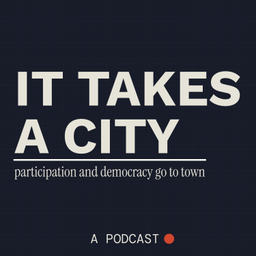
Podcast thumbnail for It Takes A City

It Takes A City

Claim This Podcast

by Stefánia Kapronczay and Flavio Proietti Pantosti

10 episodes
Updated Daily
Accepts GuestsHas SponsorsLocation 🇭🇺

Podcast Overview

It Takes a City is a podcast about participation and democracy. We believe that greater participation is key to making democracy work and to making people feel better about it. Through conversations with practitioners, we explore stories from communities with limited resources, where people are trying to reach beyond the usual voices, tackle difficult challenges, and sometimes fail along the way. We are Stefania Kapronczay and Flavio Proietti Pantosti, find us at https://takesacity.com/.

Language

🇺🇲

Publishing Since

3/2/2026

1 verified contact email on file for It Takes A City

Pitch yourself as a guest, propose sponsorships, or reach out directly to the host.

Recent Episodes

Episode thumbnail for 9. The Case For Participation: Crisis, Governance And Opportunity

May 13, 2026

9. The Case For Participation: Crisis, Governance And Opportunity

<p><br></p><p>In Episode 9, the final episode of the season, we take a step back. With our two guests, we look at the bigger picture: could participatory programs help address the crisis of democracy?</p><p>Our two experts come from very different fields. </p><p>Mitch Stripling works at the intersection of philosophy and disaster management and is the Director of the NYC Preparedness and Recovery Institute. </p><p>Carl Henrik Knutsen is a professor of political science and economics at the University of Oslo and an investigator at the Varieties of Democracy (V-Dem) project.</p><p>While we agree that democracies are in crisis today, we also discuss how crises can become catalysts for positive change. </p><p>Professor Stripling shares an encouraging story about the 1985 Mexico City earthquake, when a disaster became an opportunity for systemic transformation. </p><p>A key precondition is that those who have benefited from the system come to see what those less well off have long known: that the system is failing.</p><p>In those moments, there is a window to build something better, not by restoring what was not working, but by reimagining the entire system. In Mexico, after the earthquake, this led to the creation of labor unions for garment workers.</p><p><strong>—</strong></p><p>We’re living through a global democratic crisis, and elections around the world are sending a clear message: the system isn’t working.</p><p>It Takes a City is a podcast about participation and democracy, hosted by Stefania Kapronczay, a human rights advocate working on resilient democracies from Budapest, Hungary, and Flavio Proietti Pantosti, a social innovator and entrepreneur focused on public administration from Rome, Italy.</p><p>Through conversations with practitioners, we explore lesser-known stories of participation, often from communities with limited resources. Each episode unpacks real tactics, strategic dilemmas, and honest failures, with the goal of offering practical insights.</p><p>Visit https://takesacity.com/ or get in touch at ⁠⁠<a href="mailto:ittakesacity@gmail.com"><strong>ittakesacity@gmail.com</strong></a>⁠⁠.</p>

Episode thumbnail for 8. A Scalable Recipe: Bringing What Works To Different Cities

May 6, 2026

8. A Scalable Recipe: Bringing What Works To Different Cities

<p>Episode 8 takes us to Mexico. </p><p>We look at what it really takes to make participatory programs work in practice, and ask whether their success is less about design and more about discipline.</p><p>Dino Cantú-Pedraza, Founder and Director of Aceleradora de Ciudades, shares her experience from working inside a municipality and now supporting local governments to implement participatory programs.</p><p>She talks about the realities inside government, about the tools, and which ones work best for which goals. But in her experience, discipline matters more.</p><p>The program does not stop at design. It depends on how teams are organized, whether they get the needed support from political leadership, on champions who are not always the ones with the biggest titles, and on making sure the work is sustainable for public servants. She shares a story when they received so many participatory budgeting proposals that meeting their own deadlines became nearly impossible.</p><p>—</p><p>We’re living through a global democratic crisis, and elections around the world are sending a clear message: the system isn’t working.</p><p>It Takes a City is a podcast about participation and democracy, hosted by Stefania Kapronczay, a human rights advocate working on resilient democracies from Budapest, Hungary, and Flavio Proietti Pantosti, a social innovator and entrepreneur focused on public administration from Rome, Italy.</p><p>Through conversations with practitioners, we explore lesser-known stories of participation, often from communities with limited resources. Each episode unpacks real tactics, strategic dilemmas, and honest failures, with the goal of offering practical insights.</p><p>Visit https://takesacity.com/ or get in touch at ⁠⁠<a href="mailto:ittakesacity@gmail.com" rel="ugc noopener noreferrer" target="_blank"><strong>ittakesacity@gmail.com</strong></a>⁠⁠.</p>

Episode thumbnail for 7. Participatory Budgeting: From Experiment To Institution

April 28, 2026

7. Participatory Budgeting: From Experiment To Institution

<p>Episode 7 takes us to Lisbon, Portugal.</p><p>We look at what is probably the best-known participatory tool, <strong>participatory budgeting</strong>, and discuss how it helped transform Lisbon from a city in crisis into one that attracts people. For instance, the idea of co-working spaces came through participatory budgeting and proved to be key for Lisbon becoming a hub for digital nomads. </p><p><strong>Graça Fonseca</strong>, former Minister of Culture of Portugal and former Deputy Mayor of the City of Lisbon, shares how participatory budgeting helped transform the city.</p><p>The program did not stop with voting on projects, it continued through shared problem-solving, through implementation, and through building a sense of collective ownership between citizens and public servants.</p><p>This episode is about what happens when participation becomes a continuous process, not a one-off decision.</p><p>---</p><p>We’re living through a global democratic crisis, and elections around the world are sending a clear message: the system isn’t working.</p><p>It Takes a City is a podcast about participation and democracy, hosted by Stefania Kapronczay, a human rights advocate working on resilient democracies from Budapest, Hungary, and Flavio Proietti Pantosti, a social innovator and entrepreneur focused on public administration from Rome, Italy.</p><p>Through conversations with practitioners, we explore lesser-known stories of participation, often from communities with limited resources. Each episode unpacks real tactics, strategic dilemmas, and honest failures, with the goal of offering practical insights.</p><p>Visit https://takesacity.com/ or get in touch at ⁠⁠<strong>ittakesacity@gmail.com</strong>⁠⁠.</p>

10 total episodes available

Deep-dive analytics for It Takes A City

Frequently asked questions

Have a different question and can't find the answer you're looking for? Reach out to our support team by sending us an email and we'll get back to you as soon as we can.

What is It Takes A City?

It Takes a City is a podcast about participation and democracy.

We believe that greater participation is key to making democracy work and to making people feel better about it. Through conversations with practitioners, we explore stories from communities with limited resources, where people are trying to reach beyond the usual voices, tackle difficult challenges, and sometimes fail along the way.

We are Stefania Kapronczay and Flavio Proietti Pantosti, find us at https://takesacity.com/.

How often does this podcast release new episodes?

This podcast updates daily.

Where can I listen to this podcast?

This podcast is available on 4 platforms including Apple Podcasts, Spotify, and more. You can also use the RSS feed directly.

Does this podcast accept guests?

Yes, this podcast regularly features guests.

Legal Disclaimer

Pod Engine is not affiliated with, endorsed by, or officially connected with any of the podcasts displayed on this platform. We operate independently as a podcast discovery and analytics service.

All podcast artwork, thumbnails, and content displayed on this page are the property of their respective owners and are protected by applicable copyright laws. This includes, but is not limited to, podcast cover art, episode artwork, show descriptions, episode titles, transcripts, audio snippets, and any other content originating from the podcast creators or their licensors.

We display this content under fair use principles and/or implied license for the purpose of podcast discovery, information, and commentary. We make no claim of ownership over any podcast content, artwork, or related materials shown on this platform. All trademarks, service marks, and trade names are the property of their respective owners.

While we strive to ensure all content usage is properly authorized, if you are a rights holder and believe your content is being used inappropriately or without proper authorization, please contact us immediately at hey@podengine.ai for prompt review and appropriate action, which may include content removal or proper attribution.

By accessing and using this platform, you acknowledge and agree to respect all applicable copyright laws and intellectual property rights of content owners. Any unauthorized reproduction, distribution, or commercial use of the content displayed on this platform is strictly prohibited.