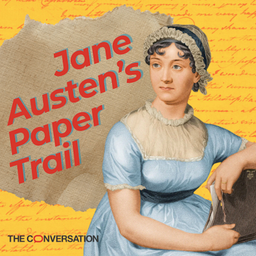
Jane Austen's Paper Trail
The Conversation
4.7from 76 ratings
- 8
- Episodes
- 76
- Ratings
- 2025
- First episode
About Jane Austen's Paper Trail
A series from The Conversation taking you on a journey through Jane Austen’s life and times with the help of the UK’s top Austen experts. Over six episodes, one per book, we visit a scandal-filled bun shop in Bath, go for a windswept walk along the sea shore at Lyme Regis and attend a glittering Regency ball in York to find out more about the woman behind the novels. This is Austen as you’ve never known her before.
- Publisher
- The Conversation
- Category
- arts · education · leisure
- Language
- en
- Explicit
- No
- First episode
- 1 Oct 2025
- Latest episode
- 28 Jan 2026
Latest episodes
8 episodes in the feed.
28 Jan 2026
Q&A: experts answer your Jane Austen questions
In this special Q&A episode we've asked a panel of Jane Austen experts to answer your questions! We’ve received a virtual sack full of letters from you, ranging from questions about Austen’s religious beliefs to her grasp of contemporary science, and even what she might have made of social media. Unlike Jane’s sister Cassandra Austen, however, we have no intention of throwing your letters into the flames. Joining host Anna Walker to discuss your questions are Emma Claire Sweeney (https://theconversation.com/profiles/emma-claire-sweeney-2429293), a senior lecturer in creative writing at the Open University, John Mullan (https://theconversation.com/profiles/john-mullan-2540669), professor of literature at University College London and Lizzie Dunford, director of Jane Austen’s House in Hampshire (https://theconversation.com/jane-austen-shunned-literary-fame-but-transformed-the-novel-from-the-shadows-270590). Jane Austen's Paper Trail is a podcast from The Conversation celebrating 250 years since Jane Austen's birth. You can also sign up to receive a free Jane Austen 250 ebook (https://tally.so/r/MeXOvY) from The Conversation, bringing together a collection of our articles celebrating her life and works. Host: Anna Walker Senior Producer and Sound Design: Eloise Stevens Executive Producer: Gemma Ware Artwork: Naomi Joseph and Alice Mason The Conversation is an independent, not-for-profit news organisation. If you like the show, please consider donating to (https://tcnv.link/2S1cahf) support our work. You can sign up here for a free daily newsletter (https://theconversation.com/uk/newsletters/the-daily-2) from The Conversation here. How Jane Austen’s landscapes mapped women’s lives (https://theconversation.com/how-jane-austens-landscapes-mapped-womens-lives-266878) Inside the Regency ballroom: what you’d experience on a night out with Jane Austen (https://theconversation.com/inside-the-regency-ballroom-what-youd-experience-on-a-night-out-with-jane-austen-270628) Why Jane Austen readers still leave letters at her graveside (https://theconversation.com/why-jane-austen-readers-still-leave-letters-at-her-graveside-269752)
9 Dec 2025
The happy ending
In the sixth episode of Jane Austen's Paper Trail from The Conversation, we explore whether Jane was happy, using her last published novel, Persuasion, as our guide. Given that happy endings in Jane Austen's novels chiefly revolve around a love match with the desired hero, some might conclude that as Austen remained a lifelong spinster, happiness must have eluded her. But this groundbreaking writer was a woman who filled her life with meaning through interests, friendships, socialising, travel, and most of all, a purpose. In this episode, Jane Wright is joined by Nada Saadaoui (https://theconversation.com/profiles/nada-saadaoui-2406991) of the University of Cumbria, whose research examines Austen’s depiction of walking in Romantic-era English landscapes, to answer the question: was Jane happy? Taking in the sea air at the Cobb in Lyme Regis, the two explore what this coastal Dorset town meant to Austen, and how it inspired the pivotal scene in Persuasion where Anne Elliot and Frederick Wentworth reignite the spark of their connection. Later in the episode, Anna Walker sits down with two more Austen experts – John Mullan (https://theconversation.com/profiles/john-mullan-2540669), professor of literature at University College London, and Freya Johnston (https://theconversation.com/profiles/freya-johnston-2540671), professor of English at the University of Oxford – to comb through what clues Persuasion offers about Austen's own happiness. Jane Austen's Paper Trail is a podcast from The Conversation celebrating 250 years since Jane Austen's birth. If you have a question you'd like to pose to Jane Austen experts for an Q&A special in early 2026, please email us on podcast@theconversation.com. You can also sign up to receive a free Jane Austen 250 ebook (https://tally.so/r/MeXOvY) from The Conversation, bringing together a collection of our articles celebrating her life and works. Host: Anna Walker Reporter: Jane Wright Senior Producer and Sound Design: Eloise Stevens Executive Producer: Gemma Ware Artwork: Naomi Joseph and Alice Mason The Conversation is an independent, not-for-profit news organisation. If you like the show, please consider donating to (https://tcnv.link/2S1cahf) support our work. You can sign up here for a free daily newsletter (https://theconversation.com/uk/newsletters/the-daily-2) from The Conversation here.
2 Dec 2025
The writer
In the fifth episode of Jane Austen's Paper Trail from The Conversation, we look what kind of author Austen was, and what Northanger Abbey reveals about her view of her profession. Austen's grave in Winchester Cathedral makes no mention that she was a writer. Publishing anonymously and disliking literary celebrity, she remained largely unknown as a writer in her lifetime despite occasional, reluctant contact with London’s literary circles. Her fifth novel, Northanger Abbey – written in 1799 but published posthumously – clearly reveals her views on writing and reading books. In this episode, The Conversation's Naomi Joseph visits Jane Austen's House (https://janeaustens.house) in Hampshire with Louise Curran (https://theconversation.com/profiles/louise-curran-1470865), lecturer in 18th-century and Romantic literature. Curran is an expert in letter writing, the development of the novel and literary celebrity. Later in the episode, Anna Walker sits down with Kathryn Sutherland (https://theconversation.com/profiles/kathryn-sutherland-2536227), emeritus professor of English at the University of Oxford, and Anthony Mandal (https://theconversation.com/profiles/anthony-mandal-114203), a lecturer in English literature at Cardiff University – to discover what Northanger Abbey reveals about Austen's views on writing. Jane Austen's Paper Trail is a podcast from The Conversation celebrating 250 years since Jane Austen's birth. If you have a question you'd like to pose to Jane Austen experts for an upcoming Q&A special, please email us on podcast@theconversation.com. Host: Anna Walker Reporter: Naomi Joseph Senior Producer and Sound Design: Eloise Stevens Executive Producer: Gemma Ware Artwork: Naomi Joseph and Alice Mason The Conversation is an independent, not-for-profit news organisation. If you like the show, please consider donating to (https://tcnv.link/2S1cahf) support our work. You can sign up here for a free daily newsletter (https://theconversation.com/uk/newsletters/the-daily-2) from The Conversation here.
25 Nov 2025
The friend
In the fourth episode of Jane Austen's Paper Trail from The Conversation, we explore who Austen made friends with, and ask what we can learn about friendship in the pages of her fourth novel, Emma. We explore who Austen’s friends were, the significance of these relationships in her life, and how she depicted female friendship in her novels. The Conversation's Jane Wright visits Box Hill in Surrey – site of an infamous picnic in Emma – with Emma Claire Sweeney (https://theconversation.com/profiles/emma-claire-sweeney-2429293), senior lecturer in creative writing at the Open University and expert in Austen's friendships. Later on, Anna Walker sits down with two more eminent Austen experts to discuss friendship in Emma -- emeritus professor Janet Todd (https://theconversation.com/profiles/janet-todd-2531040) of Cambridge University, and Bharat Tandon (https://theconversation.com/profiles/bharat-tandon-2531034), lecturer in literature at the University of East Anglia. Jane Austen's Paper Trail is a podcast from The Conversation celebrating 250 years since Jane Austen's birth. If you have a question you'd like to pose to Jane Austen experts for an upcoming Q&A special, please email us on podcast@theconversation.com. Host: Anna Walker Reporter: Jane Wright Senior Producer and Sound Design: Eloise Stevens Executive Producer: Gemma Ware Artwork: Naomi Joseph and Alice Mason The Conversation is an independent, not-for-profit news organisation. If you like the show, please consider donating to (https://tcnv.link/2S1cahf) support our work. You can sign up here for a free daily newsletter (https://theconversation.com/uk/newsletters/the-daily-2) from The Conversation here. What was Jane Austen’s best novel? These experts think they know (https://theconversation.com/what-was-jane-austens-best-novel-these-experts-think-they-know-252669) Who was Jane Austen’s best heroine? These experts think they know (https://theconversation.com/who-was-jane-austens-best-heroine-these-experts-think-they-know-253085)
18 Nov 2025
The political being
In the third episode of Jane Austen's Paper Trail from The Conversation, we explore Jane's politics, and her views on slavery through the pages of Mansfield Park. There are no strident political takes in Jane Austen’s novels, but many subtle and carefully crafted signals. Slavery was one of the biggest and most urgent public debates of Austen's times. It’s an issue most modern readers would like to see her coming down on the right side of. But she only ever wrote one black character, Miss Lambe in the unfinished work Sanditon, and her book which deals most with issue, Mansfield Park, only mentions slavery directly only once. In this episode we visit Liverpool docks, which were at the centre of Britain's transatlantic slave trade, with Corinne Fowler (https://theconversation.com/profiles/corinne-fowler-413958), a professor of postcolonial literature at the University of Leicester. And then we sit down for a deep dive into Austen’s view of the slave trade in Mansfield Park with two more experts: Olivia Robotham Carpenter (https://theconversation.com/profiles/olivia-carpenter-2476180), a lecturer in literature at the University of York, and Markman Ellis (https://theconversation.com/profiles/markman-ellis-187919), a professor of 18th-century studies at Queen Mary University London. Jane Austen's Paper Trail is a podcast from The Conversation celebrating 250 years since Jane Austen's birth. If you have a question you'd like to pose to Jane Austen experts for an upcoming Q&A special, please email us on podcast@theconversation.com. Host: Anna Walker Reporter: Naomi Joseph Senior Producer and Sound Design: Eloise Stevens Executive Producer: Gemma Ware Artwork: Naomi Joseph and Alice Mason The Conversation is an independent, not-for-profit news organisation. If you like the show, please consider donating to (https://tcnv.link/2S1cahf) support our work. You can sign up here for a free daily newsletter (https://theconversation.com/uk/newsletters/the-daily-2) from The Conversation here.
11 Nov 2025
The romantic
In the second episode of Jane Austen's Paper Trail from The Conversation, we explore romance in the world of Jane Austen through the pages of Pride and Prejudice. Every heroine in a Jane Austen novel ends up married. It is the bow on the end of every story that ties up all the loose threads – seemingly the ultimate happy ending. However, while marriage is an conclusion she chose for her characters, it is not one she chose for herself. It seems likely that Austen chose her singledom, even though she was clearly preoccupied with romance and marriage. Many readers consider her one of history's greatest writers of romance. Not least, because of Pride and Prejudice. In this episode we visit a Regency ball at the Grand Assembly Rooms in York with Meg Kobza (https://theconversation.com/profiles/meg-kobza-1436867), an expert in Georgian culture and leisure at Newcastle University. And then we dive into what Pride and Prejudice reveals about Austen's views on romance in a discussion with Octavia Cox (https://theconversation.com/profiles/octavia-cox-2429313), lecturer in 18th and 19th century literature at the University of Oxford and Adam J Smith (https://theconversation.com/profiles/adam-j-smith-177343), an associate professor in English literature at York, St. John University. Jane Austen's Paper Trail is a podcast from The Conversation celebrating 250 years since Jane Austen's birth. If you have a question you'd like to pose to Jane Austen experts for an upcoming Q&A special, please email us on podcast@theconversation.com. Host: Anna Walker Reporter: Naomi Joseph Senior Producer and Sound Design: Eloise Stevens Executive Producer: Gemma Ware Artwork: Naomi Joseph and Alice Mason The Conversation is an independent, not-for-profit news organisation. If you like the show, please consider donating to (https://tcnv.link/2S1cahf) support our work. You can sign up here for a free daily newsletter (https://theconversation.com/uk/newsletters/the-daily-2) from The Conversation here. From pulpits to protest, the surprising history of the phrase ‘pride and prejudice’ (https://theconversation.com/from-pulpits-to-protest-the-surprising-history-of-the-phrase-pride-and-prejudice-249836) What was Jane Austen’s best novel? These experts think they know (https://theconversation.com/what-was-jane-austens-best-novel-these-experts-think-they-know-252669) Netflix to remake Pride and Prejudice – why Jane Austen novels make perfect period adaptations (https://theconversation.com/netflix-to-remake-pride-and-prejudice-why-jane-austen-novels-make-perfect-period-adaptations-256649)
4 Nov 2025
The gossip
Jane Austen's Paper Trail is a podcast from The Conversation celebrating 250 years since Jane Austen's birth. In this first episode, we're delving into Austen's first novel, Sense and Sensibility where gossip – and the fear of it – plays a central role in the story. Through the rumours that swirl within its pages, we’ll find out what Austen herself thought about gossip, and the people who spread it. Along the way we travel to Sally Lunn's tearoom in Bath, where Austen herself often took tea – with Andrew McInnes (https://theconversation.com/profiles/andrew-mcinnes-1397078) of Edge Hill University. And then we dive into the role of gossip in Sense and Sensibility with Lucy Thompson (https://theconversation.com/profiles/lucy-thompson-1483565), a lecturer in 19th-century literature at Aberystwyth University and Katie Halsey (https://theconversation.com/profiles/katherine-halsey-2429303), professor of English studies at the University of Stirling. Gossip in the world of Jane Austen served several important functions: entertainment; intel; communication; miscommunication; and control. As reputations were fiercely guarded, one piece of misdirected or unfounded gossip could leave a young woman's honour in tatters. Deployed strategically, that was often precisely the point. And for women of Austen's time, being the subject of gossips could be a very dangerous thing indeed. Host: Anna Walker Reporter: Jane Wright Senior Producer and Sound Design: Eloise Stevens Executive Producer: Gemma Ware Artwork: Naomi Joseph and Alice Mason The Conversation is an independent, not-for-profit news organisation. If you like the show, please consider donating to (https://tcnv.link/2S1cahf) support our work. You can sign up here for a free daily newsletter (https://theconversation.com/uk/newsletters/the-daily-2) from The Conversation here.
1 Oct 2025
Introducing Jane Austen's Paper Trail
Introducing Jane Austen's Paper Trail, a new podcast from The Conversation. When she died aged just 41, Jane Austen's sister, Cassandra, burned most of her letters. What's left gives us tantalising clues about who she really was. Austen's characters jump to life on screen with a new adaptation for each generation… but 250 years after her birth, the woman herself remains an enigma. Over six episodes, one for each of her books, Jane Austen's Paper Trail takes you on a journey through Austen's life and times with the help of the UK's top experts. We'll head to a scandal-filled tearoom in Bath to ask was Jane a gossip? Head to a glittering Regency ball to find out whether she was a romantic? And visit her house in Hampshire to find out what she thought about being a writer. Along the way we'll delve into the characters and themes that have made her writing so enduring for so many readers. Host: Anna Walker Reporters: Jane Wright and Naomi Joseph Senior Producer and Sound Design: Eloise Stevens Executive Producer: Gemma Ware Artwork: Naomi Joseph and Alice Mason The Conversation is an independent, not-for-profit news organisation. If you like the show, please consider donating to (https://tcnv.link/2S1cahf) support our work. You can sign up here for a free daily newsletter (https://theconversation.com/uk/newsletters/the-daily-2) from The Conversation here.
Reach and audience
Public platform figures. Ratings count people who left a rating, not total listeners.
- Apple Podcasts (US)
- 4.7 / 5
- 76 ratings
Contact Jane Austen's Paper Trail
- Guest appearances
- Books guests
Based on episode analysis; this does not confirm that the show is currently accepting guests.


Host of Jane Austen's Paper Trail?
Claim your podcast to manage its listing and keep your show details accurate.
Pod Engine is an independent podcast discovery and analytics service and is not affiliated with or endorsed by this podcast. Artwork and show content belong to their owners. Full legal notice.
Explore this show
Podcast research with Pod Engine