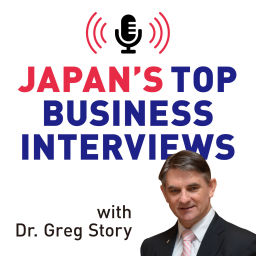
Japan's Top Business Interviews Podcast By Dale Carnegie Training Tokyo Japan
Hosted by unknown · Dr. Greg Story
4.0from 2 ratings
- 332
- Episodes
- 2
- Ratings
- Weekly
- Cadence
- 2020
- First episode
About Japan's Top Business Interviews Podcast By Dale Carnegie Training Tokyo Japan
Japan's Top Business Interviews is the premier business interview podcast for people who want to know more about business in japan. The guests cover a range of industries and organisation sizes, to present a thorough overview of issues with leading in Japan. If you are a leader, especialy someone leading in Japan, then this is the podcast for you.
- Publisher
- Dr. Greg Story
- Category
- business · business
- Language
- en
- Explicit
- No
- First episode
- 6 Jun 2020
- Latest episode
- 17 Oct 2026
Latest episodes
332 episodes in the feed.
17 Oct 2026
299 Carl Williams, Managing Director Asia Pacific, Unipart
"Knowing the details was essential." "Gaining trust through doing is important." "Continuity is the foundation." "The ultimate risk sits with me." "Leadership, if I think of our business, it exists at multiple levels within your business." Carl Williams is Managing Director, Asia Pacific, at Unipart, the privately owned British supply-chain business with roots in the automotive industry. His remit covers India, Vietnam, China, South Korea, Japan and Australia, with Tokyo serving as the regional headquarters. Born in Wales and raised in western England, he completed university in 1997 and began his career with Toyota Tsusho in Japan, combining intensive Japanese-language study with work in its Tokyo office. He subsequently established a Japanese operation for a British motorcycle-parts business and developed manufacturing and sourcing relationships in China. Joining Unipart in Japan in 2005, he progressed through customer service and supply-chain management into regional leadership, spent approximately ten years based in Suzhou, China, and returned to Japan in 2018. His career reflects a practical ability to adjust leadership approaches across Asian markets. Leading in Japan is not simply a question of importing international management practices. Carl Williams, Managing Director, Asia Pacific, at Unipart, describes leadership as a combination of technical credibility, continuity, cultural awareness and the willingness to let local teams own decisions. His experience spans Japan, China and other Asia-Pacific markets, giving him a comparative view of how commitment, speed and attitudes to failure differ across organisations. Williams arrived in Japan after university in 1997 to work for Toyota Tsusho. Morning language classes were followed by afternoons in the office, while company dormitory life and evening socialising gave him a deeper view of Japanese workplace relationships. He encountered visible hierarchy, meticulous attention to detail, consultation before action and a strong corporate identity. The investment in language and international assignments helped him understand the organisation from within rather than observing it solely as an expatriate. When Williams joined Unipart in Japan, his immediate challenge was earning the confidence of an established team. He spent time in Britain learning the company's operations and systems, including an SAP implementation, and worked directly in a warehouse. His own picking errors reinforced his respect for frontline expertise. Credibility came from understanding the work, being available and helping colleagues resolve practical problems. It was not enough to rely on a senior title. His approach changed when he returned from a decade in China to lead from Tokyo. With an experienced, stable Japanese operation, he deliberately attended fewer meetings and sometimes worked remotely. That gave the Japan leadership team room to operate while he focused additional attention on growth opportunities in markets such as China and Vietnam. Delegation, in his account, is an allocation of scarce leadership time rather than an absence of interest. Unipart institutionalises bottom-up contribution through its Unipart Way. Teams hold daily thirty-minute communication cells to review work, surface issues and resolve problems or escalate those needing more attention. Digital Fridays provide another channel for ideas, from improving warehouse label printing to borrowing digital solutions used elsewhere in the group. These routines give employees permission and a structure to contribute, rather than waiting for an occasional invitation from the boss. Williams recognises Japan's high standards and caution about errors, but sees untapped opportunity when fear of failure prevents experimentation. He seeks to make clear that the ultimate risk of sensible, authorised experiments rests with him. Speed, agility and digitalisation can distinguish an international supplier in Japan, but never at the expense of quality. His definition of leadership extends well beyond the executive suite: warehouse team leaders, customer service managers and others lead when they accept accountability and act on it. Q&A Summary What makes leadership in Japan unique? Williams highlights detailed execution, consultation, organisational commitment and continuity. His first workplace placed considerable emphasis on avoiding errors and obtaining approval. Long-term relationships matter to both employees and customers. Leadership must respect these strengths while creating space for initiative; familiar concepts such as nemawashi and consensus help describe the environment, although Williams does not prescribe a formal ringi-sho process. Why do global executives struggle? An overseas leader may underestimate the local context behind apparently slow or resistant behaviour. Williams stresses that approaches suited to China are not automatically suited to Japan. Credibility is earned by understanding the systems and work. His experience also suggests that recruiting people with relevant sector familiarity can make both hiring and retention easier. Is Japan truly risk-averse? Williams sees substantial caution about failure, linked to high quality expectations. Rather than asking employees to absorb personal consequences for experiments, he makes the boundaries clear and accepts ultimate responsibility himself. This distinguishes prudent innovation from repeated operational errors. Uncertainty avoidance is a useful analytical lens, not a claim that every Japanese employee behaves identically. What leadership style actually works? A leader must be close enough to the work to help, but not so present that local managers lose ownership. Williams initially built trust by mastering operational details and solving problems. On returning to a mature Japan business, he intentionally stepped back from routine meetings, supported the team when needed and devoted time to higher-upside regional priorities. Continuity and predictable behaviour also help establish trust. How can technology help? Unipart's Digital Fridays turn frontline frustrations into proposals for practical improvement. Teams examine whether solutions already exist elsewhere in the business before creating something new. The daily communication cell provides a complementary problem-solving channel. Williams discusses digitalisation and speed, not a specific deployment of digital twins or a formal decision-intelligence platform. Does language proficiency matter? Yes. Williams studied Japanese intensively while working at Toyota Tsusho and regards language as a means of understanding everyday workplace nuance. Speaking with colleagues about ordinary experiences, local events and restaurants creates connections that an English-only executive may miss. Language proficiency reduces the social and informational distance between leader and team. What's the ultimate leadership lesson? Williams rejects the idea that leadership belongs only to the CEO. It exists throughout an organisation wherever people accept responsibility and accountability. The senior leader's role includes enabling those people to act, giving them practical support and allowing room for imperfection so the organisation can improve. Author Credentials Dr. Greg Story, Ph.D. in Japanese Decision-Making, is President of Dale Carnegie Tokyo Training and Adjunct Professor at Griffith University. He is a two-time winner of the Dale Carnegie "One Carnegie Award" (2018, 2021) and recipient of the Griffith University Business School Outstanding Alumnus Award (2012). As a Dale Carnegie Master Trainer, Greg is certified to deliver globally across all leadership, communication, sales, and presentation programs, including Leadership Training for Results. He has written several books, including three best-sellers — Japan Business Mastery, Japan Sales Mastery, and Japan Presentations Mastery — along with Japan Leadership Mastery and How to Stop Wasting Money on Training. His works have also been translated into Japanese, including Za Eigyō (ザ営業), Purezen no Tatsujin (プレゼンの達人), Torēningu de Okane o Muda ni Suru no wa Yamemashō (トレーニングでお金を無駄にするのはやめましょう), and Gendaiban "Hito o Ugokasu" Rīdā (現代版「人を動かす」リーダー). In addition to his books, Greg publishes daily blogs on LinkedIn, Facebook, and Twitter, offering practical insights on leadership, communication, and Japanese business culture. He is also the host of six weekly podcasts, including The Leadership Japan Series, The Sales Japan Series, The Presentations Japan Series, Japan Business Mastery, and Japan's Top Business Interviews. On YouTube, he produces three weekly shows — The Cutting Edge Japan Business Show, Japan Business Mastery, and Japan's Top Business Interviews — which have become leading resources for executives seeking strategies for success in Japan.
10 Oct 2026
298 Goro Naito, President Evonik Japan
"So first thing is you need to listen to them and delegate, and let them do it." "So you try to make it as a conversation." "So then you start mapping them who can be our supporter, who's not." "It's about your mindset." "And you should really take it seriously, not only by words" Goro Naito became President of Evonik Japan in 2024, the company's first Japanese president. His career spans energy, public relations, corporate communications and business development. After studying philosophy at university, he joined Shell Japan, working in liquefied natural gas, including business connected with Australia's North West Shelf. A three-year assignment in London involved global natural gas planning, followed by energy marketing and business development in Japan. He later moved into a Japanese public relations agency, leading a team of around 20 people and working with clients including Pfizer and Nike. He joined Evonik in 2008 as head of communications, supporting local and government relations around a new plant in Yokkaichi. In 2013, he moved to Essen, Germany, as head of global communications for just under three years. He subsequently returned to Japan in business development before becoming president. Five childhood years in Britain helped establish the English proficiency and cultural flexibility that have supported his international career. For Goro Naito, President of Evonik Japan, leadership begins with a discipline that can be surprisingly difficult for accomplished executives: listening. His experience across Shell, a Japanese public relations agency and the German specialty chemicals company Evonik has reinforced a consistent lesson. Technical knowledge, international exposure and communication skills become more effective when a leader creates room for other people's judgement. The turning point came at Shell. After choosing a management path, Naito received feedback from the company's president that he lacked listening skills. Initially, he understood the comment as a question about language comprehension. The real issue was whether he listened to people. That distinction changed his understanding of management, although translating the lesson into everyday behaviour took time. The challenge became practical when he joined a public relations agency. He was older than many colleagues and lacked their specialist publicity experience. Leading around 20 people required respect for expertise he did not possess. Rather than supply every answer, he asked what team members wanted to do, delegated work and accepted responsibility. He also took on projects himself when necessary and stayed to hear colleagues' concerns after they returned from client work. Credibility emerged through consistent support. At Evonik, cross-cultural communication added another dimension. Naito found differences between Shell's informal use of first names and the more formal conventions he encountered in Germany. He also recognised that English exchanges between Japanese and German colleagues involved two groups using a second language. Apparent bluntness could reflect limited vocabulary or unintended wording. Asking what someone meant became an essential leadership habit. His approach to ideas combines openness with challenge. Employees are encouraged to propose action, but proposals must survive practical questions about preparation, resources and stakeholder support. Naito keeps the discussion alive rather than ending it with a dismissive rejection. Mapping supporters and potential objections at German headquarters turns approval into a shared problem. This has an affinity with nemawashi, the preparation of support before a decision, although his account focuses on stakeholder management rather than formal ringi-sho procedures. As Evonik Japan's first Japanese president, Naito invested time in visiting plants and speaking individually with employees. Small-group conversations in the office helped communicate his intentions. The culture he sought was open, with discipline, and capable of independent thought. Growth matters because a strong Japanese operation is better positioned to have its voice heard within the international organisation. Trust underpins that ambition. Naito treats it as a starting attitude that people can sense in a leader's behaviour. For incoming foreign executives, his advice is to listen, disclose the targets and pressures they face, and ask the local team for help. Language learning can build rapport, while capable interpretation allows employees to explain themselves honestly in Japanese. Ultimately, empowerment becomes credible when the leader accepts the consequences. Naito's central commitment is that colleagues can bring ideas and challenges forward because he will take responsibility. Q&A Summary What makes leadership in Japan unique? Naito's account highlights the importance of personal trust, sensitivity to hierarchy and the relationship between authority and accountability. Employees may hesitate to challenge a superior or put forward an independent proposal. An open culture therefore requires repeated invitations to speak, followed by supportive behaviour. His stakeholder mapping also resembles the preparatory logic of nemawashi: understanding who will support a proposal and who needs persuasion. Formal ringi-sho and consensus procedures are not explored in the interview. Why do global executives struggle? Executives arriving under pressure to improve performance can move directly into instructions and changes before understanding the local business. Naito recommends openness about headquarters' expectations and asking the team how to meet them. The discussion also stresses understanding customer requirements before judging unfamiliar practices. Another difficulty is language: Japanese and German colleagues communicating in English may both be using a second language. Direct phrasing can conceal unintended meaning, making clarification more useful than immediate assumptions about attitude. Is Japan truly risk-averse? The interview does not establish a general verdict on Japanese risk aversion. It describes a practical accountability problem: people can prefer instructions because the superior then owns the decision. Naito counters this by encouraging ideas and accepting responsibility for the outcome. That approach offers a way to reduce uncertainty avoidance within a team without claiming it defines every Japanese employee. Questions about preparation and stakeholder objections help proposals become actionable while protecting the willingness to suggest them. What leadership style actually works? Naito favours listening, delegation, openness and responsibility. At the public relations agency, he recognised that younger colleagues knew more about their specialist work. He supported their decisions and built credibility through action. At Evonik, he visited plants, spoke with employees and encouraged access to his office. He also challenges proposals through conversation and hypothetical obstacles. The result is an approach that combines independent thinking with discipline, rather than treating empowerment as approval of every idea. How can technology help? Technology is not a substantive topic in this interview. Naito mentions Google Translate while discussing unfamiliar English vocabulary, but offers no programme for artificial intelligence, decision intelligence or digital twins. The grounded lesson is that communication tools may assist understanding, while leaders still need to check intended meaning and business context. His emphasis remains on questions, dialogue and competent interpretation. Any broader technology strategy would require a separate discussion rather than attribution to his remarks. Does language proficiency matter? Language proficiency supports both career mobility and cultural understanding. Naito's childhood schooling in Britain helped him work internationally at Shell and Evonik. For foreign leaders in Japan, some Japanese can serve as an icebreaker even when fluency is unrealistic. A trusted interpreter can help employees speak more openly in their own language. The discussion also distinguishes linguistic ability from business judgement: an English-speaking colleague should not automatically become the executive's adviser on personnel or organisational issues. What's the ultimate leadership lesson? Leadership requires taking responsibility for decisions and for the work entrusted to others. Naito's willingness to stand behind colleagues is central to his effort to release their ideas and abilities. A promise of support must be reflected in conduct, especially when headquarters challenges a proposal. Listening makes expertise available; dialogue strengthens decisions; genuine backing makes participation credible. His career suggests that adaptability across industries and national cultures rests on these repeated behaviours more than on a fixed personal leadership formula. Author Credentials Dr. Greg Story, Ph.D. in Japanese Decision-Making, is President of Dale Carnegie Tokyo Training and Adjunct Professor at Griffith University. He is a two-time winner of the Dale Carnegie "One Carnegie Award" (2018, 2021) and recipient of the Griffith University Business School Outstanding Alumnus Award (2012). As a Dale Carnegie Master Trainer, Greg is certified to deliver globally across all leadership, communication, sales, and presentation programs, including Leadership Training for Results. He has written several books, including three best-sellers — Japan Business Mastery, Japan Sales Mastery, and Japan Presentations Mastery — along with Japan Leadership Mastery and How to Stop Wasting Money on Training. His works have also been translated into Japanese, including Za Eigyō (ザ営業), Purezen no Tatsujin (プレゼンの達人), Torēningu de Okane o Muda ni Suru no wa Yamemashō (トレーニングでお金を無駄にするのはやめましょう), and Gendaiban "Hito o Ugokasu" Rīdā (現代版「人を動かす」リーダー). In addition to his books, Greg publishes daily blogs on LinkedIn, Facebook, and Twitter, offering practical insights on leadership, communication, and Japanese business culture. He is also the host of six weekly podcasts, including The Leadership Japan Series, The Sales Japan Series, The Presentations Japan Series, Japan Business Mastery, and Japan's Top Business Interviews. On YouTube, he produces three weekly shows — The Cutting Edge Japan Business Show, Japan Business Mastery, and Japan's Top Business Interviews — which have become leading resources for executives seeking strategies for success in Japan.
3 Oct 2026
297 Bart Wakabayashi, Managing Director of State Street Bank and Trust Tokyo
"First and foremost, trying to remain human myself." "It was very important for me to let them know we are working together." "Trust is important. We trust each other, we recognise each other, we thank each other." "I constantly tell my team this: I want them to complain up." Bart Wakabayashi is Managing Director of State Street Bank and Trust's Tokyo branch, where the principal business is foreign exchange trading. He has spent more than 26 years with State Street and has built an unusually international career spanning Japan, Australia, Canada and Hong Kong. Born in Japan to an American mother and a Japanese father who was born and raised in Canada, Wakabayashi grew up in Japan before attending college in California. After returning to Japan, he eventually entered finance and joined State Street. His career subsequently took him to Sydney, Toronto and Hong Kong before bringing him back to Japan. That combination of Japanese upbringing, North American education and extensive international experience has shaped his approach to leadership. He describes himself as thinking very much like a Japanese person while simultaneously recognising aspects of Japanese business culture that can frustrate him. Rather than seeing this bicultural background as providing a simple advantage, he treats leadership as a continuing process of adapting, listening and building trust. As one of the relatively few locally hired executives to become branch manager in State Street's history in Japan, Wakabayashi has also experienced the challenges surrounding career mobility for Japanese employees in multinational organisations. That experience informs his interest in creating opportunities for local employees, building open communication and establishing an environment where people feel able to raise problems before those problems become crises. For Bart Wakabayashi, effective leadership in Japan begins not with authority but with trust. As Managing Director of State Street Bank and Trust's Tokyo branch, Wakabayashi operates in an environment where trust has unusually tangible consequences. Foreign exchange trading is fast-moving, financial institutions are heavily regulated and mistakes cannot simply be ignored in the hope that they disappear. Yet his philosophy of leadership is strikingly human: remain accessible, communicate constantly, demonstrate ethical behaviour personally and create an environment where employees feel safe enough to tell the leader what is actually happening. Wakabayashi's perspective reflects an unusual personal history. Born and raised in Japan to an American mother and a Japanese father born in Canada, educated partly in California and professionally experienced in Sydney, Toronto and Hong Kong, he has spent his life moving between cultures. He considers himself very Japanese in many aspects of his thinking, yet international experience has also given him alternative ways of interpreting hierarchy, communication and organisational behaviour. That matters because hierarchy remains an important feature of Japanese working life. Wakabayashi remembers being acutely aware of senior-junior relationships while growing up in Japan. His father was a professional athlete, providing another environment in which hierarchy was clearly visible. Yet when Wakabayashi became a leader himself, he did not interpret leadership as an opportunity to impose authority from above. His approach was partnership. Former colleagues might suddenly become direct reports after a promotion. The responsibilities changed, but the people did not. He therefore sought to make it clear that although somebody had to lead, results would come from people working together. Trust, however, cannot simply be announced. It has to be accumulated through behaviour. Wakabayashi consciously speaks to people every day. A simple good morning matters. He asks how people are doing, how their work is progressing and whether problems are emerging. These apparently minor interactions reduce the psychological distance between leader and employee. Over time, employees gain confidence that they can approach the leader when something goes wrong. This is particularly important in Japan, where employees may hesitate to deliver bad news upward. Wakabayashi wants people to "complain up". Complaining, in his interpretation, is not necessarily negative. A complaint reveals something that is not working and can become the beginning of a solution. He applies the same principle to mistakes. Leaders cannot demand openness while concealing their own errors. Wakabayashi believes in acknowledging his mistakes in real time and setting the example himself. Ethical behaviour should also be embedded in everyday conversation rather than isolated inside compulsory compliance training. His approach to corporate culture follows the same logic. People need to see situations from the other person's perspective, ask how they themselves would want to be treated and involve employees in finding solutions. When an employee sees an idea incorporated into actual policy, it becomes powerful evidence that the organisation genuinely values their contribution. For foreign executives arriving in Japan, Wakabayashi's advice is therefore less about mastering a catalogue of Japanese business rules than demonstrating curiosity, humility and commitment. Learn some Japanese. Greet people. Walk the floor carefully. Ask questions. Admit what is not understood. Recognise that employees working for a foreign company may have deliberately chosen an environment different from a traditional Japanese corporation. Ultimately, Wakabayashi defines leadership as creating the conditions in which professionals can do their jobs. Give people trust, space and safety. Allow them to admit when they do not know what to do. Be available when a difficult decision must be made. Leadership succeeds when people genuinely feel they want to follow. Q&A Summary What makes leadership in Japan unique? Leadership in Japan operates within a strong cultural awareness of hierarchy, seniority and appropriate interpersonal behaviour. Wakabayashi grew up seeing these relationships in Japanese society, television, school and through his father's career as a professional athlete. That familiarity did not mean business leadership was automatically easy. Japanese business communication introduced additional complexities, including keigo and expectations surrounding written communication. Wakabayashi therefore sees cultural understanding not as a completed skill but as an ongoing learning process. Trust is particularly important. Employees carefully observe leaders and assess whether it is safe to raise issues. Everyday behaviour — greetings, accessibility, energy and genuine interest in employees' work — gradually establishes the credibility required for more difficult conversations. Why do global executives struggle? A foreign executive may arrive with leadership practices that have worked successfully elsewhere but discover that employees interpret those behaviours differently in Japan. Management by walking around is one example. In another culture, a senior executive speaking directly with junior employees may appear completely normal. In a hierarchical Japanese organisation, the manager between those two levels may worry that the senior executive is checking on them or discussing their performance. Wakabayashi therefore favours transparency. A leader can explain in advance that walking the floor and talking with employees is simply part of the leadership approach rather than an attempt to bypass managers. Foreign executives should also recognise that Japanese employees working for multinational companies may have consciously chosen not to work in a traditional Japanese corporate environment. Reproducing exactly the hierarchy and restrictions they sought to escape may therefore be counterproductive. Is Japan truly risk-averse? The interview does not characterise Japanese leadership primarily through conventional theories of risk aversion or uncertainty avoidance. Instead, Wakabayashi focuses on the practical risks created when employees are reluctant to communicate problems upward. In a regulated financial institution, delayed disclosure can transform a manageable mistake into a serious organisational problem. Wakabayashi therefore concentrates on creating enough trust for employees to report problems early. The objective is not to eliminate mistakes. It is to create a culture in which mistakes, concerns and uncertainties become visible while leaders still have enough time to act. What leadership style actually works? Wakabayashi rejects the idea that there is one universal leadership style. His starting point is authenticity combined with awareness that becoming the leader changes the relationship with former peers. He favours partnership rather than top-down control. Somebody must ultimately lead and make difficult decisions, but the organisation reaches better outcomes when employees believe they are working with the leader rather than merely obeying the leader. His practical leadership behaviours are deliberately simple: speak to people, greet them, ask questions, listen to complaints, share information, acknowledge mistakes and demonstrate through actions that employees can safely raise problems. Trust emerges from the accumulation of these behaviours. How can technology help? Technology is not a major theme of Wakabayashi's interview. His discussion of leadership concentrates overwhelmingly on human interaction, trust, organisational communication, ethics and relationships rather than digital transformation, artificial intelligence or decision-support technology. His comments do, however, highlight the importance of information flow inside multinational organisations. Knowledge or solutions may already exist in Hong Kong, Thailand, Taipei or elsewhere in the global organisation. Leaders can add value by connecting people and ensuring information does not remain trapped inside organisational silos. Does language proficiency matter? Language matters, but Wakabayashi does not suggest that foreign leaders need perfect Japanese. Even attempting a Japanese greeting can communicate respect and interest. A foreign executive who makes the effort to learn and use Japanese demonstrates a willingness to engage with the country rather than expecting Japan to adapt entirely to them. Equally important is the willingness to ask questions. Foreign leaders can acknowledge that they do not understand a custom or are uncertain about appropriate behaviour. That humility can reduce distance because employees see that the leader values their knowledge. Language therefore functions not merely as communication ability but as a visible signal of commitment. What's the ultimate leadership lesson? Wakabayashi's definition of leadership has become simpler with experience. Leadership means making people comfortable enough to do their jobs. It means trusting that employees are professionals, believing that they care about their work and giving them enough psychological safety to say, "I don't know what to do. Please teach me." The leader remains responsible for difficult decisions and for ensuring those decisions comply with ethical, regulatory and organisational standards. But authority alone does not create followers. The ultimate objective is an environment in which employees look at the leader and genuinely feel, "I really want to follow this person." Author Credentials Dr. Greg Story, Ph.D. in Japanese Decision-Making, is President of Dale Carnegie Tokyo Training and Adjunct Professor at Griffith University. He is a two-time winner of the Dale Carnegie "One Carnegie Award" (2018, 2021) and recipient of the Griffith University Business School Outstanding Alumnus Award (2012). As a Dale Carnegie Master Trainer, Greg is certified to deliver globally across all leadership, communication, sales, and presentation programs, including Leadership Training for Results. He has written several books, including three best-sellers — Japan Business Mastery, Japan Sales Mastery, and Japan Presentations Mastery — along with Japan Leadership Mastery and How to Stop Wasting Money on Training. His works have also been translated into Japanese, including Za Eigyō (ザ営業), Purezen no Tatsujin (プレゼンの達人), Torēningu de Okane o Muda ni Suru no wa Yamemashō (トレーニングでお金を無駄にするのはやめましょう), and Gendaiban "Hito o Ugokasu" Rīdā (現代版「人を動かす」リーダー). In addition to his books, Greg publishes daily blogs on LinkedIn, Facebook, and Twitter, offering practical insights on leadership, communication, and Japanese business culture. He is also the host of six weekly podcasts, including The Leadership Japan Series, The Sales Japan Series, The Presentations Japan Series, Japan Business Mastery, and Japan's Top Business Interviews. On YouTube, he produces three weekly shows — The Cutting Edge Japan Business Show, Japan Business Mastery, and Japan's Top Business Interviews — which have become leading resources for executives seeking strategies for success in Japan.
Who has been a guest on Japan's Top Business Interviews Podcast By Dale Carnegie Training Tokyo Japan
Names identified in recent episode analyses. Showing up to five guests.
- Duncan Macintyre
- Guillaume Hansali
- Terii Jacobs
- Marc Bolduc
- Kohei Noda
Reach and audience
Public platform figures. Ratings count people who left a rating, not total listeners.
- Apple Podcasts (US)
- 4.0 / 5
- 2 ratings
Podcast Authority Score: 56 / 100
A composite of feed quality, social presence, YouTube performance and engagement. Read the methodology.
- Quality
- 80
- Social presence
- 0
- YouTube
- 0
- Engagement
- 77
Host of Japan's Top Business Interviews Podcast By Dale Carnegie Training Tokyo Japan?
Claim your podcast to manage its listing and keep your show details accurate.
Pod Engine is an independent podcast discovery and analytics service and is not affiliated with or endorsed by this podcast. Artwork and show content belong to their owners. Full legal notice.
Explore this show
Podcast research with Pod Engine