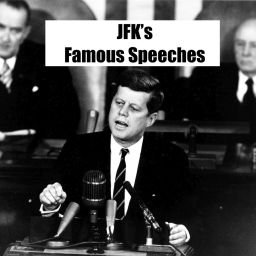
Podcast thumbnail for John Kennedy - Great Speeches - JFK

John Kennedy - Great Speeches - JFK

Claim This Podcast

by Inception Point AI

3.7(3 reviews)
12 episodes
Updated Inactive
Accepts GuestsHas SponsorsLocation 🇺🇸

Podcast Overview

John F. Kennedy was one of the most eloquent and inspiring presidents in American history. His speeches were known for their idealism, their optimism, and their call to action.In this podcast, we will listen to many of JFK's most famous speeches, including his inaugural address, his speech at Rice University on the nation's space effort, and his address to the American people during the Cuban Missile Crisis.After each speech, we will discuss its significance and its impact on American culture and history. We will also consider the relevance of JFK's message today.This podcast is for anyone who wants to learn more about John F. Kennedy, his presidency, or his speeches. It is also for anyone who is inspired by JFK's vision for a better America. This content was created in partnership and with the help of Artificial Intelligence AI.

Language

🇺🇲

Publishing Since

10/27/2023

2 verified contact emails on file for John Kennedy - Great Speeches - JFK

Pitch yourself as a guest, propose sponsorships, or reach out directly to the host.

Recent Episodes

Episode thumbnail for President John F. Kennedy JFK "Ich bin ein Berliner" Speech

February 29, 2024

President John F. Kennedy JFK "Ich bin ein Berliner" Speech

I am proud to come to this city as the guest of your distinguished Mayor, who has symbolized throughout the world the fighting spirit of West Berlin. And I am proud to visit the Federal Republic with your distinguished Chancellor who for so many years has committed Germany to democracy and freedom and progress, and to come here in the company of my fellow American, General Clay, who has been in this city during its great moments of crisis and will come again if ever needed.<br />Two thousand years ago the proudest boast was "civis Romanus sum." Today, in the world of freedom, the proudest boast is "Ich bin ein Berliner."<br />I appreciate my interpreter translating my German!<br />There are many people in the world who really don't understand, or say they don't, what is the great issue between the free world and the Communist world. Let them come to Berlin. There are some who say that communism is the wave of the future. Let them come to Berlin. And there are some who say in Europe and elsewhere we can work with the Communists. Let them come to Berlin. And there are even a few who say that it is true that communism is an evil system, but it permits us to make economic progress. Lass' sic nach Berlin kommen. Let them come to Berlin.<br />Freedom has many difficulties and democracy is not perfect, but we have never had to put a wall up to keep our people in, to prevent them from leaving us. I want to say, on behalf of my countrymen, who live many miles away on the other side of the Atlantic, who are far distant from you, that they take the greatest pride that they have been able to share with you, even from a distance, the story of the last 18 years. I know of no town, no city, that has been besieged for 18 years that still lives with the vitality and the force, and the hope and the determination of the city of West Berlin. While the wall is the most obvious and vivid demonstration of the failures of. the Communist system, for all the world to see, we take no satisfaction in it, for it is, as your Mayor has said, an offense not only against history but an offense against humanity, separating families, dividing husbands and wives and brothers and sisters, and dividing a people who wish to be joined together.<br />What is true of this city is true of Germany—real, lasting peace in Europe can never be assured as long as one German out of four is denied the elementary right of free men, and that is to make a free choice. In 18 years of peace and good faith, this generation of Germans has earned the right to be free, including the right to unite their families and their nation in lasting peace, with good will to all people. You live in a defended island of freedom, but your life is part of the main. So let me ask you, as I close, to lift your eyes beyond the dangers of today, to the hopes of tomorrow, beyond the freedom merely of this city of Berlin, or your country of Germany, to the advance of freedom everywhere, beyond the wall to the day of peace with justice, beyond yourselves and ourselves to all mankind.<br />Freedom is indivisible, and when one man is enslaved, all are not free. When all are free, then we can look forward to that day when this city will be joined as one and this country and this great Continent of Europe in a peaceful and hopeful globe. When that day finally comes, as it will, the people of West Berlin can take sober satisfaction in the fact that they were in the front lines for almost two decades.<br />All free men, wherever they may live, are citizens of Berlin, and, therefore, as a free man, I take pride in the words "Ich bin ein Berliner!"

Episode thumbnail for President John F. Kennedy JFK - The Goal of Sending a Man to the Moon 05-25-1961

February 29, 2024

President John F. Kennedy JFK - The Goal of Sending a Man to the Moon 05-25-1961

Mr. Speaker, Mr. Vice President, my copartners in Government, gentlemen and ladies:<br /><br />The Constitution imposes upon me the obligation to "from time to time give to the Congress information of the State of the Union." While this has traditionally been interpreted as an annual affair, this tradition has been broken in extraordinary times.<br /><br />These are extraordinary times. And we face an extraordinary challenge. Our strength as well as our convictions have imposed upon this nation the role of leader in freedom's cause.<br /><br />No role in history could be more difficult or more important. We stand for freedom. That is our conviction for ourselves—that is our only commitment to others. No friend, no neutral and no adversary should think otherwise. We are not against any man—or any nation—or any system—except as it is hostile to freedom. Nor am I here to present a new military doctrine, bearing any one name or aimed at any one area. I am here to promote the freedom doctrine.<br /><br />The great battleground for the defense and expansion of freedom today is the whole southern half of the globe—Asia, Latin America, Africa and the Middle East—the lands of the rising peoples. Their revolution is the greatest in human history. They seek an end to injustice, tyranny, and exploitation. More than an end, they seek a beginning.<br /><br />And theirs is a revolution which we would support regardless of the Cold War, and regardless of which political or economic route they should choose to freedom.<br /><br />For the adversaries of freedom did not create the revolution; nor did they create the conditions which compel it. But they are seeking to ride the crest of its wave—to capture it for themselves.<br /><br />Yet their aggression is more often concealed than open. They have fired no missiles; and their troops are seldom seen. They send arms, agitators, aid, technicians and propaganda to every troubled area. But where fighting is required, it is usually done by others—by guerrillas striking at night, by assassins striking alone—assassins who have taken the lives of four thousand civil officers in the last twelve months in Vietnam alone—by subversives and saboteurs and insurrectionists, who in some cases control whole areas inside of independent nations.1<br /><br />1 At this point the following paragraph, which appears in fine text as signed and transmitted to the Senate and House of Representatives, was omitted in the reading of the message:<br /><br />They possess a powerful intercontinental striking force, large forces for conventional war, a well-trained underground in nearly every country, the power to conscript talent and manpower for any purpose, the capacity for quick decisions, a closed society without dissent or free information, and long experience in the techniques of violence and subversion. They make the most of their scientific successes, their economic progress and their pose as a foe of colonialism and friend of popular revolution. They prey on unstable or unpopular governments, unsealed, or unknown boundaries, unfilled hopes, convulsive change, massive poverty, illiteracy, unrest and frustration.<br /><br />With these formidable weapons, the adversaries of freedom plan to consolidate their territory—to exploit, to control, and finally to destroy the hopes of the world's newest nations; and they have ambition to do it before the end of this decade. It is a contest of will and purpose as well as force and violence—a battle for minds and souls as well as lives and territory. And in that contest, we cannot stand aside.<br /><br />We stand, as we have always stood from our earliest beginnings, for the independence and equality of all nations. This nation was born of revolution and raised in freedom. And we do not intend to leave an open road for despotism.<br /><br />There is no single simple policy which meets this challenge. Experience has taught us that no one nation has the power or the wisdom to solve all the problems of the world or manage its revolutionary tides—that extending our commitments does not always increase our security—that any initiative carries with it the risk of a temporary defeat—that nuclear weapons cannot prevent subversion—that no free people can be kept free without will and energy of their own—and that no two nations or situations are exactly alike.<br /><br />Yet there is much we can do—and must do. The proposals I bring before you are numerous and varied. They arise from the host of special opportunities and dangers which have become increasingly clear in recent months. Taken together, I believe that they can mark another step forward in our effort as a people. I am here to ask the help of this Congress and the nation in approving these necessary measures.<br /><br />II. ECONOMIC AND SOCIAL PROGRESS AT HOME<br /><br />The first and basic task confronting this nation this year was to turn recession into recovery. An affirmative anti-recession program, initiated with your cooperation, supported the natural forces in the private sector; and our economy is now enjoying renewed confidence and energy. The recession has been halted. Recovery is under way.<br /><br />But the task of abating unemployment and achieving a full use of our resources does remain a serious challenge for us all. Large-scale unemployment during a recession is bad enough, but large-scale unemployment during a period of prosperity would be intolerable.<br /><br />I am therefore transmitting to the Congress a new Manpower Development and Training program, to train or retrain several hundred thousand workers, particularly in those areas where we have seen chronic unemployment as a result of technological factors in new occupational skills over a four-year period, in order to replace those skills made obsolete by automation and industrial change with the new skills which the new processes demand.<br /><br />It should be a satisfaction to us all that we have made great strides in restoring world confidence in the dollar, halting the outflow of gold and improving our balance of payments. During the last two months, our gold stocks actually increased by seventeen million dollars, compared to a loss of 635 million dollars during the last two months of 1960. We must maintain this progress—and this will require the cooperation and restraint of everyone. As recovery progresses, there will be temptations to seek unjustified price and wage increases. These we cannot afford. They will only handicap our efforts to compete abroad and to achieve full recovery here at home. Labor and management must—and I am confident that they will—pursue responsible wage and price policies in these critical times. I look to the President's Advisory Committee on Labor-Management Policy to give a strong lead in this direction.<br /><br />Moreover, if the budget deficit now increased by the needs of our security is to be held within manageable proportions, it will be necessary to hold tightly to prudent fiscal standards; and I request the cooperation of the Congress in this regard—to refrain from adding funds or programs, desirable as they may be, to the Budget—to end the postal deficit, as my predecessor also recommended, through increased rates—a deficit incidentally, this year, which exceeds the fiscal 1962 cost of all the space and defense measures that I am submitting today—to provide full pay-as-you-go highway financing—and to close those tax loopholes earlier specified. Our security and progress cannot be cheaply purchased; and their price must be found in what we all forego as well as what we all must pay.<br /><br />III. ECONOMIC AND SOCIAL PROGRESS ABROAD<br /><br />I stress the strength of our economy because it is essential to the strength of our nation. And what is true in our case is true in the case of other countries. Their strength in the struggle for freedom depends on the strength of their economic and their social progress.<br /><br />We would be badly mistaken to consider their problems in military terms alone. For no amount of arms and armies can help stabilize those governments which are unable or unwilling to achieve social and economic reform and development. Military pacts cannot help nations whose social injustice and economic chaos invite insurgency and penetration and subversion. The most skillful counter-guerrilla efforts cannot succeed where the local population is too caught up in its own misery to be concerned about the advance of communism.<br /><br />But for those who share this view, we stand ready now, as we have in the past, to provide generously of our skills, and our capital, and our food to assist the peoples of the less-developed nations to reach their goals in freedom—to help them before they are engulfed in crisis.<br /><br />This is also our great opportunity in 1961. If we grasp it, then subversion to prevent its success is exposed as an unjustifiable attempt to keep these nations from either being free or equal. But if we do not pursue it, and if they do not pursue it, the bankruptcy of unstable governments, one by one, and of unfilled hopes will surely lead to a series of totalitarian receiverships.<br /><br />Earlier in the year, I outlined to the Congress a new program for aiding emerging nations; and it is my intention to transmit shortly draft legislation to implement this program, to establish a new Act for International Development, and to add to the figures previously requested, in view of the swift pace of critical events, an additional 250 million dollars for a Presidential Contingency Fund, to be used only upon a Presidential determination in each case, with regular and complete reports to the Congress in each case, when there is a sudden and extraordinary drain upon our regular funds which we cannot foresee—

Episode thumbnail for President John F. Kennedy JFK Address in Miami at the Opening of the AFL-CIO Convention

February 29, 2024

President John F. Kennedy JFK Address in Miami at the Opening of the AFL-CIO Convention

Mr. Meany, Reverend Clergy, Governor Bryant, gentlemen, ladies:It's warmer here today than it was yesterday!I want to express my pleasure at this invitation. As one whose work and continuity of employment has depended in part upon the union movement, I want to say that I have been on the job, training for about 11 months, and feel that I have some seniority rights in the matter.I'm delighted to be here with you and with Secretary of Labor Arthur Goldberg. I was up in New York stressing physical fitness, and in line with that Arthur went over with a group to Switzerland to climb some of the mountains there. They all got up about 5 and he was in bed--got up to join them later--and when they all came back at 4 o'clock in the afternoon, he didn't come back with them. They sent out search parties and there was no sign of him that afternoon or night. Next day the Red Cross went out and they went around calling "Goldberg--Goldberg--it's the Red Cross." And this voice came down the mountain, "I gave at the office."Those are the liberties you can take with members of the Cabinet. But I want to say it's a pleasure to be here. This is an important anniversary for all of us, the 20th anniversary of Pearl Harbor.I suppose, really, the only two dates that most people remember where they were, were Pearl Harbor and the death of President Franklin Roosevelt. We face entirely different challenges on this Pearl Harbor. In many ways the challenges are more serious, and in a sense long-reaching, because I don't think that any of us had any doubt in those days that the United States would survive and prevail and our strength increase.Now we are face to face in a most critical time with challenges all around the world, and you in the labor movement bear a heavy responsibility. Occasionally I read articles by those who say that the labor movement has fallen into dark days. I don't believe that, and I would be very distressed if it were true.One of the great qualities about the United States which I don't think people realize who are not in the labor movement, is what a great asset for freedom the American labor movement represents, not only here but all around the world. It's no accident that Communists concentrate their attention on the trade union movement. They know that people--the working people-are frequently left out, that in many areas of the world they have no one to speak for them, and the Communists mislead them and say that they will protect their rights. So many go along.But in the United States, because we have had a strong, free labor movement, the working people of this country have not felt that they were left out. And as long as the labor movement is strong and as long as it is committed to freedom, then I think that freedom in this country is strengthened. So I would hope that every American, whether he was on one side of the bargaining table or the other or whether he was in a wholly different sphere of life, would recognize that the strength of a free American labor movement is vital to the maintenance of freedom in this country and all around the world.And I am delighted that there are here today, I understand, nearly 150 trade union leaders from nearly 32 countries around the world. I believe--and I say this as President-that one of the great assets that this country has is the influence which this labor movement can promote around the world in demonstrating what a free trade union can do.I hope that they will go back from this meeting recognizing that in the long run a strong labor movement is essential to the maintenance of democracy in their country. It's no accident that there has not been a strike in the Soviet Union for 30, or 35, or 40 years. The Communists who in Latin America, or Africa, or Asia say that they represent the people, cannot possibly--under any rule of reason or debate--say that a labor movement is free when it is not able to express its rights, not only in relationship to the employer but also to speak out and recognize the limitations of governmental power. We are not omniscient--we are not all-powerful--this is a free society, and management and labor, and the farmer and the citizen have their rights. We did not give them their rights in government. And I hope that those who go from this hall to Latin America, to Europe, to Africa, will recognize that we believe in freedom and in progress in this country, that we believe that freedom is not an end in itself, but we believe that freedom can bring material abundance and prosperity. And I want you to know that I consider this meeting and the house of labor vital to the interests of this country and the cause of freedom in the coming days.What unites labor, what unites this country, is far more important than those things on which we may disagree. So, gentlemen and ladies, you are not only leaders of your unions but you occupy a .position of responsibility as citizens of the United States; and therefore I felt it most appropriate to come here today and talk with you.First, I want to express my appreciation to you for several things. For example, I appreciate the effort that those of you who represent the interests of the men and women who work at our missile plants have made. The fact that you have given and that the men and women who work there have lived up to the no-strike pledge at our missile and space sites has made an appreciable difference in the progress that we are making in these areas--and the country appreciates the effort you are making.Secondly, we have for the first time a Presidential Advisory Committee on Labor-Management Policy which for once did not break up on the passage of the Wagner Act in 1935, but instead meets month by month in an attempt to work out and develop economic policies which will permit this country to go forward under conditions of full employment. And I want to thank you for the participation you have given that.Third, as I said, I want to thank the labor movement for what it is doing abroad in strengthening the free labor movement, and I urge you to redouble your efforts. The hope, as I have said, of freedom in these countries rests in many parts with the labor movement. We do not want to leave the people of some countries a choice between placing their destiny in the hands of a few who hold in their hands most of the property and on the other side the Communist movement. We do not give them that choice. We want them to have the instruments of freedom to protect themselves and provide for progress in their country, and a strong, free labor movement can do it--and I hope you will concentrate your attention in the next 12 months in that area--in Latin America and all around the world.The fact is that the head of the Congo-Adoula--who has been a strong figure for freedom, came out of the labor movement. And that's happening in country after country. And this is a great opportunity and responsibility for all of us to continue to work together.And finally, I want to take this opportunity to express my thanks to the AFLCIO for the support that it gave in the passage of our legislative program in the long session of the Congress. We did not always agree on every tactic. We may not have achieved every goal, but we can take some satisfaction in the fact that we did make progress toward a $1.25 minimum wage, that we did expand the coverage for the first time in 20 years; that we did pass the best housing act since 1949; that we did, finally, after two Presidential vetoes in the last 4 years, pass a bill providing assistance to those areas suffering from chronic unemployment; that we did pass a long-range water pollution bill; that we did pass increased Social Security benefits, a lowering of the retirement age in Social Security from 65 to 62 for men, temporary unemployment compensation, and aid to dependent children.And we are coming back in January and we are going to start again.The Gross National Product has climbed since January from $500 billion to an estimated $540 billion in the last quarter, and it's a pleasure for me to say that the November employment figures received this morning show not only two million more people than were working in February, but we have now an all-time high for November, 67,349,000 people working. But, more importantly, unlike the usual seasonal run in November, which ordinarily provides for an increase in unemployment of about a half a million, we have now brought the figure for the first time below the 7 percent where it's hovered down to 6.1 percent, and we're going to have to get it lower.I would not claim we've achieved full .recovery or the permanently high growth rate of which we are capable. Since the recession of '58, from which we only partially recovered, and going into the recession of 1960, too many men and women have been idle for too long a time and our first concern must still be with those unable to get work. Unemployment compensation must be placed on a permanent, rational basis of nationwide standards, and even more importantly those who are older and retired must be permitted under a system of Social Security to get assistance and relief from the staggering cost of their medical bills.The time has come in the next session of the Congress to face the fact that our eider citizens do need these benefits, that their needs cannot be adequately met in any other way, and that every Member of the Congress should have the opportunity to go on the record, up or down, on this question-and I believe when it comes to the floor--as I believe it must--they are going to vote it up and through before they adjourn in July or August.Now there are six areas that I believe that we need to give our attention to if the manpower budget is to be balanced. First, we must give special attention to the problems of our younger people. Dr. Conant's recent book only highlighted a fact which all of you are familiar with, and that is the problem of those who drop out of school before t

12 total episodes available

Deep-dive analytics for John Kennedy - Great Speeches - JFK

Frequently asked questions

Have a different question and can't find the answer you're looking for? Reach out to our support team by sending us an email and we'll get back to you as soon as we can.

What is John Kennedy - Great Speeches - JFK?

John F. Kennedy was one of the most eloquent and inspiring presidents in American history. His speeches were known for their idealism, their optimism, and their call to action.In this podcast, we will listen to many of JFK's most famous speeches, including his inaugural address, his speech at Rice University on the nation's space effort, and his address to the American people during the Cuban Missile Crisis.After each speech, we will discuss its significance and its impact on American culture and history. We will also consider the relevance of JFK's message today.This podcast is for anyone who wants to learn more about John F. Kennedy, his presidency, or his speeches. It is also for anyone who is inspired by JFK's vision for a better America.

This content was created in partnership and with the help of Artificial Intelligence AI.

How often does this podcast release new episodes?

This podcast updates inactive.

Where can I listen to this podcast?

This podcast is available on 8 platforms including Apple Podcasts, Spotify, and more. You can also use the RSS feed directly.

Does this podcast accept guests?

Yes, this podcast regularly features guests.

Legal Disclaimer

Pod Engine is not affiliated with, endorsed by, or officially connected with any of the podcasts displayed on this platform. We operate independently as a podcast discovery and analytics service.

All podcast artwork, thumbnails, and content displayed on this page are the property of their respective owners and are protected by applicable copyright laws. This includes, but is not limited to, podcast cover art, episode artwork, show descriptions, episode titles, transcripts, audio snippets, and any other content originating from the podcast creators or their licensors.

We display this content under fair use principles and/or implied license for the purpose of podcast discovery, information, and commentary. We make no claim of ownership over any podcast content, artwork, or related materials shown on this platform. All trademarks, service marks, and trade names are the property of their respective owners.

While we strive to ensure all content usage is properly authorized, if you are a rights holder and believe your content is being used inappropriately or without proper authorization, please contact us immediately at hey@podengine.ai for prompt review and appropriate action, which may include content removal or proper attribution.

By accessing and using this platform, you acknowledge and agree to respect all applicable copyright laws and intellectual property rights of content owners. Any unauthorized reproduction, distribution, or commercial use of the content displayed on this platform is strictly prohibited.