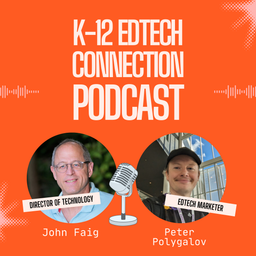
K12 EdTech Connection is a candid, no-fluff podcast about how K-12 schools and EdTech companies can work better together.
Hosted by Peter Polygalov, CEO & Founder of EdWave Marketing, and John Faig, Director of Technology at St. Patrick’s Episcopal Day School, each episode brings both sides of the table together: the vendor trying to reach schools, and the K-12 administrator deciding what to buy, pilot, or ignore.
If you care about building EdTech that truly serves teachers and students and about buying it wisely, you’re in the right place.
How a Silicon Valley Microschool Actually Buys EdTech (with Joseph Dalton-Stark, Leadways)
Most vendors pitching Leadways imagine they're pitching a district. They're not. Joseph Dalton-Stark is the founding principal of a microschool in Cupertino, CA, with roughly thirty students and families who work at Google and Apple down the road. The site licenses, the five-year rollouts, the "we work with 400 districts" pitches: none of it fits, and most reps don't bother to find out before they send.
This episode walks through how Joseph actually buys. He'll engage on LinkedIn if you sound like a human. He'll ignore a cold email unless it accidentally strikes gold. He doesn't pilot. He watches a short demo, makes the call, and moves on. He's allergic to the five-year vision pitch because his school is in year two and needs traction now. Most of his current vendors came through dinner-table referrals, not outbound. And when reps lean on scale to impress him, he tunes out: he doesn't care how many districts you serve, he cares whether someone answers the phone when something breaks.
For vendors, the lesson is sharper than usual: K-8 isn't a buyer profile, and the size of the school changes everything about how the pitch needs to sound.
27 May 2026
Why One-and-Done EdTech Dies in the Classroom (with David Platt, CUSD)
Most vendors approach Compton Unified assuming three things: that the money is there, that David Platt controls it, and that he's already interested. Usually none of the three is true. As EdTech Coordinator at the Southern California district, Platt sits between Ed Services, IT, CTE, and curriculum, and he's the one deciding whether a STEAM tool earns a place in classrooms or quietly dies on a shelf.
This episode digs into what that decision actually hinges on. Platt makes the case against "one and done" products: the windmill kit that gets built once and forgotten. The tools he keeps are the ones students can build, modify, and rebuild into something new, the ones that interface with Lego, Arduinos, and micro:bits, and that keep getting upgraded. He also gets candid about the vendor video that showed a student population that doesn't match his own, and the AI-written emails with the instructions still pasted in.
For vendors, the lesson is blunt: a Title I label tells you nothing about a district's budget, and a demo tells you nothing about whether a product will last.
9 Apr 2026
Two Buyers, Two Systems: Public vs. Private Tech Purchasing (with Chris Bell, HBCSD)
Chris Bell runs technology for Huntington Beach City School District, a K-8 public district with about 4,700 students. John runs tech at a K-8 private school in DC. Same grade levels, completely different procurement realities.
We put them side by side to show vendors what actually changes when you're selling into public vs. private. Budget cycles, approval chains, decision speed, and who holds the checkbook — almost none of it transfers cleanly. Chris needs cabinet approval and board consent. John can buy overnight from an innovations fund.
Where they align is what matters most: both dislike cold outreach and pressure tactics, both talk to other tech directors behind the scenes, and both want vendors who lead with the problem, not the product. Chris shares a story about an AI startup that never pitched — just asked for feedback — and earned his trust. John wants self-serve content so he can evaluate on his own terms before ever scheduling a demo.
24 Mar 2026
How FEV Tutor Went from Free Pilots to $50M in ARR (with Ryan Patenaude)
Our first guest episode. Ryan Patenaude co-founded FEV Tutor, built it from zero to $50 million in revenue with no outside funding, and scaled to 5,000 employees before the company was acquired in 2022. He now runs RP Impact Partners, helping mission-aligned EdTech companies accelerate growth.
Ryan tells the story of an early Zoom call with the CEO of a 200,000-student district where he led with a 15-slide feature deck and learned the hard way: in K-12, you sell results, not features.
We dig into why free pilots train districts to invest nothing, and how FEV's ICP evolved from "anyone who would buy" to a disciplined filter on district size, Title I status, and decision-making speed. Ryan walks through a pricing journey that took 15 years, from pay-as-you-go tutoring hours to a subscription model that finally cleaned up their books. He also reframes the "we don't have budget" objection: a former chancellor of NYC schools told him that if a superintendent sees value, they can find any money they want.
6 Mar 2026
When Your K12 Prospect Goes Dark
You had a great demo. They said they'd follow up. Then... nothing.
We open with two ghost stories. John's: a CEO who demoed three times over 18 months and never sent a quote. Peter's: an executive who over-communicated so aggressively that he drove an internal champion to ghosting and lost a six-figure renewal.
Then we dig into the real reasons buyers disappear: shifting priorities, budget reallocations, comparing vendors, or just the awkwardness of saying no to someone who spent an hour demoing.
What makes John hit delete? "Just checking in" emails and guilt trips. What makes him respond? Useful content, acknowledgment that timing might be off, and the "permission to close the file" email—Peter's favorite tactic that removes pressure and often triggers a reply.
The uncomfortable truth: K-12 sales cycles run 6-18 months. Silence after one demo usually means "not yet," not "never." The question is whether you'll still be top of mind when the timing is right.
24 Feb 2026
Creating Touchpoints with K-12 Buying Committees
Most EdTech vendors either blast the same generic message to everyone, talk to only one person, or try to leapfrog the tech director straight to the superintendent. All three approaches fail.
K-12 purchases aren't made by a single buyer—they're made by informal coalitions. Curriculum directors, tech directors, teacher champions, principals, and sometimes counselors all have to align before anything moves forward. And here's the uncomfortable truth: "Every vendor feels like a stalker," says John, "unless their brand building has piqued my interest to the point where I reach out to them."
We break down which channels actually reach which personas, why your touchpoint strategy might look like an incomplete charcuterie board (all cheese, no meat), and the expensive mistakes we keep seeing—like the higher ed vendor who sponsored an after-hours event at a K-12 conference. Great for free drinks. Terrible for pipeline.
We also cover what signals you should actually be capturing, why awards don't mean much in 2026, and why John hasn't had a single salesperson reach out after changing companies in 15 years.
17 Feb 2026
Make Your Website an Inbound Lead Generation Machine (Part 2)
Episode 3, Part 2: Make Your Website an Inbound Lead Generation Machine
Traditional SEO still matters, but it's declining. In 2026, your content needs to answer questions, not just rank for keywords. Welcome to AEO—Answer Engine Optimization.
In Part 2, we get into what actually makes buyers give up their email (hint: not "The Future of K-12 Education in 2026"). John shares that out of ~100 cold email CTAs he received, exactly 2 worked. The difference? Tangible value—ROI calculators, implementation templates, standards alignment guides—not generic ebooks full of stock images.
We also cover why your website needs to serve the whole buying committee (not just your ICP), why asking the same form questions twice is "data collection so rudimentary it's rude," and the uncomfortable truth that this takes 6-18 months to pay off. But when it does, it compounds—Peter shares how one site hit 70-80 qualified inbound leads per month, driving 40-50% of ARR.
Plus: a lightning round of do's and don'ts to audit your site this week.
Related: John's breakdown of good vs. bad EdTech CTAs: https://johnfaig.medium.com/outbound-edtech-marketing-c1cc194c8eec (https://johnfaig.medium.com/outbound-edtech-marketing-c1cc194c8eec)
16 Feb 2026
Make Your Website an Inbound Lead Generation Machine (Part 1)
Episode 3, Part 1: Make Your Website an Inbound Lead Generation Machine
Most EdTech websites are expensive digital brochures. They look great, list features, and generate zero qualified leads.
In Part 1, we dig into why: the "curse of knowledge" that makes vendors speak jargon instead of solving problems, and the vanity metrics trap that confuses traffic with actual buyers. Your curriculum director doesn't care about "adaptive scaffolding and standards-aligned computational thinking frameworks." She wants to know if this helps her struggling sixth graders.
We also break down what qualified traffic actually looks like—and why 9,000 of your 10,000 monthly visitors might just be students trying to log in.
Part 2 covers SEO in the age of AI, lead magnets that work in K-12, and conversion optimization.
Related: John's breakdown of good vs. bad EdTech CTAs: Outbound EdTech Marketing (https://johnfaig.medium.com/outbound-edtech-marketing-c1cc194c8eec)
12 Jan 2026
EdTech Go-To-Market Planning for 2026
It’s a new year—and for K–12 EdTech teams, 2026 is not the year to “do more.” It’s the year to get sharper.
In this episode of K–12 EdTech Connection, Peter Polygalov (EdWave Marketing) and John Faig (K–12 tech director) build a practical planning framework for founders and lean teams who want clarity, traction, and repeatable momentum—without wasting months on channels that don’t convert.
You’ll learn how to set the right success metrics based on your stage, pressure-test your ICP before you spend a dollar, and run a simple two-week learning loop that forces real progress.
What we cover
What outcome you actually need this semester (and how it changes for early vs late-stage teams)
The 6-question ICP + GTM risk checklist (clarity, pain, reachability, readiness, anti-ICP, messaging)
Why brand building has no clean ROI—and why you still need to do it anyway
John’s blunt take on outbound: “Cold email is dead.” What does work instead
Events in 2026: why conferences are a confirmation channel, not a prospecting channel
Why LinkedIn is the best “vendor + educator in the same room” platform
Sponsorships and small community groups: how to be a big fish in a small pond
The two-week learning loop: the fastest way to stop “busy work” and start compounding wins
Experiments to run in 2026, including pricing tests (and the “double the price until it breaks” story)
Plus a lightning recap: 5 Do’s + 5 Don’ts for 2026
If this episode helped, share it with a founder or marketer who’s trying to sell into K–12 this year—and follow the show so you don’t miss what’s next.
11 Dec 2025
How to Leverage K–12 EdTech Conferences as a Vendor
Are K–12 EdTech conferences actually worth it for vendors—or just an expensive field trip? In this episode, we break down how to show up at conferences so buyers actually want to talk to you.
EdTech marketer Peter Polygalov and school tech director John Faig share real stories and hard-won lessons from both sides of the booth. They unpack why conferences still matter in 2025, why the real ROI comes from prep and follow-up, and how to think about conferences as brand-building and qualification, not quick closes.
You’ll learn how to:
Decide which K–12 EdTech conferences to attend (and which to skip)
Use conferences to deepen warm relationships instead of chasing cold traffic
Ask simple, BANT-style questions to qualify leads quickly
Spot the difference between buyer-heavy and PD-heavy events
Measure success beyond badge scans and swag grabs
🎧 Listen if you’re:
An EdTech founder, marketer, or seller betting big on conferences this year
A K–12 leader who wants vendors to use your time more wisely
👉 If this episode helps you rethink your conference strategy, follow K12 EdTech Connection on your favorite podcast platform and share it with someone on the other side of the booth.
Contact K12 EdTech Connection
Guest appearances
Books guests
Based on episode analysis; this does not confirm that the show is currently accepting guests.
Host of K12 EdTech Connection?
Claim your podcast to manage its listing and keep your show details accurate.
Pod Engine is an independent podcast discovery and analytics service and is not affiliated with or endorsed by this podcast. Artwork and show content belong to their owners. Full legal notice.
Explore this show Podcast research with Pod Engine