
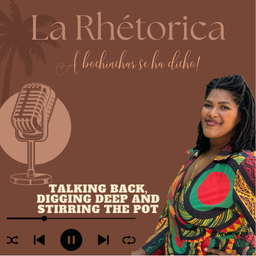
La Rhetorica Podcast
Claim This Podcastby Amanda Patterson Partin, PHD
Podcast Overview
<p>Rooted in an AfroLatina perspective, this podcast centers the voices, experiences, and brilliance of women of color in rhetoric and composition. Hosted by Amanda Patterson Partin, La Rhetórica invites listeners to explore the deep intersections of identity, power, language, and pedagogy.</p><p>Each episode opens space for nuanced dialogue, unapologetic storytelling, and scholarly reflection. Together, we examine how race, gender, and culture shape our presence in academic and professional spaces, and we ask the questions that often go unspoken: What counts as knowledge? Who gets to be called a rhetor? How do we show up fully, without shrinking or code-switching away the truth?</p><p>La Rhetórica is more than a podcast. It is a space to learn, unlearn, remember, and imagine. Pull up a chair. Bring your whole self. Let’s get into it. ¡A bochinchar se ha dicho!</p>
Language
🇺🇲
Publishing Since
10/18/2025
Reach the team behind La Rhetorica Podcast
Verified contact details for this show aren't on file yet — sign up to get notified when they land.
Recent Episodes
February 26, 2026
Episode 5: When Silence is Riskier than Speaking Up, A Conversation with Dr. Prerna Subramanian
<p>When institutions fail, who protects the people inside them? What if silence is more dangerous than speaking up?</p><p><strong>Guest: </strong>Dr. Prerna Subramanian, Assistant Professor and Interdisciplinary Researcher </p><p><strong>Host:</strong> Dr. Amanda Patterson Partin</p><p><strong>Episode Summary</strong></p><p>In this episode of La Rhetorica, Dr. Prerna Subramanian joins the podcast to discuss academic labor, institutional failure, and the emotional realities of teaching, writing, and mentoring in privatized higher education. Drawing from her experiences in Indian and transnational academic spaces, she reflects on how community becomes essential when institutions fail, how dissent is navigated under constraint, and why vulnerability functions as a rhetorical and pedagogical strategy.</p><p>The episode also explores academic writing as a site of fear, particularly for women and racialized scholars, and how editing, collaboration, and feminist mentorship can help writers reclaim authority and voice.</p><p><strong>Institutional Context and Infrastructure</strong></p><p>Dr. Subramanian discusses a recent infrastructure collapse at her university in India and situates it within broader tensions between privatized education, global branding, and material neglect. She reflects on how sudden shutdowns echo COVID-era disruptions and how faculty and students relied on the community to adapt and support one another.</p><p><strong>Speaking to Power and Choosing the Platform</strong></p><p>A central focus of the episode is how Dr. Subramanian navigates speaking out amid surveillance, hierarchy, and risk. She explains her strategic use of LinkedIn as a rhetorical space shaped by audience, visibility, and professional norms, and reflects on how privilege, positioning, and vulnerability shape public intellectual work.</p><p><strong>Writing, Editing, and Gendered Hesitation</strong></p><p>Dr. Subramanian shares insights from her work as a freelance editor, particularly patterns she has observed in dissertations written by women across racial and national contexts. She discusses how academic training often produces hedging and delayed arguments, and how editing can act as a feminist intervention by restoring clarity, confidence, and authorial presence.</p><p><strong>Mentorship, Neurodivergence, and Collaborative Writing</strong></p><p>The episode explores mentorship as relational rather than transactional. Dr. Subramanian describes her neurodivergent approach to teaching and editing, including rethinking participation, feedback, and access. She advocates for collaborative writing as a way to distribute fear, challenge individualistic norms in the humanities, and make intellectual labor more humane. The conversation also addresses rejection sensitivity dysphoria and practical systems for managing feedback.</p><p><strong>What She’s Reading</strong></p><p><a target="_new" rel="noopener" class="decorated-link" href="https://www.amazon.com/Disorientation-Novel-Elaine-Hsieh-Chou/dp/0593298357">Disorientation by Elaine Hsieh Chou</a> is a satirical novel exploring race, power, and academia through the story of a PhD student.</p><p><a target="_new" rel="noopener" class="decorated-link" href="https://a.co/d/03sNFWB3">Yellowface by R.F. Kuang</a>, a critique of publishing, cultural appropriation, and racialized credibility.</p><p><strong>What She’s Watching</strong></p><p>Love Is Blind as a lens into contemporary dating culture.</p><p>Better Late Than Single, a Korean reality series offering a slower, culturally distinct approach to intimacy and transformation.</p><p><strong>How to Connect</strong></p><p>You can find Dr. Prerna Subramanian on LinkedIn, where she writes about academic labor, editing, feminism, and institutional power.</p>
December 16, 2025
Episode 4: The Big Rhetorical Podcast Carnival: (un)tethering Surveillance: Power Dynamics, Emerging Technologies, Social Control with Dr. Codi Renee Blackmon
<p>In this special Big Rhetorical Podcast Carnival episode, Dr. Amanda Patterson Partin is joined by scholar and educator Dr. Codi Renee Blackmon (Johns Hopkins University) for a rich, honest conversation about generative AI, linguistic justice, and what writing instruction looks like in a moment of technological whiplash.</p><p>Together, they explore how AI intersects with students’ rights to their own language, the tension between standard academic English and rhetorical context, and the real consequences of surveillance, automation, and bias in writing classrooms. From the AI refusal movement to classroom praxis, from joy in writing to abstinence-education metaphors that absolutely make sense, this episode sits squarely in the messy middle. No panic. No hype. Just critical care.</p><p>This episode is part of the <strong>Big Rhetorical Podcast Carnival</strong>, hosted by Dr. Charles Woods, centered on the theme (Un)tethering Surveillance: Power Dynamics, Emerging Technologies, and Social Control</p><p><strong>What We Cover</strong></p><ul><li>Why AI is not neutral and never has been</li><li>The AI refusal movement and what refusal actually means</li><li>Linguistic justice and students’ right to their own language</li><li>How AI reinforces whiteness and standard American English</li><li>The loss of student voice and the rise of AI’s very recognizable tone</li><li>Surveillance, plagiarism panic, and why policing students is not the move</li><li>Teaching AI as both a tool and an object of inquiry</li><li>Authentic voice, rhetorical context, and audience awareness</li><li>Making writing joyful again in a world obsessed with efficiency</li><li>Why critical AI literacy matters more than blanket rules</li></ul><p>Key Takeaways</p><ul><li>AI is already embedded in academic and professional spaces, whether we like it or not</li><li>Linguistic justice and AI literacy must be taught together, not in isolation</li><li>Students deserve informed choice, including the choice to refuse AI</li><li>Context, audience, and purpose still matter more than “right vs wrong” grammar</li><li>Writing pedagogy grounded in care beats surveillance every time</li></ul><p><strong>Reading/Listening List: </strong></p><ul><li>Refusing Generative AI Movement (<a target="_blank" rel="noopener noreferrer nofollow" href="https://refusinggenai.wordpress.com/">https://refusinggenai.wordpress.com/</a>) </li><li>April Baker-Bell, Linguistic Justice</li><li>4Cs Statement on Anti-Black Racism and Black Linguistic Justice "<strong>This Ain’t Another Statement! This is a DEMAND for Black Linguistic Justice!" </strong></li><li>Text Gen Ed: Continuing Experiments by Carli Schnitzer, Annette Vee, and Tim LaQuintano</li><li>Big Rhetorical Podcast, Episode 140</li></ul><p><strong>About the Guest</strong></p><p><strong>Dr. Codi Renee Blackmon</strong> is a scholar and educator at Johns Hopkins University whose work focuses on writing studies, linguistic justice, surveillance, and critical AI literacy. She brings a deeply thoughtful, care-centered approach to teaching writing in technological contexts.</p><p><strong>About the Host</strong></p><p><strong>Dr. Amanda Patterson Partin</strong> is the host of La Rhetorica, a podcast exploring rhetoric, writing, culture, and power through conversations with scholars, educators, and thinkers who are doing the work.</p><p><strong>Listen to the Carnival!</strong></p><p>The Big Rhetorical Podcast Carnival runs from November 30 through December 4 and concludes with a keynote interview released on December 4. Catch all episodes wherever you listen to podcasts.</p>
December 4, 2025
Episode 3: Dr. Aja Martinez- Faith, Power and Counterstory
<p>In this episode, I sit down with Dr. Aja Martínez, associate professor, award-winning author, and one of the sharpest thinkers in Critical Race Theory today. We get into the deep stuff right away: the religious roots of the attacks on CRT, the long game of the New Right, and how history repeats itself when we’re not paying attention.</p><p>Dr. Martínez walks us through her and Dr. Robert Smith’s research on Derrick Bell, revealing how religion and prophetic witness sit at the very heart of early CRT work. We talk about the decades-long strategy behind Project 2025, the role of conservative think tanks, and why “how did we get here?” is the wrong question. People have been warning us. We just weren’t listening.</p><p>We also explore the personal side of this work: the risks, the canceled events, the mental load, and the joy she finds in reality TV, gardening, and her pets. Plus, she shares what it’s like writing books with her partner, how she sustains herself, and what gives her hope even in this political moment.</p><p>If you’ve wondered how faith, race, politics, and power collide in today’s culture wars, this is your episode. And if you’re new to CRT beyond the headlines, Dr. Martínez gives you the perfect reading list to start with.</p>
5 total episodes available
Deep-dive analytics for La Rhetorica Podcast
Frequently asked questions
Have a different question and can't find the answer you're looking for? Reach out to our support team by sending us an email and we'll get back to you as soon as we can.
- What is La Rhetorica Podcast?
<p>Rooted in an AfroLatina perspective, this podcast centers the voices, experiences, and brilliance of women of color in rhetoric and composition. Hosted by Amanda Patterson Partin, La Rhetórica invites listeners to explore the deep intersections of identity, power, language, and pedagogy.</p><p>Each episode opens space for nuanced dialogue, unapologetic storytelling, and scholarly reflection. Together, we examine how race, gender, and culture shape our presence in academic and professional spaces, and we ask the questions that often go unspoken: What counts as knowledge? Who gets to be called a rhetor? How do we show up fully, without shrinking or code-switching away the truth?</p><p>La Rhetórica is more than a podcast. It is a space to learn, unlearn, remember, and imagine. Pull up a chair. Bring your whole self. Let’s get into it. ¡A bochinchar se ha dicho!</p> - How often does this podcast release new episodes?
This podcast updates daily.
- Where can I listen to this podcast?
This podcast is available on 4 platforms including Apple Podcasts, Spotify, and more. You can also use the RSS feed directly.
- Does this podcast accept guests?
Yes, this podcast regularly features guests.
Legal Disclaimer
Pod Engine is not affiliated with, endorsed by, or officially connected with any of the podcasts displayed on this platform. We operate independently as a podcast discovery and analytics service.
All podcast artwork, thumbnails, and content displayed on this page are the property of their respective owners and are protected by applicable copyright laws. This includes, but is not limited to, podcast cover art, episode artwork, show descriptions, episode titles, transcripts, audio snippets, and any other content originating from the podcast creators or their licensors.
We display this content under fair use principles and/or implied license for the purpose of podcast discovery, information, and commentary. We make no claim of ownership over any podcast content, artwork, or related materials shown on this platform. All trademarks, service marks, and trade names are the property of their respective owners.
While we strive to ensure all content usage is properly authorized, if you are a rights holder and believe your content is being used inappropriately or without proper authorization, please contact us immediately at hey@podengine.ai for prompt review and appropriate action, which may include content removal or proper attribution.
By accessing and using this platform, you acknowledge and agree to respect all applicable copyright laws and intellectual property rights of content owners. Any unauthorized reproduction, distribution, or commercial use of the content displayed on this platform is strictly prohibited.