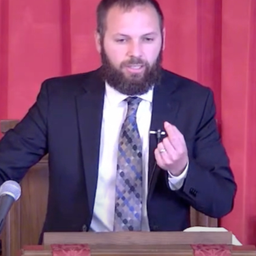
Podcast thumbnail for Love of Truth

Love of Truth

Claim This Podcast

by Michael Grasso

20 episodes
Updated Daily
Accepts GuestsHas Sponsors

Podcast Overview

Love of Truth is dedicated to biblical theology, careful exegesis, and thoughtful engagement with the most pressing theological, cultural, and ecclesiastical questions of our time. This podcast is rooted in historic, confessional Christianity and seeks to: Exposit Scripture with seriousness and depth Defend the coherence and unity of the Bible, especially the Old Testament’s witness to Christ Address doctrinal error, cultural confusion, and rival truth claims with charity and precision Equip Christians to love God with both heart and mind

Language

🇺🇲

Publishing Since

12/23/2025

1 verified contact email on file for Love of Truth

Pitch yourself as a guest, propose sponsorships, or reach out directly to the host.

Recent Episodes

Episode thumbnail for Is Isaiah 53 About Jesus? Responding to Rabbi Tovia Singer

February 18, 2026

Is Isaiah 53 About Jesus? Responding to Rabbi Tovia Singer

<p>Does Isaiah 53 describe Israel—or does it describe the Messiah who suffers for Israel? In this video, I respond directly to claims made by Tovia Singer, focusing especially on a key concession that ultimately undermines his own interpretation.Singer openly acknowledges that the Messiah is the servant in Isaiah 52:13–15. That admission is crucial. He argues that the nations (“the goiim”) were mistaken in thinking the Messiah would be lowly, since he is in fact exalted. But this is not what the text actually says. Isaiah deliberately juxtaposes exaltation and humiliation. The astonishment of the nations is not that the Messiah is lowly instead of exalted, but that the one who is high and lifted up would willingly become lowly and suffer.This matters because Singer’s own admission—that the servant in Isaiah 52:13 is the Messiah—creates a continuity problem for his reading of Isaiah 53. The passage does not signal a change in the identity of the servant. In fact, Isaiah 52:13–15 and 53:1–12 describe the servant in strikingly parallel terms: righteous, exalted, rejected, afflicted, and ultimately vindicated. If the servant in the first section is the Messiah, then the servant in the second must be as well.Singer’s attempt to identify the servant in Isaiah 53 as corporate Israel therefore collapses under the weight of the text itself. It requires not only an unmarked shift in speakers at Isaiah 53:1, but also an unmarked shift in the identity of the servant—despite the literary and theological continuity of the passage.The broader context of Isaiah confirms this reading. While Israel is sometimes called God’s servant, the book repeatedly distinguishes between sinful Israel and a righteous servant who saves Israel. In Isaiah 42, the servant who opens blind eyes is explicitly contrasted with Israel, who is described as blind. In Isaiah 49, the servant is called “Israel” and yet is raised up to restore Israel and bring salvation to the nations. This is corporate solidarity: a single representative bears the name of the people and accomplishes their redemption.Isaiah 53 stands at the climax of this pattern. The servant is righteous, suffers vicariously, bears the sins of his people, dies an atoning death, and yet has his days prolonged—language that unmistakably points to death followed by resurrection and continuing intercession.This is not later Christian invention. It is Isaiah’s own message. And it is fulfilled in Jesus Christ, the righteous servant who suffered for sinners and now lives to intercede for them.#Isaiah53 #SufferingServant #Messiah #ChristInTheOldTestament #BiblicalTheology #Apologetics #HebrewBible #JesusChrist</p>

Episode thumbnail for Is Deuteronomy 18 about Christ? Responding to Rabbi Tovia Singer

February 14, 2026

Is Deuteronomy 18 about Christ? Responding to Rabbi Tovia Singer

<p>Does Deuteronomy 18 really exclude Jesus as the Prophet like Moses? In this video, I respond to arguments made by Tovia Singer, who maintains that Joshua is the complete fulfillment of Moses’ prophecy and that no future messianic expectation remains.I begin with an important concession: Joshua is indeed a genuine fulfillment of Deuteronomy 18. Singer is right to highlight the strong textual connections between Joshua and Moses, and the Hebrew Bible itself explicitly presents Joshua as “like Moses” in significant ways. Where the argument breaks down, however, is in treating Joshua as the final fulfillment even from the perspective of the Hebrew Bible itself.The same text that affirms Joshua’s likeness to Moses also explicitly denies that he is the ultimate Prophet like Moses. Deuteronomy 34:10–12—written after Joshua’s death—declares that no prophet had yet arisen like Moses, one who knew the LORD face to face, performed unparalleled signs and wonders, and accomplished a definitive salvation. These criteria go far beyond leadership succession or Spirit-anointing, and by them Joshua clearly falls short.The Hebrew Bible itself confirms this by presenting later figures who also take up the “Moses pattern.” Elijah’s ministry intentionally mirrors Moses: wilderness provision, confrontation with false gods, theophany at Sinai, miraculous signs, and even the parting of waters. His successor Elisha intensifies this pattern further, performing greater signs and proclaiming a ministry marked not only by judgment but by grace and restoration. Yet even these prophet-like-Moses figures fail to bring lasting redemption—the kingdoms still fall, exile still comes, and Israel still waits.That expectation comes into sharp focus at the close of the Hebrew canon. Malachi promises a future Elijah who will come before the day of the LORD. If Elijah himself is a new Moses, then his future role as forerunner points forward to the final and ultimate Prophet like Moses—the Messiah.That Messiah is Jesus Christ. He alone knows God face to face, performs signs and wonders surpassing those of Moses and Elisha, accomplishes a true and final exodus from sin and death, and brings his people into the everlasting Promised Land of rest and peace—something neither Moses nor Joshua could ultimately do.Deuteronomy 18 does not undermine the Christian claim about Jesus. Read in its full biblical context, it demands him.#Deuteronomy18 #ProphetLikeMoses #JesusChrist #Messiah #BiblicalTheology #ChristInTheOldTestament #Apologetics #HebrewBible</p>

Episode thumbnail for Is Isaiah 53 about Israel?... Or the Messiah? Response to Dan McClellan

February 11, 2026

Is Isaiah 53 about Israel?... Or the Messiah? Response to Dan McClellan

<p>Does Isaiah 53 describe corporate Israel—or does it prophesy a suffering, atoning Messiah? In this video, I respond directly to claims made by Dan McClellan, particularly the assertion that the Christian reading of Isaiah 53 arose only after Jesus’ death and resurrection.I begin by identifying a central problem with this approach: it relies almost entirely on speculation. We are told that the disciples probably expected political deliverance, probably did not anticipate a dying and rising Messiah, and probably reinterpreted Isaiah 53 only once their hopes were dashed. Yet no evidence is offered for this reconstruction, nor is there any engagement with the strong messianic expectations already present in the Hebrew Bible prior to AD 40.From there, I turn to the main interpretive claim—that Isaiah 53 must refer to corporate Israel. While it is true that Isaiah 40–55 frequently speaks of Israel as God’s servant, it is demonstrably false that every reference to the servant in this section refers to the nation. In Isaiah 42, the servant who opens blind eyes is explicitly contrasted with Israel, who is described as blind. The singular servant saves the corporate servant.The same pattern appears in Isaiah 49, where the servant is called “Israel” and yet is raised up to restore Israel and bring salvation to the nations. This is corporate solidarity: a single representative bears the name of the people and accomplishes their redemption. The servant is distinguished from the nation precisely because he stands for them.Isaiah 53 continues this same trajectory. The servant is righteous, suffers vicariously, and brings justification to others—descriptions that do not fit the nation but do fit an individual savior. This reading coheres not only with Isaiah’s immediate context but with the broader biblical pattern of a suffering Messiah: from Genesis 3:15, to Joseph, to Moses, to David, to the persecuted prophets of Israel.Isaiah 53 does not invent a new idea. It brings this long-developing pattern to its theological climax by teaching that the Messiah’s suffering is substitutionary and atoning—fulfilled definitively in the death of Jesus Christ.#Isaiah53 #SufferingServant #Messiah #BiblicalTheology #ChristInTheOldTestament #Apologetics #HebrewBible #JesusChrist</p>

20 total episodes available

Deep-dive analytics for Love of Truth

Frequently asked questions

Have a different question and can't find the answer you're looking for? Reach out to our support team by sending us an email and we'll get back to you as soon as we can.

What is Love of Truth?

Love of Truth is dedicated to biblical theology, careful exegesis, and thoughtful engagement with the most pressing theological, cultural, and ecclesiastical questions of our time.

This podcast is rooted in historic, confessional Christianity and seeks to: Exposit Scripture with seriousness and depth Defend the coherence and unity of the Bible, especially the Old Testament’s witness to Christ Address doctrinal error, cultural confusion, and rival truth claims with charity and precision Equip Christians to love God with both heart and mind

How often does this podcast release new episodes?

This podcast updates daily.

Where can I listen to this podcast?

This podcast is available on 4 platforms including Apple Podcasts, Spotify, and more. You can also use the RSS feed directly.

Does this podcast accept guests?

No, this podcast does not typically feature guests.

Legal Disclaimer

Pod Engine is not affiliated with, endorsed by, or officially connected with any of the podcasts displayed on this platform. We operate independently as a podcast discovery and analytics service.

All podcast artwork, thumbnails, and content displayed on this page are the property of their respective owners and are protected by applicable copyright laws. This includes, but is not limited to, podcast cover art, episode artwork, show descriptions, episode titles, transcripts, audio snippets, and any other content originating from the podcast creators or their licensors.

We display this content under fair use principles and/or implied license for the purpose of podcast discovery, information, and commentary. We make no claim of ownership over any podcast content, artwork, or related materials shown on this platform. All trademarks, service marks, and trade names are the property of their respective owners.

While we strive to ensure all content usage is properly authorized, if you are a rights holder and believe your content is being used inappropriately or without proper authorization, please contact us immediately at hey@podengine.ai for prompt review and appropriate action, which may include content removal or proper attribution.

By accessing and using this platform, you acknowledge and agree to respect all applicable copyright laws and intellectual property rights of content owners. Any unauthorized reproduction, distribution, or commercial use of the content displayed on this platform is strictly prohibited.