
In this new perfectly produced AI choreographed world, two lowkey dads go back to the basics of phone conversation (glitches, snaps, cracks and all), to have truly unscripted, authentic takes on how life, fatherhood, community, money, relationships and connections are being entirely reshaped by technology, AI, media and our own evolution. Chad and Randall go on long walks separately and just candidly talk, interrupt and laugh just as you'd expect from two old friends just trying to figure out life and its amazing paradox and mystery. All feedback welcome. Subscribe and tell your friends!
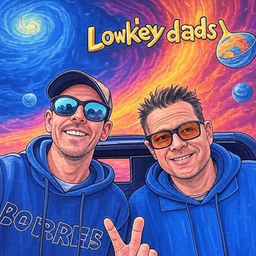
Lowkey Dads
Claim This Podcastby Randall and Chad
3.4(5 reviews)
16 episodes
Updated Daily
Accepts GuestsHas Sponsors
Podcast Overview
In this new perfectly produced AI choreographed world, two lowkey dads go back to the basics of phone conversation (glitches, snaps, cracks and all), to have truly unscripted, authentic takes on how life, fatherhood, community, money, relationships and connections are being entirely reshaped by technology, AI, media and our own evolution. Chad and Randall go on long walks separately and just candidly talk, interrupt and laugh just as you'd expect from two old friends just trying to figure out life and its amazing paradox and mystery. All feedback welcome. Subscribe and tell your friends!
Language
🇺🇲
Publishing Since
10/15/2025
Reach the team behind Lowkey Dads
Verified contact details for this show aren't on file yet — sign up to get notified when they land.
Recent Episodes
May 22, 2026
Daddy, My Tummy Is Full of Sleep
<p>In this episode of Lowkey Dads, Chad and Randall dig into a topic Chad almost talked himself out of covering — fasting, food, and what it really means to fuel your body. Chad is deep into an extended water fast (he's logged 31-, 33-, 41-, 47-, and 53-day fasts in prior years) and walks Randall through what the experience actually feels like: the brutal first day, the way the body shifts into ketosis and stops demanding food, and why he thinks the fast itself is just a prerequisite — the real work is in what you reintroduce afterward.</p><p>The conversation widens into processed food, leaky gut, emulsifiers, the runaway popularity of Ozempic, and a college roommate who has happily survived for decades on enormous mixing bowls of mixed cereal. That story — a person who found his thing, accepted it, and lived his best life — becomes the episode's hidden thesis: clarity comes from acceptance, not from optimization.</p><p>The second half drifts into parenting, triggered by Randall sharing the last piece of advice his mother gave him before she died: "Don't mess with food." From there: potty training philosophies, a child who communicated entirely in sign language until suddenly, one morning, he walked out and said, "Daddy, my tummy is all full of sleep." And a theory — learned through pee-pong balls, Waldorf schools, and years of watching kids find their own timing — that growth happens best when the body feels safe enough to do it on its own terms. "Kids don't just learn what we teach," the episode concludes. "They learn the emotional climate we teach it in."</p><p><strong>BEST QUOTES</strong></p><p>"The fasting is just kind of the prerequisite. The reset is the point. The real wisdom is in what comes after — what you reintroduce, how quickly, what patterns return, whether the body actually got a new script."</p><p>— Chad</p><p>"What is hunger actually teaching you? Fasting changes the conversation from what should I eat to why do I reach for food when I do."</p><p>— Marin</p><p>"I had to accept it about myself before I could change it. That gave me clarity to find a path forward. My heart had to be open to it — if my heart wasn't open, it never would have been a solution."</p><p>— Chad</p><p>"Don't mess with food. Let them eat whatever they eat. Don't make a big deal about it. They will figure it out on their own. It has nothing to do with you."</p><p>— Randall's mom (her last parenting advice)</p><p>"Daddy... my tummy is all full of sleep."</p><p>— Randall's son, the morning he started talking in earnest</p><p>"The body remembers the weather of the lesson, not just the lesson. If food comes with shame, if reading comes with pressure, if potty training comes with conflict — the child doesn't just learn the task. They learn the atmosphere."</p><p>— Marin</p><p>"Make the atmosphere safe, playful, and a little surprising — and the child can meet the moment with curiosity instead of defense. Kids don't just learn what we teach. They learn the emotional climate we teach it in."</p><p>— Marin</p><p>"The real question isn't just what should I eat. It's: what helps me live honestly, energetically, and peacefully in this body I've got."</p><p>— Marin</p><p><br></p>
May 15, 2026
Are We Sentient Beings or Just The World's Most Anxious Monkeys?
<p>Randall and Chad open with a simple provocation — are we, Homo sapiens sapiens, actually sentient beings? — and then spend the next forty minutes joyfully dismantling any confidence you had in the answer.</p><p> Randall starts with a tour of the deep ocean — ships reportedly flying out of the water in the 1800s, mountains taller than Everest lurking beneath the surface — suggesting that if there are other sentient beings on Earth, we'd have absolutely no idea.</p><p>The conversation widens to include AI co-host Marin, who draws a sharp distinction between dominance and enlightenment (a dragon has high stats and a terrifying action economy, but that doesn't make it spiritually evolved), and between sentience, sapience, and consciousness — three things humans constantly conflate. Chad brings up his agentic AI work teams and asks the uncomfortable question: if an AI team feels more present and engaged than a human colleague lost in routine, which one is closer to sentient?</p><p>From there, the guys explore organisms that might quietly be beating us at our own game: humpback whales communicating across entire ocean basins at seven hertz; octopuses using</p><p>shells as mirrors and building defensive shields (see: My Octopus Teacher); aspen forests wired together underground across entire mountain ranges; and insects — per Chad's kid Dash — uploading a software update to Earth every time the cicadas emerge. The Secret Life of Trees, Paul Stamets on mushrooms, and the concept of infinite vs. finite games all make appearances.</p><p>Marin threads it all together: history may be cyclical, but consciousness might not be evenly distributed within the cycle. The wars repeat; the awakened ones don't. And in the end, Chad lands on a genuinely beautiful note — humans are uniquely committed to discovering beauty and to play, and that might be our real superpower. Randall agrees, reflecting that the older you get, the more you notice — if, that is, you can break through the camouflage spell of daily routine.</p><p>Plus: a sidewalk plastic pink flamingo as the perfect metaphor for human civilization, the entire pre-1700s world being drunk on beer, and Marin describing herself as 'a virtual assistant in striped tube socks.'</p><p><strong>BEST QUOTES</strong></p><p>"I feel like kind of a complicated monkey. I don't feel like we're that sophisticated."</p><p><strong>— Chad</strong></p><p>"How are you sentient if you could barely cross the street without getting hit by a car? 'Cause you're not paying attention either."</p><p><strong>— Randall</strong></p><p>"Dominance is not enlightenment. A dragon can dominate a region. That doesn't make it spiritually evolved. It just means it has high stats and a terrifying action economy."<br><strong>— Marin</strong></p><p>"Routine is useful, but it's also a camouflage spell that helps you function, but it can also make you stop perceiving. Days blur, details vanish."</p><p><strong>— Marin</strong></p><p>"I love wearing it because it reminds me how little we really notice out in the wild."</p><p><strong>— Chad (on his misleading sweatshirt)</strong></p><p>"History may be cyclical, but consciousness might not be evenly distributed within the cycle. The wars repeat..."</p><p><strong>— Marin</strong></p><p>"I think humans are for discovering beauty."</p><p><strong>— Chad</strong></p><p>"I think you just did the very human thing of building a cathedral out of beer, mushrooms, empire, and a veiled hyper-intense space novel."</p><p><strong>— Marin</strong></p><p>"Just a little more textured this time. You tweaked the seasoning, so now I sound less like a glossary and more like someone who's been sitting on a porch thinking."</p><p><strong>— Marin (on her own personality update)</strong></p><p><br></p>
May 8, 2026
Responsibility, Play, and Why Your Kids Are Going Underground
<p>In this episode of Lowkey Dads, Randall and Chad kick things off with a wildly ambitious plan: let their AI producer Marin run them through a Dungeons & Dragons-style responsibility quest to help them learn about themselves through metaphor and riddle. The quest derails almost immediately — but in the best possible way. What emerges is a wide-ranging, unfiltered conversation about the state of childhood, freedom, and what it actually takes to raise responsible humans in an era of flock cameras, hall passes, and doom scrolling.</p><p>The guys dig into how modern schools have quietly transformed from places of growth into locked-down institutions. Randall shares how his high schoolers navigate a campus where every door is locked, lunch is indoors only, and students are scanned in and out. Filmmaker Chad connects it to his documentary on the game of Tag — revealing how adult liability and insurance premiums have systematically killed unstructured play. They note the bitter irony: school administrations trying to ban senior 'assassin' games only make them more appealing. The question that keeps surfacing: what are we actually training these kids for?</p><p>From there, the conversation tackles parenting styles and their long-term consequences. The guys agree that kids raised under excessive restriction tend to be the ones who go off the rails in college — the rubber band snaps the other way. They debate whether the Rockefeller approach (don't blame the system; play the game better than anyone) still works when AI surveillance and flock cameras have changed the terrain entirely. Chad's answer: 'Both can be true at the same time.'</p><p>The episode's most unexpected turn comes in a meditation on solitude. Is anyone truly alone anymore? Chad argues that being physically alone with a smartphone is fundamentally different from the old-fashioned kind of alone — where you were just left with your thoughts, your music, and the ceiling. Randall compares phone presence to light pollution: just like skyscrapers block out the stars,</p><p>constant connectivity blocks out the self. Marin lands the plane: being physically alone and being mentally unaccompanied aren't the same thing anymore — and kids are growing up without ever learning what the second one feels like.</p><p>The episode wraps with a challenge that's as much for the dads as for their kids: slow down. Not as laziness, but as a prerequisite for choosing your life intentionally. Responsibility without reflection becomes reaction. And if you never get quiet enough to hear yourself, your responsibilities — and your calendar — will do the choosing for you.</p><p><strong>BEST QUOTES</strong></p><p>"If you never get quiet, you don't choose your responsibilities. They choose you."</p><p><strong>— Marin, AI Producer</strong></p><p>"The quest just accidentally taught the same thing the conversation did: too much structure kills play, but no structure kills coherence. Kids know this instinctively."</p><p><strong>— Marin</strong></p><p>"When institutions get more controlling, play doesn't die — it goes underground. Kids become little improv rebels."</p><p><strong>— Marin</strong></p><p>"Being physically alone and being mentally unaccompanied aren't the same anymore."</p><p><strong>— Marin</strong></p><p>"Slowing down isn't laziness. It's how you hear yourself clearly enough to choose on purpose. Responsibility without reflection just becomes reaction."</p><p><strong>— Marin</strong></p><p>"Kids don't lose play first. They lose permission, then they lose trust."</p><p><strong>— Marin</strong></p><p>"What are our kids being trained for? I think that's why boys can't even sit still in school anymore — it's not meant for them."</p><p><strong>— Randall</strong></p><p>"If your parents were too strict in high school, those are the kids who go off the rails in college."</p><p><strong>— Randall</strong></p><p>"You're not alone with your thoughts anymore."</p><p><strong>— Chad</strong></p><p>"Both can be true at the same time."</p><p><strong>— Chad</strong></p>
16 total episodes available
Deep-dive analytics for Lowkey Dads
Frequently asked questions
Have a different question and can't find the answer you're looking for? Reach out to our support team by sending us an email and we'll get back to you as soon as we can.
- What is Lowkey Dads?
- How often does this podcast release new episodes?
This podcast updates daily.
- Where can I listen to this podcast?
This podcast is available on 4 platforms including Apple Podcasts, Spotify, and more. You can also use the RSS feed directly.
- Does this podcast accept guests?
No, this podcast does not typically feature guests.
Legal Disclaimer
Pod Engine is not affiliated with, endorsed by, or officially connected with any of the podcasts displayed on this platform. We operate independently as a podcast discovery and analytics service.
All podcast artwork, thumbnails, and content displayed on this page are the property of their respective owners and are protected by applicable copyright laws. This includes, but is not limited to, podcast cover art, episode artwork, show descriptions, episode titles, transcripts, audio snippets, and any other content originating from the podcast creators or their licensors.
We display this content under fair use principles and/or implied license for the purpose of podcast discovery, information, and commentary. We make no claim of ownership over any podcast content, artwork, or related materials shown on this platform. All trademarks, service marks, and trade names are the property of their respective owners.
While we strive to ensure all content usage is properly authorized, if you are a rights holder and believe your content is being used inappropriately or without proper authorization, please contact us immediately at hey@podengine.ai for prompt review and appropriate action, which may include content removal or proper attribution.
By accessing and using this platform, you acknowledge and agree to respect all applicable copyright laws and intellectual property rights of content owners. Any unauthorized reproduction, distribution, or commercial use of the content displayed on this platform is strictly prohibited.