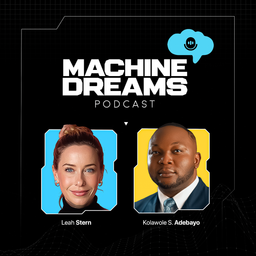
Machine Dreams is a weekly dive into the real world of AI. Hosts Kolawole Samuel Adebayo and Leah Stern talk with the founders, researchers, investors, engineers, and stakeholders shaping the future of intelligent machines. These are unfiltered, human conversations about what’s working in AI, what isn’t, and what might reshape the world next. From databases and infrastructure to agents, regulation, the future of work, and more, Machine Dreams brings clarity to arguably the most important tech story of our time.
Cameras Used to Just Record Us. AI Is Changing That
Cameras used to have one job: record what happened. Now they are starting to make sense of what they see while it happens, and that raises a bigger question. What does it mean for a camera to understand?
This week on Machine Dreams, Sam Adebayo sits down with Prof. Ron Kimmel, Chief Scientific Officer at Lumana: https://www.lumana.ai/ (https://www.lumana.ai/) and professor of computer science at the Technion. Ron has spent decades in computer vision, image processing, and 3D analysis, and he co-founded InVision, the company Intel acquired to form the foundation of its RealSense line. He is also the founder of the Technion's Geometric Image Processing Lab.
Ron makes the case that AI has largely closed the classical open problems in computer vision, and that the remaining bottlenecks are often our own hardware choices. He points out that most cars today, including his Tesla, rely on a single forward-facing camera, when biological evolution settled on two eyes hundreds of millions of years ago. He also holds a firm line on what these systems can and cannot do. Cameras can flag patterns and correlations. They cannot find causality or predict the future, and he thinks we should stop asking them to. He also shares work from computational pathology, where AI reading tumor images has matched what was previously only possible through DNA analysis. The research was published in The Lancet Oncology, and it points to patients potentially avoiding radiation or chemical treatment.
If you are a business leader wondering what your existing cameras could already tell you, or a builder trying to understand where machine vision actually stands, this conversation is a grounded place to start.
23 Sept 2026
Your Employees Are Telling AI Your Company’s Secrets. Yevgeniy Vahlis; Time to Bring AI In-House
Why do so many enterprise AI projects get built and then quietly abandoned? That's the question at the heart of this conversation with Yevgeniy Vahlis, co-founder and CEO of Shakudo: https://www.shakudo.io/. (https://www.shakudo.io/.)
Before founding the company in 2021, Yevgeniy built and led central AI teams at BMO and Borealis AI, and advised later-stage startups at Georgian. Everywhere he went, he saw the same pattern. Innovation labs produce impressive work that never reaches production. The experiments get shelved and the effort disappears. Shakudo exists to fix that, giving enterprises an end-to-end environment where a project goes from first idea to full deployment without ever leaving their own infrastructure. Their customers include Loblaw, Canada's largest retailer, plus organizations in finance, healthcare, defense, and energy.
In this episode, Yevgeniy offers a working definition of sovereign AI: the people making the decisions should have full control over the AI their organization uses. He explains why that matters more than it first appears. Data used to be backward-looking. Now it sits underneath the actual decision-making of the business, and employees at every level are sending their hardest strategic questions to third-party models. Internal snapshots of a company's risks, opportunities, and competitive position are leaving the building through ordinary daily use. Yevgeniy covers what bringing AI in-house actually requires, the guardrails that still have to be in place, and the geopolitical angle most teams haven't thought about yet.
He closes with a look five years ahead: AI running a large share of internal business processes, not replacing people but changing their jobs and raising the scale of what a team can do.
16 Sept 2026
AI Is Learning to Predict Which Bridges Need Fixing Before It’s Too Late
Bridges, roads and tunnels can last for generations, and engineers have spent decades photographing, inspecting and documenting how they change.
In this episode of Machine Dreams, we sit down with Saar Dickman, CEO of Dynamic Infrastructure, to explore how AI can bring that history together, measure damage from photographs, and help engineers understand how critical infrastructure is deteriorating over time.
Saar explains what AI can see in years of infrastructure data, how it could help engineers decide where repairs and funding are needed most, and why the technology could allow one person to oversee thousands of structures in the future.
We also get into the bigger question of what happens when an experienced engineer and an AI disagree, and why Saar believes humans should ultimately remain behind the wheel.
Learn more about Dynamic Infrastructure here: https://diglobal.tech/ (https://diglobal.tech/)
Contact Machine Dreams
Guest appearances
Books guests
Based on episode analysis; this does not confirm that the show is currently accepting guests.
Host of Machine Dreams?
Claim your podcast to manage its listing and keep your show details accurate.
Pod Engine is an independent podcast discovery and analytics service and is not affiliated with or endorsed by this podcast. Artwork and show content belong to their owners. Full legal notice.
Explore this show Podcast research with Pod Engine