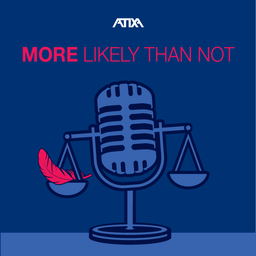
Podcast thumbnail for More Likely Than Not: An ATIXA Podcast

More Likely Than Not: An ATIXA Podcast

Claim This Podcast

by ATIXA (The Association of Title IX Administrators)

5.0(7 reviews)
19 episodes
Updated Daily
Accepts GuestsHas SponsorsLocation 🇺🇸

Podcast Overview

More Likely Than Not is ATIXA's official podcast, exploring the evolving landscape of civil rights in education. Named after the preponderance of evidence standard, often summarized as "50% and a feather," this show blends sharp insights, a touch of humor, and, most importantly, practical strategies for navigating equity compliance. Hosts Kayleigh Baker, J.D., Senior Consultant at TNG, and Joseph Vincent, M.L.S., Partner and Vice President for Investigations at TNG, unpack the ethical and procedural challenges practitioners face, including emergency removals, hostile environments, informal resolutions, faculty power dynamics, and retaliation claims. If you're asking, "Does this fall under Title IX?" or "How different is Title VI from Title VII?" or struggling to balance overlapping state and federal laws with your school's mission, this podcast is for you. Featuring expert voices from across the field, More Likely Than Not is a fast-paced, thoughtful conversation and a lifeline in today’s complex regulatory environment.

Language

🇺🇲

Publishing Since

6/20/2025

Reach the team behind More Likely Than Not: An ATIXA Podcast

Verified contact details for this show aren't on file yet — sign up to get notified when they land.

Recent Episodes

Episode thumbnail for SCOTUS Watch: Can School Employees Sue Under Title IX?

June 8, 2026

SCOTUS Watch: Can School Employees Sue Under Title IX?

<p>More Likely Than Not, an ATIXA podcast, is for general information, educational, and discussion purposes only. It’s not legal advice. If you’re dealing with a specific issue, consult your institution’s general counsel or a qualified attorney familiar with Title IX and applicable state laws. Facts, policies, and jurisdiction matter.</p><p>In Episode 18 of More Likely Than Not, Kayleigh and Joe unpack the Supreme Court’s decision to hear Crowther v. Board of Regents of the University System of Georgia and Joseph v. Board of Regents of the University System of Georgia, two cases that may decide whether employees can bring sex discrimination claims under Title IX or whether Title VII is the exclusive avenue for those lawsuits.</p><p>Their conversation explores the circuit split that prompted Supreme Court review and how changes in the litigation landscape could affect institutional compliance efforts.</p><p>The Court’s decision is still many months away, but Title IX Coordinators and administrators need to understand why this case could become one of the most consequential decisions impacting the intersection of Title IX and employment law in decades.</p><p>If you’ve ever wondered whether school employees can sue their institutional employers under Title IX, we are more likely than not covering it in this week’s episode.</p>

Episode thumbnail for A BIT More Connected (with Tim Cason, M.Ed., and Makenzie Schiemann, Ph.D., M.S.)

May 18, 2026

A BIT More Connected (with Tim Cason, M.Ed., and Makenzie Schiemann, Ph.D., M.S.)

<p>More Likely Than Not, an ATIXA podcast, is for general information, educational, and discussion purposes only. It’s not legal advice. If you’re dealing with a specific issue, consult your institution’s general counsel or a qualified attorney familiar with Title IX and applicable state laws. Facts, policies, and jurisdiction matter. </p><p>Safety and well-being are shared institutional responsibilities, and Title IX and Behavioral Intervention Teams (BITs) work best when they communicate rather than operate in silos.</p><p>In this episode, TNG Consulting and NABITA colleagues Tim Cason, M.Ed., and Makenzie Schiemann, Ph.D., M.S., join Kayleigh and Joe to explore how campuses can coordinate across Title IX and BIT/CARE teams to assess risk, support students, and respond more holistically to complex situations.</p><p>The conversation examines when Title IX Coordinators should loop in the BIT/CARE team, how institutions can share information appropriately without compromising privacy, and why early coordination matters. Tim and Makenzie also discuss the risks of isolated decision-making, the role of FERPA in information sharing, and how campuses can build stronger systems of support before concerns escalate.</p><p>If you have ever wondered how institutions can balance compliance, care, and campus safety responsibilities effectively, we are more likely than not covering it in this week’s episode.</p>

Episode thumbnail for Can Advocates Serve as Advisors?

March 30, 2026

Can Advocates Serve as Advisors?

<p>More Likely Than Not, an ATIXA podcast, is for general information, educational, and discussion purposes only. It’s not legal advice. If you are navigating a specific issue, always consult with your institution’s general counsel or a qualified attorney familiar with Title IX and applicable state laws. Your specific facts, policy, context, and, of course, state laws matter.</p><p>After what felt like a torrential downpour of Title IX-related developments, practitioners may be enjoying a brief reprieve. But the landscape is anything but calm. The Department of Education’s functions are being distributed to other federal entities, including the Department of the Treasury. This raises a key question: what does this fragmentation mean for enforcement?</p><p>For some, states are filling the gaps. Following New York’s lead in enacting a law requiring a Title VI coordinator and other mandates, states like Georgia, Missouri, and Colorado are introducing similar legislation. This signals a shift toward state-driven civil rights enforcement. Ongoing litigation, such as the federal government suing Harvard, California suing the federal government, and continued legal battles in Maine, continues to complicate the push-and-pull over authority.</p><p>Against this backdrop, we turn to a lively ATIXA listserv debate: should victim advocates serve as advisors in the Title IX grievance process? Under the 2020 regulations, parties have the right to choose an advisor of their choice. On one hand, advocates bring trust, familiarity, and a strong understanding of institutional processes. At the same time, the advisor role can become adversarial, raising concerns about confidentiality, dual roles, and how advocacy support is perceived. The conversation explores three main schools of thought and lands, unsurprisingly, somewhere in the middle.</p><p>If you have ever wondered whether an advocate can step into the advisor role without creating confusion, conflict, or unintended harm, we are more likely than not covering it in this week’s episode.</p>

19 total episodes available

Deep-dive analytics for More Likely Than Not: An ATIXA Podcast

Frequently asked questions

Have a different question and can't find the answer you're looking for? Reach out to our support team by sending us an email and we'll get back to you as soon as we can.

What is More Likely Than Not: An ATIXA Podcast?

More Likely Than Not is ATIXA's official podcast, exploring the evolving landscape of civil rights in education. Named after the preponderance of evidence standard, often summarized as "50% and a feather," this show blends sharp insights, a touch of humor, and, most importantly, practical strategies for navigating equity compliance.

Hosts Kayleigh Baker, J.D., Senior Consultant at TNG, and Joseph Vincent, M.L.S., Partner and Vice President for Investigations at TNG, unpack the ethical and procedural challenges practitioners face, including emergency removals, hostile environments, informal resolutions, faculty power dynamics, and retaliation claims.

If you're asking, "Does this fall under Title IX?" or "How different is Title VI from Title VII?" or struggling to balance overlapping state and federal laws with your school's mission, this podcast is for you.

Featuring expert voices from across the field, More Likely Than Not is a fast-paced, thoughtful conversation and a lifeline in today’s complex regulatory environment.

How often does this podcast release new episodes?

This podcast updates daily.

Where can I listen to this podcast?

This podcast is available on 4 platforms including Apple Podcasts, Spotify, and more. You can also use the RSS feed directly.

Does this podcast accept guests?

Yes, this podcast regularly features guests.

Legal Disclaimer

Pod Engine is not affiliated with, endorsed by, or officially connected with any of the podcasts displayed on this platform. We operate independently as a podcast discovery and analytics service.

All podcast artwork, thumbnails, and content displayed on this page are the property of their respective owners and are protected by applicable copyright laws. This includes, but is not limited to, podcast cover art, episode artwork, show descriptions, episode titles, transcripts, audio snippets, and any other content originating from the podcast creators or their licensors.

We display this content under fair use principles and/or implied license for the purpose of podcast discovery, information, and commentary. We make no claim of ownership over any podcast content, artwork, or related materials shown on this platform. All trademarks, service marks, and trade names are the property of their respective owners.

While we strive to ensure all content usage is properly authorized, if you are a rights holder and believe your content is being used inappropriately or without proper authorization, please contact us immediately at hey@podengine.ai for prompt review and appropriate action, which may include content removal or proper attribution.

By accessing and using this platform, you acknowledge and agree to respect all applicable copyright laws and intellectual property rights of content owners. Any unauthorized reproduction, distribution, or commercial use of the content displayed on this platform is strictly prohibited.