You didn't lose your faith. You found out something true — and now you're figuring out who you are on the other side.
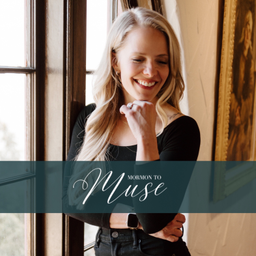
Mormon to Muse is a podcast for women navigating life after the Mormon church — the faith transition grief nobody prepares you for, the identity loss that comes with leaving a high-control religious system, and the slow, honest work of reclaiming yourself.
Each week I explore what it means to find yourself again after the Mormon church — through creative practice, life coaching tools, and the kind of honest conversation you can't have at Sunday dinner
If you've spent years being everything for everyone else and you're only now starting to wonder who you actually are — you're in exactly the right place.
Start with: "You Were Never Just a Calling."
Temptation Isn't Real: Unwinding the War for Your Soul
For years, wanting something you "shouldn't" felt like proof you were losing a spiritual battle. It wasn't. It just meant you had a healthy nervous system.
In this episode, Kristin unpacks one of the most disempowering ideas she inherited from Mormonism — the concept of temptation — and why it never actually held up once she looked at it directly. Sparked by a moment on a coaching call where a woman described her own self-doubt as "the adversary," Kristin traces exactly what LDS doctrine teaches temptation is, why framing an internal urge as an external attack quietly takes away your agency, and what happens when you stop fighting your own mind and start getting curious about it instead.
This isn't about giving yourself permission to do whatever you want. It's about taking back the part of you that was taught to treat your own impulses as enemy territory — and building an actual practice for what to do with desire once you stop calling it a war.
In this episode: What Mormon doctrine actually teaches about temptation, Satan, and mortal "testing" — and the specific mechanics of why it's disempowering
How the language of temptation collapses the gap between wanting and choosing — and why that gap is where all real agency lives
The one word swap that changes everything: replacing "temptation" with "desire" A four-step tool for working with any urge — dessert, scrolling, snapping at your kids, procrastination — without shame and without suppression
Why what you resist persists, and what Carl Jung's concept of the Shadow has to do with a piece of cake The real question to ask instead of "how do I stop wanting this": what feeling am I actually going for, and is there a way to get it I'll feel good about tomorrow
Why you were never a battlefield two outside forces were fighting over — and what it means to finally be the author instead
19 Jul 2026
"I Could Never Do That": Untangling Nature, Story, and Belief Post-Mormonism
"I'm just not creative." "I could never do that." "I'm not the kind of person who finishes things." You've said one of these — or something close to it — so many times it stopped sounding like an opinion. It started sounding like a fact. It isn't one.
In this episode, Kristin breaks down the difference between a circumstance (provable, measurable, true regardless of who's looking) and a limiting belief (a thought you've repeated until it felt like biology). She explains why your brain keeps finding evidence to confirm what you already believe about yourself, why this pattern runs especially deep for anyone raised in a high-control religious structure, and exactly how to start testing the beliefs that are quietly running your life.
In this episode: What separates a fact from a belief — and why your brain can't tell the difference on its own
Why growing up in a high-demand religious system trains you to accept assigned identities instead of testing them
Four questions to figure out whether a belief is truly yours, or something you inherited
A real coaching example: how one client dismantled "I never finish anything" by finding the evidence she'd been ignoring The one-word shift ("yet") that gets you out of black-and-white thinking
Why separating the belief from your identity — "I've been telling myself I'm not creative" vs. "I'm not creative" — changes what's possible One small experiment to try this week that gives your brain new evidence to work with
12 Jul 2026
The B- Version Is the One That Counts: Overcoming Perfectionism After High-Control Systems
Are You a Perfectionist? Here's Why That's Not the Compliment You Think It Is
Perfectionism gets worn like a badge of honor. I used to wear mine that way too. But underneath the polished exterior, perfectionism isn't a high standard — it's an impossible one.
In this episode, I break down what perfectionism actually is, why your brain defaults to it, and the practical antidote I use to get my own imperfect work out into the world.
I talk about the myth of "perfect" itself — how even our own definitions of it are nebulous, how one person's perfect manuscript is another person's rough draft.
I get into how Mormon culture trains this particular flavor of perfectionism from childhood, where testimony meetings only make room for certainty and struggle is only allowed in past tense. And I talk about how the wider culture backs this up — rewarding the finished book, not the drafts; the overnight success, not the seven invisible years before it.
I share what perfectionism actually looked like in my daily life — the schedule I built for myself with a checklist so long that missing one item gave me permission to abandon the whole day.
I walk through the small, sneaky ways perfectionism shows up for most of us: buying the supplies and never starting, quitting a new skill the second it gets hard, treating rest as something to be earned instead of allowed.
Then I get into what actually works. I talk about Brooke Castillo's concept of B- work — the idea that done imperfectly beats undone every time — and why creative practice is the best low-stakes place to build the muscle of showing up messy.
I share why I've had to get comfortable being cringe, why the loudest critics are rarely the people who've actually walked the path themselves, and a practical exercise for taking the sting out of other people's judgment.
If this episode resonates, I made something for you. My Reclamation Sketchbook (https://www.mormontomuse.com/sketchbook) is a free 7-day guided art journal — one creative prompt a day, no experience or talent required. It's the easiest place I know to practice doing something imperfectly on purpose.
Articles Referenced in this episode: https://www.psychologytoday.com/us/blog/the-discomfort-zone/202408/overcoming-perfectionism (https://www.psychologytoday.com/us/blog/the-discomfort-zone/202408/overcoming-perfectionism)
https://pmc.ncbi.nlm.nih.gov/articles/PMC4562912/ (https://pmc.ncbi.nlm.nih.gov/articles/PMC4562912/)
Reach and audience
Public platform figures. Ratings count people who left a rating, not total listeners.
Apple Podcasts (US)
5.0 / 5
10 ratings
Spotify
5.0 / 5
1 ratings
Contact Mormon to Muse
Guest appearances
Does not typically book guests
Based on episode analysis; this does not confirm that the show is currently accepting guests.
Pod Engine is an independent podcast discovery and analytics service and is not affiliated with or endorsed by this podcast. Artwork and show content belong to their owners. Full legal notice.
Explore this show Podcast research with Pod Engine