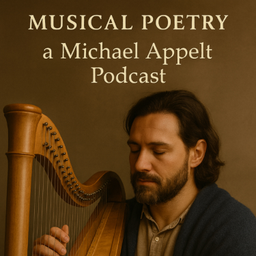
Musical Poetry is a poetry podcast where poems become music, reflection and conversation.
Each episode brings one poem and then recites it in the form of a song. Words and music intertwine to create moments of reflection, beauty, and peace.
Invictus: The Poem That Refuses to Bow | William Ernest Henley
What remains ours when life takes control out of our hands?William Ernest Henley’s Invictus is one of the most enduring poems about courage, resilience and the refusal to surrender to circumstance. Written in 1875 after years of illness and painful medical treatment, its sixteen lines gave us one of the most famous declarations in English poetry:“I am the master of my fate:I am the captain of my soul.”But Invictus is not really about controlling everything that happens to us. It begins in darkness, suffering and uncertainty. Its deeper challenge is what happens within us when life itself cannot be controlled.In this episode of Musical Poetry, we explore William Ernest Henley’s extraordinary story, the meaning behind Invictus, the surprising history of its title, and its powerful connection with Nelson Mandela and his years of imprisonment.Then the poem takes on a new form.After hearing Henley’s original words, we reinterpret their meaning for a modern listener in an original musical response, Still Unbowed.A poem written more than 150 years ago. A question that has never really gone away:The storm may not belong to us. But perhaps the soul still does.
11 Jun 2026
The Still, Sad Music: Wordsworth, Harmony and the Tired Soul
In this second contribution to our Musical Poetry series linking poetry with King Charles III’s concept of Harmony, we turn to William Wordsworth’s “Lines Written a Few Miles above Tintern Abbey.”
This episode explores nature, memory, exhaustion of the soul, and the hope of restoration. Wordsworth’s phrase “the still, sad music of humanity” becomes the emotional centre of the discussion and inspires the song featured at the end of the episode.
Our colleagues from Google’s NotebookLM discuss the attached letter, which reflects on Wordsworth, King Charles’s idea of Harmony, and the need not only to cope with the world we have created, but to become bearers of harmony ourselves.
Featuring the song: “The Still, Sad Music.”
Read the full companion letter attached to this episode here:The Still, Sad Music: Wordsworth, Harmony and the Tired Soul (https://michaelappelt.wordpress.com/wp-content/uploads/2026/06/wp-1781176806492.pdf)
10 May 2026
Each and All — after Ralph Waldo Emerson
In this episode of Musical Poetry, we begin a new series on harmony, inspired in part by the documentary Finding Harmony: A King’s Vision, which explores King Charles III’s lifelong concern for nature, sustainability, and the idea that humanity is part of nature, not apart from it. That idea led us to Ralph Waldo Emerson’s poem “Each and All.” At its heart are the unforgettable lines:“All are needed by each one;Nothing is fair or good alone.”
Emerson, who lived from 1803 to 1882, reminds us that beauty does not exist in isolation. A bird needs the river and the sky. A shell needs the shore and the sea. And perhaps we, too, need one another more deeply than we usually admit.
For this episode, “Each and All” has been transformed into a contemporary Irish folk song, carrying Emerson’s message into a new musical form.
A reflection on beauty, belonging, nature, community, and the quiet truth that harmony begins when we understand that nothing is fair or good alone.
Contact Musical Poetry
Guest appearances
Does not typically book guests
Based on episode analysis; this does not confirm that the show is currently accepting guests.
Host of Musical Poetry?
Claim your podcast to manage its listing and keep your show details accurate.
Pod Engine is an independent podcast discovery and analytics service and is not affiliated with or endorsed by this podcast. Artwork and show content belong to their owners. Full legal notice.
Explore this show Podcast research with Pod Engine