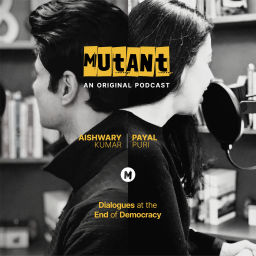
Podcast thumbnail for Mutant: The Democracy Podcast

Mutant: The Democracy Podcast

Claim This Podcast

by Institute for New Global Politics

5.0(19 reviews)
24 episodes
Updated Bi-weekly
Accepts GuestsHas SponsorsLocation 🇮🇳
47

Podcast Authority

Beta
FairBased on show quality, social media presence, reviews, charts, and more
Pod Engine
Quality40
Social0
YouTube66
Engagement71

Podcast Overview

As violence against persons and things reaches a slow, catastrophic intensity worldwide; as the political and planetary become profoundly intertwined; as the deformity in our language thwarts our very ability to think about this suicidal moment in global politics and in human affairs as such, the brilliant thinker and scholar Aishwary Kumar (in LA) and editor-interlocutor Payal Puri (in New Delhi) begin a sustained, rigorous excavation of a deceptively simple question: What is up with democracy? Taking as our starting point the 26 letters of the Roman alphabet, we create an alphabet of global political thought; a rigorous recuperation of the words and concepts without which we cannot grasp the power and the fragility of the democratic promise. Never has a podcast attempted to compress, in just 52 words — two for every letter of the alphabet — the human condition itself.

Language

🇺🇲

Publishing Since

2/3/2023

Unlock The Full Podcast Authority Score Report

See how your podcast performs across key metrics

47

Podcast Authority

Beta
FairBased on show quality, social media presence, reviews, charts, and more
Pod Engine
Quality40
Social0
YouTube66
Engagement71
7
Excellent Areas
2
Good Performance
10
Growth Opportunities
excellent
Episode Length
1h 24m
Performing excellently!
good
Show Experience
24 episodes over 2.4 years

Recommendations available

Unlock the full report to see detailed tips

poor
Publishing Consistency
Every 37 days

Recommendations available

Unlock the full report to see detailed tips

+16 More Metrics

Unlock comprehensive insights including:

  • • YouTube presence analysis
  • • Social media reach metrics
  • • RSS compliance scoring
  • • Podcast 2.0 features
  • • Technical standards
What's Included in Your Full Report

Detailed Analytics

  • Complete breakdown of all 19 authority metrics
  • Personalized recommendations for each metric
  • Industry benchmarks and comparisons
  • Technical RSS feed analysis and compliance scoring

Growth Strategies

  • Step-by-step action plans for improvement
  • Quick wins to boost your score immediately
  • Pro tips from successful podcasters
Get your free podcast insights report

See how your show performs across every key metric

Instant delivery
No spam
Attract Better Guests

High authority scores make your podcast more attractive to industry leaders and influencers who want to appear on credible shows.

Secure Sponsorships

Sponsors look for podcasts with proven authority and engagement. Your score demonstrates your podcast's value to potential partners.

Grow Your Audience

Understanding your strengths and weaknesses helps you make data-driven decisions to expand your listener base effectively.

1 verified contact email on file for Mutant: The Democracy Podcast

Pitch yourself as a guest, propose sponsorships, or reach out directly to the host.

Recent Episodes

Episode thumbnail for T | TECHNOCRACY

July 2, 2025

T | TECHNOCRACY

Aishwary Kumar examines how technology impacts democracy, arguing that forgetting the essence of technology empowers technocrats and erodes democratic capacity, ultimately threatening collective decision-making.

Episode thumbnail for T | TRUTH

May 26, 2025

T | TRUTH

Aishwary Kumar explores the complex and often paradoxical nature of truth, examining its role in politics and its impact on democratic societies, referencing Hannah Arendt's insights on totalitarianism.

Episode thumbnail for Q | QUESTION

April 23, 2025

Q | QUESTION

Has America given up its “pursuit of happiness”? Why do we ask so many questions? "How does it feel to be a problem?" Du Bois asks in a searing passage of his 1903 masterwork The Souls of Black Folk. Of all the openings that Civil Rights political thought makes in modern democratic rhetoric, perhaps the most powerful and overlooked one is its use of the question (and the pause). What if the question carries in itself not simply a moral demand but a right to logic? A systematic rethinking of the relation between truth and method not from the center of racial power but instead from the outskirts of our institutional and moral universe? We probe the implications of this question about the Question in this special episode of Mutant, anchoring our archaeology in the immortal urgency of Martin Luther King Jr.’s 1967 question, Where Do We Go From Here? “In King, the question belongs at once to the order of epistemology and of faith,” says @realaishwarykumar. "The question is that which tests the depths of our self-knowledge. That is, our awareness not merely of what we are—which lies at the foundation of ontology and its extreme nationalism—but instead of what we have become.” To think about the "question" as this primal site of democratic faith and risk, following King, @jbouie, who has been called “one of the defining commentators on politics and race of the Trump era” by Columbia Journalism Review, joins @realaishwarykumar live in our studio in Los Angeles for this episode of Mutant. “In the noise of all the platitudes about that unforgettable moral arc of which MLK speaks, it is ironically forgotten that King remained acutely aware of how easy it was for America to pivot from its promise of community into a state of brazen and violent chaos,” Aishwary points out. “King never forgets that this moral choice between community and chaos is a matter not of consecrating but instead questioning the foundations of America’s promise of equality (including equality under law). There is nothing intrinsically just about America’s moral arc unless we, by force, bend it towards justice.” Bending, indeed force, is key to this immovability of the question about our future, Aishwary reminds us. For King, only the question can tear open the fissures of American life and lighten the hills we must climb (or the abyss we must stare at). In the Black political tradition, Jamelle lays out, the question has always been an insurgent mode of expressing this sense of the future. “Black Americans have long acted as a counterpublic, posing questions to the larger public.” The question “who belongs?”, for instance, is not merely civic, it is ontological, he argues. It exposes the very terms on which life and citizenship are distributed. And it is a disjuncture dug deep into the history of American consciousness, at least since the time Frederick Douglass first asked, "What to the Slave is the Fourth of July?" And then there is BR Ambedkar, who would ask a century later about the undercaste, "Who were the Shudras?" What becomes, then, of the question as a mode of spiritual thought in our present? “Neither a rhetorical gesture nor a civic prompt, neither a function of restlessness nor of uncertainty, the question in our time returns—with catastrophic force—along the four militant threads that King had started to weave in the 1960s: political, epistemic, moral, and juridical (or punitive),” Aishwary proposes. “Only through the combination of logic and faith might we be able to reclaim, following King, a certain kind of transcendence, a sacrificial power that we all have and that America must rescue.” King’s question resists hopelessness. But it also rejects the nostalgia obscuring our own exclusions and distrust. To question is to stand at the edge of ruin and still insist on a moral vision. To question is to muster, above all, the...

24 total episodes available

Deep-dive analytics for Mutant: The Democracy Podcast

Frequently asked questions

Have a different question and can't find the answer you're looking for? Reach out to our support team by sending us an email and we'll get back to you as soon as we can.

What is Mutant: The Democracy Podcast?

As violence against persons and things reaches a slow, catastrophic intensity worldwide; as the political and planetary become profoundly intertwined; as the deformity in our language thwarts our very ability to think about this suicidal moment in global politics and in human affairs as such, the brilliant thinker and scholar Aishwary Kumar (in LA) and editor-interlocutor Payal Puri (in New Delhi) begin a sustained, rigorous excavation of a deceptively simple question: What is up with democracy?

Taking as our starting point the 26 letters of the Roman alphabet, we create an alphabet of global political thought; a rigorous recuperation of the words and concepts without which we cannot grasp the power and the fragility of the democratic promise. Never has a podcast attempted to compress, in just 52 words — two for every letter of the alphabet — the human condition itself.

How often does this podcast release new episodes?

This podcast updates bi-weekly.

Where can I listen to this podcast?

This podcast is available on 8 platforms including Apple Podcasts, Spotify, and more. You can also use the RSS feed directly.

Does this podcast accept guests?

No, this podcast does not typically feature guests.

Legal Disclaimer

Pod Engine is not affiliated with, endorsed by, or officially connected with any of the podcasts displayed on this platform. We operate independently as a podcast discovery and analytics service.

All podcast artwork, thumbnails, and content displayed on this page are the property of their respective owners and are protected by applicable copyright laws. This includes, but is not limited to, podcast cover art, episode artwork, show descriptions, episode titles, transcripts, audio snippets, and any other content originating from the podcast creators or their licensors.

We display this content under fair use principles and/or implied license for the purpose of podcast discovery, information, and commentary. We make no claim of ownership over any podcast content, artwork, or related materials shown on this platform. All trademarks, service marks, and trade names are the property of their respective owners.

While we strive to ensure all content usage is properly authorized, if you are a rights holder and believe your content is being used inappropriately or without proper authorization, please contact us immediately at hey@podengine.ai for prompt review and appropriate action, which may include content removal or proper attribution.

By accessing and using this platform, you acknowledge and agree to respect all applicable copyright laws and intellectual property rights of content owners. Any unauthorized reproduction, distribution, or commercial use of the content displayed on this platform is strictly prohibited.