
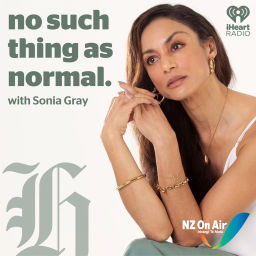
No Such Thing as Normal
Claim This Podcastby NZME
Podcast Overview
<p>At least 20% of New Zealanders are believed to be neurodivergent, but there is very little awareness, understanding and support for people with conditions such as ADHD, Autism and Dyslexia.</p> <p>Sonia Gray has a neurodivergent daughter and is an ADHDer herself. In this 10-part series she’ll talk to dozens of experts and people with a lived-experience of neurodiversity to better understand how we can support and celebrate those whose brains are wired differently.</p> <p>No Such Thing as Normal is brought to you by NZ Herald and Team Uniform, with support from NZ on Air. New episodes are available every Saturday.</p>
Language
🇺🇲
Publishing Since
5/31/2023
2 verified contact emails on file for No Such Thing as Normal
Pitch yourself as a guest, propose sponsorships, or reach out directly to the host.
Recent Episodes
May 15, 2026
35. Neurodiversity in Aotearoa: How are we doing?
<p>In the past decade, neurodivergence has become far more visible in Aotearoa. But awareness is not the whole story - the real question is whether neurodivergent people and their whānau feel truly seen and understood.</p> <p>There will always be gaps in services, funding and support. But not every change depends on a budget. Some begin with how we see neurodivergent people, how we listen to them, and whether we are willing to make room for who they really are.</p> <p>This episode opens with a family getting ready for school. On the surface, it looks smooth. But for many neurodivergent families, the hardest parts are hidden - what the world sees is often only a fraction of what parents are managing.</p> <p>We also hear from Raiha Tahuri, whose non-speaking autistic son Tomokia has taken his whānau on “a journey of self-reflection”, and opened their eyes to new ways of understanding communication, belonging and difference.</p> <p>Autism researcher Dr Jessica Tupou joins the conversation to discuss how Te Ao Māori, mātauranga Māori and collective wellbeing could help shape a more inclusive, neurodiversity-affirming Aotearoa.</p> <p>The challenges facing neurodivergent families are real, and the need for better support is undeniable. But if we focus solely on where the gaps are we risk missing what neurodivergent people have to teach us. This episode asks whether Aotearoa New Zealand is ready to build a society that recognises both the support they need and the gifts they bring.</p> <p>In this episode:</p> <ul> <li>The hidden reality behind a child who “looks fine” at school</li> <li>The emotional and financial cost for parents in New Zealand when the system does not fit their child</li> <li>Why meaningful change doesn’t always depend on funding</li> <li>The unexpected gifts of listening to, and embracing, neurodivergence</li> <li>The importance of Te Ao Māori perspectives in the way we understand difference</li> <li>Why support needs to be culturally grounded</li> <li>The advantages of being a small, interconnected country</li> <li>What true neuro-inclusion could look like in Aotearoa</li> </ul> <p>No Such Thing as Normal is made with support for NZ On Air</p><p>See <a href="https://omnystudio.com/listener">omnystudio.com/listener</a> for privacy information.</p>
May 8, 2026
34. Mental health, medication and neurodivergent burnout
<p>Anxiety, depression, chronic stress and low self-esteem are common co-occurring conditions for many neurodivergent young people. But are these struggles caused by neurodivergence itself, or by trying to fit into environments that don’t work for them?</p> <p>Child and adolescent psychiatrist Darryl-Lee Prince says not only is she seeing more school refusal and shutdown, but also more complex presentations. Among them, neurodivergent burnout. </p> <p>Professor Dave Coghill unpacks what the evidence says about SSRIs, therapy, non-stimulant ADHD medication and non-drug treatments.</p> <p>This episode is about what helps. And why these young people are not broken, but in need of the right support, understanding and environments that recognise their strengths. </p> <p>In this episode</p> <ul> <li aria-level="1">Neurodivergent burnout and masking</li> <li aria-level="1">Anxiety, dysregulation and school refusal</li> <li aria-level="1">When SSRIs can help</li> <li aria-level="1">Why therapy needs to be tailored for those who are autistic, ADHD or AuDHD</li> <li aria-level="1">Non-stimulant ADHD medication</li> <li aria-level="1">The truth about the effects of sugar, food colouring, fish oils and brain training on ADHD symptoms</li> <li aria-level="1">Is the information on TikTok trustworthy?</li> </ul> <p>No Such Thing as Normal is made with support from NZ ON Air</p><p>See <a href="https://omnystudio.com/listener">omnystudio.com/listener</a> for privacy information.</p>
May 1, 2026
33. What can science tell us about neurodivergent brains?
<p>If you - or your child - is neurodivergent, it can often feel like the world doesn’t always take you seriously. The challenges might be huge, but they’re largely invisible, and often unpredictable. So life can become a cycle of apologies and explanations.</p> <p>But advances in science are beginning to change this. In this episode we look at some of the important research happening here in Aotearoa. From brain imaging studies into ADHD, to genetic research revealing the biological pathways of autism.</p> <p>As these brain differences become measurable, the impact on individual lives is profound.</p> <p> </p> <p>In this episode:</p> <ul> <li>What brain scans are revealing about ADHD and the role of movement</li> <li>Why those with ADHD struggle to hold two ideas in their mind at one time</li> <li>The emerging science behind the genetic basis of autism</li> <li>Why identifying specific genetic variants can be life-changing for families</li> <li>The ethical considerations of autism research, and why community involvement matters</li> <li>The importance of having a biological explanation for differences</li> </ul> <p> </p> <p>Guests:</p> <p> </p> <p>Dr Jessie Jacobsen and Dr Ruth Monk: Centre for Brain Research, University of Auckland</p> <p>Dr Gil Newburn and Paul Condron: Mātai Medical Research Institute</p> <p> </p> <p>To support the work of the Centre for Brain Research <a href="https://www.auckland.ac.nz/en/fmhs/research/our-research-centres/fmhs-university-research-centres/cbr/support-cbr/donate.html">click here </a></p> <p> </p> <p>No Such Thing as Normal is made with the support of NZ On Air</p><p>See <a href="https://omnystudio.com/listener">omnystudio.com/listener</a> for privacy information.</p>
38 total episodes available
Similar Podcasts
Discover related shows you might enjoy

Grey Areas with Petra Bagust
rova | Love It Media

Kiwi Yarns
rova | Brodie Kane Media

Making Cents
Frances Cook
We Need To Talk with Toni Street
Coast

The Dom Harvey Podcast
Dom Harvey

Between Two Beers Podcast
Steven Holloway & Seamus Marten

ADHD Chatter
Alex Partridge

The Girls Uninterrupted
rova | Brodie Kane Media

Saturday Morning
RNZ

The Imperfects
Hugh van Cuylenburg, Ryan Shelton & Josh van Cuylenburg

The Boy in the Water
newsroom.co.nz

The Front Page
NZ Herald

The Paul Taylor Podcast
Paul Taylor

The Curve
The Curve Platform

No Filter
Mamamia Podcasts
Deep-dive analytics for No Such Thing as Normal
Frequently asked questions
Have a different question and can't find the answer you're looking for? Reach out to our support team by sending us an email and we'll get back to you as soon as we can.
- What is No Such Thing as Normal?
<p>At least 20% of New Zealanders are believed to be neurodivergent, but there is very little awareness, understanding and support for people with conditions such as ADHD, Autism and Dyslexia.</p> <p>Sonia Gray has a neurodivergent daughter and is an ADHDer herself. In this 10-part series she’ll talk to dozens of experts and people with a lived-experience of neurodiversity to better understand how we can support and celebrate those whose brains are wired differently.</p> <p>No Such Thing as Normal is brought to you by NZ Herald and Team Uniform, with support from NZ on Air. New episodes are available every Saturday.</p> - How often does this podcast release new episodes?
This podcast updates weekly.
- Where can I listen to this podcast?
This podcast is available on 2 platforms including Apple Podcasts, Spotify, and more. You can also use the RSS feed directly.
- Does this podcast accept guests?
Information about guest appearances is not available.
Legal Disclaimer
Pod Engine is not affiliated with, endorsed by, or officially connected with any of the podcasts displayed on this platform. We operate independently as a podcast discovery and analytics service.
All podcast artwork, thumbnails, and content displayed on this page are the property of their respective owners and are protected by applicable copyright laws. This includes, but is not limited to, podcast cover art, episode artwork, show descriptions, episode titles, transcripts, audio snippets, and any other content originating from the podcast creators or their licensors.
We display this content under fair use principles and/or implied license for the purpose of podcast discovery, information, and commentary. We make no claim of ownership over any podcast content, artwork, or related materials shown on this platform. All trademarks, service marks, and trade names are the property of their respective owners.
While we strive to ensure all content usage is properly authorized, if you are a rights holder and believe your content is being used inappropriately or without proper authorization, please contact us immediately at hey@podengine.ai for prompt review and appropriate action, which may include content removal or proper attribution.
By accessing and using this platform, you acknowledge and agree to respect all applicable copyright laws and intellectual property rights of content owners. Any unauthorized reproduction, distribution, or commercial use of the content displayed on this platform is strictly prohibited.