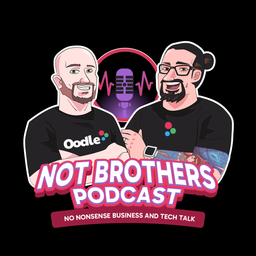
Not Brothers
Claim This Podcastby Mark Hughes, Ryan Hughes
Podcast Overview
<p><b>No Nonsense Business and Tech Talk. Just two business partners who’ve survived nearly two decades of client deadlines, all-nighters, stealing each other’s fries, and somehow still speaking at family events.</b></p><p></p><p>In 2009 they co-founded Oodle – a digital marketing agency that started with two laptops, zero clients, and an unhealthy amount of confidence. Sixteen years later it’s one of the sharpest independent shops in the country. Along the way they’ve launched other companies, products, and ideas together.</p><p></p><p>Every week they pull a couple of chairs up to a mic and rip open the exact stuff most podcasts polish to death:</p><ul><li>Which new AI and technology tools are actually shipping vs. which ones are just vaporware</li><li>The creative calls that made fortunes and the ones that almost ended them</li><li>The unsexy business decisions that separate “cool startup” from “company that pays its bills”</li><li>Real-time, zero-filter debates, because when you’ve argued over cap tables with your actual family, you stop pretending to agree</li></ul><p></p><p>Not Brothers. Just two co-founders who’ve been mistaken for siblings so often they made it the title.</p>
Language
🇺🇲
Publishing Since
1/28/2026
2 verified contact emails on file for Not Brothers
Pitch yourself as a guest, propose sponsorships, or reach out directly to the host.
Recent Episodes

June 23, 2026
Episode 15 - Your Product Is Probably Ready Before You Think
<pre><code>What happens when a digital agency starts building and launching its own software products? In Episode 15 of Not Brothers, Mark and Ryan talk about the lessons they’re learning from bringing Oodle-built products like Herald and Nebula to market. After years of helping clients promote finished products, they’re now dealing with the messier front end: product, price, placement, positioning, launch decisions, feature scope, and the temptation to keep polishing forever. They dig into why products are often ready before the builders think they are, how “done is better than perfect” applies to SaaS launches, and why overbuilding can make a product harder to sell instead of easier. They also talk about the product design trap of adding too many permissions, settings, toggles, and safeguards for problems that do not exist yet — plus why simple user experiences are much harder to create as products become more capable. Later, the conversation turns to AI: how hallucinated research can quietly poison go-to-market work, why teams need better verification habits, and how skills, agents, orchestration, and daily briefs can create real productivity gains when used with discipline. Chapters: 00:00 — No topic, so let’s talk about what we’re building 00:22 — Launching Herald as Oodle’s first product test bed 01:25 — Moving from promotion into product, price, and placement 03:11 — Nebula, feature creep, and products being ready before you think 05:44 — Shipping early enough to get real user feedback 07:05 — Done is better than perfect 08:35 — Day one starts when real users touch the thing 09:48 — Finding and removing features nobody actually uses 12:21 — Don’t add complication until it is necessary 13:03 — Permissions, theoretical problems, and soft safeguards 16:59 — Settings, toggles, and exposing complexity in the right place 18:24 — Why simple UX keeps getting harder 21:24 — Eating our own dog food while building products 22:18 — Using AI for market research without accepting bad data 24:10 — AI is not a Google search result 26:34 — Skills, repeatable workflows, and progressive disclosure 29:46 — Running multiple AI sessions without losing the plot 31:45 — Orchestrators, review agents, and long-running AI work 34:10 — Applying agent workflows beyond development 35:32 — Daily briefs, AI loops, and reclaiming focus</code></pre>

June 16, 2026
Episode 14 - AI Is Colliding With the Way Teams Build Products
<p>In this episode of Not Brothers, Ryan and Mark dig into a major shift inside modern teams: AI now lets non-technical people prototype, build, and express product ideas in ways that used to require developers, designers, and long handoff cycles.</p><p></p><p>That's powerful. It's also messy.</p><p></p><p>The upside is real. AI can take someone from a vague idea to an interactive prototype incredibly quickly, compressing wireframing, design, and prototyping into a tighter feedback loop. Designers, strategists, and PMs can create something tangible enough for the team to test and improve.</p><p></p><p>But a slick UI can create the illusion that something is "done" when there's no real infrastructure, no secure backend, and no maintainable architecture. AI is great at making something that feels real — but often it's a house of cards no responsible team can simply deploy.</p><p></p><p>The team shares what Oodle has worked through internally: oversized pull requests, skipped requirements, one-off solutions, spaghetti code, missing docs, and unclear handoffs. The big theme — AI doesn't remove the need for product thinking, it makes it more important. Ryan's example: flexible custom fields in Cortex beat hard-coding for one client. And his best metaphor: AI will bore through a concrete wall with a spoon if you ask it to, so planning still matters.</p><p></p><p>Rather than banning the tools — unrealistic, since "life finds a way" — Oodle builds guardrails: project instructions, agent rules, standards, and an internal assistant, Sheldon, that asks clarifying questions and turns vague bugs into actionable reports.</p><p></p><p>Handoff quality matters too. If you build something with AI, you still own it: explain the problem, document intent, set success criteria, and make review easy. The workflow is also inverting — technical people now ask non-technical teammates to carry prototypes further before development takes over.</p><p></p><p>The takeaway is simple: write things down. Clear writing, intent, and documentation are becoming core skills for turning ideas into real software.<br /><br /><b>Chapters</b><br /><br />00:00 — The collision between technical and non-technical teams <br />01:11 — AI gives non-technical people a new way to express ideas <br />03:12 — Why “done” is harder to define now <br />05:34 — When a polished UI creates the illusion of progress <br />07:46 — Why AI prototypes often are not deployable <br />11:20 — Guardrails, standards, and responsible AI workflows <br />15:02 — Existing products make the collision more complicated <br />17:22 — Product design versus one-off feature requests <br />20:25 — AI will dig through concrete with a spoon <br />22:05 — The problem with huge AI-generated pull requests <br />24:47 — Why smaller chunks beat massive code drops <br />27:57 — Compression, cleanup, and maintainability <br />30:28 — Better pull requests need demos, screenshots, and context <br />36:01 — What open source is teaching us about AI-generated code <br />40:02 — Why banning AI is not the answer <br />42:31 — How agents can improve bug reports and feedback loops <br />45:17 — Don’t clean up everyone else’s AI mess <br />49:09 — The workflow has flipped for idea people <br />52:59 — Writing clearly is now a core AI-era skill <br />55:10 — Final takeaway: write it down</p>

June 3, 2026
Episode 13 - Herald: Changelogs People Actually Read
<p><i>Short podcast summary</i><br />Mark and Ryan dig into Herald, Oodle’s developer-native changelog and release notes platform built for teams that ship through GitHub but hate writing product updates from scratch. Ryan explains the gap he found in existing changelog tools, why release notes usually get skipped, and how Herald uses GitHub history plus AI to turn commits and pull requests into editable release drafts. They also cover GitHub sync, nested projects, scheduled releases, customizable widgets, email notifications, and user segmentation — all aimed at making product updates easier to publish and easier for users to discover.<br /><br /><i>YouTube description</i><br />Most teams ship more than they communicate.<br /><br />In this episode of Not Brothers, Mark and Ryan talk through Herald — Oodle’s changelog and release notes platform for software teams that live in GitHub but hate writing release notes from scratch.<br /><br />Ryan explains why changelogs are usually skipped, why existing tools did not quite fit the workflow he wanted, and how Herald turns GitHub activity into draft release notes using AI. Instead of starting with a blank page, teams can connect a repository, pull in commits and pull requests, draft a release, edit the important parts, and publish across Herald, GitHub, email, and an in-app widget.<br /><br />They also get into two-way GitHub sync, public and private repositories, nested projects for related repos, scheduled releases, customizable changelog widgets, user groups, segmentation, and why discoverability matters just as much as authorship.<br /><br />Herald is built for developers, product teams, indie founders, and small SaaS teams that want to keep users informed without turning release notes into another full-time job.<br /><br />Try Herald: <a rel="noopener noreferrer nofollow" href="https://sendherald.com" target="_blank">https://sendherald.com</a><br /><br /><i>Chapters</i></p><pre><code>00:00 — Why Oodle built Herald 00:44 — What Herald is and the changelog problem it solves 03:02 — Release notes for users, engineers, and bigger feature launches 04:56 — Using AI to turn GitHub activity into draft changelogs 06:21 — Moving from creator to editor of release notes 07:22 — Two-way GitHub sync and avoiding duplicate work 09:31 — Custom categories and tuning the AI import prompt 10:25 — Public/private repos and nested projects 11:31 — Multi-repo product families and parent changelogs 13:08 — Scheduled releases 14:22 — Getting started without a blank canvas 15:30 — Drafting a release from everything since the last GitHub release 16:43 — Customizable in-app changelog widgets 17:36 — Making product updates discoverable 19:28 — In-app updates vs. noisy notifications 19:59 — Groups, JWT, and segmented changelog visibility 21:44 — Internal users, client users, and beta release use cases 22:10 — A simple tool that adds value in the right capacity 23:07 — The three user types Herald is built for 23:48 — Real release notes, testing, and future feedback 24:35 — Website demo and interactive examples 24:59 — Try Herald and let us know what you think</code></pre>
15 total episodes available
Deep-dive analytics for Not Brothers
Frequently asked questions
Have a different question and can't find the answer you're looking for? Reach out to our support team by sending us an email and we'll get back to you as soon as we can.
- What is Not Brothers?
<p><b>No Nonsense Business and Tech Talk. Just two business partners who’ve survived nearly two decades of client deadlines, all-nighters, stealing each other’s fries, and somehow still speaking at family events.</b></p><p></p><p>In 2009 they co-founded Oodle – a digital marketing agency that started with two laptops, zero clients, and an unhealthy amount of confidence. Sixteen years later it’s one of the sharpest independent shops in the country. Along the way they’ve launched other companies, products, and ideas together.</p><p></p><p>Every week they pull a couple of chairs up to a mic and rip open the exact stuff most podcasts polish to death:</p><ul><li>Which new AI and technology tools are actually shipping vs. which ones are just vaporware</li><li>The creative calls that made fortunes and the ones that almost ended them</li><li>The unsexy business decisions that separate “cool startup” from “company that pays its bills”</li><li>Real-time, zero-filter debates, because when you’ve argued over cap tables with your actual family, you stop pretending to agree</li></ul><p></p><p>Not Brothers. Just two co-founders who’ve been mistaken for siblings so often they made it the title.</p> - How often does this podcast release new episodes?
This podcast updates daily.
- Where can I listen to this podcast?
This podcast is available on 4 platforms including Apple Podcasts, Spotify, and more. You can also use the RSS feed directly.
- Does this podcast accept guests?
No, this podcast does not typically feature guests.
Legal Disclaimer
Pod Engine is not affiliated with, endorsed by, or officially connected with any of the podcasts displayed on this platform. We operate independently as a podcast discovery and analytics service.
All podcast artwork, thumbnails, and content displayed on this page are the property of their respective owners and are protected by applicable copyright laws. This includes, but is not limited to, podcast cover art, episode artwork, show descriptions, episode titles, transcripts, audio snippets, and any other content originating from the podcast creators or their licensors.
We display this content under fair use principles and/or implied license for the purpose of podcast discovery, information, and commentary. We make no claim of ownership over any podcast content, artwork, or related materials shown on this platform. All trademarks, service marks, and trade names are the property of their respective owners.
While we strive to ensure all content usage is properly authorized, if you are a rights holder and believe your content is being used inappropriately or without proper authorization, please contact us immediately at hey@podengine.ai for prompt review and appropriate action, which may include content removal or proper attribution.
By accessing and using this platform, you acknowledge and agree to respect all applicable copyright laws and intellectual property rights of content owners. Any unauthorized reproduction, distribution, or commercial use of the content displayed on this platform is strictly prohibited.