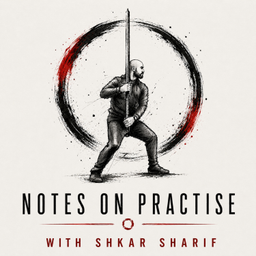
Notes on Practise is about the long road of training, cultivation, and trying to become someone worth being.
Some episodes explore movement, power, and the disciplined training of the body. Others turn inward — towards attention, effort, surrender, and meaning. Some are simply reflections on being human while trying to live with integrity.
These are spoken notes from practise.
An ongoing record of work, change, and understanding over time.
Online Training with Shkar: https://www.shaolintaichi.online/
In this episode, I explore what we actually mean by spirituality — and how easily spiritual practice can become another project of the ego.
From manifestation and the law of attraction to altered states, spiritual experiences and the pursuit of attainment, much of what we call spirituality can still revolve around the same basic impulse: I want something, and I want spirituality to give it to me.
Drawing on Buddhism, Sufism and my own experience of cultivation, I look at spirituality as something far more radical: the possibility of going beyond the ordinary mind towards genuine liberation.
What happens when the ego discovers spirituality? Does it transcend itself — or simply find more interesting things to acquire?
8 Aug 2026
#10 - Taizuquan: The Hidden Foundation of Southern Shaolin
In this episode of Notes on Practise, I take a deep dive into Taizuquan.
I explore Taizuquan as one of the foundational arts of the Southern Shaolin tradition, looking at how its San Zhan methods embody principles associated with the Yi Jin Jing, how it develops and organises the waist and spine for power transmission, and why true whole-body movement involves far more than simply moving the physical body as one unit.
We also look at the internal and external harmonies, the role of Yi and the heart-mind, physical conditioning, and Taizuquan’s distinctive approach to bridging and combat — an unyielding method shaped by the archetype of the Emperor.
Finally, I explore why I believe Taizuquan provides an essential foundation for White Crane: providing the structure, robustness and directness upon which White Crane adds sensitivity, listening and internal refinement.
An exploration of what “Emperor Fist” actually does to the body, mind and character of the person who practises it.
17 May 2026
#9 - Liminality and the Edge of Perception
For this episode of Notes on Practise, I step away from martial mechanics and combat training to talk about liminality, high strangeness, and the strange atmosphere that sometimes surrounds inner practise.
Not in the sensationalised internet sense of “mystical experiences”, but in the quieter and often more unsettling way that perception itself can begin to shift through long-term practice, attention, solitude, and transformation.
I talk about thresholds, altered feelings of place, the strange texture of certain moments in life, and why many traditional paths treated these experiences cautiously rather than romantically.
A reflective conversation on practice, perception, and the edges of the ordinary.
10 May 2026
#8 - Why Most People Never Change Through Training
Most people believe that time spent training automatically leads to transformation. But years of practise do not necessarily change a person.
In this episode I reflect on why some people are deeply reshaped through martial arts and cultivation work while others remain fundamentally untouched by the process. We explore repetition, foundations, psychological resistance, novelty, ego, and the uncomfortable reality that real transformation often requires the dissolution of the person we currently believe ourselves to be.
A meditation on training, attention, embodiment, and the long process of change.
5 May 2026
#7 - Why Martial Arts and Spiritual Practice Are Closer Than You Think | Combat, Perception, Transformation
Why is it that martial arts training and spiritual practice so often lead into each other?
On the surface, they seem completely opposed. One is physical, confrontational, rooted in pressure. The other is often associated with stillness, reflection, and inner work. But if you’ve spent any real time in either, you start to notice the same patterns emerging.
In this episode, I explore the deeper connection between the two — not at the level of discipline or mindset, but at the level of perception, identity, and how we relate to reality itself.
Martial arts training, when approached properly, exposes how you actually respond under pressure. It strips away the stories you tell about yourself and shows you what holds up when it matters. In a similar way, genuine spiritual practice works to remove distortion in how we perceive ourselves and the world.
Over time, both paths begin to converge.
We look at:
why the body is not just expressing understanding, but is the understanding
how perception changes through training
what happens to identity under pressure
the role of intent (Yi) and how it shapes the body
why control becomes a limitation, and responsiveness becomes the goal
At a certain point, martial arts stops being about fighting, and spiritual practice stops being about ideas. Both become ways of refining perception and removing illusion — until what remains can respond directly to reality.
28 Apr 2026
#6 - How I Teach Qigong and the Internal Arts | Influence, Method, and Practice
In this episode of Notes on Practise, I explain how I teach Qigong and the internal arts, the influences that shaped my approach, and why I always bring the practice back to the body.
I talk about the White Crane lineage methods I teach, including standing practice, moving work, body-opening exercises, purging methods, and stepping patterns. I also reflect on the different streams that have influenced my practice over the years.
17 Mar 2026
#5 - Outer Alchemy and Inner Alchemy | What a Teacher Can and Cannot Teach
In this episode of Notes on Practise, I explore the difference between what a teacher can guide and what must be discovered alone. Using the stages of Western alchemy — nigredo, albedo, citrinitas, and rubedo — we look at the process of psychological purification and preparation that many traditions describe as the outer work.
Beyond this lies a deeper stage of cultivation often described as crossing the abyss, where external guidance gives way to direct experience. Western traditions speak of communion with the Holy Guardian Angel, while Daoist internal alchemy describes the emergence of the Ling Tai, the embryo of spirit.
A teacher can guide the outer alchemy. The inner alchemy must ultimately unfold within the practitioner.
17 Feb 2026
#4 - How to Learn Kung Fu | Body, Combat, and the Long Game
In this episode of Notes on Practise, I explore how traditional Kung Fu systems were actually taught — particularly in Southern China — and why training often begins with conditioning and forms rather than immediate fighting techniques.Historically, these arts were designed to develop a resilient body, structural power, and reliable skill over decades, not just short-term combat ability. Sparring and practical application were important, but they existed alongside body transformation, health cultivation, and long-term development.This episode looks at who these systems were originally for, why they evolved the way they did, and what that means for modern students trying to learn Kung Fu today.
1 Feb 2026
#3 - Drifting | A Meditation on Place
In this episode of Notes on Practise, I reflect on walking without destination and what begins to change when attention is no longer shaped by efficiency.
Drawing on decades of living in central London — and the stillness of the lockdowns — this is a meditation on drifting through a place, on memory layered into streets and buildings, and on the quiet reciprocity that can emerge when we slow down enough to listen.
This isn’t a guide or a theory. It’s an invitation to move differently through the places you inhabit, and to notice what becomes available when a place is met without demand.
28 Jan 2026
#2 - Notes on White Crane | Foundations, Flavours, and Methods
White Crane Kung Fu is often treated as a single, unified system. In practice, there are several distinct flavours, each emphasising different qualities — technical precision, softer internal work, or clearer links to earlier ancestor arts.
In this episode, I look at White Crane as a final layer of refinement built on Taizuquan, and at San Zhan as the method that runs through both. The aim is not to define White Crane, but to clarify how its different expressions emerge from a shared foundation.
These are reflections from my own training and lineage.
28 Jan 2026
#1 - Kristina Shopova Sharif - How to Build a Martial Arts School
For the first episode, who better to sit down with than Kristina — the person who’s been in the middle of all of it with me.
We talk about what it really takes to build a martial arts school. The version with empty rooms, long days, bad months, doubt, pressure, and the slow work of turning an idea into a place where people actually belong.
We talk about:
– how this all started
– what nearly broke it
– what kept it alive
– the mistakes you only learn by making
– why community matters more than image
If you train, teach, build, or carry something you care about — this is for you.
Contact Notes on Practise — with Shkar Sharif
Guest appearances
Does not typically book guests
Based on episode analysis; this does not confirm that the show is currently accepting guests.
Host of Notes on Practise — with Shkar Sharif?
Claim your podcast to manage its listing and keep your show details accurate.
Pod Engine is an independent podcast discovery and analytics service and is not affiliated with or endorsed by this podcast. Artwork and show content belong to their owners. Full legal notice.
Explore this show Podcast research with Pod Engine