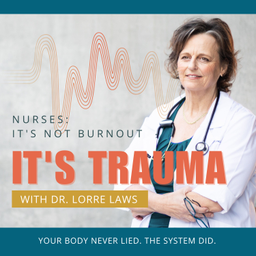
Podcast thumbnail for Nurses!  It's Not Burnout.  It's Trauma.

Nurses! It's Not Burnout. It's Trauma.

Claim This Podcast

by Lorre Laws

17 episodes
Updated Daily
Accepts GuestsHas SponsorsLocation 🇺🇸

Podcast Overview

76% of nurse burnout symptoms are actually unresolved nurse trauma. Not burnout. Trauma. The distinction changes everything about how you heal. For 50 years they sold you the wrong diagnosis. Dr. Lorre Laws, nurse neuroscientist, trauma researcher, and author of Nursing Our Healer's Heart, has the science they never taught you in nursing school. Every week, Dr. Lorre exposes what healthcare institutions are hiding about nurse-specific trauma and guides you through her evidence-based 5-Step Nurse Trauma Healing Process. No resilience theater. No wellness platitudes. Just the truth. It's not burnout. It's nurse trauma. And you deserve to know the difference.

Language

🇺🇲

Publishing Since

2/20/2026

Reach the team behind Nurses! It's Not Burnout. It's Trauma.

Verified contact details for this show aren't on file yet — sign up to get notified when they land.

Recent Episodes

Episode thumbnail for How Corporate Dressed Up Wage Theft as a Policy Update

June 18, 2026

How Corporate Dressed Up Wage Theft as a Policy Update

<p></p><p>A summa cum laude new grad with every advantage, traumatized in under three months. In this episode Dr. Lorre Laws walks through her daughter Megan's first hospice job, the corporate phone call that moved nurses from hourly to salary, and why that maneuver is wage theft dressed as policy.</p><p>The episode names the science the system avoids, that seventy-six percent of burnout symptoms map onto trauma responses, and shows what becomes possible when a nurse recognizes trauma in real time.</p><p><strong>Key Points</strong></p><ul><li>A new grad assigned fourteen to sixteen hospice patients across a three-hour radius is an unsafe ratio for any nurse.</li><li>The hourly-to-salary switch with no load reduction is wage theft dressed as a policy update.</li><li>Up to thirty percent of new graduate nurses leave in year one. Thirty-seven to fifty-seven percent leave by end of year two.</li><li>Seventy-six percent of what the industry calls burnout maps onto trauma responses.</li><li></li><li>Dr. Karen Foli's 2022 Middle Range Theory defines the trauma types nurses actually face.</li><li>Insufficient resource trauma and system-induced trauma are the two most common types.</li><li>Recognizing trauma in real time let Megan renegotiate her role and stay on her terms.</li></ul><br/><p><strong>Resources Mentioned</strong></p><p>Free masterclass. drlorrelaws.com/masterclass</p><p>Free nurse-specific trauma assessment. drlorrelaws.com/assessment</p><p>Nursing Our Healer's Heart, free chapter. drlorrelaws.com/chapter</p><p><strong>Next Episode Teaser</strong></p><p>Next week, four early-career nurses who identified nurse-specific trauma in real time, and what their reflections reveal about the generation entering practice now.</p><p><strong>Connect with Dr. Lorre Laws</strong></p><p>Website drlorrelaws.com | Community drlorrelaws.com/community | Newsletter and Book drlorrelaws.com/chapter</p>

Episode thumbnail for Less Than Three Months

June 4, 2026

Less Than Three Months

<p>She graduated at the top of her class with every advantage. Less than three months into hospice nursing, the system traumatized her.</p><p>Dr. Lorre Laws shares the story of her own daughter, Megan, a summa cum laude new grad who chose hospice and was traumatized in under three months despite every possible support. The episode names the pattern behind new-graduate nurse attrition, walks through four of the seven nurse-specific traumas from Foli's framework, and makes the case that 76 percent of what the profession calls burnout is actually trauma.</p><p>What you will hear.</p><p>Up to 30 percent of new grads leave within their first year. 37 to 57 percent are gone by year two.</p><p>96 percent of nurses carry at least one PTSD symptom. Nearly 1 in 4 meet full diagnostic criteria.</p><p>Two nurses are assaulted every hour in the United States.</p><p>Foli's seven nurse-specific traumas, and the four Megan hit in three months.</p><p>Why the diagnosis has been wrong for five decades.</p><p>The Nervous System Reset is the only live event of 2026. Three half-days, June 26 to 28. Enrollment closes Sunday June 7.</p><p></p><p>Resources.</p><p>Enroll in the Nervous System Reset. <a href="https://drlorrelaws.com/reset" rel="noopener noreferrer" target="_blank">https://drlorrelaws.com/reset</a></p><p>Join the free community. <a href="https://drlorrelaws.com/community" rel="noopener noreferrer" target="_blank">https://drlorrelaws.com/community</a></p><p></p>

Episode thumbnail for The $415,000 Reason Hospitals Target Experienced Nurses

May 28, 2026

The $415,000 Reason Hospitals Target Experienced Nurses

<p>Simone is an emergency department nurse with nearly 25 years of experience, a perfect track record, and zero occurrences.</p><p>After she questioned unsafe staffing assignments, her hospital handed her a blank PIP template and told her to write her own performance improvement plan. In this episode, Dr. Lorre Laws does the math. The hospital stands to save $354,578 by forcing Simone out and connects Simone's story to a documented, nationwide pattern of hospitals reducing experienced nurse staffing as a profit strategy. The institutional term is skill mix optimization. The human term is pruning.</p><p>kEYTAKE AWAYS</p><ul><li>The hospital stands to save a net $354,578 by replacing an experienced nurse with a new graduate when wages, benefits, and replacement cost are calculated together.</li><li>A July 2024 University of Pennsylvania School of Nursing study documented that hospitals are actively reducing experienced RN staffing as a cost-cutting strategy they call skill mix optimization.</li><li>A 10-percentage-point reduction in experienced RN share is associated with 7% higher odds of in-hospital death and a projected 10,947 avoidable patient deaths annually.</li><li>That same model saves a 300-bed hospital $2.4 million per year in labor costs.</li><li>The PIP has become a documented mechanism for constructing a paper trail after a termination decision has already been made. The allegation is kept vague by design because a specific allegation can be challenged. A vague one cannot.</li><li>Cases from Mission Hospital in North Carolina and Saint Vincent Hospital in Massachusetts show the same pattern. The nurse advocates. The allegation is always communication, attitude, or professionalism. No incident. No date. No witness.</li><li>A nurse running on a regulated nervous system can see the chessboard. She cannot be destabilized by a vague PIP with no incident, no date, and no witness.</li></ul><br/><p><strong>Resources Mentioned</strong></p><p>Nervous System Reset Waitlist | <a href="drlorrelaws.com/reset" rel="noopener noreferrer" target="_blank">drlorrelaws.com/reset</a></p><p>Nurse Trauma Assessment | <a href="drlorrelaws.com/assessment" rel="noopener noreferrer" target="_blank">drlorrelaws.com/assessment</a></p><p>Community | <a href=" drlorrelaws.com/community" rel="noopener noreferrer" target="_blank"> drlorrelaws.com/community</a></p>

17 total episodes available

Deep-dive analytics for Nurses! It's Not Burnout. It's Trauma.

Frequently asked questions

Have a different question and can't find the answer you're looking for? Reach out to our support team by sending us an email and we'll get back to you as soon as we can.

What is Nurses! It's Not Burnout. It's Trauma.?

76% of nurse burnout symptoms are actually unresolved nurse trauma. Not burnout. Trauma. The distinction changes everything about how you heal.

For 50 years they sold you the wrong diagnosis. Dr. Lorre Laws, nurse neuroscientist, trauma researcher, and author of Nursing Our Healer's Heart, has the science they never taught you in nursing school.

Every week, Dr. Lorre exposes what healthcare institutions are hiding about nurse-specific trauma and guides you through her evidence-based 5-Step Nurse Trauma Healing Process.

No resilience theater. No wellness platitudes. Just the truth.

It's not burnout. It's nurse trauma. And you deserve to know the difference.

How often does this podcast release new episodes?

This podcast updates daily.

Where can I listen to this podcast?

This podcast is available on 4 platforms including Apple Podcasts, Spotify, and more. You can also use the RSS feed directly.

Does this podcast accept guests?

No, this podcast does not typically feature guests.

Legal Disclaimer

Pod Engine is not affiliated with, endorsed by, or officially connected with any of the podcasts displayed on this platform. We operate independently as a podcast discovery and analytics service.

All podcast artwork, thumbnails, and content displayed on this page are the property of their respective owners and are protected by applicable copyright laws. This includes, but is not limited to, podcast cover art, episode artwork, show descriptions, episode titles, transcripts, audio snippets, and any other content originating from the podcast creators or their licensors.

We display this content under fair use principles and/or implied license for the purpose of podcast discovery, information, and commentary. We make no claim of ownership over any podcast content, artwork, or related materials shown on this platform. All trademarks, service marks, and trade names are the property of their respective owners.

While we strive to ensure all content usage is properly authorized, if you are a rights holder and believe your content is being used inappropriately or without proper authorization, please contact us immediately at hey@podengine.ai for prompt review and appropriate action, which may include content removal or proper attribution.

By accessing and using this platform, you acknowledge and agree to respect all applicable copyright laws and intellectual property rights of content owners. Any unauthorized reproduction, distribution, or commercial use of the content displayed on this platform is strictly prohibited.